WORLD
WORLD
Kashiwa-no-kami
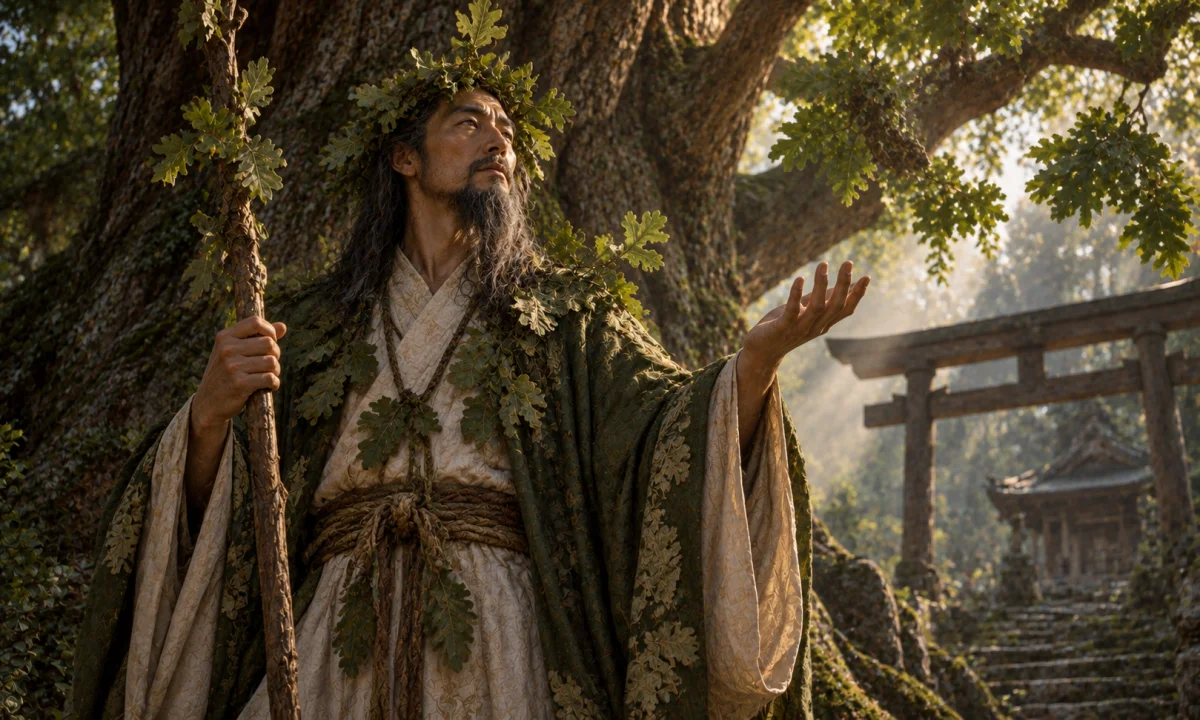
Kashiwa-no-kami is best understood as a Japanese tree kami associated with the kashiwa, usually identified with the daimyo oak (Quercus dentata) or, in some contexts, with oak trees more generally. The name can be translated as “the kami of the kashiwa.” Unlike major figures such as Amaterasu or Susanoo, Kashiwa-no-kami is not a single, consistently described deity with a widely preserved mythological biography. The name may refer to a local sacred presence, a tutelary spirit of a particular tree or grove, or a traditional designation for the divine power believed to inhabit the kashiwa.
The meaning of the name
In Japanese, kashiwa refers to an oak or oak-like tree, especially the daimyo oak, whose large leaves were traditionally used for wrapping food. Kami is a flexible religious term. It may mean a deity, a powerful spirit, a sacred presence, or a being associated with a particular place, natural feature, ancestor, or social institution. Consequently, Kashiwa-no-kami does not necessarily indicate one universally defined god. It may simply describe the kami of a kashiwa tree.
Japanese religious language often forms names in this way. A mountain, waterfall, old tree, rock, field, or village may have its own kami without belonging to a single standardized national pantheon. Such a kami can be recognized through local worship, shrine tradition, oral custom, or the sanctity of a particular natural object. The exact identity of Kashiwa-no-kami therefore depends on the place and tradition in which the name is used.
The spelling may also vary. Japanese references can use forms meaning “kashiwa tree kami,” “kami of the oak,” or “the spirit of the kashiwa.” Romanization is not completely uniform, and an English-language reference may treat a local tree spirit as though it were a named mythological character. Those presentations should be approached carefully.
Origins in Japanese sacred tree tradition
The religious background of Kashiwa-no-kami lies in the long-standing Japanese reverence for trees and groves. Before and alongside the development of formal shrine architecture, sacred places could be marked by an unusually old tree, a group of trees, a rock, a spring, or a mountain. The object itself was not always worshipped as a god in human form. Rather, it could serve as a focus through which the presence of a kami was encountered.
A sacred tree may be called a shinboku, meaning “sacred tree,” or may be protected by a shimenawa, a sacred rope made from rice straw or other material. White paper streamers known as shide may be attached to the rope. These signs do not prove that every old tree has a separate named deity, but they indicate that the tree has been set apart from ordinary space and treated with ritual respect.
Kashiwa trees were suitable objects of reverence because of their size, durability, broad leaves, and seasonal character. In much of Japan, their leaves turn brown but may remain attached to the branches through winter before falling when new leaves begin to emerge. This visible renewal could be associated with continuity, protection, and the passage between old and new growth. Such symbolism is not a fixed doctrine belonging exclusively to Kashiwa-no-kami, but it helps explain why an oak tree might become a local sacred emblem.
Japanese traditions of sacred trees should not be reduced to a single idea of “nature worship.” They developed through overlapping practices associated with local communities, shrine ritual, agricultural life, Buddhist institutions, household observance, and regional folklore. In some places the tree was regarded as the dwelling place of a kami; in others it was a boundary marker, an ancestral object, a source of shade and food-wrapping leaves, or a visible sign of the age of the community.
Kashiwa leaves and ritual food
The kashiwa has an important cultural association with food. Its large leaves were used to wrap offerings and cooked foods, helping to keep food clean and making it easier to carry or present. The most familiar surviving custom is kashiwa-mochi, a rice cake filled with sweet bean paste and wrapped in a kashiwa leaf.
Kashiwa-mochi is especially associated with the Boys’ Festival, now commonly called Children’s Day, celebrated on 5 May. The leaf is not normally eaten. Its role is practical, symbolic, and seasonal. Because old leaves may remain until new leaves appear, the kashiwa has been connected in popular interpretation with the continuation of the family line: parents remain until children grow and succeed them. This association is often expressed through the idea that “new leaves do not appear until the old leaves fall,” although the wording and interpretation vary.
The connection between the kashiwa and kashiwa-mochi does not establish that Kashiwa-no-kami is specifically a god of the Boys’ Festival, childbirth, or family succession. Those themes belong to the broader cultural symbolism of the tree and the seasonal custom. A local shrine or household may connect its kashiwa kami with food, prosperity, family continuity, or protection, but such associations should not be treated as universal attributes.
Attributes and symbolic meanings
Because Kashiwa-no-kami lacks a standardized canonical description, no single appearance or set of powers can be assigned with confidence. The kami may be represented by the tree itself rather than by an anthropomorphic image. A shrine might preserve an old kashiwa as its sacred object, place a rope around its trunk, or identify a grove as the kami’s dwelling.
Symbolic meanings that may be associated with a kashiwa kami include:
- Continuity: the tree’s persistence through the seasons can suggest the endurance of a household, settlement, or lineage.
- Protection: a large tree may stand at the edge of a village, near a shrine, or beside a road, creating an image of shelter and guardianship.
- Renewal: the emergence of new leaves after the winter period allows the tree to represent regeneration and the return of life.
- Nourishment: the use of kashiwa leaves in handling and wrapping food links the tree with domestic preparation and offerings.
- Local identity: an old tree can become a landmark through which a community remembers its own history.
These are interpretive themes rather than a fixed theology. A kami’s character is often shaped by the needs and stories of the community that venerates it. One kashiwa tree may be connected with a shrine’s foundation, another with a village boundary, and another with a family tradition.
Mythological sources and the limits of the evidence
The major early Japanese mythological records, especially the Kojiki and the Nihon Shoki, do not present Kashiwa-no-kami as a major deity with a developed genealogy and narrative cycle comparable to Amaterasu, Izanagi, Izanami, or Susanoo. These works mention many natural features and divine beings, but the presence of trees in early mythology does not mean that every tree had a distinct, named god in the surviving texts.
Early Japanese religious literature also reflects processes of selection and organization. Court-sponsored chronicles emphasized imperial genealogy, political legitimacy, major cults, and myths considered important to the central state. Local beliefs were often preserved elsewhere: in regional gazetteers, shrine records, temple documents, medieval legends, festival practices, family traditions, and place-names. The absence of Kashiwa-no-kami from a major narrative source therefore does not disprove local veneration. It does mean that claims about a single ancient pan-Japanese deity should be made cautiously.
There is no securely established cycle of myths explaining Kashiwa-no-kami’s birth, marriage, battles, or descent from another god. Nor is there a universally agreed human-like appearance. Descriptions that give the figure a particular gender, costume, weapon, or family relationship may reflect a specific local tradition, a modern retelling, or an attempt to turn a general tree kami into a character.
Relationship to Shinto practice
Kashiwa-no-kami fits most naturally within the flexible religious world commonly called Shinto, although the boundaries between Shinto, local custom, and other Japanese religious traditions have never been completely rigid. A sacred tree can be honored at a shrine, in a village, beside a household, or at a site where no large shrine building exists.
Ritual attention may include purification, offerings of rice, sake, salt, water, or seasonal food, and prayers for the welfare of the community. The kami is not necessarily imagined as permanently confined inside the trunk. In Japanese ritual thought, a kami may be invited, welcomed, approached, or manifested at a sacred site. The tree provides a stable and visible focus for that relationship.
Local practice is especially important in interpreting the name. A shrine may have a formal enshrined deity and also protect an old kashiwa tree that has become sacred over time. In another setting, the kashiwa itself may be the central object of reverence. Genealogies, shrine histories, and oral explanations may disagree, and some traditions may use a different name for the same sacred tree.
Distinguishing Kashiwa-no-kami from similar names
Several Japanese names can cause confusion when written in roman letters.
- Kashima-no-kami: This usually refers to Takemikazuchi, the martial deity associated with Kashima in eastern Japan. Kashima and kashiwa are different words, and Kashima-no-kami is not an oak-tree deity.
- Kusu-no-kami: This name may refer to a sacred camphor tree or its kami. The camphor tree, called kusu, is distinct from the kashiwa.
- Tree kami in general: Japanese tradition includes many sacred trees and tree-associated spirits. Evidence for one tree deity should not automatically be transferred to another.
- Kashiwa as a place-name: Kashiwa is also the name of places in Japan, including Kashiwa City in Chiba Prefecture. A deity associated with a location called Kashiwa is not necessarily Kashiwa-no-kami in the sense of an oak-tree spirit.
- Personal and occupational names: Terms connected with food preparation, court offices, or historical surnames may contain sounds resembling kashiwa. They should not be assumed to refer to the tree kami.
These distinctions matter because Japanese divine names often contain common nouns, place-names, titles, and occupational terms. A similar romanized form can conceal a substantial difference in spelling and meaning.
Cultural significance
The importance of Kashiwa-no-kami lies less in a dramatic myth than in the way Japanese religious culture can invest ordinary natural objects with presence and obligation. An old tree may connect the living community with earlier generations, the seasonal cycle, the local landscape, and the practical activities of preparing and sharing food.
Such traditions also express a form of stewardship. When a tree is treated as sacred, cutting it down or damaging it can become not merely a practical decision but a breach of communal memory and ritual order. The kami’s “power” is therefore not always portrayed as a supernatural attack or blessing. It may be experienced through the tree’s continued survival, the observance of festivals, the protection of a place, or the social duties created by reverence.
The kashiwa’s connection with family succession is particularly significant in later cultural interpretation. It provides a natural image for the relationship between generations, but it should not be presented as an exclusive ancient doctrine of Kashiwa-no-kami. The symbolism developed through the tree’s botanical behavior, household custom, and seasonal celebrations rather than through a single canonical myth.
Later representation and popular culture
Kashiwa-no-kami is not a prominent figure in modern Japanese popular culture. The name appears far less often than famous kami, yokai, and legendary heroes. When it is used in contemporary fiction, games, illustrated encyclopedias, or fantasy writing, the character may be portrayed as an oak guardian, an elderly spirit, a woodland deity, or a protector of children and families.
These portrayals can draw inspiration from genuine Japanese ideas about sacred trees, but they are creative adaptations rather than evidence for a standardized traditional appearance. A horned forest spirit, a warrior in leaf-patterned robes, or a humanoid guardian carrying an oak staff belongs to modern artistic convention unless a particular local source supports it.
The most reliable understanding of Kashiwa-no-kami is therefore modest but meaningful: it is a name for the sacred presence associated with a kashiwa tree or oak, rooted in Japanese traditions of venerating natural places. Its identity, ritual role, and symbolism may change from one locality to another, and the surviving evidence does not justify treating it as a single universally defined deity.