WORLD
WORLD
Cochimetl
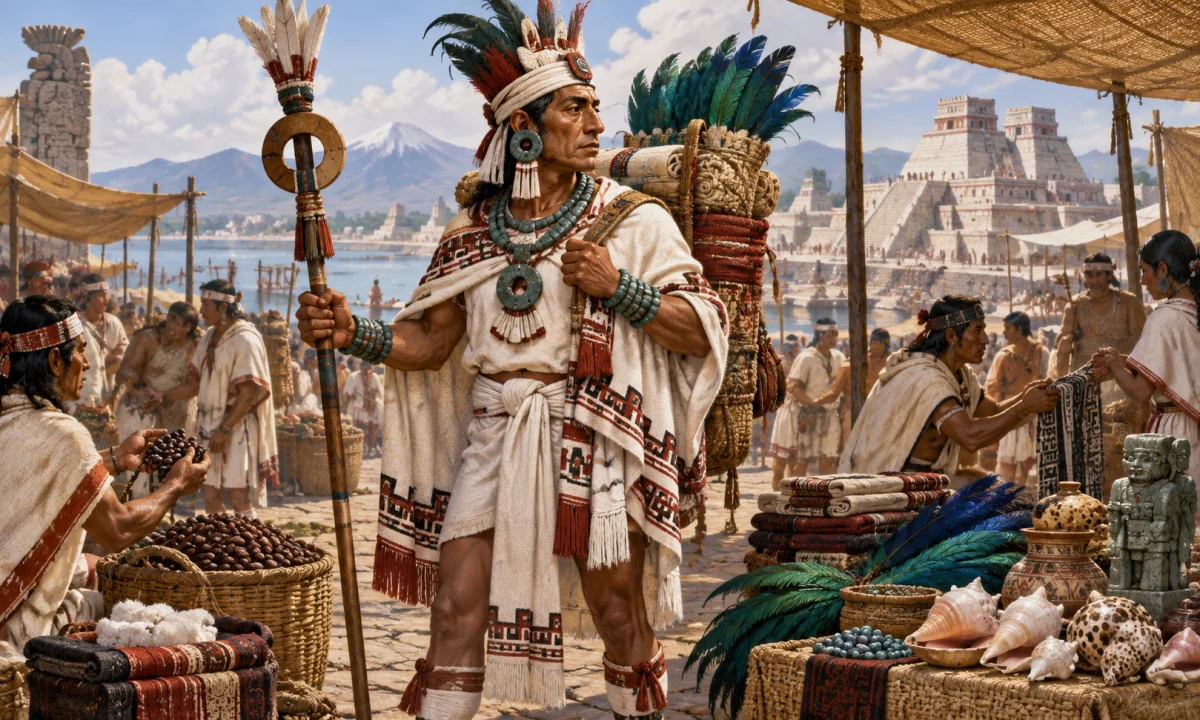
Cochimetl is a name associated in some modern reference works with an Aztec or Nahua deity of sleep. The figure is obscure, however, and the surviving evidence is much less substantial than it is for better-documented deities such as Huitzilopochtli, Tlaloc, Quetzalcoatl, or Mictlantecuhtli. No widely preserved Aztec myth gives Cochimetl a clearly defined biography, family, temple cult, or set of sacred ceremonies. As a result, descriptions of Cochimetl should be treated cautiously: the association with sleep is common in modern summaries, while the historical status of the figure and the details attributed to it remain uncertain.
Name and identity
The name is usually written Cochimetl, and it may also appear with a division such as Cochi-Metl. The first element resembles the Classical Nahuatl verb cochi, “to sleep.” The second element, metl, is the Nahuatl word for maguey or agave. On that basis, the name is often interpreted approximately as “sleeping maguey” or “maguey of sleep.” Such a translation is suggestive rather than definitive. Nahuatl names can be metaphorical, grammatically compressed, or difficult to interpret when recorded outside their original context.
The name alone does not prove that Cochimetl was a major deity of sleep in pre-Hispanic central Mexico. Colonial-era records preserve many Nahuatl personal names, place names, ritual expressions, and local divine titles, and not every name represented a fully independent god. A name could refer to a local manifestation, a sacred object, a ritual association, or a figure whose worship was limited to a particular community.
Modern lists of Aztec gods commonly describe Cochimetl as a god of sleep, sometimes extending the description to dreams or nighttime rest. Those additional details are not equally well supported. The safest characterization is that Cochimetl is a poorly documented figure traditionally identified in modern sources with sleep, rather than a deity whose mythology is securely reconstructed from detailed early texts.
The Aztec and Nahua religious setting
The Aztec Empire formed part of a wider Nahua-speaking religious world in central Mexico. Its capital, Tenochtitlan, stood within a region where religious traditions had developed over many centuries and where communities shared certain gods, stories, ritual practices, and concepts while also maintaining local differences. “Aztec mythology” is therefore a convenient modern label, not the name of a single uniform system recorded in one authoritative scripture.
Religious knowledge was transmitted through ceremonies, priestly instruction, oral performance, painted manuscripts, temple practice, songs, and the names of places and people. Much of this tradition was disrupted or transformed after the Spanish conquest in the sixteenth century. Christian missionaries and colonial administrators recorded information about Nahua religion, but they did so for particular purposes and through European categories. Some records preserve valuable Indigenous testimony; others are incomplete, selective, or shaped by the assumptions of their authors.
The most important surviving sources include works associated with Bernardino de Sahagún and Nahua informants, pictorial manuscripts, colonial-language dictionaries, ritual and calendrical records, and archaeological evidence. These sources document numerous gods and sacred powers, but they do not provide a complete catalogue of every figure known in every Nahua community. The absence of Cochimetl from prominent mythological narratives cannot by itself prove that the name was unknown, yet the lack of a clear cult, narrative cycle, or detailed iconography makes firm claims difficult.
Sleep in Nahua thought
Sleep was not necessarily understood as a purely biological condition separate from religion. As in many traditional cultures, dreams could be treated as meaningful experiences, warnings, memories, or encounters with forces beyond ordinary waking life. Night, darkness, illness, altered consciousness, and the boundary between life and death all had religious significance in Mesoamerican thought. This broader setting makes an association between a deity and sleep plausible, even when the particular evidence for Cochimetl is limited.
Nahua religious ideas also connected the human person with animating forces, breath, vital energy, and forms of personal destiny. Colonial sources use different terms and explanations for these concepts, and modern scholars do not always agree on how they should be translated. It would be misleading to reduce Nahua ideas about dreaming to a simple equivalent of a modern “god of sleep.” Sleep could intersect with healing, divination, fear, omens, death, and the activity of supernatural beings.
The maguey element in the name, if the traditional interpretation is correct, may evoke one of the most important plants of central Mexico. Maguey supplied fibre, food, roofing material, needles, fuel, and fermented drinks. Its sap could be processed into pulque, a drink with important ritual associations. Maguey was therefore not merely an agricultural plant. It belonged to a dense network of economic, bodily, agricultural, and sacred meanings.
That symbolism does not establish a specific role for Cochimetl. It does, however, show why a name combining sleep and maguey might have carried associations that are not obvious in English. A plant name could refer to transformation, fertility, intoxication, bodily states, or a local sacred tradition rather than describing a literal physical appearance.
Attributes and possible function
Modern descriptions generally assign Cochimetl the domain of sleep. Some portray the figure as a protector of sleepers, a power governing dreams, or a supernatural explanation for the onset of sleep. These roles should be presented as later summaries or interpretations, not as securely documented features of an ancient cult.
There is no widely accepted pre-Hispanic image that can confidently be identified as Cochimetl. No standard costume, emblem, animal companion, weapon, temple, or characteristic posture is securely associated with the name. Claims that Cochimetl had a particular appearance or controlled specific types of dreams usually go beyond what the surviving evidence can support.
The same caution applies to gender. English-language lists often call Cochimetl a “god,” following a general habit of using masculine language for named deities. The name itself does not provide enough evidence to establish a clearly defined gendered identity. Nahua sacred powers could be represented through changing forms, paired principles, titles, or overlapping manifestations. It is preferable to call Cochimetl a deity or supernatural figure unless a particular source gives stronger information.
Nor is there reliable evidence for a separate mythology involving battles, marriages, divine parentage, or a journey through the underworld. A figure connected with sleep might naturally be linked by modern imagination to dreams, night, death, or the underworld, but these associations should not be turned into invented stories about Cochimetl.
Stories and relationships
No major surviving Aztec narrative is securely centred on Cochimetl. The well-known cycles concerning the creation of the world, the birth of Huitzilopochtli, the deeds of Quetzalcoatl, the conflict involving Coyolxauhqui, or the rulers of the dead do not provide a clear place for this figure. Cochimetl is also not generally presented in the principal colonial accounts as a major member of the divine families described there.
This lack of mythology is significant. Many entries in popular encyclopaedias present every named deity as though each had a defined personality and a complete set of stories. In reality, the evidence for Mesoamerican religious figures varies greatly. Some are attested in multiple manuscripts and archaeological contexts; others occur only in a brief colonial reference, a name list, a local tradition, or modern compilations whose sources are not made clear.
There is no well-established relationship between Cochimetl and Mictlantecuhtli, the ruler of the dead, or with Tezcatlipoca, a powerful deity associated with night, fate, sorcery, rulership, and conflict. A connection might seem logical because all these themes can involve darkness or altered states, but similarity of subject matter is not evidence of a traditional family relationship.
Likewise, Cochimetl should not automatically be identified with a dream deity from another Mesoamerican culture. Maya, Mixtec, Zapotec, and other traditions had their own religious systems, languages, and sacred histories. The presence of a sleep-related figure in one culture cannot be used to fill the gaps in the evidence for another.
Evidence and scholarly caution
The central difficulty surrounding Cochimetl is not that the figure has a complex mythology with many contradictory versions. It is that the documentation is too thin to establish a detailed mythology with confidence. Modern references may repeat the same short description—usually “Aztec god of sleep”—without indicating whether it comes from a colonial manuscript, a dictionary, an Indigenous oral tradition, an image, or a later encyclopaedic compilation.
Repeated publication does not necessarily make a claim historically stronger. A statement copied through many websites and lists can appear well established while ultimately resting on an uncertain or misunderstood reference. For that reason, interpretations of Cochimetl should distinguish between three levels of information:
- Relatively consistent modern attribution: the association of the name with sleep.
- Plausible but uncertain interpretation: a connection between the name, dreams, nighttime, or the symbolic importance of maguey.
- Unsupported embellishment: a detailed appearance, temple, family, narrative, or set of powers not tied to identifiable historical evidence.
This distinction is especially important because the term “Aztec” can encourage false precision. The Aztec Empire included many communities, and religious practice differed by place and historical period. A local or obscure divine name need not fit neatly into the hierarchical pantheon reconstructed from the religious life of Tenochtitlan.
Distinguishing Cochimetl from similar names and figures
Cochimetl should not be confused with the Cochimí, an Indigenous people of the Baja California peninsula. The similarity in spelling is coincidental in this context. The Cochimí language family and cultural history belong to the northwestern region of Mexico and should not be treated as evidence for an Aztec deity.
Cochimetl is also distinct from Yacatecuhtli, the well-documented Nahua deity associated with merchants and long-distance trade. It is distinct from Patecatl, a deity connected with pulque, healing, and medicines, and from Mayahuel, a female figure strongly associated in later sources with the maguey plant and the production of pulque. Because the word metl means maguey, modern writers sometimes draw a direct connection between Cochimetl and Mayahuel. No such identification is securely established.
The figure should also be kept separate from Tonacatecuhtli and Tonacacihuatl, primordial providers in some Nahua creation accounts, and from Citlalicue, a celestial mother figure whose identity and attributes vary by source. Broad themes such as fertility, night, sleep, or plant power do not make different deities interchangeable.
Cultural significance
Cochimetl is significant less because a large body of myth survives about the figure than because the name illustrates the uneven preservation of Indigenous religious knowledge. Popular accounts often give the impression that the Aztec pantheon is a fixed list, comparable to a modern reference catalogue. In practice, Nahua religion consisted of overlapping local traditions, titles, manifestations, and ritual relationships, many of which were transformed or lost during colonisation.
The subject also demonstrates why plant symbolism matters in Mesoamerican religious history. Maguey was central to everyday life and ritual culture, while sleep and dreams belonged to the uncertain boundary between ordinary bodily experience and the supernatural. Even if the exact meaning of Cochimetl cannot be recovered, the name points toward a religious world in which substances, bodily states, natural processes, and divine powers could be closely connected.
Modern reception
Cochimetl has little established presence in major modern popular culture. The figure is more often encountered in online lists of Aztec gods, short mythology encyclopaedias, and role-playing or fantasy discussions than in a continuous Indigenous tradition or a widely known work of literature, film, or games. These modern presentations sometimes expand the brief sleep-related attribution into a fully characterized deity with visual designs and personality traits.
Such adaptations can be creative, but they should not be mistaken for evidence about ancient Nahua religion. A historically responsible depiction would acknowledge the uncertainty surrounding the name, avoid assigning unsupported myths or iconography, and distinguish a modern imaginative interpretation from the limited traditional material that may lie behind it.