WORLD
WORLD
Yacatecuhtli
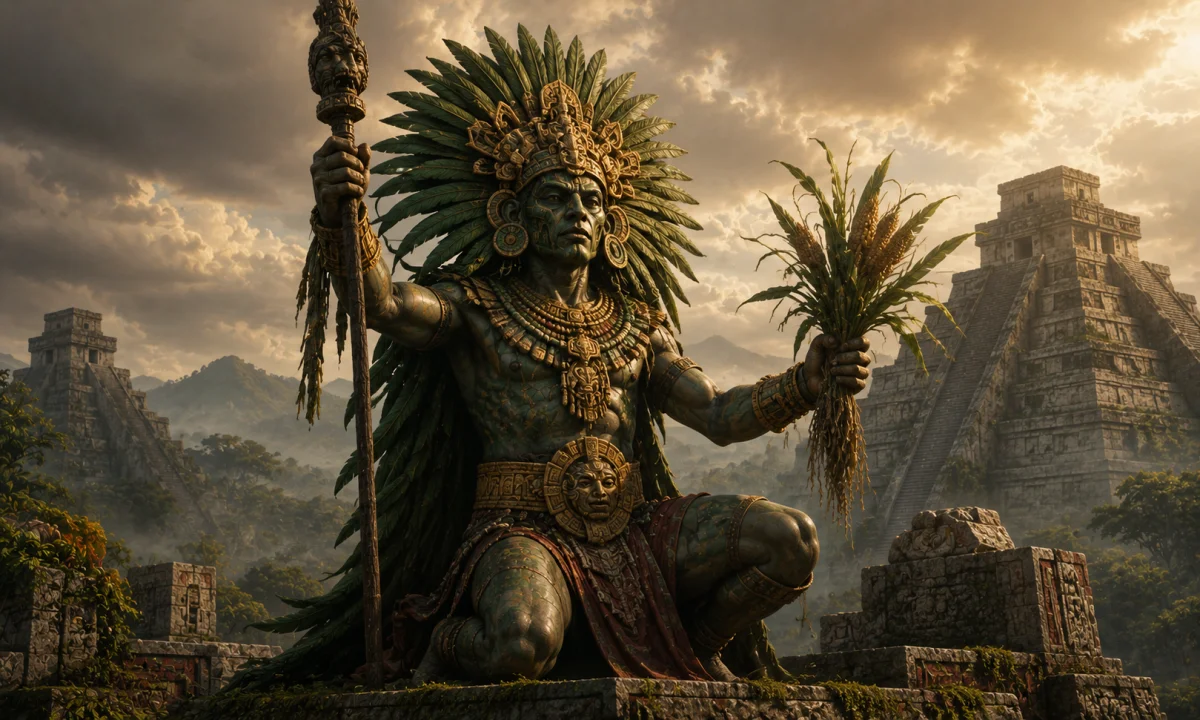
Yacatecuhtli is an Aztec deity associated with travel, commerce, and the protection of merchants, especially long-distance traders. In the religious world of the Mexica and related Nahua peoples of central Mexico, he belonged to the wider network of gods who governed movement, exchange, and the risks of the road. Surviving information about Yacatecuhtli comes from colonial-era descriptions, later summaries of Nahua belief, and the interpretive work of modern scholars. As with many Mesoamerican deities, his profile is partly clear and partly shaped by the fragmentary nature of the sources.
Origins and cultural setting
Yacatecuhtli belongs to Aztec mythology, but that label can hide important complexity. The Mexica were one Nahua people among several in central Mexico, and their religion shared many features with neighboring communities. Knowledge of Yacatecuhtli comes through the colonial period, when Spanish writers and Indigenous informants recorded parts of pre-Conquest religion after the fall of Tenochtitlan in 1521. Those records are uneven. Some preserve genuine ritual detail, while others are filtered through Christian interpretation or the attempt to fit Nahua gods into European categories.
Within that setting, Yacatecuhtli is best understood as a patron of pochteca, the professional merchant class who carried goods over long distances and played important economic, diplomatic, and sometimes espionage roles. Trade in the Aztec world was not only an economic activity but also a sacred and socially charged one. The movement of wealth, routes, and obligations required divine protection. A god connected with travel and commercial success therefore occupied an important place in the religious imagination of merchants and possibly in broader civic life as well.
The name is usually explained from Nahuatl as meaning “Lord of the Nose” or “He Who Is the Nose Lord”, though translations can vary because Nahuatl compounds are often interpreted in more than one way. In this case, the “nose” is not a random body part. In Mesoamerican symbolism, the nose can indicate direction, prominence, or a guiding point. The exact symbolic force of the name is not always certain, and scholars have proposed different readings. What is clear is that the name itself was meaningful within Nahua language and ritual thought.
Name, identity, and classification
Yacatecuhtli is generally classified as a god, not a hero, spirit, or ancestor. He is sometimes discussed alongside other merchant-related or travel-related deities, but he should not be collapsed into them. The documentary record does not always provide a full mythic biography, so his identity is established more through function than through narrative. That is common in Aztec religion, where many divine beings are known primarily by their domains, cults, and ritual associations rather than by extensive story cycles.
Some sources and modern reference works connect Yacatecuhtli with broader ideas of roads, guidance, and the success of journeys. In that respect he may overlap conceptually with other deities of movement and direction, but he remains specifically tied to merchant travel. He is not the same as gods of war, rain, or agriculture, even if the boundaries between divine roles were never completely rigid in Nahua thought.
Because surviving information is incomplete, some details about his status are uncertain. It is not always possible to say whether Yacatecuhtli was primarily a pan-Nahua deity, a more specialized Mexica god, or a figure whose importance varied from one community to another. The safest interpretation is that he was a recognized patron within the wider Nahua religious sphere, with particular significance for the merchant class.
Roles and symbolism
Yacatecuhtli’s central role was to safeguard travel and commerce. For merchants who moved across dangerous terrain, through unfamiliar towns, and into politically complex regions, such protection mattered greatly. Long-distance trade exposed people to robbery, warfare, accidents, weather, and ritual danger. A patron deity could be invoked before departure, honored along the route, and thanked upon return. In this context, Yacatecuhtli functioned not only as a source of divine help but also as a sign that trade itself was embedded in sacred order.
His symbolism is likely connected to the idea of guidance. A merchant must know where to go, how to proceed, and how to return. The “nose” in his name may suggest a leading point or a forward-facing orientation, fitting a deity associated with finding direction. That interpretation is plausible, but the surviving sources do not provide a single definitive explanation. As with many ancient religious names, later scholars must balance linguistic analysis with caution.
Yacatecuhtli also symbolizes mobility and connection. Merchants did more than carry commodities. They linked distant communities, transmitted news, and helped sustain political relationships. A god of merchants therefore presided over exchange in the broadest sense: goods, information, and social contact. In Aztec society, these activities had both practical and ritual importance, making the merchant deity part of a much larger cultural logic of reciprocity and movement.
Merchants, ritual practice, and divine protection
The strongest evidence for Yacatecuhtli’s importance comes from his association with the pochteca. These traders formed a distinctive and respected group, though they were not identical to the noble elite. They often traveled in organized caravans and were associated with specialized knowledge, discipline, and secrecy. Because they operated in dangerous and politically sensitive environments, they relied on ritual to mark departures, ask for favor, and manage uncertainty.
Colonial accounts suggest that merchants could make offerings or perform ceremonies in his honor. Exact ritual details vary by source and are not always preserved in full, but the general pattern is consistent with Nahua religion more broadly: deities received attention through offerings, prayers, fasting, and ceremonial observance. Yacatecuhtli would have been invoked where movement and trade intersected with sacred obligation.
It is also possible that Yacatecuhtli was honored in settings beyond the merchant guild itself, though the evidence is not always precise. In Aztec society, the gods of specialized groups often reflected wider social values. Even people who were not professional merchants would have understood the broader significance of commerce and travel. Still, his strongest and clearest identity remains tied to the pochteca.
Appearance and iconography
There is no single universally agreed visual portrait of Yacatecuhtli, and surviving descriptions are limited. Aztec deities were often represented through costume, emblems, and ritual arrangements rather than in the fixed “portrait” sense common in later European art. For Yacatecuhtli, the most reliable emphasis is on function rather than detailed appearance.
Where he appears in scholarly discussion of Aztec religion, he is usually linked to the material and symbolic markers of merchants and travel. Such markers may include staffs, bundles, or other signs of movement and burden, although the exact iconography can vary by source and context. Since the record is fragmentary, it is better to say that he was probably represented through symbols of guidance and commerce rather than to claim one definitive image.
He should not be confused with deities whose visual identity is much better known from codices or sculpture. The absence of a fully standardized image does not mean he was insignificant. Many Mesoamerican divine figures were central in ritual life without leaving behind abundant iconographic certainty.
Stories and surviving references
Unlike major culture heroes or cosmic deities with elaborate mythic narratives, Yacatecuhtli is not preserved through a large cycle of dramatic stories. That does not mean stories never existed; rather, the surviving sources focus more on his role and worship than on adventures or genealogies. This is a common problem in the study of Aztec religion. Colonial chroniclers often recorded lists of gods and brief ritual notes but not the full range of oral traditions that may once have surrounded them.
Some accounts place him among the divine patrons who were consulted for success in dangerous undertakings. The merchant world itself may have supplied the stories most closely associated with him: successful journeys, safe returns, and the avoidance of misfortune. In that sense, his “mythology” may have been less about epic narrative and more about lived ritual experience.
Modern scholarship sometimes tries to reconstruct his position in relation to broader Nahua cosmology. Those interpretations can be useful, but they remain interpretations. There is no single surviving myth that establishes all aspects of his character in the way a later literary deity might be documented. For Yacatecuhtli, role and practice matter more than story.
Relationship to the pochteca
The connection between Yacatecuhtli and the pochteca deserves special attention because it reveals how religion and economy overlapped in the Aztec world. The pochteca were not ordinary street vendors. They were long-distance specialists who could travel to faraway regions and interact with foreign communities. Their work required trust, discipline, and often discretion. In a society where goods and political intelligence were both valuable, their function had strategic importance.
Yacatecuhtli provided a divine framework for that identity. By honoring a merchant god, the pochteca affirmed that their work was not merely material but also socially and spiritually meaningful. The road was dangerous, and success depended on more than human effort. The deity’s role therefore expressed an important Nahua idea: practical activity and sacred order were intertwined.
This does not mean that every merchant necessarily practiced the same rituals in the same way. The evidence suggests variation by locality, period, and individual community. Still, Yacatecuhtli stands out as one of the clearest examples of a deity associated with commerce as a specialized profession.
Interpretation and cultural significance
Yacatecuhtli offers insight into how the Aztecs understood movement across space. Travel was not neutral. Roads connected communities, but they also exposed travelers to risk, unfamiliar obligations, and spiritual vulnerability. A god of merchants and journeys speaks to a world in which geography, economy, and ritual were inseparable.
He also helps show that Aztec religion was not limited to grand cosmic forces. It extended into the practical routines of society. Deities could govern agriculture, childbirth, warfare, rain, healing, and trade. Yacatecuhtli’s presence in that system shows that commerce was considered worthy of divine attention. Far from being purely secular, exchange carried moral and ritual weight.
From a broader cultural perspective, Yacatecuhtli reflects the sophistication of Mesoamerican trade networks. Long-distance merchants were essential to the circulation of luxuries, raw materials, and information. A patron deity for that activity indicates that the Aztecs recognized the importance of organized mobility and the dangers involved in maintaining it.
In scholarly interpretation, Yacatecuhtli is sometimes discussed as part of a larger pattern in which gods embody social functions. This is not a modern simplification imposed from outside; it is a useful way of describing how many Nahua deities operated in lived religion. A god of merchants was also a god of social role, professional identity, and collective memory.
Distinction from similar figures
Yacatecuhtli is sometimes confused with other Mesoamerican or Aztec beings connected to travel, roads, or commerce. That confusion is understandable because the surviving sources are incomplete and because several deities could overlap in function. Still, distinctions matter.
- He is not a general god of all travel, but specifically a patron tied to merchants and long-distance exchange.
- He is not a war god, even though merchants sometimes encountered war-related dangers and political intelligence.
- He is not a fertility or rain deity, though trade goods and agricultural products were part of the broader economy.
- He should not be merged with similar-sounding names unless the sources clearly identify them as the same being, which they do not in this case.
In studies of Aztec religion, it is important not to force neat equivalences where the evidence is ambiguous. Yacatecuhtli’s identity is secure enough as a merchant deity, but beyond that, the details should be handled carefully. Where sources differ, that difference should be acknowledged rather than smoothed over.
Later reception and modern interest
Yacatecuhtli is not widely known in modern popular culture compared with better-known Aztec gods such as Huitzilopochtli, Quetzalcoatl, or Tlaloc. When he does appear, it is usually in reference works, educational material, or discussions of pre-Columbian religion rather than in major fictional adaptations. That relative obscurity reflects the specialized nature of his cult as much as the fragmentary survival of the sources.
In modern Mesoamerican studies, however, Yacatecuhtli remains useful for understanding the social depth of Aztec religion. He reminds readers that gods were not only rulers of the sky or battlefield but also patrons of labor, exchange, and daily risk. For scholars and general readers alike, he offers a window into the spiritual life of merchants whose journeys helped hold the empire together.
Interest in Yacatecuhtli also reflects a broader effort to recover the complexity of Indigenous religions beyond the few names most often repeated in textbooks. His figure does not need dramatic legends or spectacular iconography to matter. The surviving record shows enough to identify him as a meaningful deity of trade and travel in the Aztec world, one whose importance lay in the very movement of people and goods across Mesoamerica.