WORLD
WORLD
Acolmiztli
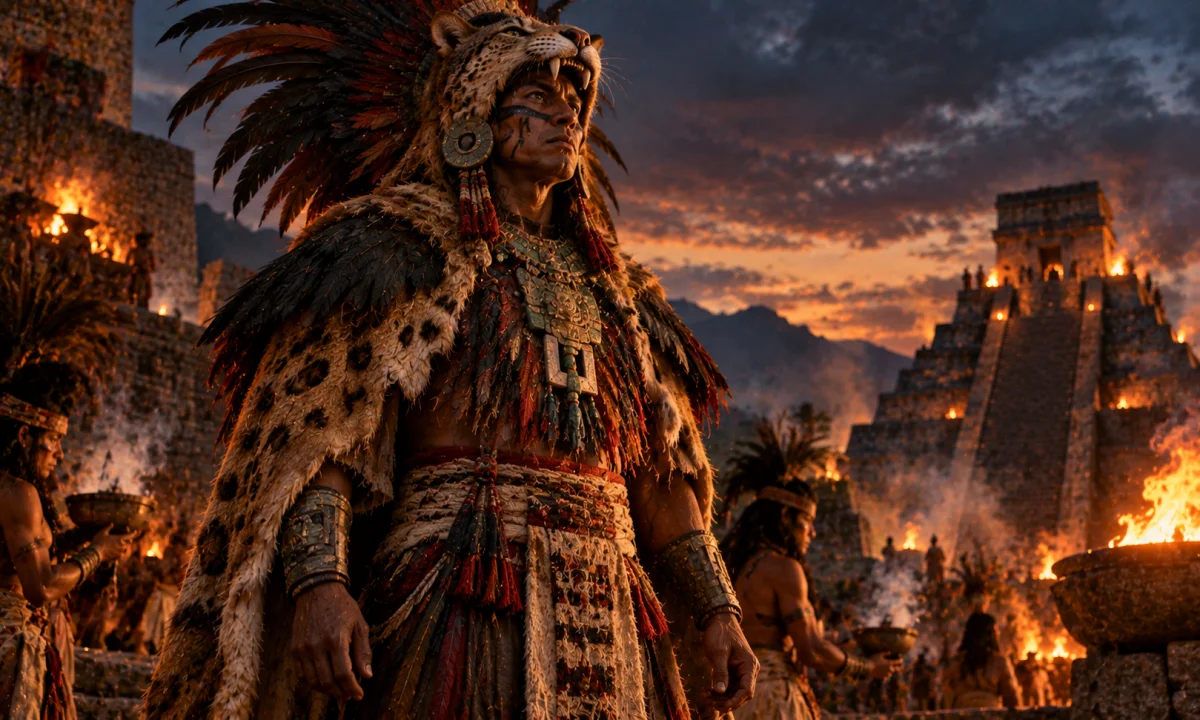
Acolmiztli was the personal name of the ruler, poet, and philosopher better known as Nezahualcoyotl of Texcoco. He belonged to the Acolhua-speaking Nahua tradition of central Mexico and lived during the fifteenth century, before and during the formation of the Aztec, or Mexica-led, Triple Alliance. Although Acolmiztli is often included in discussions of Aztec mythology, he was not primarily a god or supernatural being. He was a historical ruler whose life later became surrounded by heroic, literary, and religious traditions.
Name and identity
Acolmiztli is generally understood as a Nahuatl name formed from words associated with the arm or shoulder and the miztli, commonly translated as a mountain lion or puma. Translations such as “puma arm,” “strong arm of the puma,” or “arm of the mountain lion” appear in modern discussions. The precise nuance is uncertain because Nahuatl compounds can be interpreted in more than one way, and colonial spellings do not always preserve the full detail of pre-Hispanic pronunciation.
Acolmiztli is best known under the name Nezahualcoyotl, usually translated as “fasting coyote” or “coyote who fasts.” He used this name during his life, and it became the principal name by which later histories remembered him. The two names should not normally be treated as belonging to different people. Acolmiztli was an earlier or personal name associated with the same ruler, while Nezahualcoyotl became his better-known public name.
There is no strong evidence that Acolmiztli was a separate puma deity who was later confused with the king. The name's animal imagery may have expressed strength, courage, or royal identity, but a personal name containing an animal term does not by itself establish worship of a distinct supernatural being. Some modern summaries also present Acolmiztli as though he were solely a mythological character. That description obscures his place in the historical traditions of Texcoco.
Texcoco and the Acolhua world
Acolmiztli was associated with Texcoco, a major city-state on the eastern side of Lake Texcoco. Its ruling dynasty identified itself with the Acolhua, a Nahua-speaking people who had established political power in the eastern Valley of Mexico. Texcoco was one of the region's most important centres of government, law, poetry, engineering, and ritual learning.
Texcoco was not simply a minor partner of Tenochtitlan. It maintained its own royal traditions and intellectual culture. The city's court was associated with poets, singers, judges, astronomers, architects, and learned priests. Later accounts idealized Texcoco as a place of refined wisdom, sometimes contrasting it with the military dominance of the Mexica capital. That contrast should not be taken too literally: Texcoco was also a powerful state involved in warfare, tribute, political alliances, and imperial expansion.
The world into which Acolmiztli was born was politically unstable. Several central Mexican states were subject to the Tepanec power centred on Azcapotzalco. Rival dynasties competed for control of cities, trade routes, agricultural land, and tribute. The upheavals of this period shaped Acolmiztli's life and later helped produce the alliance that made the Mexica and their partners dominant in central Mexico.
Family, exile, and the struggle for power
Traditional histories identify Acolmiztli's father as Ixtlilxochitl, ruler of Texcoco, and his mother as Matlalcihuatzin. His maternal family was connected with the ruling house of Tenochtitlan. These relationships linked Texcoco to other important Nahua dynasties, although the exact genealogical details vary among colonial-era accounts.
When Acolmiztli was still young, his father came into conflict with Tezozomoc, the powerful ruler of Azcapotzalco. Ixtlilxochitl was defeated and killed, usually dated to the early fifteenth century. Acolmiztli was forced into hiding or exile, while Texcoco's political control was contested. Stories of his youth emphasize danger, disguise, movement between allies, and the preservation of his claim to the Texcoco throne.
These accounts combine political memory with the narrative patterns of a heroic biography. The young heir survives the destruction of his household, matures in exile, gathers supporters, and eventually returns to reclaim his inheritance. The broad political crisis is historically plausible and supported by several traditions, but individual scenes and speeches cannot be treated as securely documented eyewitness evidence.
Acolmiztli later joined forces with the Mexica ruler Itzcoatl and the influential counsellor Tlacaelel. Their coalition opposed Maxtla, the ruler of Azcapotzalco, after Tezozomoc's death. The defeat of Maxtla around 1428 transformed the political order of the Valley of Mexico. Tenochtitlan, Texcoco, and Tlacopan formed the alliance commonly called the Triple Alliance. Acolmiztli was restored as ruler of Texcoco, traditionally in 1431.
The alliance later became the foundation of the empire often called the Aztec Empire. It was not a single centralized state in the modern sense. Each member retained its own ruler and institutions, while the allied powers shared military campaigns and divided tribute. Texcoco's participation was therefore central to the rise of Mexica power, even though Tenochtitlan eventually became the most prominent member of the alliance.
Ruler, builder, and lawgiver
As ruler of Texcoco, Nezahualcoyotl was remembered for abilities extending beyond warfare. Traditional accounts portray him as a lawgiver, judge, architect, engineer, patron of poetry, and organizer of royal gardens. Some of these descriptions may reflect later idealization, but they correspond to Texcoco's reputation as a major centre of administration and learning.
He is associated with the construction and improvement of waterworks around the lakes. Accounts credit him with helping to develop aqueducts and hydraulic systems that brought fresh water from springs at Chapultepec toward the island settlements of the Valley of Mexico. He is also linked with the great dike, or albarrada, that separated fresh and salt water in Lake Texcoco and helped reduce flooding. Such projects were collective achievements requiring labour, engineering knowledge, and political authority; attributing them to one ruler expresses royal patronage rather than solitary construction.
The hill and garden complex of Tetzcotzingo, near Texcoco, is especially associated with Nezahualcoyotl. Its terraces, channels, reservoirs, stairways, and cultivated areas formed a carefully designed royal landscape. Later descriptions celebrate the site as a garden, retreat, ceremonial centre, and demonstration of hydraulic expertise. The surviving remains show the sophistication of pre-Hispanic landscape engineering, although the exact function of every feature and the extent of Nezahualcoyotl's personal involvement remain subjects of interpretation.
Colonial narratives also describe him as establishing or reforming laws and judicial procedures. These accounts often present him as an unusually wise and just ruler, a model of orderly government. They should be read alongside the conventions of Indigenous and European royal biography. A respected ruler could be remembered through exemplary stories in which his judgments display intelligence, restraint, and concern for social order.
Poetry, religion, and the question of wisdom
Nezahualcoyotl is one of the most famous poets associated with pre-Hispanic central Mexico. Poems attributed to him survive mainly through colonial manuscripts, especially collections of Nahuatl songs and poems recorded after the Spanish conquest. Their themes include the fragility of life, the passing of flowers and song, the uncertainty of human fame, friendship, death, and the search for what is lasting.
Attribution is not always certain. Nahuatl poetic works were transmitted orally and collectively, and colonial compilers recorded material after the political and religious world of the central Mexican states had been disrupted. A poem bearing Nezahualcoyotl's name may preserve courtly traditions connected with him without necessarily being a verbatim composition by his own hand. The poems remain important evidence for Nahua literary culture, but they should not be treated as a perfectly preserved personal diary.
Later writers often portray Nezahualcoyotl as a philosopher who recognized a supreme, invisible creator above the many gods of central Mexican religion. This image is connected with terms such as Tloque Nahuaque, “the one who is near everything,” and Ipalnemoani, often rendered as “the one by whom we live.” These terms occur in Nahuatl religious and poetic contexts, but their meanings and relationships are debated. They do not automatically prove that Nezahualcoyotl taught a simple form of monotheism comparable to a later European theological system.
Some colonial accounts say that Nezahualcoyotl built a tower or temple without an image for a supreme deity and rejected human sacrifice. Such reports may preserve elements of Texcocan religious thought, but they were written in a period when Indigenous traditions were being interpreted through Christian categories. The evidence does not justify turning him into an entirely non-pagan reformer or a modern-style monotheist. He belonged to a ritual world that included temples, priestly institutions, offerings, warfare, dynastic ceremonies, and devotion to numerous divine powers.
A more cautious interpretation presents him as a royal intellectual whose attributed poetry explores the limits of human knowledge and the instability of earthly achievement. The recurring image of flowers and song expresses both artistic creation and the temporary nature of life. This philosophical reputation is one reason he became so important in later Mexican cultural memory.
Appearance and symbolic qualities
No securely authenticated contemporary portrait provides a complete physical description of Acolmiztli. Images of Nezahualcoyotl in manuscripts, monuments, schoolbooks, and modern art are conventional representations rather than reliable records of his appearance.
The puma or mountain lion associated with the name Acolmiztli can be understood as an emblem of force, nobility, and military courage. It should not be assumed that he possessed a fixed animal transformation or the supernatural powers of a jaguar or puma deity. In Mesoamerican symbolism, powerful animals could signify rank and strength without making a human ruler a god.
The name Nezahualcoyotl adds a different symbolic emphasis. Fasting was an important religious and penitential practice among Nahua elites and priests, while the coyote was an animal with complex associations, including cleverness, adaptability, and liminality. “Fasting coyote” is therefore more than a literal nickname, although the exact circumstances in which the name was adopted are not certain.
Death and later historical memory
Nezahualcoyotl died in 1472, according to the standard historical chronology. His son Nezahualpilli succeeded him as ruler of Texcoco. Nezahualpilli was also remembered as a learned and capable king, helping preserve the idea of a Texcocan dynasty distinguished by law, poetry, and intellectual achievement.
Much of what is known about Acolmiztli comes from sources written after the conquest, including Indigenous annals, dynastic histories, pictorial records interpreted by later readers, and works produced by Indigenous authors writing in the colonial period. These materials are indispensable, but they do not all serve the same purpose. Some preserve genealogies and political events; others recount moralized stories, royal achievements, or poetic traditions. Spanish colonial writers also selected and reshaped Indigenous accounts according to their own interests.
The historian Fernando de Alva Ixtlilxochitl, who claimed descent from the Texcocan royal house, played a particularly important role in transmitting stories about Nezahualcoyotl and Texcoco. His works preserve valuable Indigenous historical traditions, while also presenting Nezahualcoyotl as an exemplary ruler and wise thinker. His testimony must therefore be considered alongside other evidence rather than accepted without qualification.
Acolmiztli in modern culture
In modern Mexico, Nezahualcoyotl is widely honoured through streets, schools, statues, public buildings, poetry collections, and cultural institutions. His name is often used to represent Indigenous intellectual achievement, Nahuatl literature, environmental engineering, and the historical importance of Texcoco.
Modern portrayals sometimes separate “Acolmiztli,” imagined as a fierce puma-like warrior, from “Nezahualcoyotl,” imagined as a peaceful philosopher. Traditional evidence does not support such a strict division. The names refer to different aspects of the remembered identity of one ruler: dynastic power, military struggle, religious reflection, artistic patronage, and political authority.
He also appears in historical fiction, educational media, games, and popular retellings of Aztec history. These adaptations may dramatize his exile, give him supernatural abilities, or treat the puma in his name as a literal spirit companion. Such features belong to modern interpretation rather than securely attested Nahua tradition. The historical Acolmiztli was a human ruler whose later reputation placed him at the meeting point of history, literature, religion, and legend.