WORLD
WORLD
Huitzilopochtli
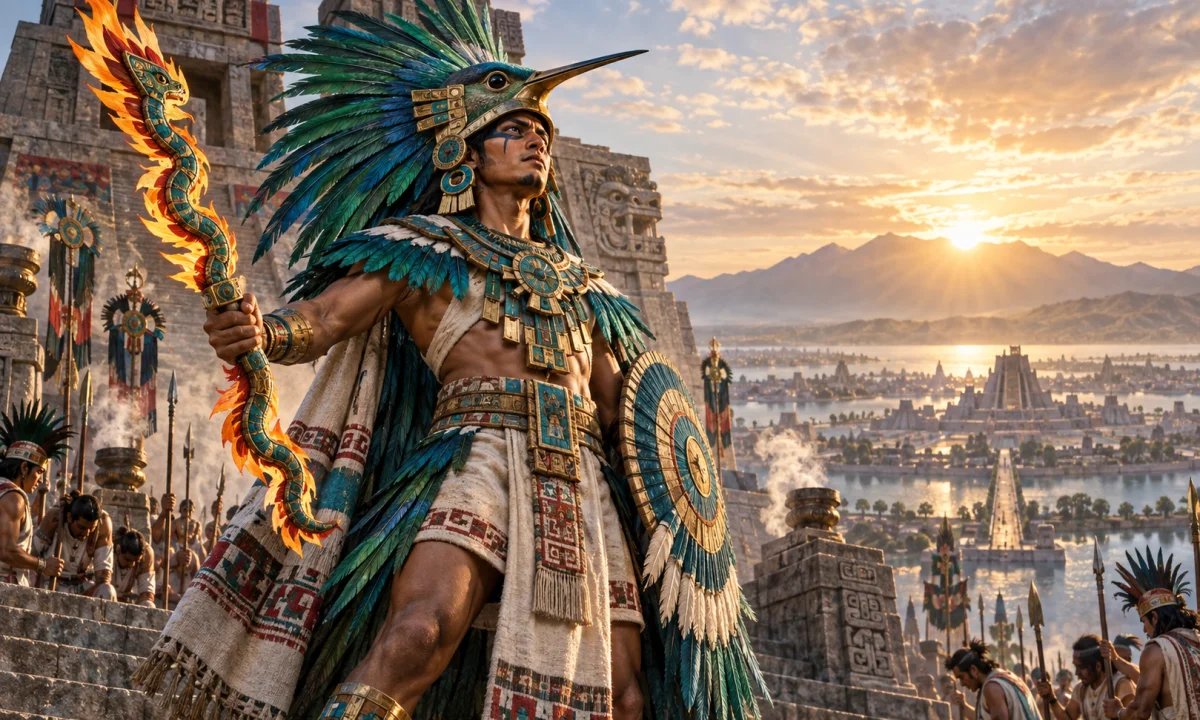
Huitzilopochtli was a major deity of the Mexica, the Nahua-speaking people who founded and ruled the city-state of Tenochtitlan in central Mexico. He was associated with warfare, the sun, rulership, sacrifice and the Mexica’s sacred history of migration. In the political religion of the Mexica Empire, Huitzilopochtli was the principal patron of the ruling dynasty and one of the two central gods worshipped in the Templo Mayor, beside Tlaloc, the deity of rain and agricultural fertility.
The name “Aztec” is widely used in English, but “Mexica” is often more precise when discussing Tenochtitlan and its imperial institutions. Huitzilopochtli was not simply a universal “Aztec god”: different Nahua communities had their own local traditions, gods and ritual emphases. His importance grew especially through the history and expansion of the Mexica state.
Sources and historical setting
Knowledge of Huitzilopochtli comes from a combination of archaeological evidence, Indigenous pictorial manuscripts and accounts written in the colonial period. Important evidence includes the remains of the Templo Mayor, painted codices and works produced after the Spanish conquest by Indigenous or mestizo authors, sometimes in collaboration with Spanish missionaries. These materials preserve valuable traditions, but they do not present a single, uncontested version of the god.
Colonial descriptions must be read carefully. Spanish writers often interpreted Nahua religion through Christian categories and sometimes emphasized practices they considered shocking or demonic. At the same time, Indigenous informants and artists preserved details that would otherwise have been lost. The surviving evidence therefore reflects several viewpoints rather than a neutral record of pre-conquest belief.
The Templo Mayor at Tenochtitlan had two principal shrines at its summit. One was dedicated to Tlaloc, whose powers supported rain, crops and the fertility of the land. The other was dedicated to Huitzilopochtli. This pairing expressed the interdependence of agricultural life and imperial warfare: the city needed rain and harvests, but the Mexica state also understood military victory, tribute and ritual obligation as foundations of political order.
Name and identity
Huitzilopochtli is commonly explained as deriving from the Nahuatl words huitzilin, “hummingbird,” and opochtli, “left” or “left side.” The name is therefore often translated as “Hummingbird of the Left.” Some interpretations connect the left side with the south, because certain Mesoamerican directional systems associate the south with a deity’s left-hand side when facing the rising sun. For that reason, “Hummingbird of the South” also appears in translations.
The exact interpretation is not completely certain. Nahuatl compounds can carry religious and metaphorical meanings that are difficult to reproduce in a short English translation, and modern scholars do not always agree on how the directional element should be understood. The hummingbird element, however, is clear and important. Hummingbirds were associated with vitality, movement, brilliance and martial imagery. Their rapid flight and apparent fearlessness made them fitting symbols for a warrior deity.
Huitzilopochtli was both a god and a specifically Mexica patron. His identity was tied to the community’s migration from its ancestral homeland and to the foundation of Tenochtitlan. He was not merely a solar deity in the broad sense. Although he became strongly associated with the sun and with the struggle of light against darkness, his roles also included the direction of the Mexica people, the protection of the ruling house and the maintenance of a military order.
Appearance and attributes
Descriptions and images of Huitzilopochtli vary, but he is frequently shown as a fully armed warrior. His regalia could include hummingbird imagery, a feathered headdress, a shield and a spear-thrower. He is also associated with Xiuhcoatl, the “turquoise serpent” or “fire serpent,” a powerful weapon that he uses in the myth of his birth. The exact appearance of the god in individual manuscripts differs, since artists worked within particular regional and ritual conventions.
Huitzilopochtli is often depicted with blue-green or dark body paint and with facial markings, though colour schemes are not entirely uniform across surviving sources. The hummingbird was especially significant in representations of his identity. The god’s connection with the sun was expressed through movement and combat: each day, the sun’s passage could be imagined as a struggle requiring support from divine and human powers.
His weapons and military regalia did not mean that he was only a god of battle in the modern sense. Warfare in Mexica society was connected to tribute, political authority, captives, ritual performance and the nourishment of the sacred order. A military victory could have economic and religious consequences at the same time. Huitzilopochtli therefore represented the state’s expansion as well as the obligations that accompanied it.
The birth of Huitzilopochtli
The best-known story of Huitzilopochtli’s birth is recorded in the tradition commonly called the birth myth of Coatlicue. Coatlicue, a powerful earth mother, was sweeping at a sacred place when a ball of hummingbird feathers fell into her clothing. She became pregnant after keeping the feathers, and her existing children reacted with anger and shame.
Her daughter Coyolxauhqui, whose name is often translated as “Painted with Bells” or “She of the Bells on the Cheeks,” encouraged her brothers, the Centzon Huitznahua, to attack their mother. The Centzon Huitznahua are frequently translated as the “Four Hundred Southern Stars,” although “four hundred” in Nahua expression can suggest an innumerable multitude rather than a literal count. The story is preserved in several forms, and the details of the episode vary among sources.
Huitzilopochtli emerged from Coatlicue’s womb fully armed. He carried the Xiuhcoatl and defeated the attackers. In the most familiar version, he killed Coyolxauhqui and dismembered her, casting her body down a mountain. He then overcame the remaining star-like brothers, who fled in different directions.
The myth is powerfully represented by the great stone disk known as the Coyolxauhqui Stone, discovered at the Templo Mayor in 1978. It shows a dismembered female figure with elaborate ornaments. The sculpture does not simply function as an illustration of a written story; it formed part of a ceremonial architectural setting. Its placement at the base of the temple stairway created a visual relationship between the fallen Coyolxauhqui and the shrine of Huitzilopochtli above.
The story has several levels of meaning. It connects Huitzilopochtli with the sun’s daily or seasonal struggle, with the defeat of rival forces and with the political triumph of the Mexica over enemies. It also reflects ideas about cosmic order, sacred mountains and the relationship between celestial bodies and earthly ritual. Modern interpretations sometimes reduce the myth to a simple “sun versus moon” story, but that equation does not capture all its political and ceremonial dimensions.
Migration and the foundation of Tenochtitlan
Mexica traditions describe Huitzilopochtli as the divine guide of the migrating people. He communicated through priests, sacred bundles, dreams or other signs, directing the community during a long journey toward its eventual home. The details differ between sources, and later accounts may have organized complex historical traditions into a more linear narrative.
The migration stories culminate in the sign that identified the Mexica settlement site: an eagle perched on a prickly pear cactus growing from a rock, often shown with a serpent. This image became the emblem of Tenochtitlan and remains visible in the coat of arms of modern Mexico. Some early depictions and accounts do not include the serpent, so the familiar form should not be treated as identical in every pre-Hispanic version.
According to tradition, the Mexica founded Tenochtitlan on an island in Lake Texcoco in 1325, although the precise historical chronology and the relationship between different foundation traditions are debated. Huitzilopochtli’s shrine established the sacred centre of the new city. The migration narrative gave the Mexica a divine mandate and presented their capital not as an accidental settlement but as the destination chosen by their patron.
Warfare, rulership and sacrifice
Huitzilopochtli’s worship was closely connected to the Mexica military state. The rulers of Tenochtitlan presented themselves as guardians of the god’s cult and as leaders responsible for obtaining captives and tribute. Major military campaigns could therefore be described as serving both political and sacred purposes. The god’s temple was enlarged by successive rulers, making its physical prominence a declaration of imperial power.
Ritual offerings to Huitzilopochtli included food, flowers, incense, precious materials and the blood of sacrificial victims. Human sacrifice formed part of some major state ceremonies, including ceremonies connected with temple dedication and agricultural or military festivals. Spanish sources sometimes provide dramatic descriptions, while archaeology confirms that human sacrifice occurred in the Mexica world. The scale, frequency and exact meaning of individual rites remain subjects of scholarly debate, and colonial numbers should not automatically be accepted as precise.
The central festival associated with Huitzilopochtli was Panquetzaliztli, usually held during the late autumn or early winter period in the Mexica calendar. Its name is commonly translated as “raising of the banners.” The festival involved processions, dancing, offerings and ceremonies honouring the god. A figure made from amaranth dough was ritually treated as an image of Huitzilopochtli and later divided and consumed in a sacred meal. Surviving accounts differ in their descriptions of the festival’s sequence and symbolism.
Another figure linked with Huitzilopochtli was Paynal, whose name is often interpreted as “the one who hurries” or “the swift one.” Paynal appears in accounts as a representative, manifestation or ceremonial substitute for Huitzilopochtli, especially in processions and ritual performances. The relationship is not always described in exactly the same way, and Paynal should not automatically be treated as a completely separate god with an independent mythology.
Relationships with other deities
Coatlicue is Huitzilopochtli’s mother in the birth tradition, while Coyolxauhqui is his sister and the Centzon Huitznahua are his brothers or elder siblings. These relationships belong to a particular cycle of Mexica myth and should not be assumed to represent a universal Mesoamerican family tree.
Huitzilopochtli’s pairing with Tlaloc at the Templo Mayor is one of the most important religious relationships associated with him. Tlaloc governed rain, springs, storms and agricultural abundance, whereas Huitzilopochtli represented the Mexica state’s martial and solar power. Their shared temple did not mean that the two gods were identical or interchangeable. It reflected the complementary needs of the imperial capital: food, water and fertility on one side, and warfare, rulership and sacred obligation on the other.
Huitzilopochtli is sometimes compared with Tezcatlipoca because both could be powerful, martial and politically significant male deities. They are not the same figure. Tezcatlipoca had his own complex identity, myths and ritual traditions, and in some contexts the two could be rivals or belong to different theological groupings. Likewise, Huitzilopochtli should not be merged with Tonatiuh, the sun deity, even though their cults and symbolism could overlap.
Meaning in Mexica religion
Huitzilopochtli helped explain who the Mexica were and why their capital held a central place in their world. His migration guidance transformed political history into sacred history. His victory over Coyolxauhqui and the star-like brothers provided a mythic model for the defeat of enemies and the establishment of order. His association with the sun gave daily and cosmic significance to the duties of warriors, rulers and ritual specialists.
The god’s religion also expressed a reciprocal relationship between humans and divine powers. Mexica thinkers understood the world as dependent on continual offerings and correct ritual action. This did not mean that every individual participated in the most extreme state ceremonies, nor that all Nahua peoples practiced religion in exactly the same manner. It does mean that Huitzilopochtli’s cult cannot be separated from the institutions of the city, the authority of the ruler and the broader ceremonial calendar.
The imagery of the Templo Mayor made these ideas visible. A visitor moving through the sacred precinct encountered architecture, sculpture, processions and offerings that linked the city to mountain, battlefield, sky and mythic time. The Coyolxauhqui Stone, the twin shrines and the temple’s repeated rebuilding turned the capital itself into a stage for the continuing renewal of the Mexica cosmos.
After the Spanish conquest
Following the Spanish conquest of Tenochtitlan in 1521, the public cult of Huitzilopochtli was suppressed by colonial authorities and Christian missionaries. His images and temple were destroyed or buried, while the Templo Mayor was replaced by colonial buildings in the developing city of Mexico. Indigenous memories nevertheless survived in manuscripts, oral traditions, place names and later historical works.
In modern Mexico, Huitzilopochtli is most visible through archaeology, museums, school history, national symbols and scholarship on Nahua civilization. His name and stories also appear in novels, games, fantasy fiction and other popular-cultural works. Such adaptations often simplify him into a generic god of war or a villainous “Aztec” deity. Those portrayals belong to modern interpretation rather than to the full religious and historical tradition preserved around the Mexica capital.
Contemporary discussions increasingly distinguish the achievements and beliefs of the Mexica from colonial stereotypes about “the Aztecs.” They also recognize that Nahua peoples and communities have continued to shape their own relationships with Indigenous history, even though the ancient state cult of Huitzilopochtli cannot simply be assumed to survive unchanged. The deity remains an important subject in the study of Mesoamerican religion, imperial ideology, Indigenous art and the history of Tenochtitlan.