WORLD
WORLD
Acuecueyotl
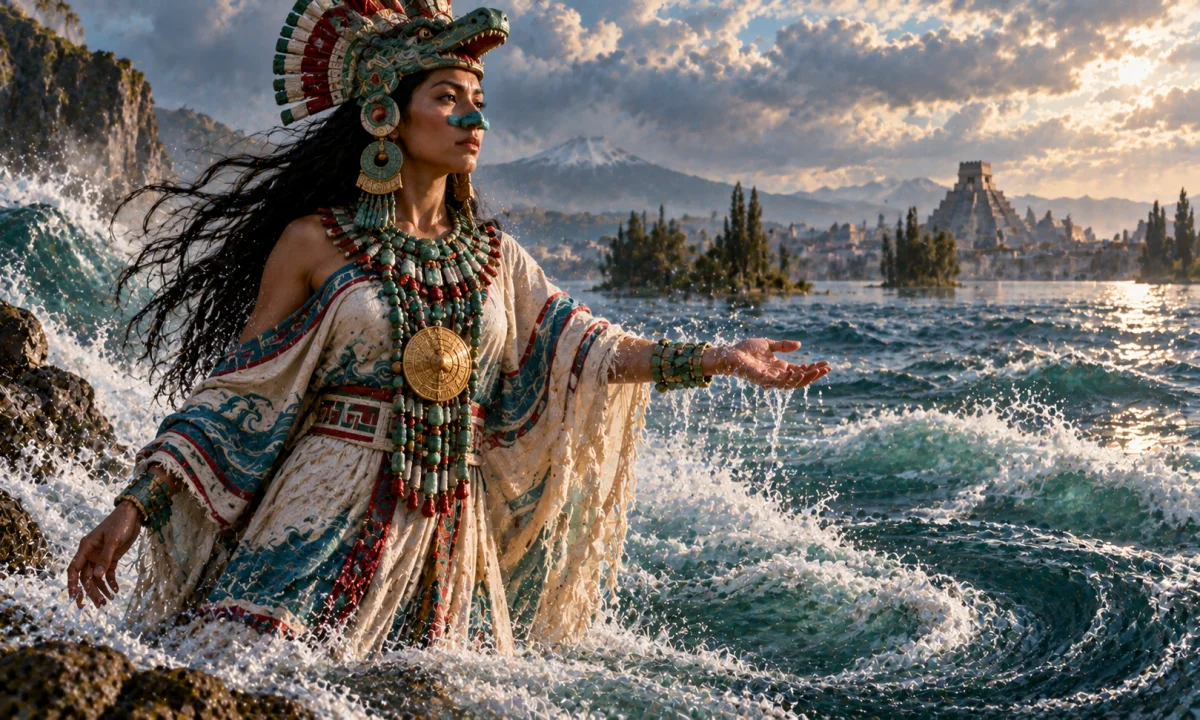
Acuecueyotl is a poorly documented water-related figure associated with Aztec or Nahua religious tradition. The Nahuatl name is commonly interpreted in connection with cuecueyotl, a wave, ripple, or movement on water. Some modern reference works describe Acuecueyotl as a deity of waves or water and place the figure among the Tlaloque, the rain and mountain beings connected with Tlaloc. However, the surviving evidence does not establish Acuecueyotl as a major, independently documented god with a clearly known cult, mythology, or standard image.
Name and meaning
The name is usually written Acuecueyotl, although spelling varies because the available records were written in colonial Latin orthography rather than in a single standardized modern system for Nahuatl. Forms such as Acuecueyotli may also appear. The name is generally understood as referring to water in motion, especially a wave, ripple, or splashing surface.
Nahuatl religious names often describe a natural force, a visible phenomenon, or a quality associated with a deity. A word connected with waves could therefore function in more than one way. It might identify a supernatural being, serve as an epithet for a broader water deity, or describe one aspect of a group of related powers. The existence of the name by itself does not prove that Acuecueyotl possessed a separate temple, priesthood, or extensive mythology.
Interpretations are further complicated by the nature of the sources. Much of what is known about Aztec religion comes from records produced in the sixteenth century, after the Spanish invasion, by missionaries, Indigenous scholars, or collaborators working within colonial institutions. These records preserve valuable Nahua information, but they do not provide a complete catalogue of every deity. They also sometimes translate, group, or classify religious beings according to European expectations about gods and spirits.
Religious and cultural setting
For the Nahua peoples of central Mexico, water was not a single religious category. Rain, springs, rivers, lakes, irrigation, storms, fertility, drowning, disease, and agricultural productivity could all involve different sacred powers. Water was necessary for maize cultivation and human life, but it could also arrive as destructive flooding or hail. The same natural force could therefore be beneficial, dangerous, or both.
The most prominent rain and storm deity in central Mexican religion was Tlaloc. Tlaloc was associated with rain, mountain springs, agricultural fertility, lightning, and the watery forces that sustained crops. His attendants or subordinate beings, commonly called the Tlaloque, were connected with particular forms or sources of rain and with the mountains from which rain was believed to emerge.
Other important water-related figures included Chalchiuhtlicue, the “Jade-Skirted One,” who was associated especially with lakes, rivers, springs, and flowing water; Huixtocihuatl, linked with salt and salt water; and Opochtli, associated in some traditions with fishing, hunting on water, and tools used by people who depended on lakes. These figures should not automatically be treated as interchangeable with Acuecueyotl.
Within this wider religious environment, a name meaning “wave” or “water movement” fits the Nahua tendency to recognize sacred agency in specific natural processes. Acuecueyotl may have represented a particular expression of aquatic power rather than an all-purpose god of water.
Identity and classification
Acuecueyotl is often classified as an Aztec water deity, but this description should be treated cautiously. The surviving evidence is too limited to define a universally accepted identity. In modern summaries, Acuecueyotl is sometimes called a god of waves, sometimes a water spirit, and sometimes one of the Tlaloque. These descriptions reflect attempts to organize fragmentary material rather than a securely documented ancient classification.
The association with the Tlaloque is plausible in terms of subject matter. The group was connected with rain, clouds, mountain water, and the distribution of storms. Yet not every named water-related being in a colonial source can confidently be identified as one of the Tlaloque. Some names may represent local traditions, descriptive titles, ritual terms, or aspects of better-known deities.
There is also no firm basis for presenting Acuecueyotl as one of the principal gods of the Mexica state. Tlaloc, Chalchiuhtlicue, Huitzilopochtli, Tezcatlipoca, Quetzalcoatl, and other major figures have much stronger documentary and archaeological evidence. Acuecueyotl belongs to a less clearly defined part of the religious vocabulary associated with water.
Attributes and possible powers
The safest interpretation of Acuecueyotl’s sphere is moving water. The name suggests waves, ripples, or the lively surface of water rather than water in an abstract or universal sense. Such imagery could apply to lakes, rivers, springs, rainfall striking the ground, or water disturbed by wind and weather.
Because the evidence is limited, detailed claims about Acuecueyotl’s appearance are uncertain. No widely accepted canonical image survives that allows the figure to be identified securely. Descriptions sometimes found in modern encyclopedias or online lists may assign a water jar, aquatic ornaments, or the familiar facial features of Tlaloc, but these details should not be treated as established attributes of Acuecueyotl unless they are supported by a specific image or text.
The same caution applies to supposed powers. Acuecueyotl may be described as controlling waves, protecting fishermen, or governing rivers, but these claims are not equally well documented. They may arise from the literal meaning of the name or from comparisons with better-attested water beings. It is more accurate to say that the figure’s name places it within a sacred vocabulary of water movement than to construct an elaborate independent divine personality.
Water movement nevertheless carried important symbolic meanings in Nahua thought. Waves could express vitality, change, danger, and the boundary between stable land and unstable water. A wave might nourish fields through irrigation or rainfall, while excessive water could destroy homes and crops. A supernatural power associated with waves would therefore fit a religious system in which natural forces required respect, ritual attention, and proper balance.
Relationship to Tlaloc and other water powers
Acuecueyotl is most often discussed in relation to Tlaloc, because Tlaloc’s religious sphere included rain and the broader life-giving power of water. This does not mean that Acuecueyotl was simply another name for Tlaloc. The two names have different meanings and do not have equally strong evidence behind them.
Tlaloc possessed a long-established cult, distinctive iconography, major festival observances, and an important place in state and regional religion. His characteristic imagery includes large circular eyes, fanged features, and other signs associated with rain and storm power, although representations vary. None of this can automatically be transferred to Acuecueyotl.
Chalchiuhtlicue also deserves careful distinction. She was a major water goddess whose name means “She of the Jade Skirt,” and she was associated with rivers, lakes, springs, fertility, childbirth, and the dangers of water. Acuecueyotl’s wave-related name could overlap with her domain, but overlap does not establish identity or a family relationship.
Likewise, Acuecueyotl should not be confused with Atlacamani, a name sometimes connected in modern lists with storms or hurricanes, or with Matlalcueye, a regional mountain and water-associated figure whose identity and relationship to other goddesses vary across traditions. Nahua religious beings could share natural domains without being versions of one another.
Stories and surviving traditions
No major mythological narrative centered on Acuecueyotl is securely preserved in the best-known colonial accounts. There is no widely attested creation story, conflict, genealogy, or heroic episode that can be assigned to the figure with confidence. This absence is significant: it means that a detailed biography of Acuecueyotl would go beyond the evidence.
Some accounts of Aztec religion describe groups of rain or water beings rather than presenting every supernatural power as an independent character with a full mythic cycle. A name associated with waves could have belonged to such a network of related powers. In that setting, Acuecueyotl would be understood through ritual and environmental relationships—rain, flowing water, storms, agricultural fertility, and the dangers of flooding—rather than through a long sequence of stories.
The lack of a surviving narrative does not make the name meaningless. Indigenous religious traditions included many local, specialized, or context-dependent powers that were not recorded in the accounts most often used by modern readers. Colonial writers also selected particular subjects according to their missionary aims. A figure’s limited documentation may therefore reflect the history of recording as much as the figure’s importance in lived religion.
Cultural significance
Acuecueyotl is useful for understanding the complexity of Nahua ideas about nature. Aztec religion did not divide the world into a simple opposition between “gods” and “ordinary objects.” Mountains, caves, springs, lakes, weather events, animals, and agricultural processes could all possess sacred significance. A name connected with a wave shows how a distinct movement of water could be recognized within this larger religious landscape.
The figure also illustrates why modern categories such as “god of water” can be misleading. Water was distributed among several deities and sacred forces, each connected with particular places, activities, or effects. A lake, a spring, a storm, a wave, and salt water did not necessarily belong to one unified department ruled by a single god.
For farmers, fishers, boat users, and communities living near lakes or rivers, water was both material and spiritual. Ritual relationships with water sought rain and fertility but also protection from storms, flooding, illness, and drowning. Even when Acuecueyotl cannot be assigned a precise cult function, the name belongs to this world of reciprocal dependence between human communities and powerful natural forces.
Evidence and uncertainty
Modern descriptions of Acuecueyotl often present a confident profile: a named Aztec god, a particular physical form, a defined family relationship, and a fixed set of powers. The surviving evidence does not justify all of these details. Much of the certainty in popular summaries comes from combining a suggestive name with information about Tlaloc, Chalchiuhtlicue, or the Tlaloque.
A historically careful description should therefore distinguish between three levels of information. First, the name is associated linguistically with water movement or waves. Second, the name is placed by modern interpreters within the broad religious world of Nahua water powers. Third, the claim that Acuecueyotl was a fully independent deity with a standard appearance, family, temple, or mythology remains uncertain.
Acuecueyotl is consequently best treated as a little-documented water-related figure or religious designation in Aztec-era Nahua tradition. Its importance lies less in a large body of surviving myths than in what it reveals about the specialized and overlapping ways that Nahua communities understood water, weather, and the forces that sustained or threatened life.