WORLD
WORLD
Mayahuel
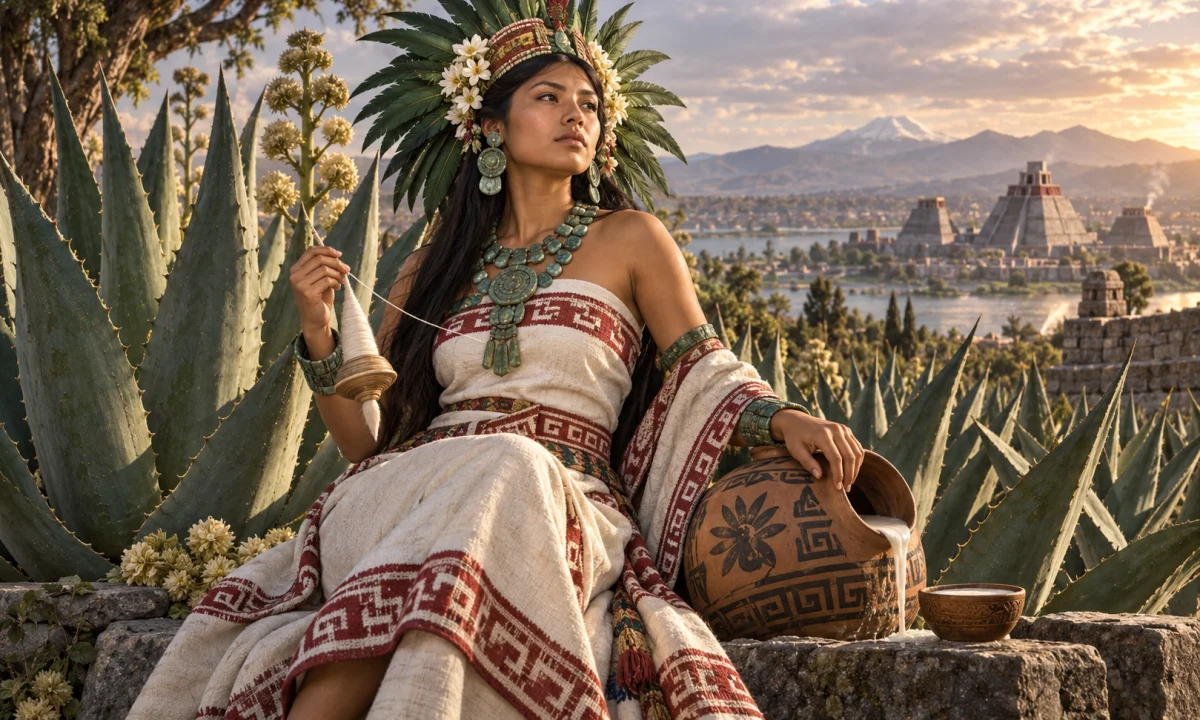
Mayahuel is a goddess associated with the maguey or agave plant, its nourishing sap, and pulque, the fermented drink made from that sap in central Mexico. She belongs to the religious traditions of the Nahua peoples, including the Mexica, often called the Aztecs. In surviving colonial-era accounts, Mayahuel is connected with fertility, nourishment, sexual vitality, agricultural abundance, and the sacred power of intoxicating drink. Her traditions are not preserved in one single, consistent myth, however. Different manuscripts and later interpretations present her identity, relationships, and stories in varying ways.
Cultural setting
Mayahuel’s importance is closely related to the central place of maguey in Mesoamerican life. The plant, known scientifically as agave, was not merely a source of alcohol. Its leaves supplied strong fibres for rope, thread, sandals, mats, and clothing. Its spines could be used as pins or ritual instruments, while its leaves provided roofing material and fuel. The sap, often called aguamiel, could be consumed fresh or allowed to ferment into pulque.
Pulque was a significant ceremonial and social drink. It was associated with divine beings, fertility, celebration, and altered states of consciousness. Colonial descriptions indicate that access to pulque was regulated in particular social and ritual circumstances, although the rules were not always as simple or absolute as later summaries suggest. The drink was especially important in ceremonies connected with agricultural fertility and the wellbeing of the community.
Within this setting, Mayahuel represented more than a personification of a plant. She embodied the life-giving potential of maguey: food, drink, fibre, reproduction, and renewal. Her traditions also reflect the ambivalent character of pulque. It could nourish and heal, but intoxication could also lead to disorder or dangerous excess. The gods associated with pulque therefore belong to a religious world in which pleasure, fertility, drunkenness, and danger were closely connected.
Name and identity
Mayahuel is usually understood as a Nahuatl name, sometimes written Mayahuel, Mayáhuel, or with a long-vowel spelling such as Māyāhuēl. Colonial orthographies did not consistently mark vowel length or pronunciation, which accounts for some differences in modern spelling. The precise meaning of the name is uncertain. It is often loosely explained as referring to maguey, but the etymology is not secure enough to treat every popular translation as established fact.
Mayahuel is commonly classified as a goddess of maguey and pulque. This description is useful, but the categories used by modern writers should not be mistaken for a fixed ancient classification system. Nahua divine beings could possess several overlapping roles, and their identities could be expressed through costumes, cult titles, local traditions, and relationships with other deities.
Some accounts present Mayahuel as a young woman or maiden, while others emphasize her as a maternal or nourishing power. She is sometimes described as the consort of Patecatl, a deity associated with healing, medicinal substances, and the discovery or preparation of pulque. Together, Mayahuel and Patecatl are frequently identified as the parents of the Centzon Totochtin, the “Four Hundred Rabbits,” a collective of pulque deities. These relationships are widely repeated, but the surviving evidence does not provide a single standardized family tree for all the figures connected with pulque.
Appearance and sacred imagery
Mayahuel’s visual identity is linked to the maguey plant. In manuscript images, she may appear emerging from, seated within, or closely associated with a maguey. Such images communicate that the goddess is not simply standing beside the plant as an unrelated figure; she is a divine expression of its generative power.
Illustrations associated with Mayahuel can include the distinctive leaves and spines of the agave, vessels for liquid, and other signs connected with pulque and fertility. The exact details vary according to the manuscript and the interpretation of individual signs. Colonial codices often use a complex visual language in which colour, headdress, body paint, posture, and objects identify a deity or ritual action. It is therefore risky to assign a fixed meaning to every item shown in a modern reproduction.
Her association with the maguey also gives her a distinctive relationship with bodily substance. The plant’s sap emerges from a living body and can be transformed into a powerful drink. This process made maguey an appropriate symbol for nourishment, fertility, and transformation. The plant appears to give part of itself to sustain human beings, while its sharp spines and difficult cultivation remind observers that abundance is not without danger or labour.
Mayahuel and the origin of maguey
A well-known story connects Mayahuel with the discovery or origin of the maguey plant. In its most familiar form, she is a young divine woman kept under the authority of an older female being, often identified in retellings as a frightening star or night deity. Quetzalcoatl encounters her, brings her away, and joins with her. The pair are transformed into a tree so that they can remain together. When the older guardian discovers them, she attacks the tree and tears Mayahuel apart. Quetzalcoatl buries her remains, and the first maguey grows from them.
This narrative is often presented as a complete and uniform “myth of Mayahuel,” but the evidence is more complicated. Versions of the story appear in colonial compilations, and details differ between sources. The older female figure is not identified in exactly the same way in every retelling, and the story’s connection with the star demons known as tzitzimime reflects interpretive choices that are not always stated identically in the primary texts.
The story nevertheless expresses several ideas that fit Mayahuel’s wider significance. Her death becomes a source of nourishment for human beings, transforming loss into agricultural abundance. The plant that grows from her remains is both generous and armed, with nourishing sap protected by sharp leaves and spines. Her relationship with Quetzalcoatl also places the origin of maguey within a larger tradition of divine knowledge being brought to humanity.
It is important not to assume that every detail in the popular version was part of a single pre-Hispanic narrative told throughout central Mexico. The major colonial sources were written after the Spanish conquest, often by Indigenous informants and scholars working with Spanish missionaries or colonial institutions. They preserve valuable Nahuatl traditions, but they may also combine regional variants, reinterpret oral narratives, or arrange material according to European literary and religious expectations.
The Four Hundred Rabbits and pulque
Mayahuel is strongly connected with the Centzon Totochtin, whose name means “Four Hundred Rabbits.” The number four hundred commonly conveys an immense or innumerable multitude rather than a literal count. The rabbits were associated with pulque and with the many possible behaviours produced by intoxication. One person might become cheerful, another quarrelsome, another lustful, and another melancholy. The rabbit imagery gave a memorable way to describe the drink’s varied effects.
In accounts that identify Mayahuel and Patecatl as the parents of the Four Hundred Rabbits, the goddess becomes the maternal source of a large divine group. The relationship links the maguey plant to the drink produced from it and to the social consequences of drinking. Some of the rabbit deities have individual names and distinctive associations, but the group as a whole is more important than a rigidly fixed list of members.
Another important pulque deity is Ometochtli, “Two Rabbit,” who appears as a prominent figure among the pulque gods. Ometochtli should not simply be treated as another name for Mayahuel. He is a separate divine figure, even though he belongs to the same religious complex. Likewise, the Four Hundred Rabbits are not all alternative forms of Mayahuel; they are associated beings within the larger tradition of pulque.
Pulque could be treated as a sacred substance, but that did not mean intoxication was considered harmless. Nahua moral and ritual traditions placed considerable emphasis on appropriate conduct, age, circumstance, and social order. Stories about drunkenness could show both the pleasurable and destructive effects of the drink. Mayahuel’s role therefore belongs to a religious system that valued pulque while recognizing that divine gifts could become dangerous when used without restraint.
Relationships with other deities
Mayahuel’s closest traditional relationship is generally with Patecatl, who is connected with medicine and pulque. The precise nature of their partnership varies in modern descriptions. Some accounts call him her husband or consort, while others simply place them together as parents of the pulque gods. It is better to describe the relationship as a recurring association in the sources than to impose a single universally accepted biography on the pair.
Quetzalcoatl is connected with Mayahuel in the origin story described above. This does not necessarily mean that Mayahuel was consistently regarded as his wife or permanent consort. The narrative relationship serves a particular mythic purpose: Quetzalcoatl helps bring her, and through her the maguey, into the human world. Stories involving divine encounters should not automatically be converted into fixed genealogical relationships.
Mayahuel is also sometimes compared with other female deities associated with sexuality, fertility, childbirth, or nourishment. Such comparisons can be illuminating, but they do not make the goddesses interchangeable. Tlazolteotl, for example, has important associations with sexuality, pollution, confession, and purification, while Chicomecoatl is strongly associated with maize and food. Their areas of meaning may overlap with Mayahuel’s fertility symbolism, but they remain distinct figures with different traditions and ritual identities.
Sources and historical evidence
Knowledge of Mayahuel comes primarily from manuscripts and textual records produced during the colonial period. These include the Florentine Codex, compiled under the direction of Bernardino de Sahagún with the participation of Nahua scholars and informants; the Codex Borbonicus; the Codex Borgia and related ritual manuscripts; the Codex Magliabechiano; and historical compilations such as the Historia de los mexicanos por sus pinturas and the Leyenda de los Soles.
These sources do not all have the same origin or purpose. Some are ritual calendars, some are illustrated religious manuscripts, and some are historical or mythographic compilations. A manuscript image may emphasize a deity’s ritual costume, while a prose account may focus on a story or genealogy. Differences between sources are therefore not necessarily errors. They may reflect regional traditions, different genres, or the selective recording of oral knowledge.
Archaeological evidence can establish the great antiquity and importance of agave cultivation and pulque production in Mesoamerica, but it rarely identifies Mayahuel directly. A depiction of a plant, a vessel, or a female figure cannot automatically be assigned to her without supporting contextual evidence. Claims about her pre-Hispanic worship should therefore distinguish between material evidence for maguey use and textual or iconographic evidence for the goddess herself.
The word “Aztec” also requires some care. It is a widely used modern term for the civilization centred on the Mexica capital of Tenochtitlan and related Nahua-speaking peoples. Mayahuel’s traditions belong to a wider Nahua and central Mexican religious environment, not only to the Mexica state in a narrow political sense. Local communities could preserve their own versions of divine identities and ritual practices.
Meaning and cultural significance
Mayahuel represents the transformation of a plant into a network of human and divine relationships. Maguey grows in environments where other crops may be difficult to sustain, and it can provide liquid, food, fibre, tools, and building materials. Its usefulness made it a symbol of practical abundance as well as sacred fertility.
Her mythology also highlights the idea that nourishment may come through sacrifice. In the story of her death and transformation, Mayahuel does not merely create a crop by command. Her body becomes the source of the plant. This theme appears in many agricultural traditions, but its meaning should be interpreted within the specific Nahua context rather than treated as proof of a universal “earth mother” category.
The goddess’s association with pulque connects her to altered consciousness, social identity, and ritual power. The Four Hundred Rabbits express the countless personalities that drink can reveal or produce. Mayahuel therefore stands at the meeting point of agriculture, bodily pleasure, medicine, fertility, and moral risk.
Mayahuel in modern culture
Mayahuel continues to appear in discussions of Mesoamerican mythology, agave history, Mexican identity, and the cultural heritage of pulque. Modern representations often portray her as a beautiful woman surrounded by agave leaves or as a romantic companion of Quetzalcoatl. Such images can make the tradition accessible, but they frequently simplify differences between colonial sources and turn a complex religious figure into a single “goddess of tequila.”
That comparison is historically misleading. Tequila is a distilled spirit developed in the colonial and modern periods, whereas Mayahuel’s traditional association is primarily with maguey and pulque. Agave spirits may share the plant’s broader cultural heritage, but they should not be presented as identical to the drink known in pre-Hispanic religious traditions. Modern artistic and commercial uses of Mayahuel belong to later reception, while her original significance is rooted in Nahua understandings of maguey, pulque, fertility, and divine nourishment.