WORLD
WORLD
Amaranth
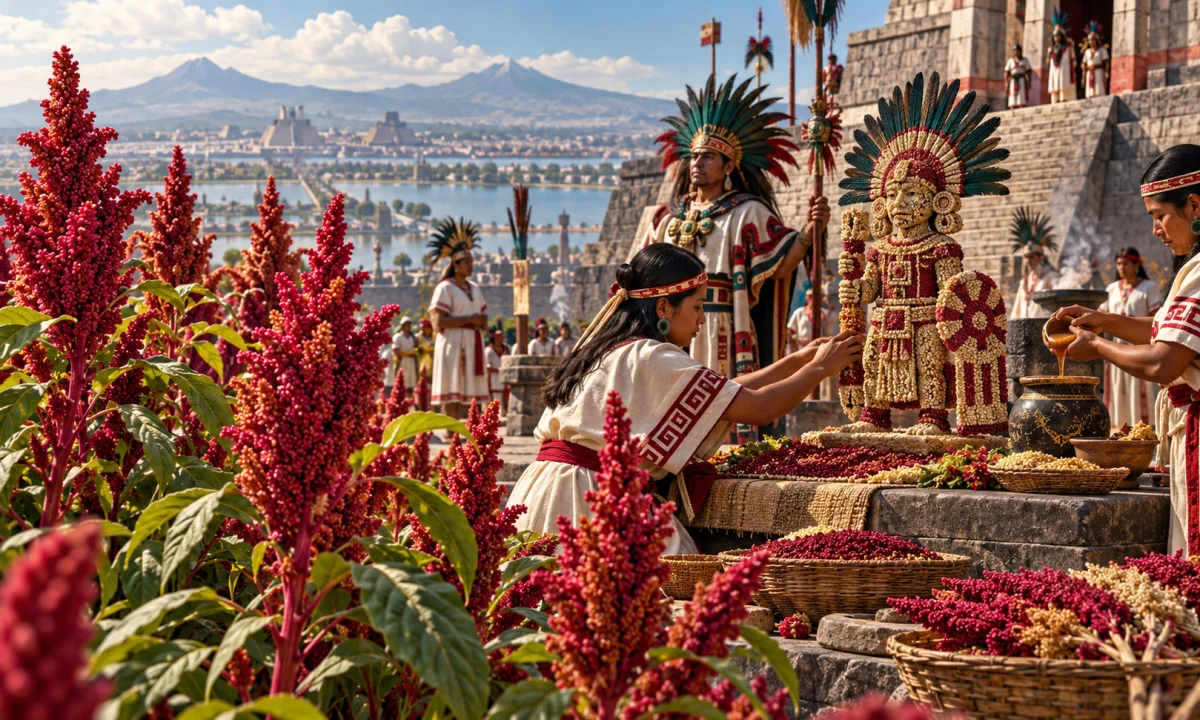
Amaranth is not the name of a clearly attested Aztec god, hero, or supernatural being. In discussions of Aztec mythology, the name usually refers instead to the amaranth plant and to ritual objects made from its seeds. Known in Nahuatl sources as huauhtli, amaranth was an important food crop in central Mexico and acquired religious significance through ceremonies connected with gods such as Huitzilopochtli. The English name can therefore be useful when discussing Aztec ritual, but treating “Amaranth” as an independent Aztec deity is misleading.
Amaranth in the Aztec world
Amaranth belongs to the genus Amaranthus, a group of plants cultivated in many parts of the Americas. Several species were grown in Mesoamerica, and the exact species intended by every colonial description cannot always be established with certainty. In central Mexico, amaranth seeds were valued as a nutritious crop, while the leaves could also be eaten as a vegetable. The plant grew alongside maize, beans, squash, and other crops that supported urban and rural life.
The Nahuatl word huauhtli is commonly translated as “amaranth,” although historical identifications may include more than one related plant. The word was not the personal name of a deity. It referred primarily to a cultivated food and its seed. The plant’s religious importance arose from what people did with it in particular ceremonies, especially when its seeds were combined with a sweet binding substance and shaped into sacred images.
Amaranth was cultivated across a wider region than the Aztec imperial heartland. Nahua-speaking communities and other Mesoamerican peoples used related plants in different ways, and the evidence does not support assigning every tradition concerning amaranth to the Mexica, the people often called the Aztecs. “Aztec amaranth mythology” is therefore a modern shorthand for a more specific subject: the role of huauhtli and amaranth dough in Mexica ritual practice.
Surviving evidence and its limitations
Knowledge of amaranth’s ceremonial role comes mainly from colonial-period accounts written after the Spanish invasion. Important descriptions were recorded by missionaries and chroniclers who gathered information from Nahua elders, ritual specialists, interpreters, and earlier Indigenous records. These accounts preserve valuable details about festivals, offerings, sacred images, and agricultural life, but they must be read carefully.
Colonial writers often interpreted Nahua ceremonies through Christian categories. They sometimes compared the eating of a sacred image with Christian communion, or described Indigenous rites as distorted versions of Christian practices. Such comparisons reveal how the writers understood what they saw; they do not necessarily reproduce Nahua theology in its own terms. The sources also vary in their descriptions of the materials, timing, and meaning of the rituals.
Archaeological evidence confirms that amaranth was an important ancient crop, but material remains rarely identify the precise meaning of a particular ritual object. Much of the religious interpretation comes from written sources whose original Indigenous statements were filtered through translation, transcription, and colonial assumptions. For this reason, claims about amaranth should distinguish between well-supported agricultural evidence and more speculative attempts to reconstruct ancient belief.
The sacred dough called tzoalli
A central practice associated with amaranth involved a substance commonly transcribed as tzoalli or zoalli. It was made from ground amaranth seeds mixed with a sweet material, often described as honey or the syrup of the agave plant. The resulting dough could be formed into images of gods or other sacred figures.
These images were not ordinary statues. They were prepared for ritual use, handled within a ceremonial setting, and treated as embodiments or representations of a deity. The precise theological status of the image is difficult to express in modern terms. It was not simply an illustration, yet the sources do not justify reducing it to the claim that the dough was literally believed to be a god in exactly the same sense as a living person or a stone idol.
One of the best-known associations is with Huitzilopochtli, the Mexica patron deity of war, rulership, and the sun. During the festival of Panquetzaliztli, celebrated in the month associated with Huitzilopochtli, a large image of the god was reportedly made from amaranth dough. Priests and worshippers performed rites before it, and portions of the image were eventually distributed and eaten.
Colonial descriptions use language of eating the god’s body or receiving his substance. Modern writers have sometimes called this a “pagan Eucharist,” but that phrase is an analogy rather than a neutral description of Mexica religion. It can obscure important differences between Christian sacramental theology and Nahua ideas about sacred presence, offering, reciprocity, and the transformation of divine power through ritual action.
Huitzilopochtli and the ritual image
Huitzilopochtli held an exceptional position in the Mexica religious and political order. He was associated with the Mexica migration, the foundation of Tenochtitlan, warfare, royal authority, and the expansion of the empire. His major temple stood at the summit of the Templo Mayor, where he shared a monumental shrine with Tlaloc, the rain and agricultural deity.
In the festival rites connected with Huitzilopochtli, an amaranth image could be adorned and treated with the honors given to a divine presence. Accounts describe participants making offerings, singing, processing, and carrying out acts of devotion before the image. At the end of the ceremony, the image was divided among participants and consumed.
The ritual should not be confused with the ordinary consumption of amaranth as food. The seeds were a staple or supplementary crop, while the tzoalli image was a consecrated object prepared for a specific religious event. Its meaning came from the combination of agricultural substance, skilled manufacture, festival timing, priestly action, and communal participation.
Interpretations of the rite differ. Some scholars emphasize the transformation of a crop into a divine image and then into food shared by the community. Others focus on ideas of sacrifice, renewal, divine nourishment, or the circulation of sacred power. These interpretations are not mutually exclusive, but the available sources do not provide a single explanation that settles every question.
Amaranth, agriculture, and sacred reciprocity
Amaranth’s importance was connected to the wider religious significance of cultivated plants. In Mesoamerican societies, agriculture was not merely an economic activity. Crops depended on rain, fertile soil, seasonal cycles, human labor, and relations with powerful divine beings. Food could therefore become an offering, a sign of abundance, or a medium through which people entered into reciprocal relationships with the gods.
Amaranth was especially suitable for ritual shaping because its small seeds could be ground into a workable paste. Its high nutritional value may also have made it an appropriate material for a sacred image that was later consumed. This practical quality does not explain the whole ritual, however. The use of a foodstuff in a religious image connected nourishment with divine embodiment and communal participation.
The symbolism should not be reduced to a simple “plant god” interpretation. There is no secure evidence that the Mexica worshipped Amaranth as a separate plant deity. Rather, amaranth was one of several natural substances that could acquire ritual force through preparation and consecration. Its significance depended on its relationship to particular gods, festivals, and forms of worship.
Was Amaranth a god in Aztec mythology?
No independent Aztec deity named Amaranth is securely documented. The name is an English plant name, not the standard Nahuatl name of an attested Mexica god. Online summaries and modern retellings sometimes present Amaranth as a goddess of immortality, eternal life, or undying beauty. Those traits usually come from other traditions or from modern symbolic associations with the plant’s name, not from established Aztec mythology.
The confusion may arise from several overlapping facts. Amaranth was an important Mesoamerican crop; it was used to make sacred images; and the English word “amaranth” has long been associated with unfading flowers. These facts can be combined into a compelling modern character, but they do not demonstrate that the Mexica personified the plant as a goddess called Amaranth.
It is also important not to treat every reference to “Aztec amaranth” as evidence for a mythological figure. A plant can be ritually important without being a deity. Similarly, an image made from a crop can represent Huitzilopochtli without making the crop itself identical to Huitzilopochtli.
Distinction from the Greek amaranth
The word amaranth has a separate history in Greek literature and later European tradition. It comes from a Greek term meaning approximately “unfading” or “not withering.” Greek and later European authors associated the amaranth with immortality, permanence, and flowers that did not fade. In English literature, the word could become a poetic symbol of eternal life or undying fame.
That symbolism is not evidence of an Aztec belief in a goddess called Amaranth. The Greek-derived name was applied in European languages to plants known scientifically or popularly as amaranths, while the Nahuatl name huauhtli belonged to the Indigenous linguistic and cultural setting of central Mexico. The two traditions may be compared because they both developed associations between a plant and endurance, but they should not be merged.
Spanish rule and the decline of ceremonial use
After the Spanish conquest, Indigenous religious practices were attacked by missionaries and colonial authorities. Ceremonial images made from amaranth dough were viewed as forms of idolatry, particularly when they were connected with major Mexica gods. The suppression of these rites contributed to the decline of their public religious use.
Amaranth itself did not disappear. Communities continued to cultivate and eat it, and related foods survived in altered forms. One well-known modern sweet, often called alegría, is made from puffed amaranth seeds bound with honey or sugar. It is a contemporary food with Indigenous roots, but it should not automatically be described as an unchanged survival of the ancient Huitzilopochtli ceremony. The ingredients may be related, while the social and religious meanings are different.
Modern interpretations
In modern popular culture, amaranth may appear as a symbol of immortality, resilience, hidden ancient wisdom, or sacred food. Fantasy fiction, games, spiritual writing, and internet mythology sometimes turn the plant into a goddess or supernatural being. Such portrayals can draw loosely on the plant’s Mesoamerican history, Greek etymology, or general associations with endurance.
These modern uses belong to reception history rather than securely documented Aztec religion. A respectful interpretation can acknowledge the genuine importance of huauhtli in Nahua life while avoiding the invention of a deity for whom the historical evidence is lacking. The most reliable description of Amaranth in an Aztec context is therefore not “a goddess of eternal life,” but an important Mesoamerican crop whose seeds became material for sacred images and ritual food, especially in ceremonies associated with Huitzilopochtli.