WORLD
WORLD
Mictlantecuhtli
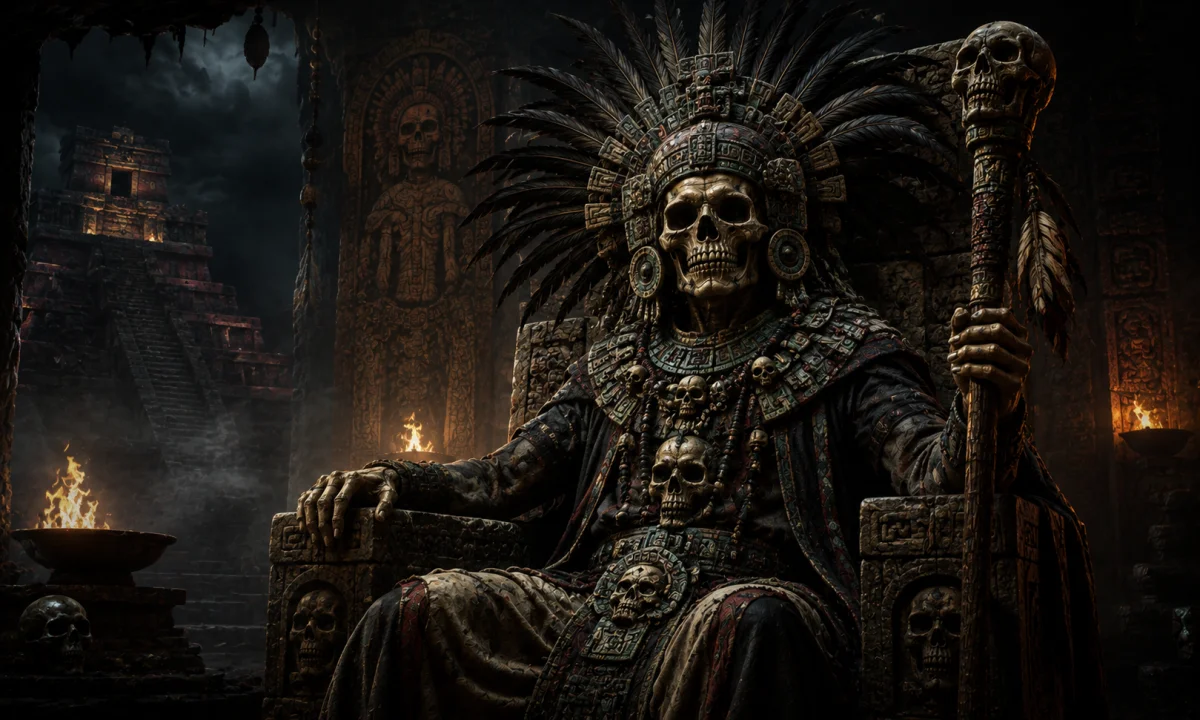
Mictlantecuhtli is the principal lord of Mictlan, the realm of the dead in Nahua and especially Mexica (Aztec) religious tradition. His name is commonly translated as “Lord of Mictlan,” although English renderings and spellings vary, including Mictlantecutli and Mictlan Tecutli. He was associated with death, the dead, darkness and the regions beneath the earth, but he was not simply an embodiment of evil. Mictlantecuhtli belonged to a religious system in which death was part of the continual movement of life, fertility, sacrifice and cosmic renewal.
Name and identity
The name Mictlantecuhtli comes from Classical Nahuatl. It combines Mictlan, the place or realm of the dead, with tecuhtli, a term meaning “lord,” “noble” or “ruler.” The name therefore identifies him primarily as the ruler of Mictlan rather than as a universal god of death in the abstract.
Nahuatl spelling was not standardized in the same way as modern written languages, and colonial authors recorded Indigenous names using different orthographies. For that reason, forms such as Mictlantecuhtli and Mictlantecutli are both encountered. The pronunciation of the name in ancient Nahuatl also cannot be recovered with complete certainty from modern English spellings.
Mictlantecuhtli is often described as a death god, but that label can obscure his traditional role. He governed the dead who entered Mictlan and was connected with the processes that followed death. He was not necessarily a malicious tempter or a devil-like opponent of the other gods. In many Nahua accounts, Mictlan was a difficult and dangerous destination, but it was also a normal part of the structure of the cosmos.
Mictlan and the fate of the dead
Mictlan was generally understood as the destination of people who died in ordinary ways, rather than through a death that assigned them to another sacred realm. Colonial-era Nahua accounts describe several possible destinations after death. People who died in circumstances associated with the rain god Tlaloc, such as drowning or certain illnesses, could go to Tlalocan. Warriors who died in battle and women who died in childbirth had distinctive posthumous destinies connected with the sun. The dead who did not belong to those categories were commonly associated with Mictlan.
Descriptions of Mictlan often divide it into a sequence of challenging regions or stages. In accounts recorded after the Spanish conquest, the dead may have to travel through nine levels or regions before reaching their final destination. These descriptions are not identical in every source, and scholars continue to debate how consistently the number nine was applied across different traditions.
The journey was not normally presented as a moral judgment in the Christian sense. A person did not reach Mictlan because of sin and escape it through moral purification. Instead, the destination depended largely on the manner of death and the person’s place within the cosmic order. The dead might face mountains that collide, freezing winds, dangerous animals and other obstacles. Some traditions also associate a dog with the journey across a body of water. This helps explain the importance of dogs in funerary beliefs and imagery, although the exact details vary among sources.
Colonial descriptions state that the journey to the deepest part of Mictlan took several years, often given as four. The dead therefore required ritual care after burial. Food, water, paper, clothing and other offerings could be provided for the deceased, and the sacrifice of a dog is mentioned in some accounts. These records were produced in a period of cultural change, so they should be treated as evidence for recorded Indigenous traditions rather than as perfectly preserved transcripts of pre-conquest belief.
Origins and surviving evidence
Knowledge of Mictlantecuhtli comes from several kinds of evidence. Spanish missionaries and Indigenous collaborators recorded Nahua religious ideas in works such as the Florentine Codex. Other information appears in pictorial manuscripts, colonial histories and descriptions of ceremonies. Archaeological discoveries, including skeletal sculptures and representations of death at major Mexica ritual sites, provide additional evidence, although identifying a particular image is not always certain.
These sources do not form a single, uniform scripture. Mexica religion was expressed through ritual, images, oral traditions, songs, calendrical practices and regional customs. The surviving written records were compiled after the conquest, frequently through conversations between Indigenous informants and European or mestizo chroniclers. They preserve valuable material, but they also reflect translation, selection and the religious assumptions of their recorders.
Mictlantecuhtli was part of a wider Mesoamerican concern with death and regeneration. Skeletal imagery could signify mortality, but it could also refer to the hidden forces beneath the earth from which plants and other forms of life emerged. Death deities were therefore not merely symbols of destruction. They could be associated with the soil, bones, reproduction and the transformation of one state of existence into another.
Appearance and symbols
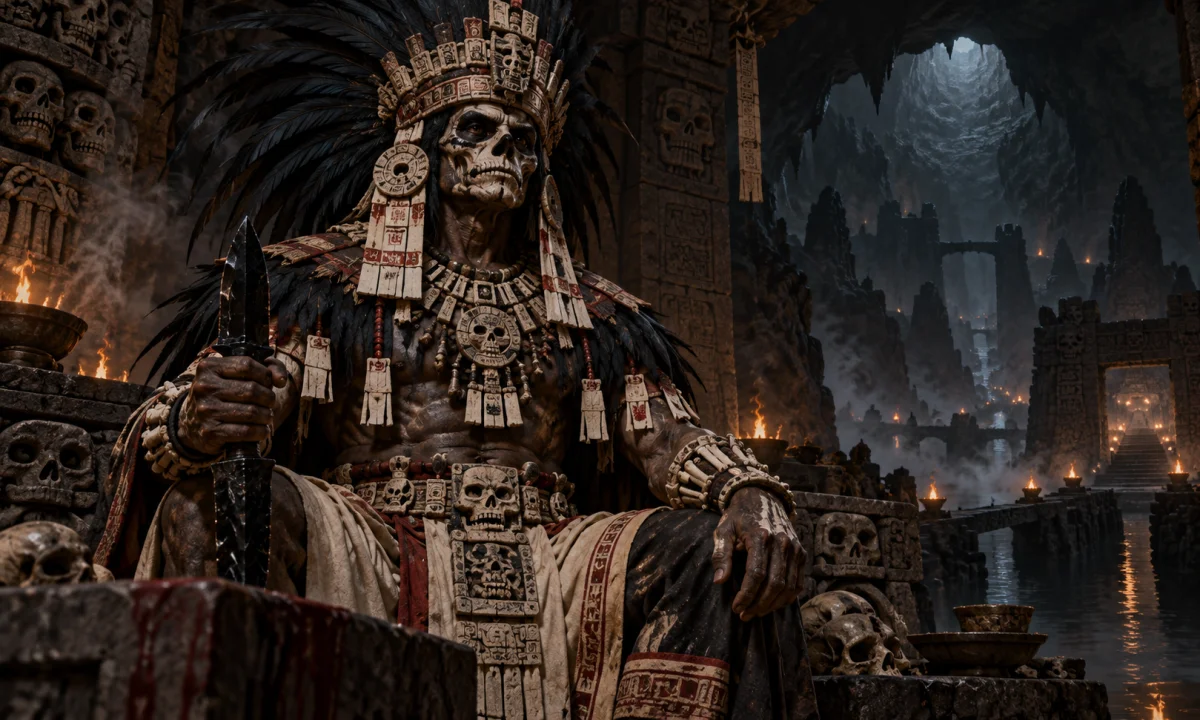
Mictlantecuhtli is commonly shown as a skeletal or corpse-like figure. His exposed bones, skull-like head, clawed hands and feet, and sometimes open abdomen or hanging organs emphasize physical decay. Some images depict him with blood, hair or remnants of flesh, combining the appearance of a dead body with the presence of an active supernatural ruler.
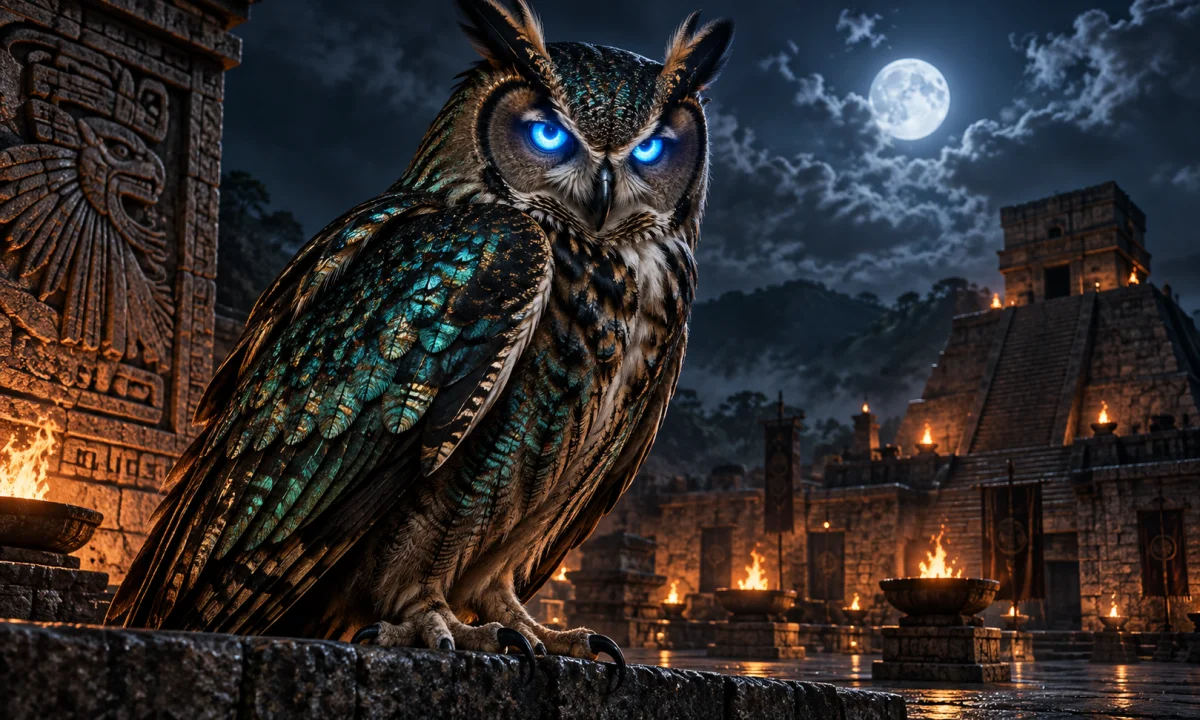
His imagery can include features associated with nocturnal and subterranean creatures, such as owls, bats, spiders and other animals linked with darkness or burial places. These associations are not equally prominent in every representation. The most secure and consistent feature is the skeletal body, which marks his relationship to the dead and to the realm beneath the surface of the earth.
Mexica artists used visual conventions rather than realistic portraiture. A skeletal body did not necessarily indicate that the figure was powerless or permanently dead. It could communicate authority over corpses, the transformative force of death, and the connection between bones and the renewal of life. Mictlantecuhtli’s terrible appearance was therefore religiously meaningful rather than simply intended to frighten.
He may also be associated with the dog sign Itzcuintli in calendrical contexts. Dogs were important in beliefs about the journey of the dead, though not every dog image or dog-related practice should automatically be identified with Mictlantecuhtli. Calendar associations could also vary according to the manuscript and ritual system being described.
Mictlantecuhtli and Mictecacihuatl
Mictlantecuhtli is frequently paired with Mictecacihuatl, the “Lady of Mictlan.” She is described as the female ruler or queen of the dead and is sometimes said to reside with him in Mictlan. Their pairing reflects the complementary male and female structures found throughout Nahua religion, where major cosmic functions could be expressed through paired deities.
The two figures should not automatically be treated as one deity with two names. Mictlantecuhtli and Mictecacihuatl are distinct figures in the traditions that name both of them, even though their offices overlap. Some modern explanations give Mictecacihuatl the title “Lady of the Dead” and Mictlantecuhtli the title “Lord of the Dead,” but the surviving evidence does not support a single universally fixed biography or hierarchy for them.
The creation of humanity and the bones of the dead
One of the most important stories involving Mictlantecuhtli concerns the creation of the people of the present age. In a creation account recorded in a colonial Nahua tradition, Quetzalcoatl travels to Mictlan to obtain the bones of people from an earlier age. These bones are needed to create new human beings after the destruction of a previous world.
Mictlantecuhtli initially agrees to let Quetzalcoatl take the bones, but he sets a difficult condition. Quetzalcoatl must sound a conch shell trumpet and complete a task associated with leaving Mictlan. The shell has no holes, so Quetzalcoatl uses worms to bore openings and bees to make it produce sound. The story presents him as clever, but it also shows that Mictlantecuhtli is not a passive guardian. He tries to prevent Quetzalcoatl from taking the bones, and the journey becomes a contest between the lord of the dead and the creator figure.
In the same tradition, Quetzalcoatl takes the bones but falls while escaping or while trying to leave Mictlan. The bones are broken, and this event explains why human beings are not all the same size. Quetzalcoatl ultimately brings the bones to the gods, who use them in the creation of humanity. The story connects death and the underworld directly with the origin of living people: humanity is made from the remains held by the lord of the dead.
Different versions of the story give varying details about the trumpet, the escape and the figures who accompany Quetzalcoatl. Xolotl is associated with Quetzalcoatl in some creation narratives, but the surviving traditions should not be forced into one fully consistent version. The central theme remains the same: the bones of the dead are a source of new life, and Mictlan is a necessary part of creation rather than a realm outside the cosmic order.
Ritual and religious significance
Mictlantecuhtli’s importance was connected with funerary customs, offerings and the treatment of ancestors. Mexica communities did not regard the dead as irrelevant after burial. The deceased could remain part of family and community memory, while ritual acts acknowledged the continuing connection between the living world and the world below.
Death was also linked to agricultural renewal. Seeds disappear into the earth before plants emerge, and bones remain beneath the ground after the body has decayed. This made the underworld a place of concealment and transformation as well as danger. Mictlantecuhtli’s skeletal form could therefore evoke both the finality of death and the hidden potential of regeneration.
The Mexica religious calendar gave death-related powers a place within cyclical time. Certain deities governed days, periods of the ritual calendar or specific supernatural offices. Mictlantecuhtli’s appearances in calendrical manuscripts show that he was not confined to funerary ceremonies. His authority could be invoked in relation to time, fate and the cosmic forces that affected ordinary life.
Distinctions from similar figures
Mictlantecuhtli should not be confused with Ah Puch, a death deity from Maya traditions. Ah Puch is a name found in colonial accounts concerning the Maya world, whereas Mictlantecuhtli belongs to Nahua religious traditions. Both can appear as skeletal or death-associated beings in modern illustrations, but they come from different cultures and religious systems.
He is also not the same as Hades from ancient Greek religion or Yama from South Asian traditions. Comparisons can be useful when discussing rulers of the dead, but the social, ritual and cosmological meanings of Mictlan are specifically Mesoamerican. Nor should Mictlantecuhtli be equated with Satan or with a Christian devil. His function is that of a lord of the dead within a complex pantheon, not an embodiment of absolute evil.
Modern popular culture sometimes confuses Mictlantecuhtli with Santa Muerte, the modern folk saint represented as a female skeleton. Santa Muerte emerged within a much later religious and cultural context and is distinct from the pre-conquest Nahua deity. The shared skeletal imagery reflects broader associations with mortality, but it does not establish an identity between the two figures.
Later reception and modern representation
Mictlantecuhtli is now widely represented in museums, educational material, novels, comics, films, games and fantasy artwork. Modern portrayals often turn him into a villain, a demon or a single personification of death. Such interpretations can be effective as fiction, but they simplify the traditional figure by removing him from the ritual and cosmological setting of Mictlan.
He is sometimes connected in popular discussions with the modern Day of the Dead. Día de los Muertos is a later festival shaped by Indigenous practices, Catholic observances and regional Mexican traditions. Mictlantecuhtli is relevant to conversations about pre-Hispanic ideas of death, but he is not universally worshipped as the central deity of the modern festival. Contemporary celebrations differ greatly by community, and their imagery should not be treated as a direct survival of a single ancient ceremony.
For the Mexica, Mictlantecuhtli represented the authority of the dead and the perilous realm beneath the living world. His stories also express a more complex idea: the dead are not merely absent, and the underworld is not simply an evil place. Bones, burial, darkness and decay belong to the same cosmic process that produces new human life. That relationship between mortality and renewal remains the most important key to understanding his place in Aztec mythology.