WORLD
WORLD
Coyolxauhqui
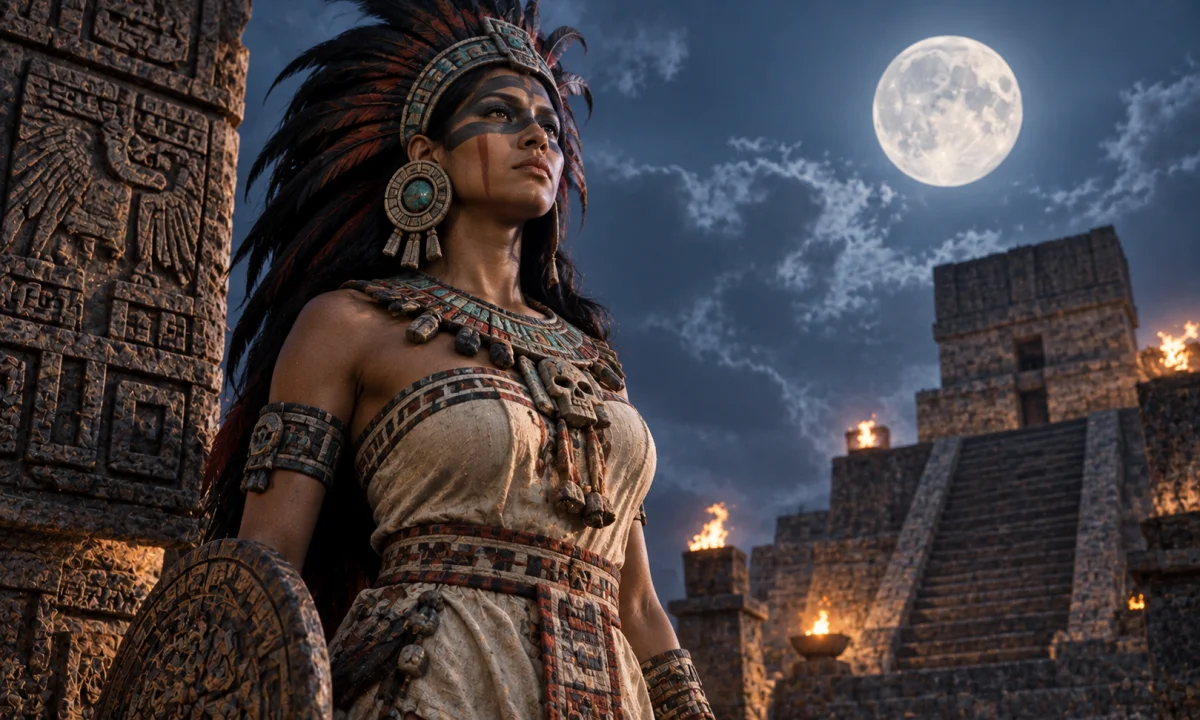
Coyolxauhqui is a major figure in Mexica, or Aztec, mythology, best known as the leader of the Centzon Huitznahua and the enemy of the newborn god Huitzilopochtli. In the central myth associated with her, she leads an attack against her mother, Coatlicue, and is defeated, dismembered and thrown from the mountain of Coatepec. The story was closely connected with Mexica ideas about warfare, sacrifice, celestial order and the power of Huitzilopochtli, the patron god of Mexico-Tenochtitlan.
Coyolxauhqui is also famous because of a large stone disk found near the Templo Mayor in present-day Mexico City. Its carved image of a dismembered female figure became one of the most important discoveries in the archaeology of ancient Mexico. Although she is often called an Aztec moon goddess, that description requires qualification. Her association with the moon is influential, but the surviving evidence does not establish a simple or universally accepted identification between Coyolxauhqui and the moon.
Name and identity
The name Coyolxauhqui is written in several forms because colonial-era transcriptions of Nahuatl did not use a single standardized spelling. The name is commonly interpreted in relation to coyolli, a bell or rattle, and a word associated with adornment, coloring or painting. It is therefore often translated as “She Who Is Adorned with Bells” or “She Who Is Painted with Bells.” The exact grammatical analysis and preferred translation vary among specialists.
The bells are an important part of her visual identity. In Mexica art, Coyolxauhqui is frequently shown with bell-like ornaments on her cheeks. Her name should not be confused with the names of unrelated deities or legendary figures from other Mesoamerican traditions. She belongs specifically to the Mexica religious world, although the myth and imagery formed part of a broader Mesoamerican tradition in which mountains, celestial bodies, warfare and ritual death could be represented through powerful visual symbols.
Coyolxauhqui is sometimes classified as a goddess, but the surviving myths present her in several overlapping ways: she is a divine woman, the daughter of Coatlicue, the sister and antagonist of Huitzilopochtli, and the leader of a group of celestial or supernatural warriors. Her role is more specific than that of a general goddess of the moon, war or fertility.
The Mexica religious setting
The Mexica built a state religion around a large group of gods, sacred places and ritual practices. Their capital, Mexico-Tenochtitlan, stood on an island in Lake Texcoco and was dominated by the Templo Mayor, a monumental stepped temple with twin shrines. One shrine was dedicated to Huitzilopochtli, while the other was dedicated to Tlaloc, the god associated with rain and agricultural fertility.
Huitzilopochtli was central to Mexica identity. He was associated with the sun, warfare, rulership and the Mexica migration from their ancestral homeland. His cult emphasized victory, military expansion and the continual maintenance of cosmic power. Coyolxauhqui’s story provided a mythic account of his birth and his victory over enemies who threatened his mother and, symbolically, the proper order of the world.
The surviving accounts were recorded after the Spanish conquest by Indigenous informants, missionaries and colonial writers. Important versions appear in works connected with Bernardino de Sahagún and in other early colonial histories. These records preserve Indigenous traditions, but they are not direct transcripts of pre-Hispanic performances. They were collected in a period of religious upheaval and were shaped by translation, editorial choices and the interests of their authors. Details can therefore differ between versions.
The story of Coatepec
The best-known narrative begins with Coatlicue, a powerful mother figure whose name means “She of the Serpent Skirt.” While she is sweeping on the sacred mountain of Coatepec, a ball of hummingbird feathers or down descends and enters her body. She becomes pregnant with Huitzilopochtli.
Coatlicue’s existing children are distressed and angered by the pregnancy. In many versions, Coyolxauhqui urges her brothers to kill their mother because they regard the pregnancy as shameful or dishonorable. The brothers are known collectively as the Centzon Huitznahua, usually translated as the Four Hundred Southerners or Four Hundred Stars. The number four hundred expresses a vast multitude rather than a precise census.
Coyolxauhqui leads the armed group toward Coatepec. The unborn Huitzilopochtli warns Coatlicue that he will protect her. He is then born fully armed, carrying a shield and the fiery serpent weapon called the Xiuhcoatl. In the most widely known version, he decapitates Coyolxauhqui and cuts her body into pieces. He then casts her remains down the mountain. Huitzilopochtli pursues the Centzon Huitznahua and defeats many of them, while some escape.
The episode is a mythic victory of Huitzilopochtli over a hostile coalition, but it also has a strong celestial dimension. Coyolxauhqui and the Centzon Huitznahua are frequently interpreted as representing the moon and the stars, while Huitzilopochtli represents the sun overcoming them. That reading is compelling within the structure of the story, yet the sources do not present the symbolism in a single, fully consistent explanation. The identity of Coyolxauhqui as the moon is therefore best described as an interpretation rather than an uncontested fact.
The Coyolxauhqui Stone
In 1978, electrical workers discovered a large carved stone near the Templo Mayor in Mexico City. The find led to renewed excavations of the temple precinct and transformed knowledge of the ancient capital. The monument, now commonly called the Coyolxauhqui Stone, is a monumental circular relief showing a dismembered female figure.
The figure lies in a contorted position, with the head separated from the body and the arms and legs arranged as if they have been cut apart. She wears elaborate ornaments, including bell-like cheek decorations, a headdress and other items associated with high-status Mexica imagery. The carving does not simply portray a corpse. It presents a carefully constructed sacred image in which bodily dismemberment, movement and costume communicate identity and mythic power.
The stone was placed at the base of the stairway leading toward the shrine of Huitzilopochtli. Its position was significant. Anyone approaching the shrine would encounter the image of the defeated Coyolxauhqui below the ascent to the god’s temple. The arrangement could be understood as a monumental representation of Huitzilopochtli’s victory on Coatepec: the viewer moved upward toward the victorious god while the dismembered enemy remained below.
The monument may also have participated in ritual actions involving warfare and sacrifice. Mexica ceremonies often connected mythic events with performances carried out in temples, processions and offerings. The exact ritual use of the stone is not known, and it should not be assumed that every detail of the myth was reenacted in a literal manner. Its placement nevertheless shows that Coyolxauhqui’s defeat was an important part of the religious and political message of the Templo Mayor.
Appearance and symbolism
Coyolxauhqui’s imagery focuses on a body broken apart but still richly adorned. Her ornaments identify her as a powerful divine figure rather than an ordinary victim. The bells on her cheeks refer to her name, while her headdress and bodily decoration place her within the visual language of Mexica sacred art.
The dismembered form has several possible meanings. It represents the mythic destruction of Huitzilopochtli’s enemy, but it can also evoke the fragmentation of defeated forces and the transformation of a dangerous power into a controlled one. The body’s placement on a circular monument may further encourage associations with celestial movement, although the stone is not a simple diagram of the moon.
Mexica religious images often combine several levels of meaning at once. A figure can be a character in a myth, a representation of a celestial force, an emblem of political authority and an object used in ritual. Coyolxauhqui’s image should therefore not be reduced to one modern label such as “moon goddess.” Her most secure identities are those established by the myth and the monument: daughter of Coatlicue, leader of the Centzon Huitznahua, opponent of Huitzilopochtli and the dismembered figure represented at the base of his temple.
Coyolxauhqui and the moon
Modern descriptions often state that Coyolxauhqui was the moon. This association comes from the contrast between her defeat and the rising power of Huitzilopochtli, as well as from the story’s relationship to stars and celestial cycles. The Centzon Huitznahua are commonly linked with the stars of the southern sky, and the combat at Coatepec can be read as a symbolic account of the sun overcoming the night.
However, Mexica concepts of the moon were not necessarily organized around one single goddess in the way some modern summaries suggest. The Nahuatl word Metztli means moon, and colonial sources contain different statements about lunar beings and identities. The evidence does not provide a universally accepted ancient statement that Coyolxauhqui was exclusively or straightforwardly the moon. Some scholars emphasize a lunar interpretation; others stress her role as a defeated warrior and the leader of a celestial group without equating her completely with one heavenly body.
The moon association is therefore useful when presented carefully. It reflects an important scholarly and popular interpretation of the Coatepec narrative, but it should not erase the ambiguity of the sources or the broader symbolism of the figure.
Relationship with Coatlicue and Huitzilopochtli
Coyolxauhqui’s family relationships are essential to her significance. As the daughter of Coatlicue, she belongs to a powerful divine family connected with earth, fertility, serpents, death and creation. Coatlicue is not merely a passive mother in the narrative: her pregnancy becomes the immediate cause of the conflict, and her protection by Huitzilopochtli places the maternal body at the center of the cosmic struggle.
Her relationship with Huitzilopochtli is defined by opposition. They are siblings, but their conflict is also a contest between competing forms of order. Coyolxauhqui leads a force that attempts to kill the pregnant Coatlicue, while Huitzilopochtli emerges as an armed defender. His victory confirms his supernatural authority and provides a mythic foundation for the military ideology of the Mexica state.
The story does not portray Coyolxauhqui as an insignificant antagonist. She is the leader of the attack, and the monumental treatment of her body gives her defeat lasting power. The enemy must be represented in order for the victor’s triumph to be understood. Her presence at the temple therefore expresses both subordination to Huitzilopochtli and the extraordinary danger of the force he overcame.
Distinguishing Coyolxauhqui from related figures
Coyolxauhqui should not be confused with Coatlicue. Coatlicue is her mother, the serpent-skirted divine figure whose unexpected pregnancy begins the conflict. Coyolxauhqui is the daughter who leads the attack against her. Their imagery can appear together in discussions of Mexica motherhood, death and creation, but they are distinct figures.
She is also not the same as Huitzilopochtli, even though both are associated with celestial interpretations and warfare. Huitzilopochtli is the newborn victor of the Coatepec story and the patron god of the Mexica capital. Coyolxauhqui is his defeated sister and opponent.
Nor should she automatically be equated with every Mesoamerican moon goddess. Maya, Zapotec, Mixtec and other cultures had their own lunar beings and traditions, which cannot be merged with the Mexica story. Similar themes—such as the moon, stars, mountains and divine conflict—do not prove that the figures are identical.
Legacy and modern interpretation
The discovery of the Coyolxauhqui Stone made her one of the most recognizable figures from ancient Mexico. Museums, archaeological exhibitions, school materials and public discussions frequently use the monument to explain the Templo Mayor and the religious ideology of Mexico-Tenochtitlan. The image has also become important in modern conversations about Indigenous history, gender, bodily violence and the recovery of Mexica heritage.
Modern interpretations sometimes recast Coyolxauhqui as a symbol of female independence, resistance or the recovery of a fragmented identity. Such readings can be meaningful in contemporary art and cultural politics, but they are modern uses of the figure rather than direct descriptions of her pre-Hispanic religious role. In the surviving Mexica tradition, she is principally a powerful divine warrior and leader who is defeated by Huitzilopochtli in the foundational conflict at Coatepec.
Her enduring importance comes from the unusual combination of myth, monument and political symbolism. Coyolxauhqui is at once a daughter, a warrior, a celestial figure in interpretation, a defeated enemy and the subject of one of the most striking sculptures from the Mexica world.