WORLD
WORLD
Patecatl
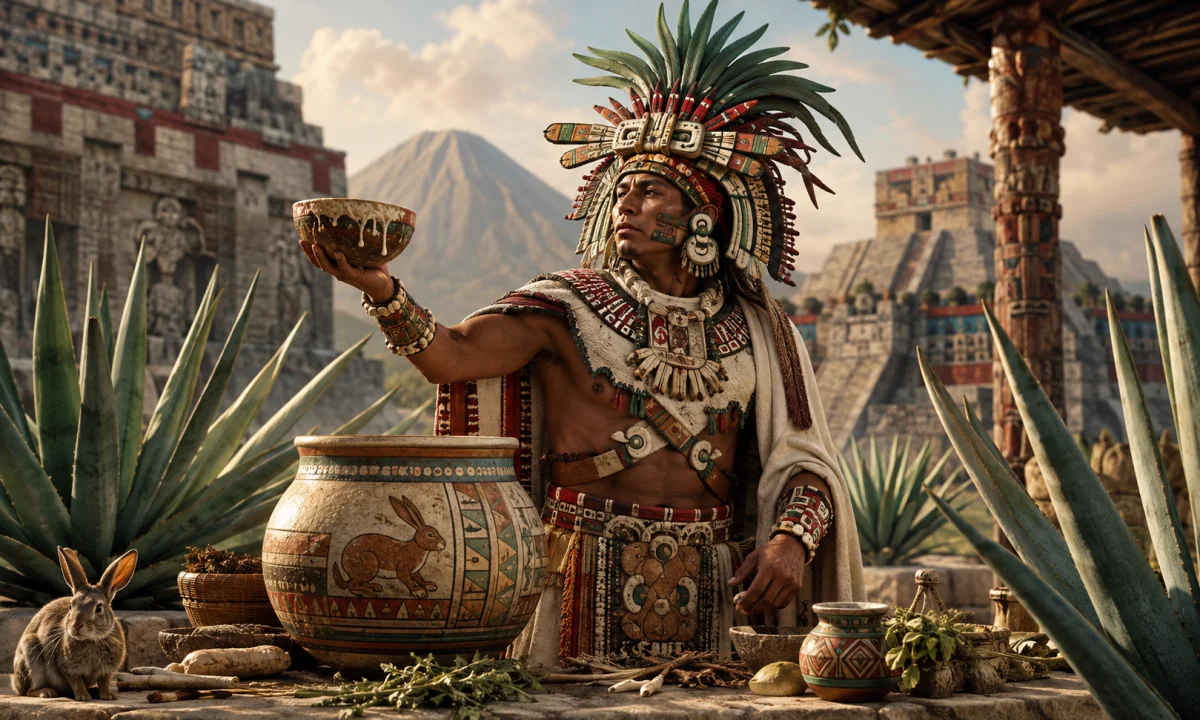
Patecatl is a deity of ancient Nahua religion, commonly described as a god associated with medicine, healing substances, and the preparation of pulque. He belongs to the wider group of supernatural beings connected with octli, the fermented drink made from the sap of the maguey or agave plant. In accounts of central Mexican religion, Patecatl is especially important as the husband of Mayahuel and the father, or collective progenitor, of the Centzon Totochtin, the “Four Hundred Rabbits” who personified the many forms and effects of pulque intoxication.
The name and identity of Patecatl are not entirely uniform across surviving sources. Spanish colonial writers recorded Nahuatl religious traditions from different communities and at different times, while pictorial manuscripts use visual signs rather than explanatory prose. As a result, descriptions of Patecatl can vary. He is often called a god of medicine or medicinal herbs, but his role is closely interwoven with fermentation, altered states, fertility, and the sacred importance of maguey. He should not be understood simply as an Aztec equivalent of a modern physician or as a god of alcoholic drink in the narrow modern sense.
Cultural setting
Patecatl belonged to the religious world of the Nahua peoples of central Mexico, including the Mexica, often called the Aztecs. Their religious traditions were expressed through temple ceremonies, household practices, calendrical observances, oral narratives, painted manuscripts, songs, and the specialized knowledge of ritual experts. The surviving evidence comes mainly from the period of Spanish colonial rule, especially from Indigenous informants and bilingual or Spanish-speaking authors who recorded older traditions after the conquest.
These sources do not present a single, systematic pantheon. A deity could have several related functions, different local names, or varying importance in different communities. The word “Aztec mythology” is therefore useful as a broad modern label, but it can conceal the diversity of Nahua religious traditions. Patecatl’s associations are clearest in material concerning maguey, pulque, medicinal knowledge, and the group of pulque deities.
Maguey was a valuable and versatile plant. Its fibres could be made into cord, cloth, and paper-like materials; its leaves and spines had practical uses; and its sap could be fermented into pulque. The plant was therefore economically important as well as religiously meaningful. The production and consumption of pulque were governed by social and ritual rules, and the drink could be associated with fertility, celebration, healing, divine possession, and dangerous loss of control.
The meaning of Patecatl’s name
The Nahuatl name is usually written Patecatl or Patécatl, with spelling varying according to the conventions of modern editors and colonial manuscripts. Its interpretation is also not completely settled. Many descriptions connect the name with patli, a Nahuatl word associated with medicine, medicinal substances, or remedies. On this basis, Patecatl is frequently interpreted as “he of medicine,” “he associated with medicine,” or a similar expression.
Other analyses have treated the name as referring to a person or being connected with a place, substance, or specialized form of knowledge. The exact grammar and etymology are debated, and a confident single translation can give a false impression of certainty. The traditional association between Patecatl and healing substances is more secure than any one English rendering of his name.
The name should also be kept distinct from the names of other Nahua gods. Patecatl is sometimes reduced in modern summaries to “the god of pulque,” but this description leaves out his medical and botanical associations. Conversely, calling him only a god of medicine overlooks his place within the sacred mythology of agave fermentation.
Patecatl and the invention of pulque
In Nahua tradition, Patecatl is linked with the discovery or improvement of the process by which maguey sap becomes pulque. The precise form of the story differs in surviving accounts, but the general pattern connects Patecatl with the knowledge of roots, plants, or other substances that make fermentation possible. He is therefore not merely a drinker or guardian of pulque; he represents the technical and medicinal knowledge through which the drink acquires its distinctive power.
Pulque was made from the sweet sap of the maguey, known in Nahuatl as aguamiel in later Spanish usage. Once collected, the sap fermented naturally, although the process could be encouraged or controlled with suitable materials. The traditional narratives that associate Patecatl with medicinal roots reflect an understanding that fermentation involved skilled preparation rather than occurring as a purely accidental transformation.
Colonial descriptions sometimes explain Patecatl’s role through a story in which he discovers the appropriate substance for producing pulque or teaches others how to use it. Such accounts should not be treated as laboratory records or as a single canonical myth. They preserve a religious interpretation of brewing knowledge: the transformation of plant sap into an intoxicating drink was a gift or discovery belonging to the divine world.
The connection between medicine and intoxication may seem contradictory from a modern perspective, but Nahua categories did not necessarily separate them in the same way. Plants could heal, harm, alter consciousness, or participate in ritual depending on their preparation and use. Patecatl’s identity reflects this broader understanding of powerful natural substances.
Relationship with Mayahuel
Patecatl is traditionally associated with Mayahuel, a goddess of maguey and pulque. In many accounts, Mayahuel is described as his wife or consort. Their relationship joins two complementary aspects of the drink’s sacred origin: Mayahuel embodies the maguey plant and its nourishing sap, while Patecatl represents medicinal knowledge, fermentation, or the substances that transform the sap into pulque.
Mayahuel has her own important mythology. A well-known narrative tells how she escaped with Quetzalcoatl from a celestial or guarded place and came to the earth, where she became connected with the maguey. In versions of the story, a hostile relative or supernatural pursuer kills her, after which Quetzalcoatl and other forces preserve or transform what remains of her into the maguey plant. Patecatl is not always central to this particular narrative, and he should not be inserted into every story about Mayahuel.
The marriage of Patecatl and Mayahuel is especially significant in traditions concerning pulque and the pulque deities. It presents the drink as the product of cooperation between plant fertility and specialized knowledge. Their relationship also helps explain why Patecatl may be treated as a secondary or companion deity in some contexts while still having a distinct identity and function.
The Centzon Totochtin
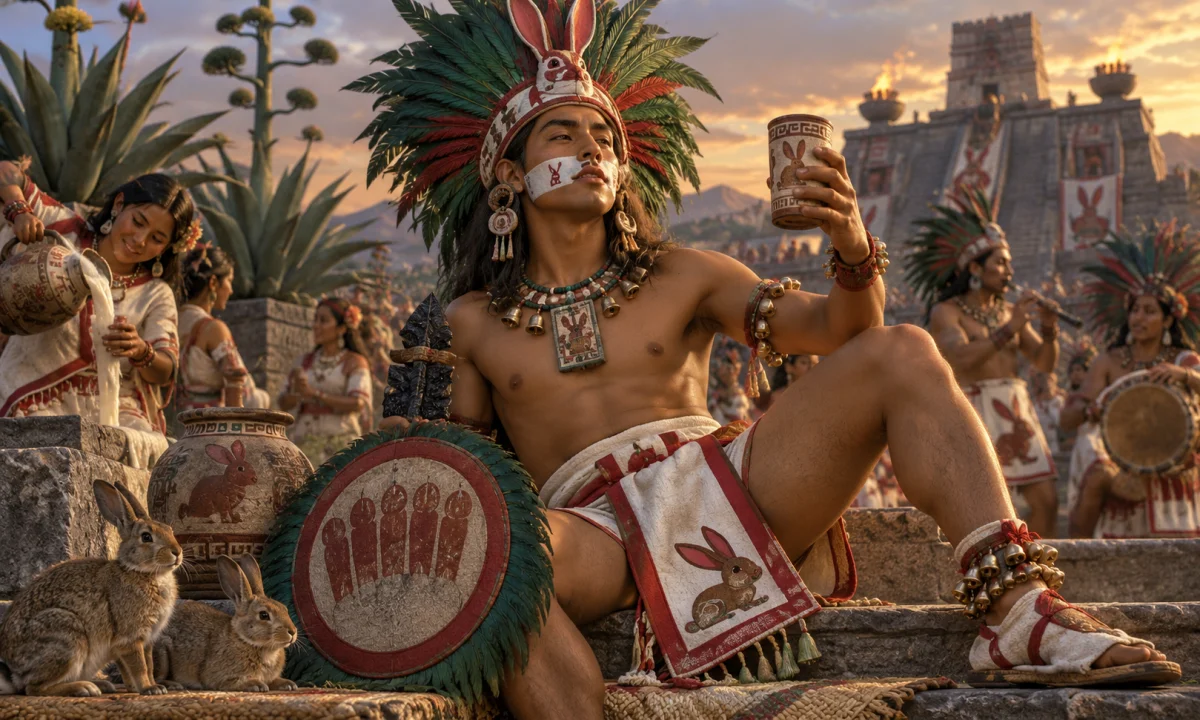
The Centzon Totochtin, usually translated as the “Four Hundred Rabbits,” were a collective group of pulque gods or spirits. The number four hundred was a conventional expression of abundance or an innumerable multitude rather than a literal census. Each rabbit could represent a different form of intoxication, a different social consequence of drinking, or a distinct manifestation of pulque’s unpredictable power.
Patecatl and Mayahuel are commonly presented as the parents of the Centzon Totochtin. This relationship makes Patecatl a generative figure within the mythology of intoxication. The many rabbit beings were not simply comic characters representing drunkenness. They formed a divine explanation for why pulque could affect people in dramatically different ways: one person might become joyful, another aggressive, another amorous, another disorderly, and another overwhelmed by visions or physical weakness.
Rabbits were suitable symbols for this group for several reasons. They were prolific animals and therefore fit the idea of countless offspring. They were also associated in Nahua thought with fertility, abundance, and the unpredictable growth of the natural world. The rabbit image may additionally have been connected with the effects of pulque or with calendrical and lunar symbolism, although individual explanations should not be treated as universally established.
In some traditions, the pulque gods include named figures with particular attributes, while in others they appear mainly as a collective. Patecatl is one of the more clearly identified members of the wider pulque complex, but the boundaries between individual pulque deities and their group are not always consistent in the sources.
Medicine, plants, and healing
Patecatl’s association with medicine is one of the most important features distinguishing him from a deity concerned only with drunkenness. Nahua medical practice included knowledge of plants, minerals, animal products, physical treatments, ritual actions, and methods for diagnosing illness. Healing was not divided into a strictly “natural” sphere and a strictly “religious” sphere in the modern manner. A remedy could have practical effects while also requiring proper ritual handling or knowledge of its spiritual dangers.
Calling Patecatl a god of medicine does not mean that every healer worshipped him in the same way, or that he controlled all forms of illness. Nor does it establish that every plant used in Nahua medicine belonged specifically to him. His title and traditional associations indicate a connection with medicinal substances and the knowledge required to prepare them, particularly in relation to the plants and processes associated with pulque.
Some modern accounts connect Patecatl with peyote or with hallucinogenic plants in general. These claims should be treated cautiously. Nahua peoples possessed extensive knowledge of psychoactive and medicinal plants, but the surviving evidence does not justify assigning every such substance to Patecatl. A general association with powerful plants is not proof that he was specifically the patron of a particular species or that later descriptions of “drug use” accurately represent his ancient role.
Ritual importance of pulque
Pulque had social and sacred significance beyond ordinary refreshment. It could be offered to deities, consumed during ceremonies, and associated with fertility, agricultural abundance, and the flow of life-giving substances. Its use was regulated, and accounts from the colonial period describe restrictions concerning who could drink, when drinking was permitted, and how intoxication was judged.
These restrictions reveal an important tension in Patecatl’s religious context. Pulque could be sacred and beneficial, yet excessive or improper consumption could lead to disorder and punishment. The Centzon Totochtin provided a mythic language for this ambiguity. The drink was powerful because it came from the divine world, but divine power could not be handled carelessly.
It is misleading to describe Nahua religion as simply celebrating alcohol. Pulque was not identical to modern commercial alcohol, and its ritual value cannot be separated from the agricultural, medicinal, and social world of maguey cultivation. Patecatl’s role belongs to that complete system of meanings rather than to a modern category such as “party god” or “god of addiction.”
Sources and uncertainty
Knowledge of Patecatl comes from a combination of colonial-era written records and Indigenous pictorial traditions. Some accounts were produced by Christian missionaries who recorded Nahua testimony, translated Indigenous terms, and interpreted unfamiliar beliefs through European categories. Other records preserve names, ritual scenes, or deity groupings without explaining every visual sign. These materials are invaluable but incomplete.
There is no surviving pre-conquest theological treatise that defines Patecatl’s identity in a single authoritative form. Differences between accounts may reflect regional traditions, changes over time, the purposes of the recorders, or the difficulty of translating Nahuatl concepts into Spanish and then into modern English. Assertions about his precise rank, appearance, temples, or individual ceremonies should therefore be made with care.
Patecatl’s visual representation is also less securely standardized in popular descriptions than that of more frequently depicted figures such as Huitzilopochtli, Tlaloc, or Quetzalcoatl. Images in manuscripts may identify deities through combinations of costume, colour, body markings, objects, and context. A single illustration should not automatically be treated as a universal portrait of Patecatl.
Distinguishing Patecatl from related figures
- Mayahuel: Mayahuel is the maguey and pulque goddess associated with the plant itself, while Patecatl is more closely linked with medicine, preparation, and fermentation. They are often presented as consorts, but they are not interchangeable names for one deity.
- The Centzon Totochtin: These are the collective “Four Hundred Rabbits,” the many pulque deities associated with the effects of intoxication. Patecatl is commonly described as their father, not as another name for the entire group.
- Quetzalcoatl: Quetzalcoatl appears in important stories involving Mayahuel and the origin of maguey, but his presence in those narratives does not make him identical with Patecatl or establish him as the sole creator of pulque.
- Tlaloc: Tlaloc governs rain, storms, water, and agricultural fertility. Because maguey and pulque were connected with nourishment and fertility, their traditions can overlap thematically, but Tlaloc is not a pulque deity under another name.
- Modern “god of drugs” descriptions: These expressions often combine several ancient associations—medicine, intoxicating drinks, and powerful plants—into a simplified category that does not accurately represent the surviving evidence.
Interpretation and cultural significance
Patecatl is best understood as a figure at the meeting point of plant knowledge, healing, fermentation, and controlled intoxication. His mythology expresses the idea that natural substances possess more than one kind of power. A plant may nourish the body, provide medicine, alter perception, support ritual, and create social danger, depending on how it is gathered and prepared.
His relationship with Mayahuel and the Centzon Totochtin places him within a family structure that explains the complete life of pulque: the maguey provides the sap, Patecatl contributes the knowledge of transformation, and the rabbit deities embody the drink’s many effects. This is not a modern scientific account of fermentation, but it is a culturally meaningful explanation of how a familiar agricultural product becomes a force capable of changing human behaviour.
Patecatl also illustrates why ancient deities should not be assigned rigid modern categories. “Medicine,” “alcohol,” “fertility,” and “intoxication” were not isolated departments of experience. Religious traditions could connect them through the shared power of plants, bodily states, and ritual knowledge. His importance lies less in a long sequence of individual myths than in the network of relationships that gives pulque and medicinal substances their sacred meaning.
Patecatl in modern culture
Patecatl occasionally appears in modern books, websites, games, and fictional treatments of Mesoamerican mythology. These portrayals often emphasize one easily recognizable aspect, such as medicine, alcohol, herbal knowledge, or psychoactive plants. Such adaptations may use his name creatively, but they should not be confused with the surviving Nahua traditions.
Modern popular culture also tends to present Mesoamerican deities as members of a fixed pantheon with standardized powers and visual designs. Patecatl’s historical identity is more specific and more nuanced. He belongs to traditions in which maguey, pulque, healing substances, and the many consequences of intoxication were connected, while the details of his name, imagery, and stories varied across sources.