WORLD
WORLD
Pulque
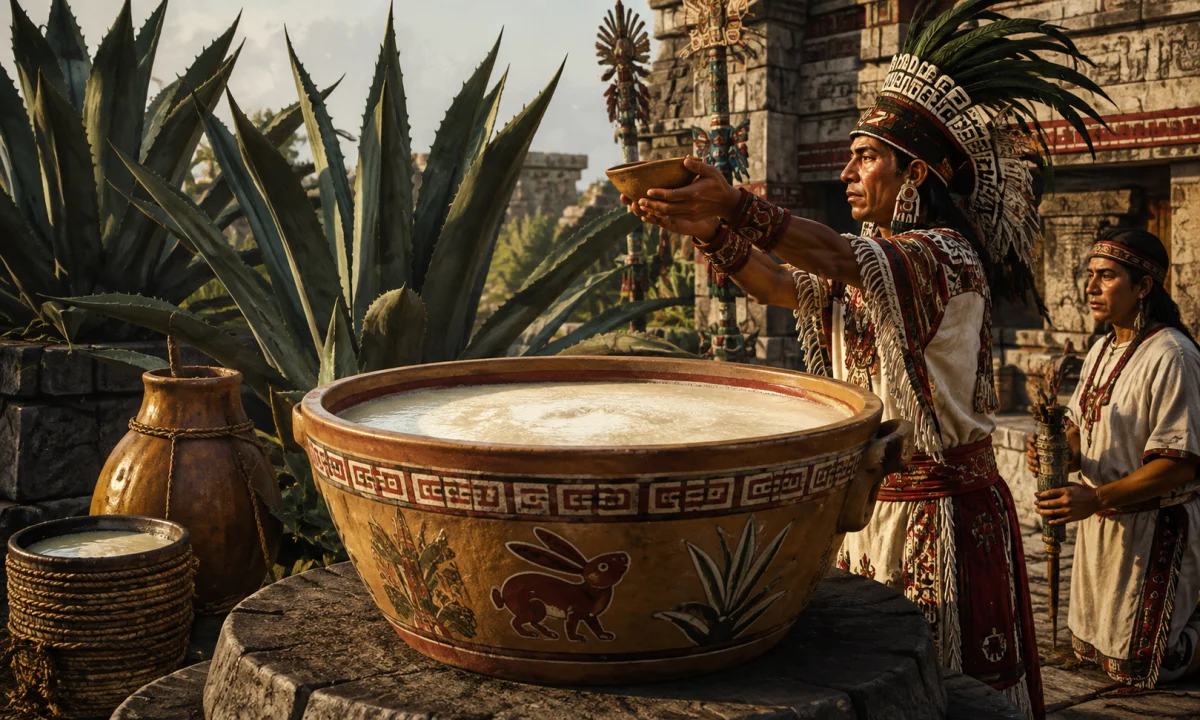
Pulque is a fermented alcoholic drink made from the sweet sap of the maguey, or agave, plant. In the religious traditions of central Mexico, especially those associated with the Mexica—often called the Aztecs—pulque was more than a beverage. It belonged to a sacred complex involving fertility, rain, vegetation, intoxication, birth, death and ritual transformation. Several deities and mythic groups were connected with it, most famously Mayahuel, the maguey goddess, and the Centzon Totochtin, the “Four Hundred Rabbits” associated with drunkenness and the many effects of pulque.
Pulque itself is not a god or a single mythological being. It is a culturally important substance whose meanings were expressed through myths, ceremonies, priestly practices and images. The surviving evidence comes largely from early colonial records written or compiled after the Spanish conquest, along with Indigenous pictorial manuscripts, archaeological remains and later Nahua traditions. These sources do not always agree, and the religious significance of pulque could vary according to the occasion, the person drinking it and the deity being honoured.
The drink and the maguey plant
Pulque is produced from the fermented sap of an agave, especially plants traditionally identified with Agave salmiana and related species. In Nahuatl, the plant was commonly known as metl. When an agave approaches maturity, its central flowering stalk can be removed, allowing sweet sap to collect in a hollow made at the plant’s heart. This sap, called aguamiel in later Spanish usage, ferments into a cloudy, mildly alcoholic drink.
The process connects pulque directly to the life cycle of the agave. The plant grows for years before flowering and then dies after producing its flowering stalk. Its sap, fibres, leaves and spines were all useful. Maguey supplied material for ropes, sandals, clothing, paper-like surfaces and roofing, while its sap could serve as food or drink. This practical importance helps explain why the plant acquired religious associations with nourishment, fertility and renewal.
The Nahuatl word octli is often translated as “pulque,” although the two terms are not perfectly identical in every context. Colonial writers also recorded expressions referring to fresh, fermented or spoiled drink. Poliuhqui, for example, could refer to pulque that had gone bad or become excessively sour, and the word was later used in names connected with deities or sacred places. Spanish speakers eventually popularised the word pulque, whose precise etymology is debated.
Pulque in Mexica and wider Mesoamerican society
Although pulque is strongly associated with the Mexica imperial world, its history is much older than the formation of the Mexica state. Agave cultivation and fermented agave beverages were known in several parts of Mesoamerica. Archaeological evidence indicates that agave processing and fermentation had deep regional histories, while colonial-era Indigenous communities preserved their own practices and explanations.
In the Mexica capital of Tenochtitlan and other central Mexican communities, pulque could be consumed in domestic, ceremonial and political settings. It was used in offerings and was associated with particular festivals. Some traditions connect it with rulers, warriors, priests, healers, the elderly and people undergoing important life transitions. The drink was not simply treated as an ordinary intoxicant separated from religion. Its capacity to alter perception made it suitable for encounters with the sacred, but that same capacity made its use subject to rules and social judgement.
Descriptions of Mexica drinking restrictions come mainly from colonial sources, particularly accounts influenced by Christian moral concerns. These records should therefore be read carefully. They describe prohibitions against drunkenness and punishments for certain forms of public intoxication, but they may simplify or moralise Indigenous practices. The evidence suggests that alcohol use was regulated rather than universally forbidden. Age, social position, ritual circumstances and the condition of the drinker all mattered.
Pulque could be offered to gods, used in rites of passage and consumed during festivals. Some traditions describe it as a drink for the aged or for those permitted to use it on special occasions, while other accounts mention ritual drinking by groups whose duties involved warfare, sacrifice or religious service. The regulations were not necessarily consistent across every community or period.
Mayahuel and the sacred maguey
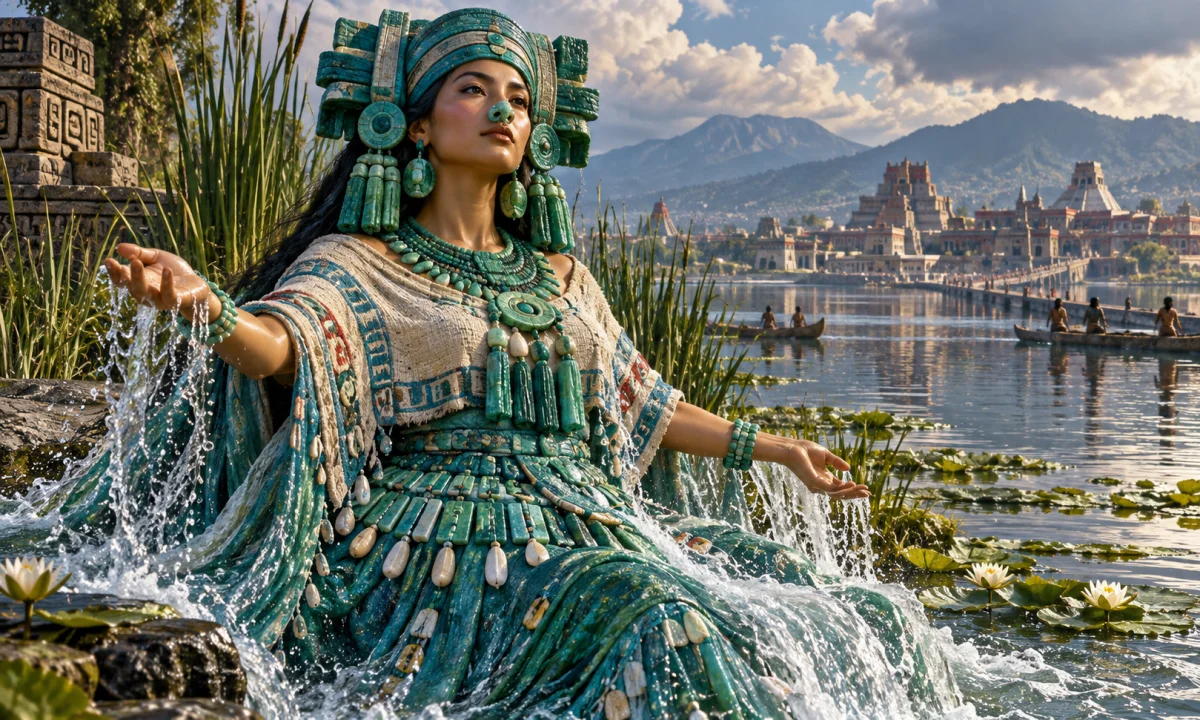
Mayahuel is the figure most directly associated with the maguey plant and its nourishing sap. She is often described as a young woman or goddess, sometimes with multiple breasts, an image that emphasises abundance and her ability to nourish humanity. In artistic representations she may be shown with maguey leaves, a distinctive headdress or other signs of vegetation and fertility.
One widely known story presents Mayahuel as living under the control of an older female relative, frequently identified in modern retellings as her grandmother. The god Quetzalcoatl discovers or visits her, and the two descend to the human world. In some versions they transform themselves into a flowering or branching tree so that they can remain together. The older relative discovers them, destroys the transformed Mayahuel, and Quetzalcoatl later gathers her remains. From these remains, or from the place associated with her death, the maguey grows.
This story is preserved in forms that differ in detail, and not every version gives the same names or relationships. Some popular retellings present it as a straightforward romance between Quetzalcoatl and Mayahuel, but the surviving traditions are more varied than that simplified narrative suggests. The story’s central significance is the connection between danger, death, vegetal renewal and the gift of a valuable substance to human beings.
Mayahuel’s importance is not limited to alcohol. As a personification or sacred identity of the maguey, she represents the plant’s many benefits. The agave provides food, fibres, medicine and materials as well as sap. Her association with pulque therefore belongs to a wider understanding of the maguey as a life-supporting plant rather than to a narrow concept of a “wine goddess.” The comparison with European wine deities can be convenient, but it can also obscure the specific agricultural and material context of Mayahuel.
The Centzon Totochtin, or Four Hundred Rabbits
The Centzon Totochtin are a group of supernatural beings whose name means “Four Hundred Rabbits.” They are associated with pulque, drunkenness and the varied behaviours produced by intoxication. The number four hundred in Mesoamerican Nahuatl usage can indicate an innumerable or very large multitude rather than a literal count. Their name therefore conveys the idea of countless rabbits or countless forms of drunkenness.
Each rabbit could represent a different kind of intoxication or a distinct disposition revealed under the influence of pulque. Some were linked with particular places, occupations, moods or social roles. The group allowed Nahua religious thought to express an important observation: intoxication does not affect every person in the same way. One drinker may become cheerful, another aggressive, another sensual, another solemn or another disorderly. These changes could be interpreted through the presence or influence of different rabbit beings.
Among the better-known members is Ometochtli, whose name means “Two Rabbit.” He is often treated as a leading or representative figure among the Centzon Totochtin. Other names associated with the group include Tepoztecatl, Tepoztēcatl in some spellings, and Pahtécatl or Patecatl. The exact status of these figures varies among sources. Some accounts treat them as individual pulque-related gods; others place them within a broader group of rabbit deities or festival identities.
The rabbits should not be reduced to mascots of drinking. They belong to a religious system in which fertility, excess, humour, social danger and divine power could exist together. Pulque could nourish and heal, but it could also lead to loss of control. The Centzon Totochtin gave mythic form to this ambiguity.
Patecatl and other related deities
Patecatl is associated in several traditions with pulque and with the discovery or development of fermentation. His name is sometimes translated in ways connected with medicine, healing or “one who is of the place of medicines,” although the interpretation of Nahuatl divine names can be uncertain. He is also connected with deer, medicinal knowledge and the preparation of pulque in some accounts.
Patecatl is frequently described as the consort of Tlazolteotl, a powerful goddess associated with sexuality, fertility, impurity, confession and the absorption of moral or ritual wrongdoing. Their relationship places pulque within a broader network of ideas about bodily substances, desire, transgression and cleansing. It does not mean that pulque was simply regarded as sinful or impure. Rather, it occupied a boundary between nourishment and excess, social order and disorder, sickness and healing.
Mayahuel, Patecatl and the Centzon Totochtin appear together in some colonial descriptions of pulque-related divine groupings, but the surviving sources do not provide one fully consistent pantheon. Different communities, festivals and informants may have emphasised different figures. Modern summaries sometimes merge all of these beings into a single “pulque god,” but that erases important distinctions between the maguey goddess, fermentation-related deities and the many rabbit beings.
Myths of discovery and invention
Some traditions explain that the gods learned how to make pulque after the discovery of aguamiel. In these accounts, a god or divine group identifies the sweet sap of the maguey and develops the process by which it can ferment. Patecatl is sometimes credited with finding or inventing an ingredient or method, while other versions give a central role to Mayahuel, Quetzalcoatl or the Centzon Totochtin.
These stories are not technical brewing manuals. They explain why fermentation is a sacred transformation and why a plant growing from the earth can produce a drink capable of changing human behaviour. The mythology also presents pulque as a divine gift that requires appropriate knowledge. Human beings receive benefits from the gods, but those benefits can become dangerous when used without restraint.
A famous episode in the history of the Mexica ruler Topiltzin Quetzalcoatl connects pulque with political and religious crisis. Colonial narratives tell of a plot in which the ruler was induced to drink pulque, become intoxicated and suffer humiliation or lose his authority. The details vary substantially, and the story may combine historical memory, political symbolism and later moral interpretation. It should not be treated as a simple record of one securely documented event.
The episode is significant because it portrays intoxication as a threat to disciplined leadership. Quetzalcoatl’s association with sobriety, priestly conduct or ideal rulership contrasts with the disorienting power of pulque. Yet Quetzalcoatl also appears in traditions connected with Mayahuel and the transmission of the drink. The myths therefore do not offer a single judgement: pulque can be a divine gift, a source of sacred knowledge and a force capable of undoing social order.
Ritual use and religious meaning
Pulque could serve as an offering to deities and as a substance consumed in ceremonies. Its colour, foaming surface and fermenting action may have contributed to its symbolism, although specific interpretations are not always recorded clearly. Like other precious foodstuffs, it could be poured out, placed before sacred images or incorporated into ritual acts.
Its connection with fertility is especially strong. The maguey is a plant that stores nourishment and produces a sweet liquid before its final flowering. Pulque could consequently be linked with rain, agricultural abundance, sexual fertility and the continuation of life. These associations overlapped with the broader religious importance of water, maize and the earth, but pulque retained its own identity as a fermented and mind-altering substance.
Some accounts associate pulque with sacrifice and with the treatment of sacrificial victims. The evidence is complicated, and descriptions from colonial authors can reflect their own agendas. It is safer to say that pulque participated in certain ritual contexts involving offerings, priests, festivals and sacrifice than to claim that it had one universal function in every ceremony.
Religious restrictions also reveal its social power. Drunkenness could be condemned when it endangered households, public order or ritual obligations. At the same time, ceremonial intoxication could be legitimate under controlled conditions. This distinction resembles the treatment of many sacred substances in world religions: the substance is not defined solely by its ordinary use, but by who uses it, when it is used and what relationship to the divine it expresses.
Images and symbols
Rabbit imagery is a major visual symbol of pulque-related tradition. Rabbits may appear with drinking vessels, in groups, or in scenes suggesting celebration and altered behaviour. Their association with fertility and rapid reproduction may have strengthened their connection with the fecundity of the maguey and the abundance of its sap.
Maguey leaves, pointed spines, bowls and vessels are also important signs. Some representations of Mayahuel show her emerging from or standing beside a maguey, while others emphasise her nourishing role. Archaeological interpretations must be cautious, however. Not every image of an agave plant or rabbit can automatically be identified as a depiction of Mayahuel or a member of the Centzon Totochtin. Identification depends on the object’s context, accompanying signs and comparison with other evidence.
Colonial manuscripts sometimes record Nahua religious concepts using alphabetic writing and painted imagery together. These records are invaluable, but they were produced after conquest and often through collaboration between Indigenous informants and European or Christian interpreters. The result is neither a direct transcript of pre-conquest belief nor a purely European invention. It is a layered record that must be interpreted with attention to language, context and variation.
Distinguishing pulque from related drinks and figures
Pulque is sometimes confused with mezcal or tequila, but these are different products. Pulque is made by fermenting agave sap, whereas mezcal and tequila are distilled from cooked agave hearts or other parts of the plant. Their histories, production methods and modern cultural identities are not interchangeable. Pre-Hispanic central Mexican traditions concerned with pulque should not be retroactively described as traditions of tequila.
Mayahuel should also be distinguished from other Mesoamerican goddesses associated with earth, fertility, water or agriculture. She may overlap symbolically with them, as deities in Mesoamerican traditions often share attributes, but she is specifically linked with the maguey and its nourishing products. Likewise, the Centzon Totochtin are not merely another name for Mayahuel, and Ometochtli is not identical to the entire group.
Quetzalcoatl’s role varies by tradition and historical context. The deity associated with wind, priesthood, knowledge and the feathered serpent is not automatically the same as every historical ruler or every later cultural hero called Quetzalcoatl. Stories involving him and pulque belong to a complex body of religious and political traditions rather than to one fixed biography.
Colonial history and modern significance
After the Spanish conquest, pulque continued to be produced and consumed. Colonial authorities and Christian missionaries often criticised Indigenous drinking practices, while the beverage also entered new commercial and social systems. Over later centuries, pulque became an important regional product, especially in the central Mexican highlands, and pulquerías developed distinctive urban and rural cultures around it.
Modern popular culture sometimes presents Mayahuel as a romantic goddess of alcohol or treats the Centzon Totochtin as a colourful pantheon of drinking spirits. Such portrayals can draw attention to real Indigenous traditions, but they may also simplify them into fantasy characters detached from agriculture, ritual regulation and colonial history. Contemporary artists, writers and game designers may freely reinterpret these figures; those adaptations should be distinguished from the evidence for pre-Hispanic and early colonial belief.
Pulque remains a living beverage rather than merely an archaeological or mythological subject. Producers continue to harvest aguamiel and ferment it according to regional practices, although industrial change, land use, economic pressures and competition from other drinks have affected its production. The enduring importance of pulque lies in the way it brings together plant knowledge, labour, local identity, ritual memory and the long history of Indigenous life in Mesoamerica.