WORLD
WORLD
Tlaloc
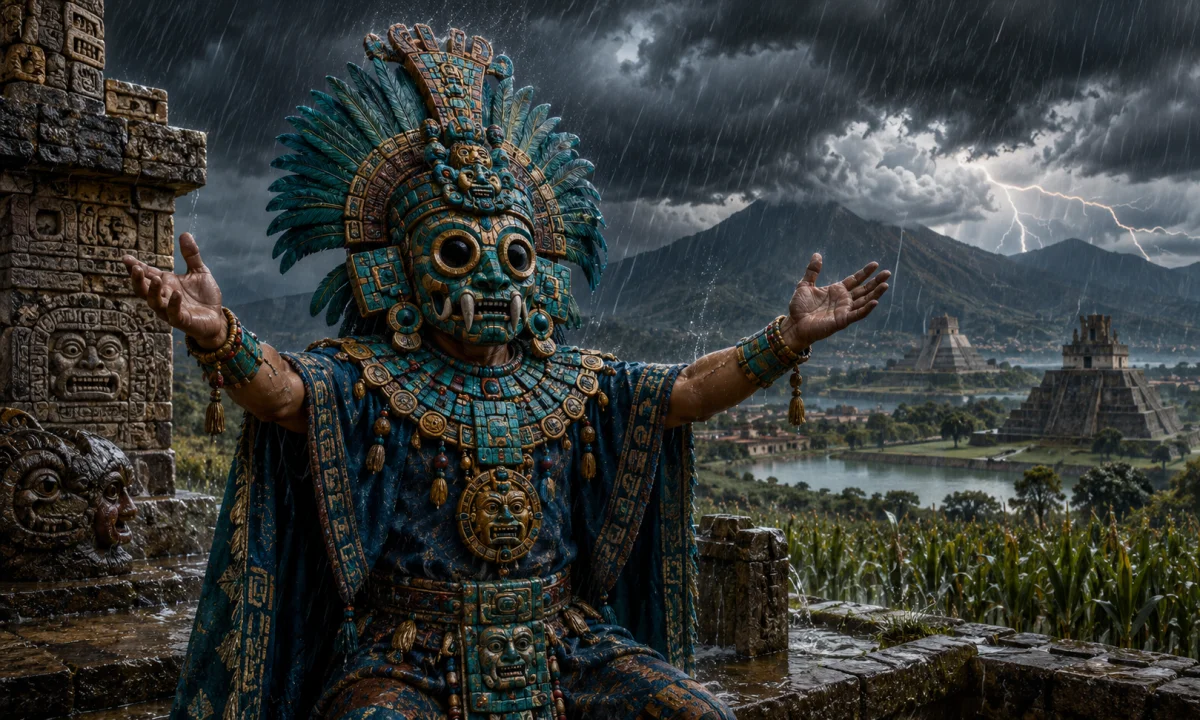
Tlaloc is a major rain and storm deity of central Mexican, especially Nahua and Mexica (Aztec), religious tradition. He was associated with rain, fertility, springs, mountain water, lightning and the forces that could either nourish crops or destroy them. Tlaloc was not simply a personification of pleasant weather: drought, torrential rain, hail, floods and lightning all belonged to the dangerous power of the atmosphere. His worship formed one of the most important parts of religious life in the Basin of Mexico.
Origins and cultural setting
Tlaloc was worshipped by the Mexica, the dominant power in the Aztec Empire during the fifteenth and early sixteenth centuries, but his cult was older than the Mexica state. Rain and storm deities had long been important throughout Mesoamerica, and images resembling later Tlaloc appear in earlier central Mexican art. However, the exact relationship between these earlier figures and the historical Tlaloc cannot always be demonstrated. Similar visual features may reflect shared religious ideas rather than an unbroken identity.
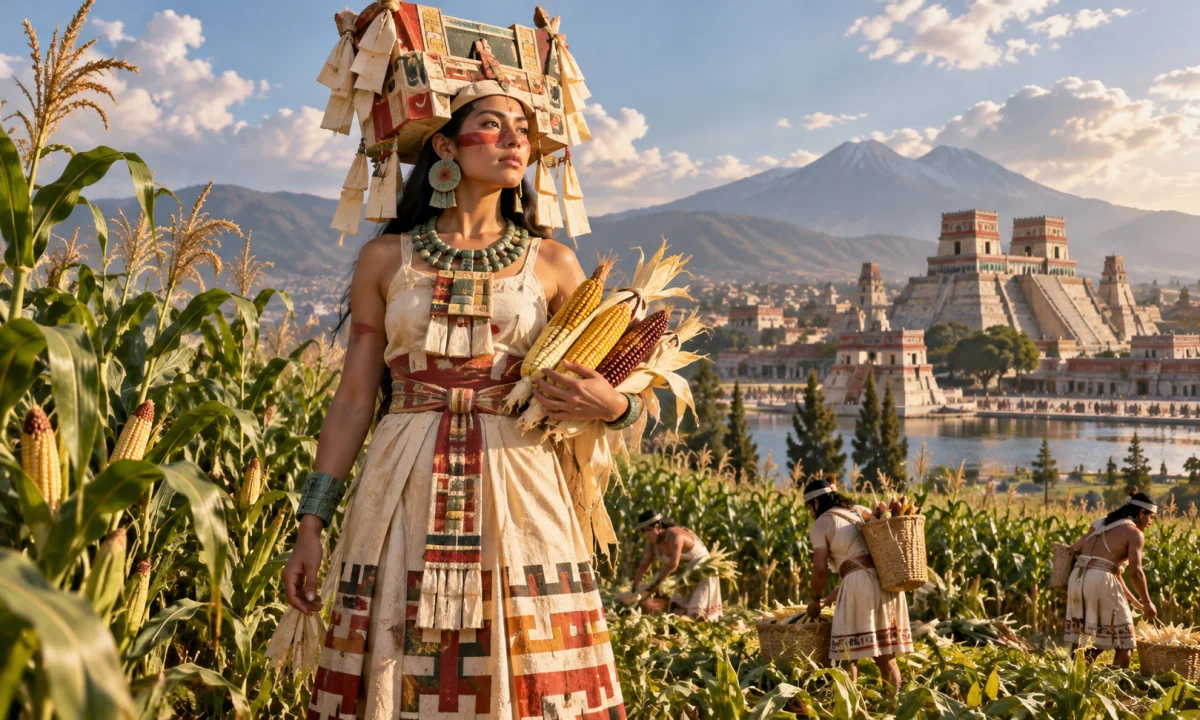
The Mexica lived in a landscape where agricultural success depended heavily on seasonal rainfall. Their capital, Tenochtitlan, stood in the lake system of the Basin of Mexico, while maize cultivation relied on carefully managed water, fertile soil and predictable weather. Tlaloc therefore represented both the promise of abundance and the threat of catastrophe. A successful rainy season supported maize, beans, squash and other crops; a failed or excessive season could bring hunger, disease and political instability.
His worship was also connected with mountains. In central Mexican religious thought, mountains were often imagined as repositories of water. Clouds gathered around their peaks, springs emerged from their slopes and rain seemed to descend from their hidden interiors. Mount Tlaloc, east of the Basin of Mexico, was an important sacred site with a sanctuary and evidence of ritual activity. The mountain was not merely named after a distant god; it formed part of the sacred geography through which Tlaloc's power was understood.
The name Tlaloc
The name is commonly written Tlaloc in English, while scholars may write Tlāloc to indicate the long vowel in Classical Nahuatl. The pronunciation and exact etymology are not entirely straightforward. The name has often been connected with Nahuatl words relating to earth or the surface of the land, but proposed translations differ, and its original meaning remains debated. A confident literal translation should therefore be treated cautiously.
Tlaloc was a Nahua deity, but “Aztec god” is a broad modern label. The word Aztec can refer to several Nahua-speaking peoples and is often used for the imperial culture of the Mexica. Tlaloc's importance extended beyond the Mexica alone, and local communities could understand or worship him through their own traditions. Colonial descriptions also use names and categories that do not always correspond neatly to precolonial religious concepts.
Appearance and iconography
Tlaloc is commonly identified in Mesoamerican art by a distinctive face. Typical features include large round or goggle-like eyes, a prominent upper lip or moustache-like element, and fangs or curling forms around the mouth. Serpentine shapes are often incorporated into the face, headdress or surrounding design. Artists represented him in several different ways, so no single image functions as a universal portrait.
Blue and green colours are frequently associated with him because they evoke water, vegetation and precious greenstone. These colour associations vary according to the object and artistic tradition, and surviving pigments are not always preserved. Tlaloc may also appear with a headdress, water jars, lightning symbols or other signs of atmospheric power. Some images that modern observers call “Tlaloc” are difficult to identify with complete certainty, especially when they come from periods or regions outside the Mexica heartland.
One important symbol is the vessel or jar from which rain could be released. In interpretations based on Nahua accounts, thunder and lightning could be understood through the breaking or striking of water containers held by supernatural rain beings. This imagery helped explain why rain arrived with flashes, crashes and sudden changes in intensity. The vessel was therefore not merely decorative; it expressed the idea that rainfall was controlled, distributed and potentially disrupted by divine forces.
Rain, fertility and danger
Tlaloc's principal power was the control of rain. He could send the water necessary for crops, fill lakes and springs, and make the earth fertile. At the same time, he could send destructive storms, hail and floods. His power was morally and practically ambivalent: it was indispensable, but it could not be treated as harmless or predictable.
Rain was associated with growth and renewal, while water also connected Tlaloc with death and disease. Colonial accounts describe certain illnesses as belonging to the domain of water and rain, including conditions involving swelling or bodily fluids. The precise identification of these illnesses with modern medical categories is uncertain. What is clear is that Tlaloc's sphere included forms of sickness as well as agricultural prosperity.
Lightning and drowning were especially significant in accounts of Tlaloc's power. People who died through lightning strikes, drowning or certain water-related illnesses were sometimes said to go to Tlalocan, his paradisiacal realm. This destination differed from other post-mortem destinations in Nahua thought, which could depend on the manner of death rather than on a person's moral character. Tlalocan was described as a place of abundant vegetation, food and water, although surviving accounts present the realm in different ways.
The Tlaloque and the distribution of rain
Tlaloc was accompanied or served by the Tlaloque, a group of rain beings whose name is related to his. The singular and plural forms should not be confused: Tlaloc is the principal deity, while the Tlaloque are associated rain spirits or subordinate powers. Colonial Nahua descriptions portray them as active in producing different kinds of weather.
The Tlaloque could strike vessels or jars containing rain, causing water to fall upon the earth. Different vessels or actions could produce beneficial rain, destructive storms, hail or other atmospheric effects. This model presented weather as the work of a network of supernatural agents rather than as the action of one isolated god. The Tlaloque were also connected with mountains, springs and local places where rain and water were thought to originate.
Some sources describe four directional or regionally distributed Tlaloque. Their colours and associations vary between accounts, and later interpretations sometimes impose a more rigid system than the evidence supports. The general idea of multiple rain powers is well established, but every detail of their organisation should not be treated as uniform across all Nahua communities.
Tlaloc's relationships and related deities
Colonial sources frequently describe Chalchiuhtlicue, “She of the Jade Skirt,” as Tlaloc's wife or female counterpart. Chalchiuhtlicue was associated with lakes, rivers, springs, flowing water and fertility. Their relationship reflects a broad distinction between rain from the sky and water present on the earth, although the boundaries were not absolute. Other accounts and traditions give different relationships or emphasise other water deities, so the pairing should not be assumed to represent one universally fixed myth.
Water powers could also be associated with figures such as Huixtocihuatl, a goddess connected with salt and salt water. These deities were not simply interchangeable names for Tlaloc. Nahua religion contained overlapping domains in which rain, lakes, springs, fertility, salt and agricultural production could be connected without becoming identical.
Tlaloc was also linked with the Mexica state deity Huitzilopochtli. At the Templo Mayor in Tenochtitlan, the principal temple had twin shrines, one dedicated to Huitzilopochtli and the other to Tlaloc. Their juxtaposition expressed the combined importance of warfare, imperial power, rain and agricultural sustenance. It also shows that Tlaloc was not a minor nature spirit placed outside political religion. He occupied a central position in the ceremonial life of the capital.
Temples, offerings and ritual observance
The Templo Mayor shrine dedicated to Tlaloc contained offerings connected with water, fertility and the landscape. Archaeological discoveries from the temple precinct include marine materials, greenstone, plants, animals and other objects that reflected aquatic and agricultural symbolism. Such deposits do not provide a complete explanation of every ritual, but they demonstrate the richness of ceremonies associated with his cult.
Mexica ritual calendars included ceremonies for rain and agricultural renewal. Festivals such as Atlcahualo, Tozoztontli and Etzalcualiztli have been associated in colonial accounts with Tlaloc, the Tlaloque and other rain powers, although the emphasis and participants differed from one festival to another. Rituals could involve offerings of food, incense, precious materials, water-related objects and living beings.
Some colonial accounts report the sacrifice of children during ceremonies for Tlaloc and the rain powers. These accounts are important evidence, but they must be read critically. They were recorded after the Spanish conquest, often through Christian interpreters and writers with their own religious and political purposes. Archaeology confirms that children were sacrificed in some Tlaloc-related contexts, yet the meaning and circumstances of individual offerings cannot always be reconstructed. It is inaccurate either to ignore this evidence or to repeat colonial descriptions without considering their context and limitations.
Important myths and surviving traditions
There is no single surviving “myth of Tlaloc” equivalent to a complete canonical scripture. Knowledge of him comes from a combination of archaeology, painted manuscripts, colonial Nahuatl texts, Spanish-language chronicles and later interpretations. These sources sometimes disagree because they reflect different communities, periods and purposes.
In accounts of the successive cosmic ages, Tlaloc is sometimes said to have ruled an earlier sun or world. In one well-known version, the world associated with Tlaloc ended through a rain of fire, while another deity later governed a subsequent age. The details vary among sources, and these stories should not be treated as one fixed Aztec creation narrative. Nahua traditions included multiple accounts of cosmic origins and destruction.
Tlalocan is more consistently associated with those whose deaths were caused by water, lightning or certain illnesses. The realm's abundance has sometimes led modern writers to call it a paradise. That description is useful as a broad comparison, but Tlalocan belonged to a specific Nahua understanding of death, landscape and divine power. It was not simply an equivalent of the Christian heaven or a universal reward for virtuous people.
Earlier Mesoamerican imagery and interpretation
Archaeologists have identified rain-related imagery in central Mexico centuries before the Mexica Empire. The monumental art of Teotihuacan, for example, includes figures and symbols associated by many scholars with rain, water, vegetation and storm power. Some of these are conventionally called Tlaloc figures, but the ancient inhabitants of Teotihuacan left no clear explanation proving that they used the later Nahuatl name or conceived the deity in exactly the same way.
Continuities between earlier Mesoamerican rain traditions and Mexica religion are plausible, particularly in the importance of mountain water, agricultural fertility and storm symbolism. Nevertheless, similarity does not prove that every earlier rain image depicts the same individual deity. Scholarly identification is strongest when iconography, archaeological context and later indigenous descriptions support one another.
Distinguishing Tlaloc from other rain gods
Tlaloc should not be confused with every Mesoamerican storm or rain deity. The Maya rain god Chaac, the Zapotec storm deity often called Cocijo, and other regional powers belong to different cultural and linguistic traditions. They share broad themes because rain was important throughout Mesoamerica, not because they were simply different names for Tlaloc.
Within Nahua tradition, the Tlaloque are also distinct from Tlaloc, even though their names and functions are closely related. Chalchiuhtlicue is associated with water but is not merely a female version of Tlaloc. These distinctions matter because Mesoamerican religions organised natural forces through networks of related beings rather than through one standard pantheon used identically everywhere.
Later reception and modern culture
After the Spanish conquest, devotion to precolonial deities was condemned, transformed or absorbed into Christian frameworks, while indigenous communities continued to preserve local understandings of rain, mountains and sacred places in changing forms. Modern scholarship reconstructs Tlaloc from both indigenous records and colonial testimony, but the surviving evidence does not amount to a complete record of preconquest belief.
Tlaloc's striking eyes, fangs and storm symbolism have made him prominent in museums, historical fiction, fantasy art, video games and other popular media. These modern representations may borrow his name while turning him into a generic “Aztec god of rain,” a villain, or a fantasy monster. Such portrayals are creative adaptations rather than reliable descriptions of Nahua religion. The traditional Tlaloc was a complex power of rain, fertility, disease, death and mountain water, embedded in a living agricultural and ceremonial world rather than defined only by an unusual face or supernatural weapon.