WORLD
WORLD
Atlatonan
Atlatonan is a little-documented female deity associated in Aztec and broader Nahua religious traditions with water, the earth, and illnesses affecting the skin. Her name is also written Atlatonin or with minor orthographic variations. Unlike major deities such as Tlaloc, Huitzilopochtli, or Chalchiuhtlicue, Atlatonan does not have a large, clearly preserved body of myths. Much of what is said about her comes from brief colonial descriptions, later catalogues of Nahua gods, and modern attempts to interpret fragmentary evidence.
Name and identity
The name Atlatonan is generally interpreted as containing atl, the Nahuatl word for “water,” together with a maternal element related to tonan, “our mother.” It is therefore often rendered as “Our Mother in Water” or “Our Water Mother.” Such translations are useful indications of the deity’s associations, but the exact grammatical analysis and intended meaning are not entirely certain.
Colonial manuscripts used inconsistent spelling systems for Nahuatl. The same divine name can consequently appear in forms such as Atlatonan, Atlatonin, or Atlatonán. These forms are usually treated as variants of one name rather than as evidence for several separate goddesses. The spelling differences should not be confused with a different being named Atotonilco, Atlacoya, or another deity whose name also contains a reference to water.
Atlatonan is commonly classified as a goddess of water and the earth, with a particular connection to skin disease. Some modern summaries call her a water goddess, while others describe her as an earth mother or a patron of people suffering from serious illnesses. These descriptions may reflect related aspects of her role rather than a single, formally fixed classification. Nahua religious categories were not always exclusive: a deity could participate in several overlapping spheres, including fertility, illness, healing, agricultural production, and the dangerous powers of water.
Cultural setting
Atlatonan belongs to the religious world of the Nahua-speaking peoples of central Mexico. “Aztec mythology” is a convenient modern label, but it can conceal the diversity of the region’s traditions. The Mexica of Tenochtitlan shared many deities and religious concepts with other Nahua communities, yet local cults, names, ceremonies, and interpretations could differ.
Water had a profoundly ambivalent significance in this world. Rain made agriculture possible, springs and lakes sustained settlements, and aquatic environments supported travel and food production. At the same time, floods, storms, drowning, and waterborne or water-associated illnesses made water a potentially threatening force. Water deities were therefore not simply benevolent figures who granted moisture. They could also demand respect, cause affliction, or mediate access to health and fertility.
Illness likewise had religious as well as physical dimensions. The Aztec and other Nahua peoples recognized practical treatments and herbal knowledge, but disease could also be understood as the result of divine displeasure, ritual imbalance, an encounter with a sacred power, or the action of a particular deity. A god or goddess associated with a disease might be feared, propitiated, or appealed to for relief. This pattern helps explain why Atlatonan could be linked both with illness and with the people who sought healing.
Surviving evidence
No surviving pre-Hispanic narrative provides a complete biography of Atlatonan. The evidence for her comes from the general body of information about Nahua religion recorded after the Spanish conquest. Important types of evidence include alphabetic accounts written in or translated from Nahuatl, pictorial manuscripts, descriptions of festivals, lists of deities, and colonial discussions of native beliefs.
The most substantial records of Aztec religion were produced in the sixteenth century, often through collaboration between Indigenous informants and European or mestizo writers. These works preserve valuable information, but they also present difficulties. Indigenous religious concepts were translated into Christian and European categories; different informants may have described local practices differently; and some records were compiled long after the political collapse of the Mexica state.
Atlatonan appears to have occupied a relatively minor or specialized place in these records. The surviving references do not establish a single, universally accepted myth concerning her birth, marriage, offspring, or struggles with other gods. Modern encyclopaedias sometimes provide elaborate family relationships for her, but many of those details are not securely supported by the primary colonial evidence.
Associations with water and the earth
Atlatonan’s name and descriptions connect her with water, but she should not automatically be treated as another name for the better-known rain god Tlaloc or his female companions. Tlaloc governed rain, storms, mountain water, agricultural fertility, and a powerful group of supernatural beings often called the Tlalocs. His principal female counterpart was Chalchiuhtlicue, associated with flowing water, rivers, lakes, and other bodies of water.
Atlatonan seems to represent a more specific or differently focused aspect of watery power. Her associations may involve the life-giving and dangerous qualities of water as they affect the human body and the land. The maternal element in her name supports an interpretation of water as a nourishing or generative force, while her connection with disease shows that this motherhood was not necessarily gentle or protective in a modern sense.
The connection with the earth is also difficult to define precisely. In Mesoamerican religion, earth goddesses frequently combined fertility, nourishment, birth, decay, and death. Soil produces crops, but the earth also receives the dead and can be imagined as a devouring or dangerous mother. If Atlatonan was understood as an earth-and-water goddess, her role may have joined agricultural dependence on moisture with the earth’s power to sustain or afflict human life. The available evidence is too limited to assign her a detailed agricultural function with confidence.
Illness and skin disease
One of Atlatonan’s most frequently repeated associations is with skin disease, sometimes described in older sources or modern translations using the word “leprosy.” That terminology requires caution. European writers used familiar disease categories to describe conditions they encountered in the Americas, and the historical identification of a specific illness is not always possible. The records may refer to chronic skin disorders, visible lesions, or a broader class of afflictions rather than to modern leprosy in its precise medical sense.
Atlatonan’s relationship with such illnesses appears to have been religious rather than merely symbolic. A deity connected with a disease could be regarded as its source, its owner, or an authority capable of removing it. People suffering from a serious or socially visible condition might make offerings, observe particular restrictions, or seek the deity’s favour. The available evidence does not permit a detailed reconstruction of these practices, but her inclusion in discussions of illness indicates that she was more than an abstract personification of water.
Skin disease also has an important social dimension. Visible illness could affect a person’s place within the community, relationships, and ability to participate in ordinary activities. A divine patron associated with sufferers may have provided a religious framework for understanding an otherwise frightening or stigmatizing condition. This does not mean that Atlatonan should be described simply as a “goddess of leprosy”; that phrase reduces a complex and uncertain tradition to one modern diagnostic label.
Appearance and iconography
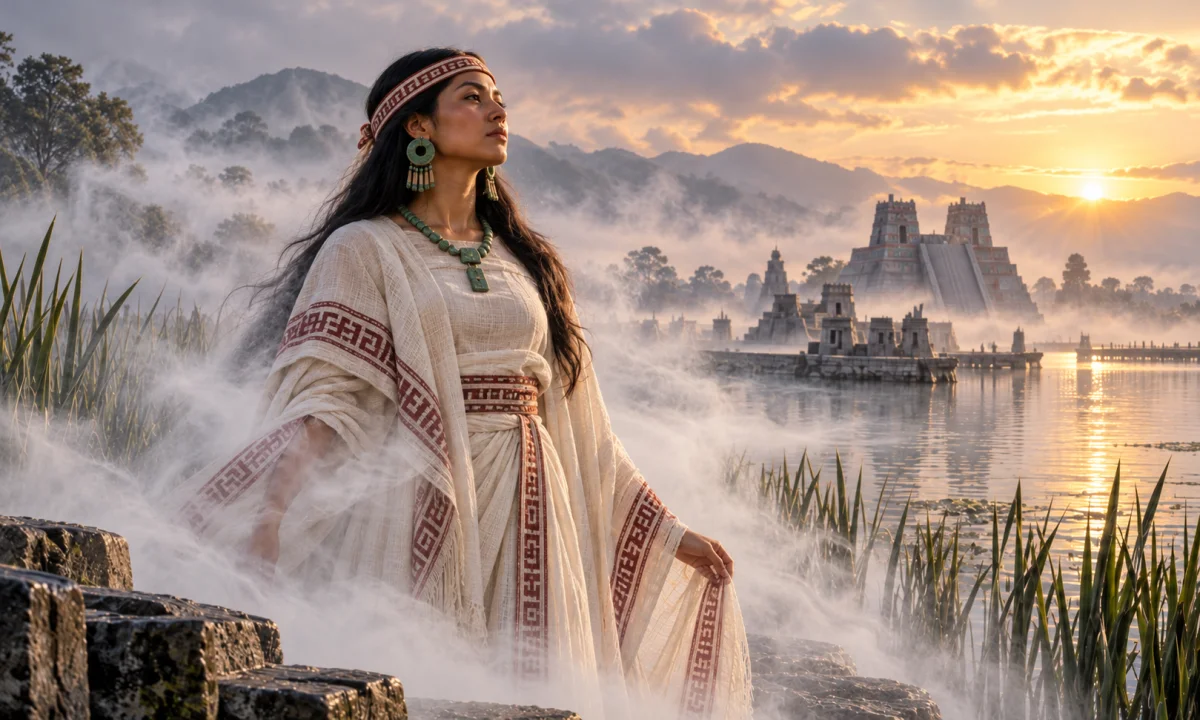
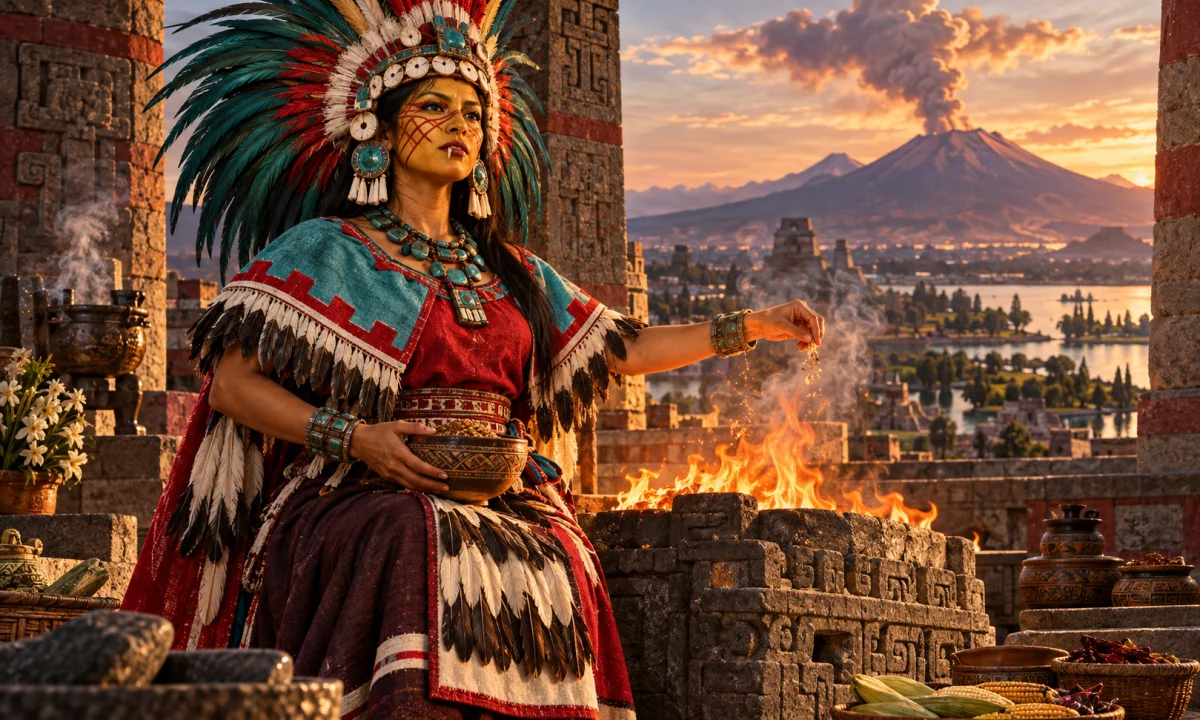
There is no securely established, universally recognized image of Atlatonan comparable to the familiar representations of Coatlicue, Tlaloc, or Chalchiuhtlicue. Some modern illustrations depict her as a richly dressed woman surrounded by water, vegetation, or aquatic symbols. These images are modern interpretations unless they can be tied to a specific manuscript identification, and they should not be treated as established ancient iconography.
The same caution applies to claims about her clothing, headdress, colours, animals, or ritual objects. Mesoamerican manuscripts often use visual signs that identify gods through combinations of costume, facial paint, ornaments, and associated symbols. However, a female figure near water cannot automatically be identified as Atlatonan, and an image of an earth or water goddess may represent another deity entirely.
Atlatonan’s lack of a clear iconographic profile is itself significant. It suggests either that her cult was less prominent in the surviving central Mexican records, that she was represented under another divine identity in particular contexts, or that colonial documentation failed to preserve the information needed for identification. It is better to acknowledge this uncertainty than to construct a fixed appearance from generic images of Aztec goddesses.
Relationships with other deities
Atlatonan is sometimes described in modern sources as the wife of Tezcatlipoca or as the mother of one or more important gods. These genealogical claims should be treated cautiously. Nahua divine relationships could vary between traditions, and colonial writers did not always record the same family structures. More importantly, some popular reference works repeat one another without demonstrating that a particular relationship appears in an early source.
The best-known origin accounts for the major gods often identify primordial powers such as Ometecuhtli and Omecihuatl, or describe the actions of other central deities. Atlatonan is not consistently placed within these origin narratives. There is therefore no secure basis for presenting her as the universal mother of the gods or as the biological mother of the major Aztec pantheon.
Nor should she be merged with Toci, Coatlicue, Cihuacoatl, or Chalchiuhtlicue simply because all are female figures with maternal, earthly, aquatic, or fertility-related associations. Nahua religion contained many overlapping divine powers. Similar functions do not prove that the figures were identical, and a deity could share an attribute with another without being one of that deity’s names.
Ritual significance
Atlatonan’s apparent importance lies in the meeting point between environment, bodily vulnerability, and religious care. Water was essential to the survival of settled communities, yet it could also bring danger. The earth provided food while receiving the dead. Illness could be understood through both practical and sacred forms of knowledge. A goddess combining these associations would embody forces that humans depended upon but could never completely control.
This pattern is common in Mesoamerican religious thought. Deities were not arranged in a simple opposition between good and evil. The same power might nourish crops, cause destruction, punish transgression, or grant recovery. A deity associated with illness was not necessarily evil, just as a water deity was not necessarily benevolent. Such figures expressed the unpredictable relationships between humans, landscape, bodily health, and the supernatural world.
Atlatonan’s maternal title may have conveyed intimacy and dependence rather than sentimental affection. Calling a deity “mother” could acknowledge her as a source of nourishment, a guardian of a community, or a power to whom people owed obligations. In the context of disease, the maternal image may also suggest an appeal to a divine authority capable of recognizing and alleviating suffering.
Distinguishing Atlatonan from related figures
- Chalchiuhtlicue is the better-attested goddess of flowing water, lakes, rivers, and aquatic fertility. She is often associated with Tlaloc and has a much clearer presence in surviving art and ritual descriptions.
- Tlaloc is a major male deity of rain, storms, mountain water, and agricultural fertility. Atlatonan’s water associations do not make her a female form of Tlaloc.
- Toci, “Our Grandmother,” is associated with the earth, midwives, healing, and other maternal functions. Her title resembles the maternal element in Atlatonan’s name, but the two figures are not automatically identical.
- Coatlicue is a powerful earth and mother goddess known especially from Mexica sculpture and myths connected with Huitzilopochtli. Her prominence and iconography should not be transferred to Atlatonan.
- Atlacoya is another water-related female deity whose name and associations can lead to confusion. Similar references to water do not demonstrate that she and Atlatonan were the same goddess.
Later reception
Atlatonan has received comparatively little attention in mainstream modern popular culture. She occasionally appears in encyclopaedias of mythology, fantasy games, online lists of Aztec gods, and modern artwork. These treatments often expand her role into a fully developed goddess of oceans, healing, or fertility. Such portrayals may be creative reinterpretations, but they should not be mistaken for securely documented Aztec tradition.
Contemporary writers also sometimes present Atlatonan as a major goddess with a detailed family tree, standardized appearance, and clearly defined powers. The historical record does not support that level of certainty. A responsible description preserves the more limited evidence: Atlatonan was a Nahua or Aztec-associated female deity whose name and surviving references connect her with water, earth, and serious skin ailments, while many details of her mythology and cult remain unknown.