WORLD
WORLD
Chalchiuhtlicue
Chalchiuhtlicue is a major water deity in Nahua, especially Mexica (Aztec), religious tradition. Her name is commonly translated as “She of the Jade Skirt” or “She Who Wears a Jade Skirt.” She was associated with lakes, rivers, springs, streams, irrigation, rainwater and the life-giving movement of water. In some traditions she was also connected with childbirth and fertility. Like many Mesoamerican deities, however, her identity was not limited to a single function: water could sustain crops and human life, but it could also bring floods, drowning and destruction.
Name and identity
The name Chalchiuhtlicue comes from Classical Nahuatl. It is related to chalchihuitl, a word for greenstone or jade, and cueitl, meaning a skirt or garment. Colonial sources and modern publications use several spellings, including Chalchihuitlicue. The differences largely reflect attempts to represent Nahuatl sounds and grammatical forms using changing European spelling conventions.
“Jade” in this name should not be understood only as a reference to a precious material. Greenstone had strong associations with water, fertility, preciousness and vitality in Mesoamerican thought. A green or blue-green color could evoke spring water, vegetation, lakes and the living landscape. The name therefore presents Chalchiuhtlicue as a figure whose clothing expresses the value and power of water.
Chalchiuhtlicue is sometimes described as a goddess, but the category “goddess” does not map perfectly onto Nahua religious ideas. Nahuatl-speaking peoples understood divine powers through overlapping names, manifestations, offices and relationships. A deity could have several aspects, and a title could emphasize a particular force or manifestation without creating a completely separate being. Surviving accounts also differ in how they describe Chalchiuhtlicue’s relationship to other water powers.
Cultural setting and surviving evidence
Knowledge of Chalchiuhtlicue comes mainly from early colonial records written after the Spanish conquest, along with Indigenous pictorial manuscripts and archaeological objects. The most important written descriptions were produced by colonial-era observers who recorded Nahua traditions, often with the help of Indigenous informants. These records preserve valuable information, but they do not represent a single, uniform statement of pre-conquest religion. Regional traditions differed, and Christian interpretation sometimes affected the way Indigenous beliefs were described.
Mexica religion placed water within a broad network of sacred powers. Tlaloc governed rain and was connected with the mountain realm known as Tlalocan, while the tlaloque were lesser or accompanying rain beings associated with storms, springs and other manifestations of water. Chalchiuhtlicue belonged to this wider sacred environment, but she was not simply a female version of Tlaloc. She had her own names, imagery and ritual associations.
Water was especially important to communities living around the lakes of the Basin of Mexico. The Mexica capital, Tenochtitlan, stood in a lake environment shaped by canals, freshwater springs, agricultural wetlands and changing water levels. Water supported transport, farming and daily life, yet floods and salinity posed serious dangers. A water deity could therefore be generous and threatening at the same time. This combination of nourishment and danger is central to understanding Chalchiuhtlicue.
Appearance and symbols
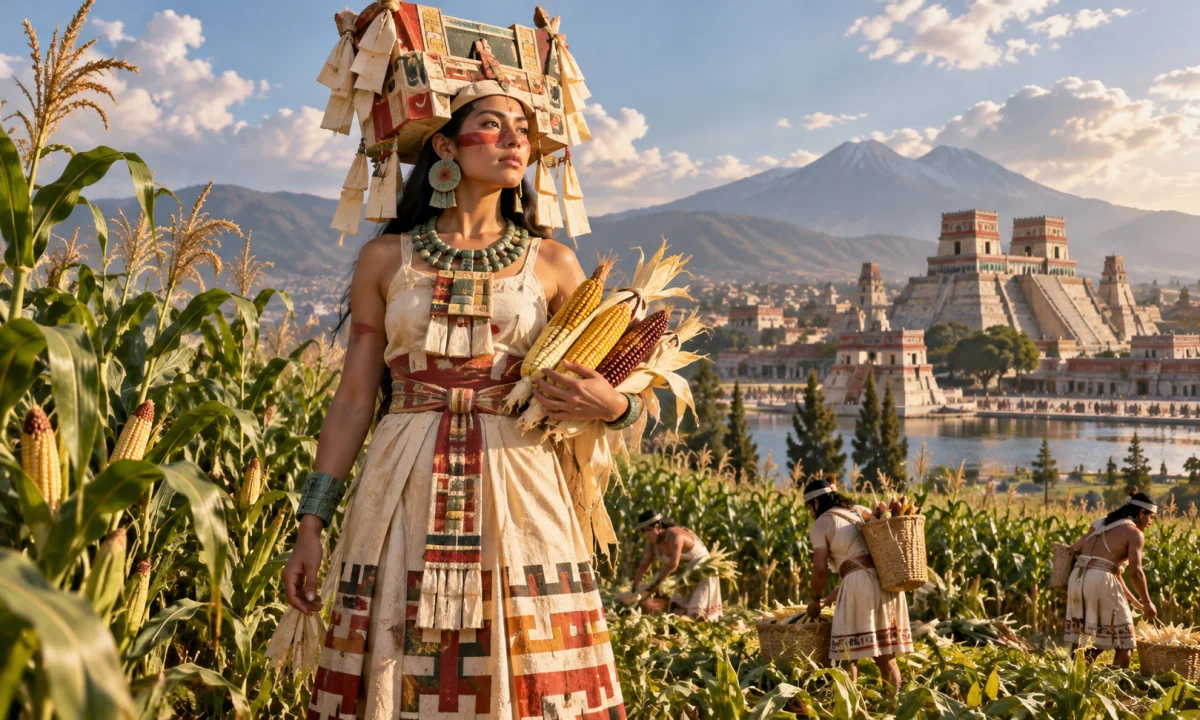
In painted manuscripts, Chalchiuhtlicue is generally shown with clothing and ornaments that mark her relationship to water and jade. Her skirt may be represented in green or blue-green tones, and her costume can include bands, tassels or other signs associated with precious water and flowing liquid. Her appearance is not identical in every manuscript. Indigenous painters used conventions that could vary according to the document, region and ritual context.
Water streams, jade ornaments and green or blue colors are among the most important visual signs associated with her. These should not be treated as a rigid set of symbols that appears in every representation. Rather, they are recurring elements within a larger visual language shared by water deities and other sacred beings.
A large stone sculpture commonly identified as Chalchiuhtlicue is displayed in Mexico City’s National Museum of Anthropology. It represents a seated female figure wearing an elaborate headdress and a broad, richly marked garment. The identification is conventional and widely accepted in museum and popular discussion, although the exact identity and original meaning of some Aztec sculptures can be difficult to establish with certainty. The figure’s monumental scale and formal posture convey authority rather than a merely decorative association with water.
Some modern images portray Chalchiuhtlicue as a blue-skinned woman, a mermaid or a generic “water goddess.” Such imagery may be inspired by her association with lakes and rivers, but it does not necessarily reproduce traditional Nahua representations. The surviving Indigenous images are more highly structured and symbolic than many modern fantasy depictions.
Water, fertility and childbirth
Chalchiuhtlicue’s principal sphere was water in its terrestrial and life-sustaining forms. This included lakes, springs, rivers and streams, rather than only rain falling from the sky. Tlaloc and the rain powers were particularly important for storms and rainfall, while Chalchiuhtlicue was strongly connected with bodies and courses of water on the earth.
Her significance also extended to fertility. Water allowed maize and other crops to grow, supported aquatic life and made human settlement possible. The connection between water and birth was also meaningful. Colonial descriptions associate Chalchiuhtlicue with childbirth and with the waters surrounding the unborn child. Some accounts present her as a protector or patron of women in labor, although the surviving evidence does not provide a single, universally consistent doctrine about her role.
Nahua religious thought often linked bodily processes, agricultural growth and cosmic renewal. Water could cleanse, nourish and animate, but it could also carry illness or overwhelm communities. For this reason, Chalchiuhtlicue should not be reduced to a benevolent fertility figure. Her power was morally and physically ambivalent, reflecting the unpredictable force of the natural world.
Relationship with Tlaloc and other water beings
Colonial accounts commonly describe Chalchiuhtlicue as the wife or companion of Tlaloc. Other passages or interpretations identify her as his sister, and some traditions use kinship terms in ways that do not correspond exactly to modern Western ideas of family. The relationship is therefore best presented as variable rather than fixed. It places both figures within the same powerful water complex without making them identical.
Tlaloc was primarily associated with rain, storms, lightning, mountains and the distribution of life-giving moisture. Chalchiuhtlicue was more closely associated with lakes, rivers, springs and flowing or gathered water. These distinctions are useful, but they should not be treated as absolute divisions. Mesoamerican deities frequently overlapped, and the boundaries between rain, springs, lakes, fertility and agricultural abundance were naturally interconnected.
Chalchiuhtlicue should also be distinguished from Huixtocihuatl, a goddess associated especially with salt and salt water, and from Matlalcueye, a name connected in some traditions with a mountain and a female rain or water power. Some colonial writers and modern scholars have compared or identified certain of these figures, but they are not automatically interchangeable. Regional worship, changing titles and incomplete records make simple one-to-one equivalences uncertain.
The Fourth Sun and the great flood
One of the best-known stories involving Chalchiuhtlicue appears in accounts of the Five Suns, the Nahua explanation of successive cosmic ages. In the version preserved in the colonial Nahuatl work known as the Leyenda de los Soles, Chalchiuhtlicue becomes the sun of the fourth age, known as Nahui Atl, or “Four Water.” This age ends in a catastrophic flood. Human beings are transformed into fish, and the existing world is destroyed by water.
The story is not a universal or unchanging Nahua creation myth. Accounts of the Five Suns differ in their sequence, details and treatment of the gods. In some versions, the sun of each age is associated with a different deity, including Tezcatlipoca, Quetzalcoatl, Tlaloc and Chalchiuhtlicue, but the arrangement and narrative emphasis can vary. The flood story nevertheless provides a powerful expression of her cosmic scale: she is not merely a spirit of a local stream but a force capable of governing an entire age of the world.
In some retellings, Chalchiuhtlicue weeps or releases so much water that the flood lasts for a prolonged period. Other versions focus more simply on the destruction of the age and the transformation of its people. These differences matter because popular summaries often combine details from separate colonial accounts and present them as one standardized myth. The surviving traditions are better understood as related versions rather than as chapters from a single canonical scripture.
Ritual importance
Water deities received offerings and ceremonies because water was essential to agriculture, settlement and human survival. Ritual attention could be directed toward rain, springs, lakes, canals and the seasonal cycle. Accounts of Mexica religious practice describe ceremonies involving Tlaloc, the tlaloque and other water powers; Chalchiuhtlicue could be included within this sacred network.
Some colonial descriptions connect water-related rites with offerings to children, whose voices and tears were understood within the ritual logic of rain and fertility. These accounts must be treated carefully. They describe practices that were filtered through colonial observation, and modern readers should not detach them from the larger religious system of reciprocity, obligation and concern for agricultural survival. Nor should every ritual connected with Tlaloc and rain automatically be assigned specifically to Chalchiuhtlicue.
Festivals and ceremonies associated with water deities changed according to location and ritual calendar. Later summaries sometimes assign Chalchiuhtlicue a single fixed festival, but the evidence is more complicated. Her presence is best understood through the broader ceremonial treatment of water, agricultural fertility, springs and lakes rather than through one universally documented annual celebration.
Meaning and interpretation
Chalchiuhtlicue embodies the double nature of water. She represents nourishment, agricultural productivity, bodily life and the renewal of the landscape. At the same time, her association with the flood places her among powers that cannot be controlled by human wishes. Water is precious precisely because it is powerful, and its power includes the ability to destroy.
The jade imagery attached to her name reinforces this relationship. Jade and related greenstones were valued materials, but their color also evoked vegetation and water. The phrase “jade skirt” can therefore be read as a poetic image of a deity clothed in the living waters of the earth. It should not be assumed that every use of the name refers to a literal garment or to a single standardized costume.
Her connection with childbirth gives her symbolism another dimension. Birth, rainfall and agricultural growth all involve the release of life-supporting fluid. This does not mean that Nahua religion reduced women’s bodies, crops and rivers to one simple metaphor. Rather, it shows how different forms of generation could be understood through related sacred ideas of moisture, emergence and renewal.
Chalchiuhtlicue in modern culture
Chalchiuhtlicue appears today in museum exhibitions, historical fiction, fantasy art, educational media and works by artists interested in Indigenous Mesoamerican traditions. Contemporary creators may use her as a symbol of water protection, ecological responsibility, feminine power or resistance to environmental destruction. These interpretations can be meaningful modern responses, but they should be distinguished from the evidence for pre-conquest and colonial Nahua religion.
Modern descriptions sometimes call her an “Aztec mermaid,” an ocean goddess or the universal goddess of all water. Those labels are convenient but misleading. She was not traditionally a mermaid, and her primary associations were with the inland waters and agricultural environment of central Mexico rather than with a generalized fantasy sea. Her identity is most accurately understood within the interconnected religious world of Nahua rain, lake, river, fertility and cosmic powers.