WORLD
WORLD
Coatlicue
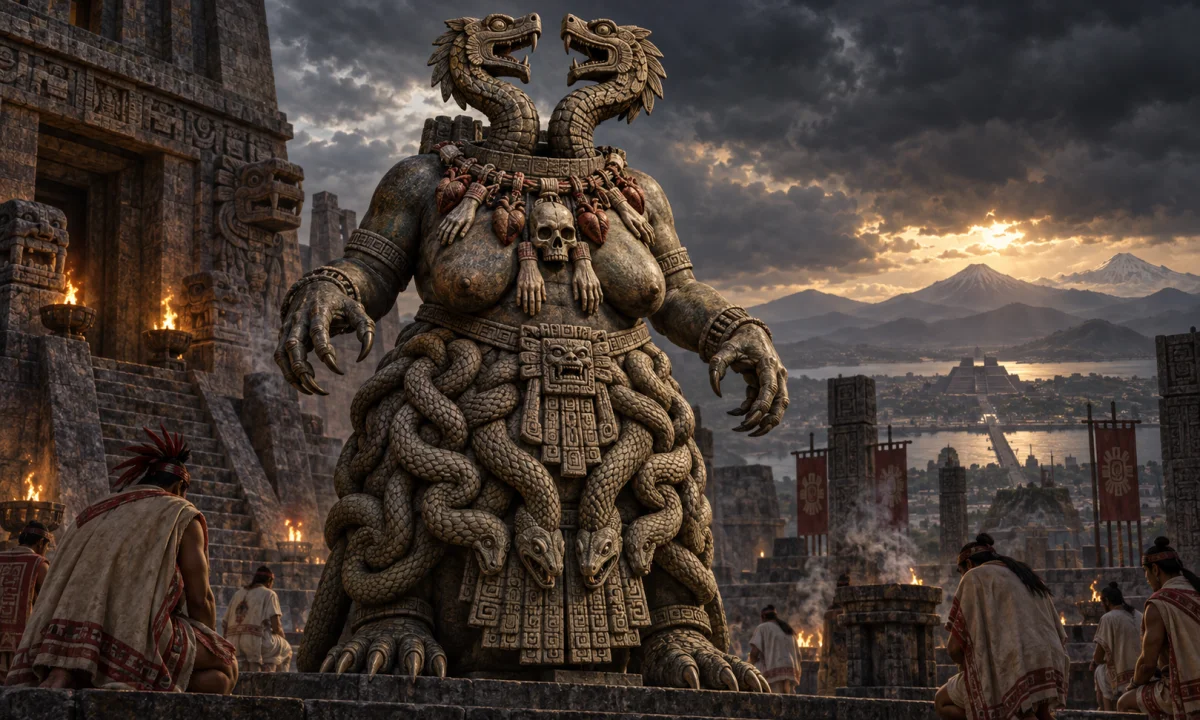
Coatlicue is a major earth and mother deity in Mexica, often called Aztec, religious tradition. Her name is commonly translated as “She of the Serpent Skirt,” referring to the garment of intertwined snakes associated with her most famous monumental image. Coatlicue was connected with the earth’s generative power, death, fertility and the terrifying forces that sustain the world. She should not be understood simply as a benevolent mother goddess: in Nahua religious thought, nourishment and destruction could belong to the same sacred power.
Name and religious setting
Coatlicue comes from the Nahuatl Coātlīcue, generally analysed as coātl, “snake,” and cueitl, “skirt.” The name therefore means something close to “She Who Has a Serpent Skirt.” Spelling varies in English because Nahuatl was recorded by Spanish writers using changing orthographic conventions. Forms such as Coatlicue, Coatlicueh and Coātlīcue may appear in scholarly or historical discussions.
The Mexica were a Nahuatl-speaking people whose capital, Tenochtitlan, stood on an island in Lake Texcoco. Their state religion included numerous gods and goddesses whose powers overlapped rather than forming a rigid system of separate domains. A deity could be associated with several aspects of the natural and social world, while related figures could share symbols, myths or titles. For that reason, Coatlicue is best treated as a distinct deity with important connections to other earth, mother and war-related figures, not as a simple equivalent of every goddess who wears serpents or represents the earth.
Surviving information comes from several kinds of evidence. Spanish colonial accounts recorded Nahuatl traditions after the conquest, sometimes through Indigenous testimony and sometimes through European interpretation. The Florentine Codex, compiled in the sixteenth century under the direction of Bernardino de Sahagún with the participation of Nahua scholars and artists, preserves descriptions of deities, ceremonies and myths. Pictorial manuscripts, archaeological sculpture and later historical writings provide additional evidence. These sources do not always agree, and the names and identities applied to monuments today can reflect modern scholarly reconstruction as well as ancient usage.
Coatlicue’s identity and roles
Coatlicue is commonly described as an earth mother and as the mother of gods. This description reflects her association with birth, nourishment and the earth as a source of life. Yet the earth in Mexica thought was also a consuming and dangerous power. Crops grew from it, but the dead were buried in it; humans depended on it, but it could also produce earthquakes, famine and other forms of destruction. Coatlicue’s imagery brings these opposing dimensions together.
She is associated with serpents, the earth, fertility, death and regeneration. Serpents could signify more than evil or danger. They were linked to the earth, water, movement and bodily or cosmic transformation. A skirt made from snakes suggests a body composed of living, changing forces rather than ordinary clothing. The association also links Coatlicue to the broader importance of serpentine imagery in Mesoamerican religion.
Some modern descriptions call Coatlicue a “goddess of the earth,” but that phrase can be misleading if it suggests a single, universal Earth Mother in the modern sense. Nahua religious categories were more specific and more fluid. Coatlicue’s significance arose from particular myths, images, rituals and relationships within Mexica culture. Her maternal identity did not make her harmless, and her terrifying appearance did not mean that she lacked a life-giving role.
The famous monumental image
The object most strongly associated with Coatlicue is a monumental stone sculpture now known as the Coatlicue statue. It was discovered in Mexico City in 1790, during construction and levelling work in the colonial capital. The discovery took place near the former ceremonial centre of Tenochtitlan, where other major Mexica monuments were also found. The sculpture is now one of the best-known works of Mexica art.
The statue’s traditional identification as Coatlicue is powerful but should be stated with care. It has no surviving inscription that simply names it. Its iconography closely corresponds to colonial descriptions of Coatlicue, especially the serpent skirt, but scholars have also examined whether the monument represents a particular deity, a broader earth-power, or a specific ritual manifestation. Calling it “the Coatlicue statue” is conventional, while acknowledging that the exact ancient identification is an interpretive matter.
The sculpture presents a frightening composite figure. Two large serpent heads meet at the neck, creating the impression that the figure has been decapitated and that snakes emerge from the wound. Her body bears a skirt of intertwined serpents. Her hands and feet have claws, and her breasts hang prominently, suggesting both motherhood and the physical burden of feeding. A necklace made from human body parts includes a skull and severed hands or hearts, depending on how the details are described. The figure’s posture and scale make her appear powerful, ancient and unsettling rather than idealised in a conventionally human way.
The image does not illustrate a single simple idea. The breasts can evoke nourishment, while claws and skull imagery point toward death and predation. The serpents may suggest earth, fertility and transformation, but they also make the body appear unstable and supernatural. The decapitated neck may relate to sacrifice, violence and the transformation of bodily substance into sacred power. Mexica art frequently combined apparently opposing signs to express the dangerous reciprocity between humans, gods and the natural world.
The birth of Huitzilopochtli
Coatlicue’s most famous myth concerns the birth of Huitzilopochtli, the Mexica patron deity of war, the sun and the Mexica people. In accounts preserved in colonial-era sources, Coatlicue was sweeping at a sacred place on Coatepec, often translated as Serpent Mountain. A ball of hummingbird feathers or other fine feathers fell into her clothing. After she placed it near her body, she became pregnant.
Her children were alarmed and offended by the pregnancy. The daughter most prominently named in the story is Coyolxauhqui, “She Whose Face Is Painted with Bells,” although some versions or interpretations give the story a more complex set of relationships. Coyolxauhqui and her brothers, the Centzon Huitznahua, commonly translated as the Four Hundred Southerners or Four Hundred Stars, decided to kill Coatlicue. They approached Coatepec as a threatening group, with Coyolxauhqui often functioning as their leader.
Coatlicue was afraid, but the unborn Huitzilopochtli reassured her. When the attackers arrived, he emerged from her womb fully armed. He carried a serpent-shaped weapon called the xiuhcoatl, often translated as “fire serpent,” and defeated the hostile group. He killed Coyolxauhqui, dismembered her and drove the Centzon Huitznahua away or destroyed them.
The story is strongly connected with the Mexica ceremonial complex and with the great temple known as the Templo Mayor. A large stone disk depicting Coyolxauhqui shows her dismembered body, and its placement at the base of the temple stairway has often been interpreted in relation to the myth of Coatepec. Worshippers or ritual participants approaching the temple would encounter the image below the stairway leading toward the sanctuary of Huitzilopochtli. This arrangement allowed architecture, sculpture, myth and ceremony to reinforce one another.
The myth is sometimes explained as a narrative of the sun defeating the moon and stars, with Huitzilopochtli as the sun, Coyolxauhqui as the moon and the Centzon Huitznahua as stars. That interpretation is influential, but it should not be treated as the only meaning or as a complete translation of Mexica religious thought. The story also concerns sacred warfare, the founding identity of the Mexica, ritual sacrifice, the dangerous birth of a powerful deity and the political importance of Huitzilopochtli’s cult.
Relationships with other figures
Coatlicue is most clearly connected with Huitzilopochtli, Coyolxauhqui and the Centzon Huitznahua through the Coatepec birth narrative. In that story, she is the threatened mother whose pregnancy leads to a violent cosmic and political event. Her role is essential even though the narrative’s immediate victor is Huitzilopochtli.
Coatlicue is also associated in modern discussion with figures such as Toci, “Our Grandmother,” and Cihuacoatl, a powerful female deity whose name means “Serpent Woman.” These relationships are difficult to define precisely. The figures share aspects, symbols or ritual associations, and Nahua religious traditions could treat a deity through multiple manifestations or titles. However, they should not automatically be collapsed into one goddess. Cihuacoatl has her own myths and iconography, while Toci is a distinct figure whose relationship to earth, healing and social order is not identical to Coatlicue’s.
Coatlicue is sometimes connected with Tonantzin, a Nahuatl title meaning “Our Revered Mother” or “Our Mother.” Tonantzin could function as an honorific or devotional title rather than as the personal name of one single goddess in every context. Later interpretations have often linked Coatlicue, Tonantzin and the Virgin of Guadalupe, especially because the shrine of Guadalupe arose at Tepeyac, a place associated in colonial accounts with an earlier Indigenous sacred presence. Such connections are historically important, but they should not be presented as proof that Coatlicue and the Virgin of Guadalupe were simply the same deity. The religious histories are complex and changed substantially under colonial rule.
Symbolism of the serpent and the body
Coatlicue’s body is central to her meaning. It is not a naturalistic portrait of an elderly woman or a literal anatomical description. Instead, the sculpture assembles human, animal and supernatural elements into a sacred form. The body is maternal and predatory, fertile and skeletal, grounded and monstrous.
The serpent skirt is the most obvious attribute, but the snakes at the neck are equally significant. Their joined heads create a doubled or mirrored form, turning the site of injury into a source of living movement. This can be understood as an image of sacrifice and regeneration, although the precise meaning intended by the ancient sculptors cannot be recovered with certainty. The skull necklace presents death as something worn and transformed into an ornament of power.
Claws link Coatlicue to animals that grasp, tear and consume. They may also indicate a deity who belongs to a realm beyond ordinary human society. Her breasts suggest motherhood without removing the threat expressed by the rest of the sculpture. Rather than separating care from violence, the image presents them as interconnected aspects of existence: the same earth that nourishes life also receives the dead.
Historical reception of the statue
After its discovery in 1790, the monumental sculpture did not immediately receive the modern admiration now associated with it. Colonial and postcolonial authorities treated major Indigenous images in ways shaped by Christian religion, ideas about idolatry and changing attitudes toward the pre-Hispanic past. The statue was reportedly reburied after being displayed, in part because officials feared that Indigenous people might respond to it as a sacred object. It was later brought out again and became an important object for antiquarian and scholarly study.
During the nineteenth and twentieth centuries, Coatlicue came to occupy a prominent place in Mexican discussions of Indigenous history, national identity and artistic heritage. Archaeologists and art historians examined the sculpture as evidence of Mexica religion and state power. Artists, writers and political thinkers also used Coatlicue as a symbol of Mexico’s Indigenous past, sometimes emphasising her maternal force and sometimes her terrifying, fragmented body. These modern meanings are significant, but they are not identical to the meanings the sculpture held in Tenochtitlan.
Coatlicue in modern culture
Coatlicue appears in contemporary art, literature, museum exhibitions, educational materials and discussions of Indigenous and Mexican identity. Modern writers may use her as a symbol of mixed heritage, female power, creation through violence or the survival of Indigenous memory. Feminist and decolonial interpretations have particularly explored the way her body challenges idealised images of motherhood and femininity.
These interpretations are modern engagements with an ancient deity and monument. They can be valuable without being mistaken for direct survivals of Mexica belief. Popular culture sometimes simplifies Coatlicue into a generic “Aztec goddess,” a monster, or an interchangeable mother-earth figure. Such portrayals leave out the specific Nahua setting, her relationship to Huitzilopochtli and Coyolxauhqui, and the complex combination of fertility, death, sacrifice and political religion expressed through her imagery.