WORLD
WORLD
Ometecuhtli
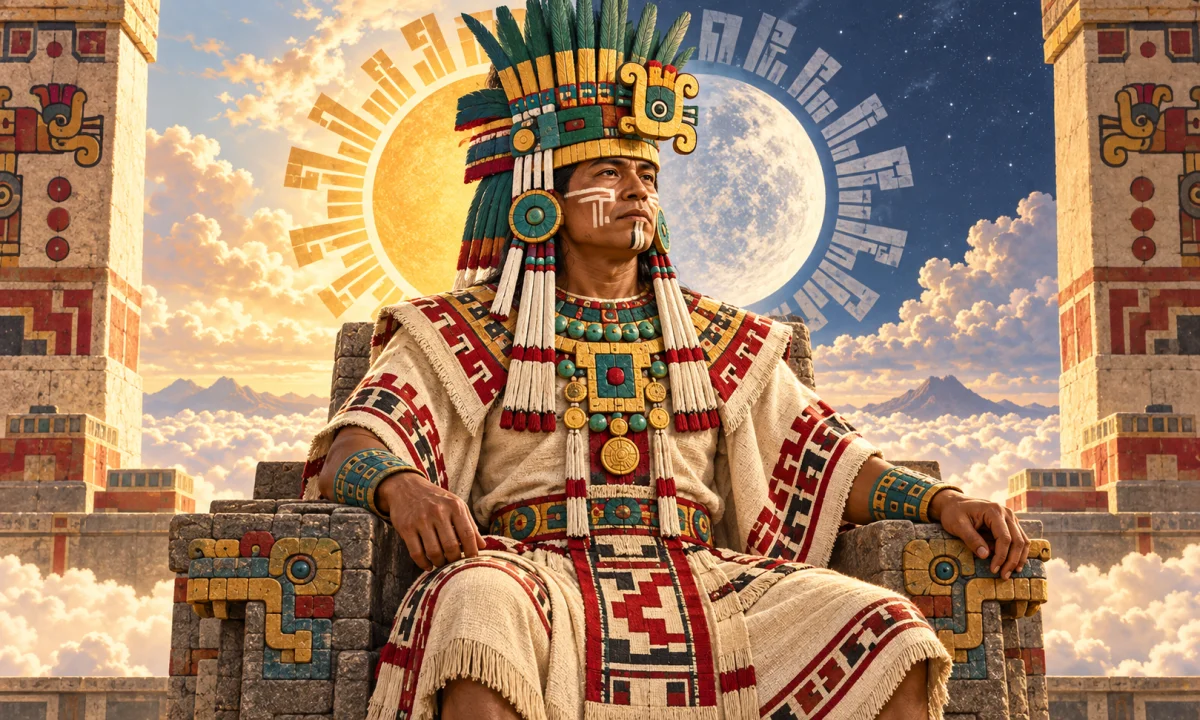
Ometecuhtli is a creator figure in Nahua religious thought, especially in accounts associated with the Aztec or Mexica world. His name is usually translated as “Lord Two” or “Two Lord.” He is commonly presented as the masculine aspect of a primordial complementary pair with Omecihuatl, “Lady Two.” Together, they are often called Ometeotl, a name interpreted as “Two God” or “the God of Duality.”
Unlike Huitzilopochtli, Tlaloc, or Quetzalcoatl, Ometecuhtli was not primarily a deity of a major public cult with a widely recognized temple image. He belongs instead to a more abstract level of cosmology: the remote source of divine and cosmic generation. The surviving evidence is colonial, recorded in Nahuatl or translated into Spanish after the Spanish conquest, and different sources do not describe him in exactly the same way. For that reason, claims about Ometecuhtli should distinguish between specific early traditions and later scholarly interpretations.
Name and identity
The Nahuatl name Ometecuhtli combines ome, meaning “two,” with tecuhtli, a term that can mean “lord,” “ruler,” or “noble.” The related name Omecihuatl combines ome with cihuatl, “woman” or “lady.” The pair therefore expresses a masculine and feminine polarity rather than two unrelated gods.
The name Ometeotl is often treated as the collective or unified form of this dual divinity. Its interpretation is not entirely straightforward. It may be translated as “Two God,” “Dual God,” or “God Two,” and scholars have debated how frequently the term was used in pre-Hispanic religious life. The concept is strongly associated with modern scholarship on Nahua religion, particularly interpretations that emphasize cosmic duality, but the surviving indigenous-language and colonial sources do not present one single, universally consistent theology.
Ometecuhtli is also connected with Omeyocan, usually understood as the “Place of Two” or the “Place of Duality.” Omeyocan was imagined as a high celestial region, often identified with the highest heaven. In descriptions of the cosmos, Ometecuhtli and Omecihuatl occupy this remote sphere and generate or sustain the divine order below them.
Cultural and religious setting
Ometecuhtli belongs to the religious world of the Nahua-speaking peoples of central Mexico. “Aztec mythology” is a convenient modern label, but it can conceal the diversity of Nahua traditions. The Mexica of Tenochtitlan shared many religious ideas with other Nahua communities while also maintaining distinctive political and ceremonial traditions.
Nahua religion did not always divide the world into sharply separate gods with completely independent personalities. Deities could have multiple names, aspects, titles, and manifestations. A divine name might describe a role, a place, a relationship, or a quality rather than identify an entirely separate being. This makes it difficult to place Ometecuhtli into a fixed list of gods in the manner of a modern pantheon.
The idea of complementary forces was important in Nahua thought. Male and female, sky and earth, life and death, heat and moisture, movement and stillness, and other paired principles could be understood as mutually dependent rather than as simple opposites. Ometecuhtli and Omecihuatl represent this generative complementarity at the highest cosmic level. Their duality does not necessarily mean that one is good and the other evil. It expresses the cooperation of different powers in the production and maintenance of existence.
Surviving sources and their limits
Knowledge of Ometecuhtli comes primarily from early colonial records made after the conquest of Mexico. These include Nahuatl-language materials, Spanish accounts based on indigenous informants, and illustrated manuscripts. Important discussions of high creator figures and celestial regions appear in works such as the Historia de los mexicanos por sus pinturas, the Codex Vaticanus A, and other colonial compilations concerning Nahua history and religion.
The Florentine Codex, compiled under the direction of Bernardino de Sahagún with Nahua collaborators, preserves a large amount of information about Nahua gods, prayers, rituals, and cosmology. It also demonstrates why interpretation must be cautious: the work was produced in a Christian colonial environment, its material passed through translation and editing, and not every theological term appears with the same prominence in every source.
Some modern scholars, especially those studying Nahuatl philosophical language, have placed Ometecuhtli and Omecihuatl at the center of a systematic theology of divine unity and duality. Other scholars have questioned whether this system reflects a single widespread pre-Hispanic doctrine or whether it combines ideas from sources that vary by region, period, and genre. The evidence supports the importance of dual creator figures in certain Nahua traditions, but it does not justify treating every later description of Ometeotl as an unquestioned record of Mexica orthodoxy.
Cosmic role and attributes
Ometecuhtli is generally described as a primordial creator and generative power. He and Omecihuatl stand above the more active gods who shape particular stages of the cosmos, govern natural forces, or participate in mythic conflicts. Their remoteness is part of their character. They are not usually portrayed as descending into the human world to perform dramatic deeds or demand a specific famous sacrifice.
The pair are associated with the generation of gods, the ordering of the cosmos, and the origin of life. In some accounts, they produce or engender major divine beings who then take active roles in the creation of the world and its successive ages. These accounts vary in their genealogies and in the names assigned to the first creators, so it is safer to describe Ometecuhtli as a primordial source than to impose one rigid family tree on all Nahua mythology.
Ometecuhtli does not possess a single securely established appearance. Surviving traditions do not provide a standardized portrait comparable to the familiar images of Tlaloc with goggle-like eyes or Quetzalcoatl in serpent form. Artistic representations labelled with modern names can therefore be speculative. A figure shown in a manuscript or modern illustration should not automatically be identified as Ometecuhtli simply because the figure appears male, elderly, royal, or divine.
His most important attributes are conceptual:
- Primordial status: he belongs to the highest and earliest level of the divine order.
- Generative power: with Omecihuatl, he represents the source from which gods, worlds, and living beings arise.
- Duality: his identity depends on complementary relationship rather than isolated individuality.
- Cosmic remoteness: his dwelling, Omeyocan, is placed in the uppermost celestial realm.
- Continuity: the pairing of masculine and feminine principles suggests an ongoing process of generation and renewal.
Omeyocan and the highest heaven
Omeyocan is often described as the home of Ometecuhtli and Omecihuatl. Nahua cosmological accounts commonly imagine the universe as consisting of layered heavens above the earth and regions below it. The exact number and arrangement of these levels differ among sources, but Omeyocan is generally placed at the summit or in a position of exceptional height.
The location is more than a simple residence. It expresses the creators’ separation from ordinary divine activity. Gods associated with rain, warfare, agriculture, fire, childbirth, or death interact more directly with human beings and ritual institutions. Ometecuhtli and Omecihuatl occupy a higher conceptual plane, where the fundamental principles of existence are established.
Some accounts connect the highest dual deity with the origin of human souls or with the destiny of the unborn. These descriptions should not be treated as a single universally accepted doctrine. They do, however, show how the pair could be understood as governing beginnings even when they were not the immediate agents in a particular creation episode.
Creation stories and differing genealogies
Nahua creation traditions do not form one continuous canonical narrative. Several stories describe the creation of the heavens, earth, humans, and the successive worlds or “Suns,” but their characters and sequences differ. In some traditions, a primordial divine couple gives rise to the gods who struggle over the creation of the world. In others, creator figures are named Tonacatecuhtli and Tonacacihuatl, or the emphasis falls on the four Tezcatlipocas and their contests.
Because of this variation, Ometecuhtli is sometimes identified or closely associated with other creator figures, especially Tonacatecuhtli, “Lord of Our Sustenance,” and his female counterpart Tonacacihuatl. Some scholars see these names as aspects or titles within a related high-cosmic complex. Others treat them as distinct divine designations that later interpreters have brought together. The sources do not allow every apparent equivalence to be settled with certainty.
Likewise, accounts sometimes say that the primordial pair produced four major gods, frequently identified with forms of Tezcatlipoca. Those gods then participate in the creation of the world, the establishment of the heavens, and the succession of cosmic ages. The precise genealogy varies, and it should not be assumed that every Nahua community told the story in the same form.
Ometecuhtli should also not be made the direct parent of every important Aztec deity merely because he is described as a primordial creator. The birth of Huitzilopochtli, for example, is traditionally associated with Coatlicue at Coatepec, while Quetzalcoatl has several different origin stories. These figures belong to distinct mythic narratives even when a broad cosmology places them within a universe ultimately generated by higher powers.
Relationship with Omecihuatl
Omecihuatl is not simply a secondary consort added to Ometecuhtli’s story. The two figures form a complementary unit, and the female aspect is essential to the meaning of the pair. In a tradition that understands generation through the interaction of male and female principles, Ometecuhtli alone does not fully express the creative power attributed to Ometeotl.
At the same time, the pair should not be interpreted only through modern assumptions about a married divine couple. The language of lord and lady, or male and female, is part of the recorded tradition, but their function is also philosophical and cosmological. They can represent the structure of complementary existence rather than characters whose relationship is narrated through personal adventures.
Their dual identity has sometimes been compared with other Mesoamerican creator pairs, but comparison must be careful. Maya, Mixtec, Zapotec, and other Mesoamerican traditions developed their own cosmologies and divine names. Similar ideas about paired creative forces do not prove that the figures are identical or that one tradition directly borrowed the concept from another.
Interpretation and religious significance
Ometecuhtli is significant because he shows that Nahua religion included forms of theological reflection beyond myths of heroic combat and natural phenomena. The figure represents an attempt to express how multiplicity emerges from unity and how the world depends upon complementary forces. His mythology is therefore especially important for understanding Nahua ideas about order, generation, and the relationship between visible gods and a remote cosmic source.
Interpretations that describe Ometeotl as an entirely abstract, philosophical “one god” should also be treated carefully. Although the dual creator is remote and conceptually elevated, Nahua religion was not simply monotheistic in the Christian or modern philosophical sense. It included many divine beings, sacred forces, places, ancestors, and manifestations. The term “supreme god” can be useful as a rough description of rank in some interpretations, but it may obscure the flexible and plural character of Nahua theology.
Nor is Ometecuhtli best understood as a god of “balance” in the generalized modern sense. Complementarity is a more precise idea: different powers cooperate, oppose one another, and generate further forms of life and order. Duality does not guarantee harmony, and the wider mythology contains conflict, destruction, sacrifice, and transformation as necessary parts of cosmic existence.
Distinction from similar figures
- Ometeotl: usually refers to the unified dual divinity or the principle represented by Ometecuhtli and Omecihuatl. It is not simply another unrelated male god.
- Omecihuatl: the complementary female figure, often called “Lady Two.” She should not be omitted when discussing the meaning of Ometecuhtli.
- Tonacatecuhtli: a creator and sustainer whose name means “Lord of Our Sustenance.” He is sometimes identified with Ometecuhtli, but the equivalence is interpretive and not uniform across sources.
- Quetzalcoatl: a major feathered-serpent deity associated with wind, knowledge, creation, and other roles. He is not another name for Ometecuhtli.
- Huitzilopochtli: the Mexica patron deity of warfare and the sun in important traditions. His mythology and cult are distinct from the remote dual creator.
- Tezcatlipoca: a group of powerful creator and cosmic deities involved in creation stories and struggles among the gods. They may appear in genealogies descending from primordial creators, but they are not identical with Ometecuhtli.
Later reception
Ometecuhtli has received renewed attention through modern scholarship, discussions of Nahua philosophy, and contemporary efforts to recover Indigenous religious concepts. Modern writers sometimes present Ometeotl as a universal principle of masculine and feminine energy or as a straightforward equivalent of a single supreme deity. Such presentations may be meaningful to contemporary audiences, but they should not be confused with a complete reconstruction of pre-Hispanic Mexica belief.
The name also appears occasionally in popular media, fantasy settings, games, and modern spiritual writing. These uses often simplify the figure into a generic creator god or a symbol of cosmic balance. They are modern adaptations rather than evidence for additional ancient attributes. Traditional material presents Ometecuhtli more subtly: as the male aspect of a remote, generative duality whose importance lies in cosmic origin and complementarity rather than in a fixed appearance or a large cycle of heroic myths.