WORLD
WORLD
Omecihuatl
Omecihuatl is a female figure associated with the highest level of Nahua cosmology and with the principle of sacred duality. Her name is usually translated as “Lady Two” or “Lady of Duality.” In colonial-era accounts, she appears alongside Ometecuhtli, “Lord Two,” as part of a primordial male–female pair connected with creation, generation and the ordering of the cosmos.
Omecihuatl belongs to the religious traditions of the Nahua peoples of central Mexico, including the Mexica, commonly called the Aztecs. However, the evidence for her identity is not uniform. Some sources present Omecihuatl and Ometecuhtli as a supreme creator couple; others use related names such as Tonacacihuatl and Tonacatecuhtli, or describe divine powers without clearly separating them into individual persons. As a result, interpretations of Omecihuatl depend heavily on which source is being examined and how colonial descriptions are understood.
Name and meaning
The name Omecihuatl is formed from elements of Nahuatl. Ome means “two,” while cihuatl means “woman” or “female person.” The corresponding masculine name, Ometecuhtli, combines ome with tecuhtli, a word that can mean “lord,” “ruler” or “noble.” The pair may therefore be rendered as “Lady Two” and “Lord Two,” or more interpretively as the female and male aspects of duality.
Older publications frequently use the spelling Omecíhuatl, with an accent mark reflecting Spanish conventions. Modern English-language writing often omits the accent and uses “Omecihuatl.” Neither spelling necessarily represents a different being.
The number two had a strong conceptual importance in Nahua thought. It could express complementary forces such as male and female, light and darkness, life and death, heat and cold, or generation and destruction. Duality did not always imply a rigid opposition. Complementary forces could depend on one another and together produce movement, fertility and change. Omecihuatl’s significance is therefore better understood through relationships and balance than through the image of a goddess with a single, fixed domain.
Cosmic setting
Several colonial sources place the primordial pair in Omeyocan, a name commonly translated as “Place of Duality.” Omeyocan was associated with the highest heaven, above the other celestial levels recognized in Nahua cosmological descriptions. In this setting, Omecihuatl and Ometecuhtli were imagined as occupying a position close to the origin of divine and cosmic order.
Some accounts describe the couple as having generated or presided over other gods. They are sometimes connected with the four Tezcatlipocas, powerful divine figures identified in later sources by colors or directional associations. These accounts do not form a single consistent creation story, however. The surviving texts differ in their sequence of events, names and relationships, and the identity of the primordial pair may overlap with other creator figures.
Omeyocan should not be understood simply as an ordinary heaven where human souls went after death. Nahua accounts describe several heavens and other destinations, but Omeyocan occupies a particularly elevated and abstract position. It functions as a cosmic source or seat of generative power rather than as a clearly narrated landscape with a detailed mythology of its own.
Sources and historical uncertainty
Knowledge of Omecihuatl comes mainly from sources recorded after the Spanish invasion of central Mexico. These include alphabetic histories, religious descriptions and information collected from Nahua speakers. Some accounts were written by Spanish or Indigenous authors working within colonial institutions; others preserve material from pictorial manuscripts or oral traditions. They are invaluable, but they do not provide a single uncontested account of Nahua religion.
The Historia de los mexicanos por sus pinturas and the works associated with Bernardino de Sahagún are among the colonial records relevant to discussions of primordial creator pairs. Such texts were produced in a period of religious conflict and translation. Christian categories, European assumptions about “gods,” and the practical difficulties of rendering Nahuatl concepts in Spanish could all affect the final presentation.
For this reason, scholars do not always treat Omecihuatl as a universally recognized, fully independent goddess in the same way as figures such as Tlaloc or Coatlicue. Her name appears in important accounts, but the surviving evidence does not establish that every Nahua community worshipped her under that name or represented her in the same way. In some contexts, “Omecihuatl” may designate one half of a cosmic pair; in others, the term may be closely related to a title, an aspect or an alternative name for a creator power.
Omecihuatl and the creator pair
Omecihuatl is most often discussed together with Ometecuhtli. Their pairing expresses a generative union in which female and male principles cooperate. They are not simply a divine married couple in the ordinary human sense. Their relationship represents a cosmic structure: the two aspects of sacred power that make production, birth and transformation possible.
In some colonial descriptions, the pair is linked to the origin of the gods and the creation of the world. They may be portrayed as remote, primordial beings who exist before the more familiar struggles among the gods. Their authority is therefore different from that of a deity who rules a particular city, natural force or ritual institution.
Other accounts emphasize Tonacacihuatl and Tonacatecuhtli, whose names are often translated as “Our Sustenance Lady” and “Our Sustenance Lord.” These figures are associated with food, nourishment and the generative source of life. Some sources treat them as equivalent to Omecihuatl and Ometecuhtli, while others preserve distinctions between the names. It is not safe to assume that every occurrence of one pair is automatically interchangeable with every occurrence of the other.
The relation among these names remains a matter of interpretation. They may reflect different titles for a supreme dual principle, variations between traditions, or the work of colonial authors attempting to organize complex Nahua theological ideas into a coherent genealogy. A careful account should therefore describe the associations without presenting a single reconstruction as certain.
Roles and symbolism
Omecihuatl’s principal role is generative rather than narrowly functional. She is associated with the female side of cosmic duality, the power of conception and the principle through which life can be produced. This does not mean that she was simply a goddess of childbirth. The concept extends beyond human reproduction to include the formation of gods, the continuity of the world and the reciprocal forces underlying existence.
Her connection with the highest heaven gives her a transcendent quality. Unlike deities whose myths focus on rain, war, fire, agriculture or specific sacred places, Omecihuatl belongs to a more abstract level of cosmology. She can be understood as part of an explanation for why the universe contains complementary forces and how those forces generate the world known by humans.
The feminine aspect of the pair should not be reduced to passivity. In Nahua religious thought, female divine power could be fertile, protective, dangerous, authoritative and transformative. The female principle could give life but could also participate in death, renewal and cosmic change. At the same time, descriptions of Omecihuatl are too limited to support a detailed list of personal attributes, clothing, sacred animals or ritual offices.
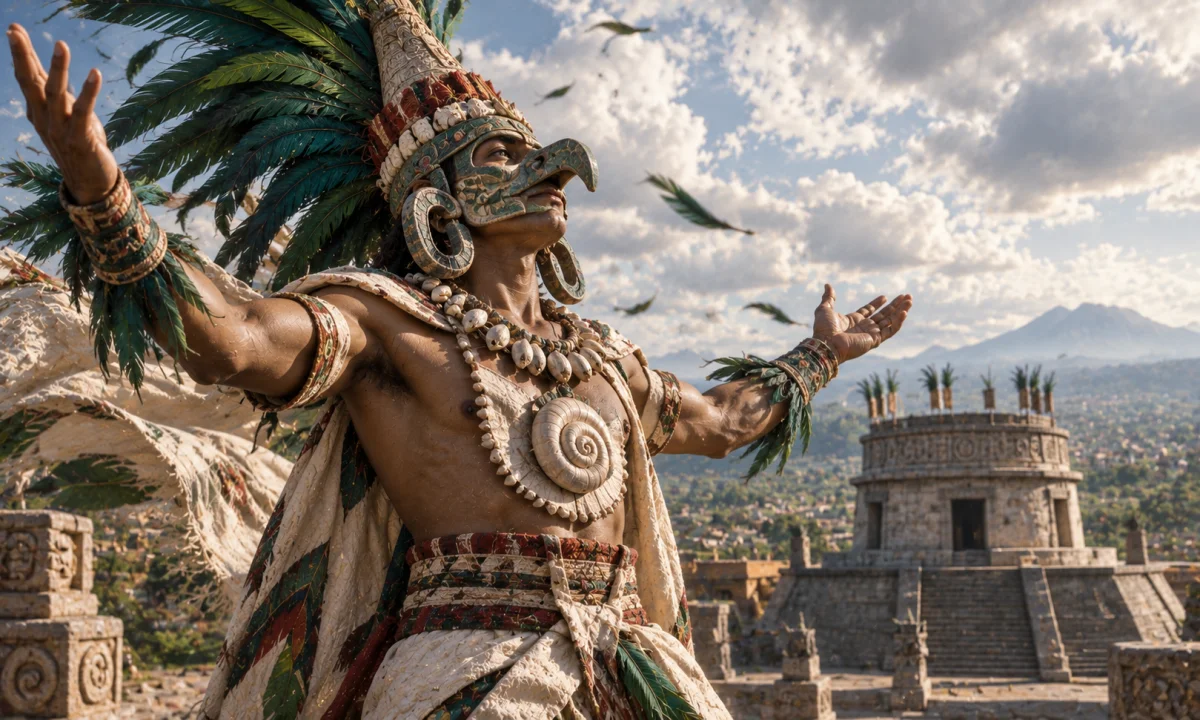
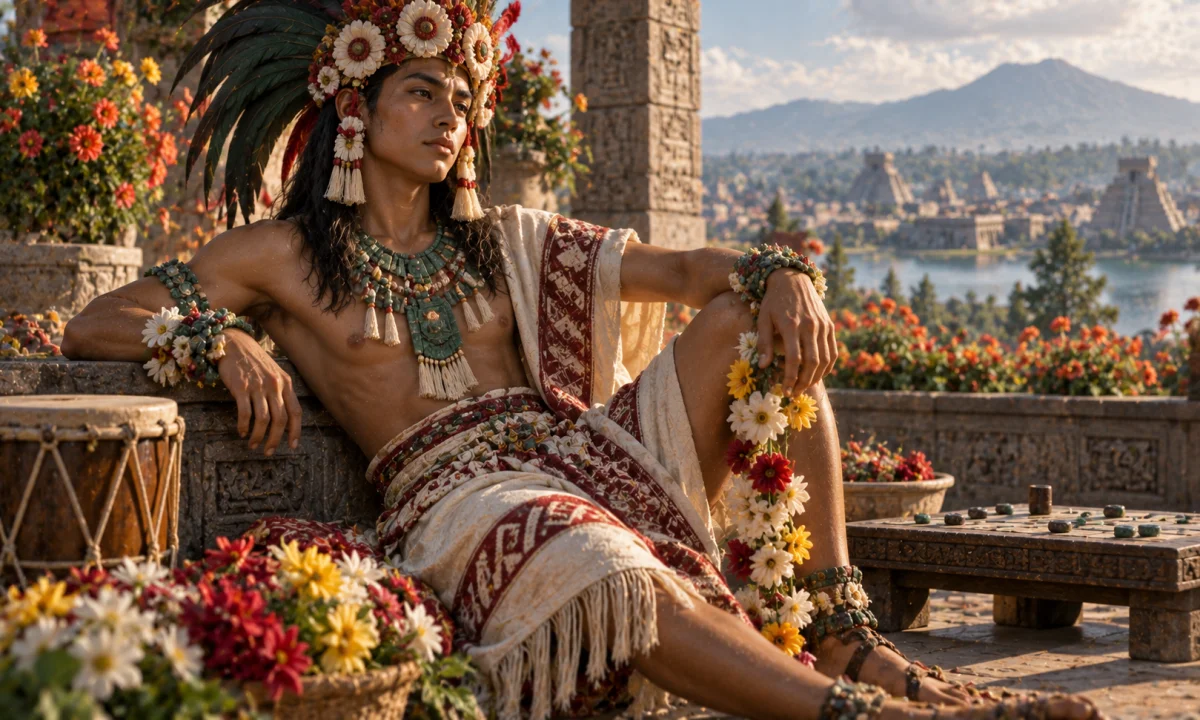
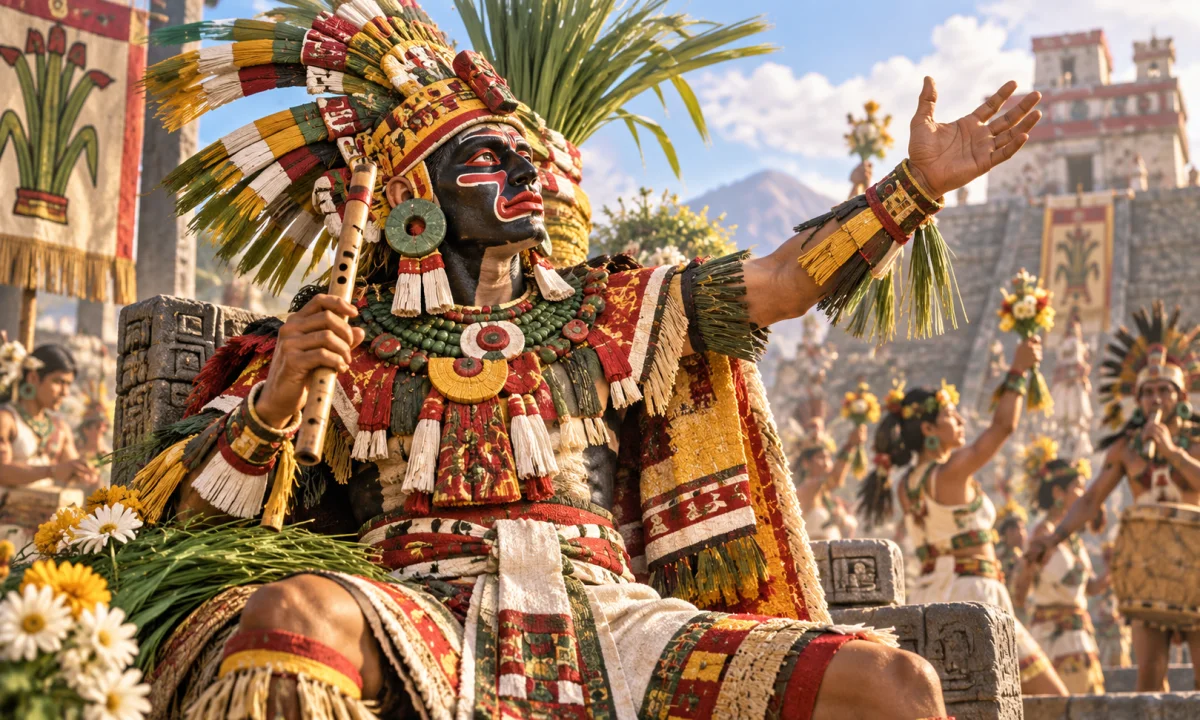
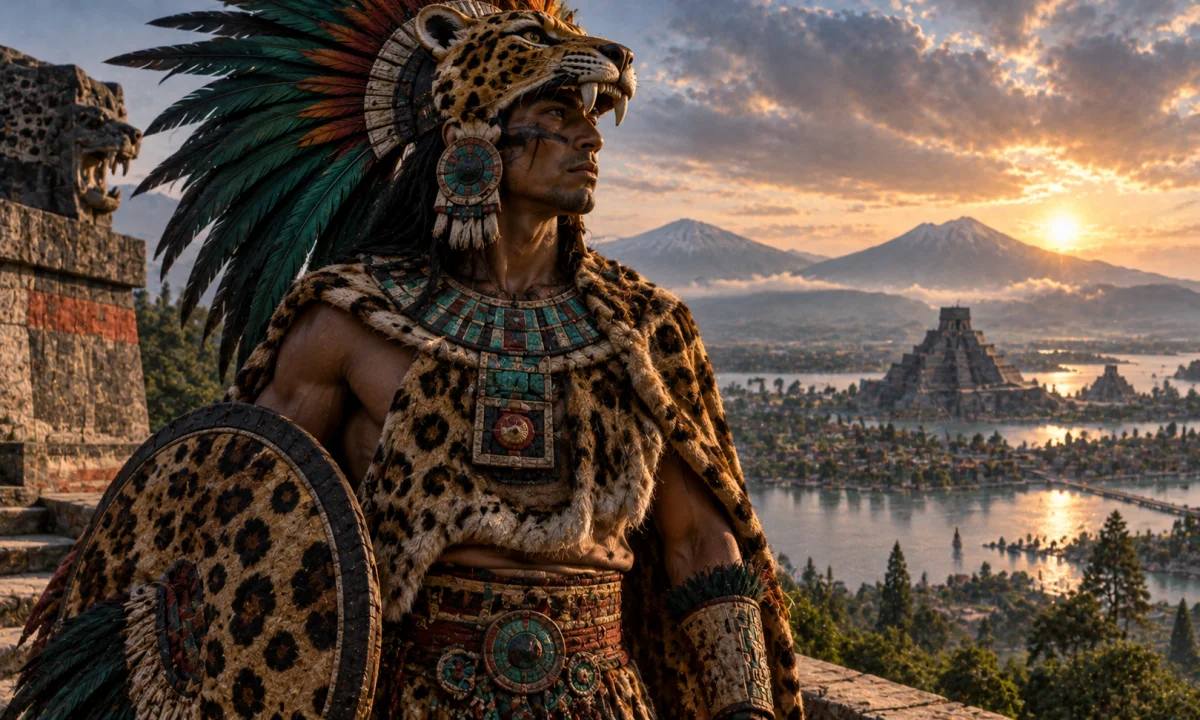
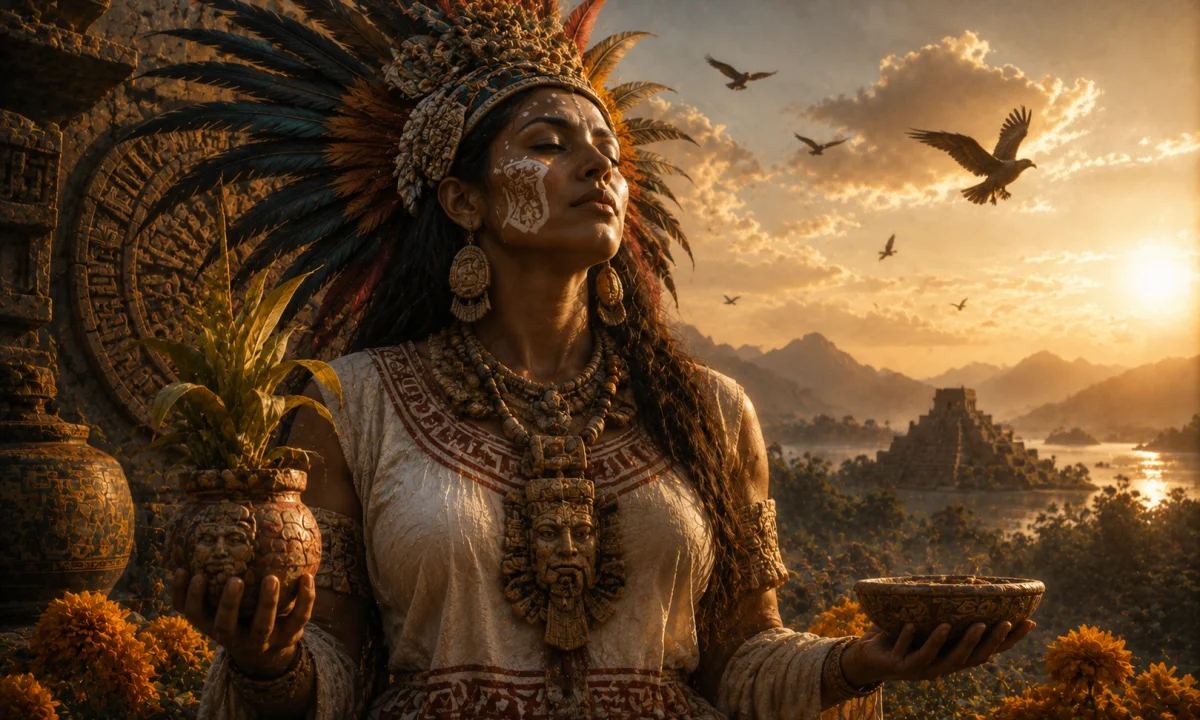
There is no reliable basis for assigning her a standardized physical appearance. Modern illustrations sometimes portray her as a richly dressed Aztec queen or as an elderly mother goddess, but these images are artistic interpretations rather than securely documented ancient representations of Omecihuatl. The surviving evidence does not provide a widely agreed iconographic type for her.
Creation narratives and divine generations
Omecihuatl is sometimes described as one of the ancestors or sources of a group of major gods. In accounts involving the four Tezcatlipocas, the primordial creator pair stands at the beginning of a chain of divine generations. The four figures are often associated with different colors and directions, although the details vary among sources and modern interpretations.
These narratives should not be treated as a single canonical Nahua Bible. Nahua religion had no one universally authorized scripture, and traditions could differ between communities, historical periods and genres. A creation account recorded by a colonial historian may preserve one regional or interpretive version, while a ritual text, pictorial manuscript or later ethnographic tradition may organize the cosmos differently.
The famous story of the creation and destruction of successive worlds, often called the Five Suns, does not always name Omecihuatl directly. The gods who shape or restore the world in those narratives are usually more active participants than the remote primordial pair. Omecihuatl’s importance lies chiefly in the cosmic foundation from which divine activity becomes possible, not in a single universally known adventure.
Relationship to other female figures
Omecihuatl should not be confused with Coatlicue, the earth mother associated with the Mexica and with the birth of Huitzilopochtli. Coatlicue has a strong and distinctive body of myth, imagery and ritual associations, including serpents, earth, fertility and death. Omecihuatl, by contrast, is a more remote figure of primordial duality, and no evidence shows that the two names simply refer to the same goddess.
She is also distinct from Cihuacoatl, whose name means “Woman Serpent.” Cihuacoatl could refer to a powerful deity, a mythic mother figure and a title used by a high Mexica political official. Her associations include childbirth, warfare, lamentation and the earth. The shared element cihuatl means “woman,” but that linguistic similarity does not establish an identity between Cihuacoatl and Omecihuatl.
Likewise, Omecihuatl is not identical by definition with Tonantzin, a Nahuatl term meaning “Our Revered Mother.” Tonantzin could function as a respectful title for a female sacred figure and was used in different historical and religious contexts. It is sometimes connected in popular discussions with other mother goddesses, but the title alone does not prove a direct identification with Omecihuatl.
Gender and sacred duality
Omecihuatl is important for understanding how gender could operate symbolically in Nahua cosmology. Her pairing with Ometecuhtli suggests that creation was not imagined as the product of an exclusively male supreme power. Female and male dimensions were both necessary to cosmic generation.
At the same time, it would be misleading to project modern ideas of gender equality or a simple “goddess-centered” religion onto the evidence. Nahua society had complex gender roles, and divine symbolism cannot be read as a direct description of social life. The paired creator figures express theological complementarity, but they do not by themselves prove that women and men held identical political, economic or ritual positions.
The concept of duality also differs from the idea of two completely separate gods who merely happen to cooperate. Omecihuatl and Ometecuhtli may be understood as distinct named aspects of one cosmic reality. The exact balance between unity and distinction is one of the interpretive difficulties surrounding the tradition.
Modern interpretations and popular culture
Omecihuatl appears today in books, websites, games, novels and spiritual movements that draw on Mesoamerican mythology. Modern presentations often describe her as the supreme Aztec mother goddess, the creator of all life or the female half of an absolute deity called Ometeotl. Some of these descriptions are inspired by genuine Nahuatl terms and colonial traditions, but they frequently combine evidence from different sources into a more unified system than the historical record supports.
The term Ometeotl, commonly translated as “Two God” or “Dual God,” is especially important in modern discussions. Some writers use it as the name of a supreme dual deity made up of Ometecuhtli and Omecihuatl. Scholars have debated how widespread this concept was in pre-Hispanic religion and whether colonial sources present it in a form shaped by European ideas of a single highest god. “Ometeotl” should therefore be treated as an interpretive term whose meaning and historical status require care.
Modern artistic depictions may give Omecihuatl elaborate symbols, fixed colors, specific animals or a detailed mythology not established by early sources. Such creative developments can have value as contemporary cultural expression, but they should be distinguished from documented Nahua tradition. The historical Omecihuatl is best understood as a name connected with a primordial female principle and with the sacred duality of the highest cosmos, within a body of evidence that remains varied and incomplete.