WORLD
WORLD
Cihuacoatl
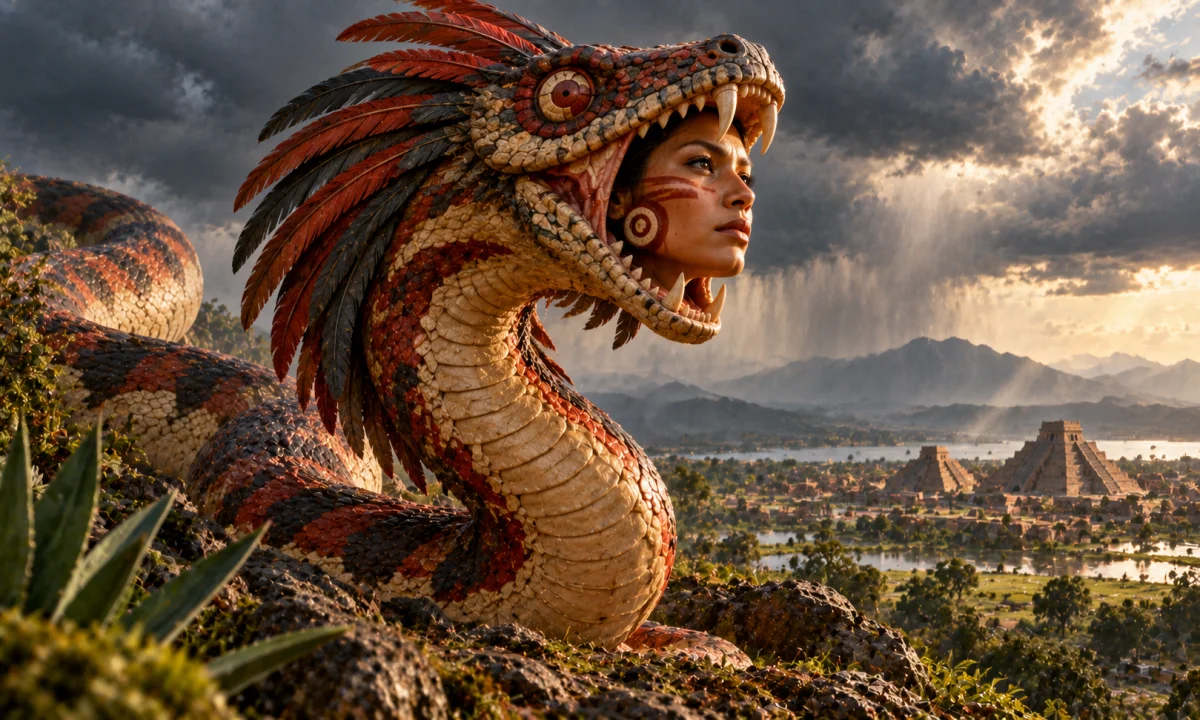
Cihuacoatl was an important female deity and political title in the religious and governmental world of the Nahua peoples, especially the Mexica, commonly called the Aztecs. Her name is usually translated as “Serpent Woman” or “Woman Serpent,” from the Nahuatl words cihuatl, “woman,” and coatl, “serpent.” Cihuacoatl was associated with childbirth, midwives, the earth, warfare, death and powerful forms of motherhood. The same name was also given to one of the highest offices in the Mexica state, creating a close but sometimes confusing relationship between a supernatural figure and a human political institution.
Historical and cultural setting
Cihuacoatl belongs to the religious traditions of Nahua-speaking peoples in central Mexico. The term “Aztec mythology” is widely used, but it can conceal important differences among communities, periods and surviving sources. The Mexica of Tenochtitlan are the best documented group associated with Cihuacoatl, although related religious ideas circulated more widely in Mesoamerica.
Most information about Cihuacoatl comes from early colonial accounts written after the Spanish conquest. These include the Florentine Codex, compiled in Nahuatl with Indigenous informants and scribes under the direction of Bernardino de Sahagún, as well as other colonial histories, vocabularies and pictorial manuscripts. These sources preserve valuable Indigenous traditions, but they were produced in a period of profound political and religious change. Their descriptions may reflect translation choices, Christian interpretation, selective recording or differences between local traditions.
Pre-conquest images and signs also provide evidence, although identifying individual deities in Mesoamerican art is not always certain. A particular headdress, garment or emblem could identify a deity, a priest, a ruler, a ritual role or a broader religious concept. Cihuacoatl therefore should not be treated as a single figure with one universally fixed appearance and biography.
Name and identity
Cihuacoatl is commonly written without accents in English, but forms such as Cihuacóatl and the more linguistically precise Cihuācōātl also appear. The name refers directly to a woman associated with a serpent. In Nahua religious thought, serpents were not simply symbols of evil. They could express the earth, fertility, renewal, dangerous power and connection with water or the underworld. The combination of woman and serpent therefore suggests a being who was fertile and life-giving but also formidable, chthonic and potentially destructive.
Cihuacoatl was both a deity and a title or name connected with other figures. Some colonial sources associate her with Quilaztli, a name or epithet whose exact relationship to Cihuacoatl varies by source. In certain traditions, Cihuacoatl-Quilaztli appears as a powerful ancestral or earth-related goddess. In others, the names may reflect distinct manifestations, local traditions or overlapping religious identities rather than two completely separate beings.
She should not be reduced to a “goddess of snakes.” Her serpent name is one part of a larger religious identity involving women’s reproductive power, the battlefield, the earth and the danger surrounding birth and death.
Roles and religious associations
Childbirth and midwifery
Cihuacoatl was closely connected with childbirth and the women who assisted at birth. Midwives held an important social and ritual position in Nahua communities. Birth was understood as a dangerous passage, and the language used for childbirth could compare a woman’s struggle with the work of a warrior. A woman who died in childbirth could receive an honour similar to that given to a warrior who died in battle, because both were understood to have died in a sacred struggle.
This connection helps explain Cihuacoatl’s combination of maternal and martial qualities. She was not simply a gentle protector of mothers. Her power belonged to the perilous threshold between life and death. The birth chamber could be treated as a battlefield, while a woman who successfully gave birth was praised for her courage.
Midwives invoked religious powers during labour and carried out ceremonies surrounding pregnancy, birth and the disposal of ritual objects. Cihuacoatl’s presence in this context reflects the authority of women’s reproductive knowledge as well as the fear surrounding complications, infant death and maternal mortality.
Earth, fertility and death
Cihuacoatl’s associations with the earth overlap with those of several other Nahua goddesses. The earth could nourish crops and sustain human life, but it could also consume the dead. Fertility was therefore not understood as separate from decay, sacrifice and mortality. A goddess connected with the earth might be both mother and devourer, provider and destroyer.
Descriptions of Cihuacoatl sometimes emphasize a fearsome appearance, including a gaping or fanged mouth, dark or marked features, and clothing or ornaments associated with death. Such imagery should not be interpreted as evidence that she was an evil demon in the later European sense. It expresses the dangerous, consuming and sacred aspects of the earth and of female power.
War and the warrior woman
Cihuacoatl also had a martial dimension. She could be understood as a warrior woman or as a supernatural force supporting warfare. This association was connected to the Nahua comparison between battle and childbirth, but it also reflected the independent religious importance of female warriors and women who died in childbirth. The two groups were sometimes imagined as taking part in cosmic movement after death.
Some descriptions connect Cihuacoatl with weapons, shields or warrior clothing. Other traditions emphasize her broom, a ritual object linked with purification and domestic or ceremonial labour. These features are not necessarily contradictory. The broom can represent ritual preparation and the management of sacred space, while the weapons express her power in conflict. Her identity included both the work of sustaining life and the violence required to defend or transform it.
Appearance and symbols
There is no single portrait of Cihuacoatl accepted across all Nahua sources. She is often imagined as a woman wearing a serpent-related emblem or costume, but specific artistic details differ. In descriptions associated with the Mexica, she may wear a white garment, carry a shield or broom, or display signs of death and frightening supernatural power. Some images show the visual language of an aged or dangerous woman rather than an idealized young mother.
Her appearance may overlap with that of other earth and mother goddesses, particularly Coatlicue, whose name means “She of the Serpent Skirt.” Both figures can be represented through serpents, earth symbolism and maternal power. Their identities are nevertheless not identical. Coatlicue is especially associated with the birth of Huitzilopochtli and with her serpent skirt and necklace of human remains, whereas Cihuacoatl has a stronger association with childbirth, midwives, the political office bearing her name and the lamenting woman of certain colonial accounts.
Images of Cihuacoatl may also use symbols that modern viewers interpret too narrowly. Serpents, bones, dark paint, open mouths and blood were not merely signs of wickedness. In Nahua religious art, they could indicate sacred danger, earth power, sacrifice, transformation and the unstable boundary between life and death.
Myths and relationships
Cihuacoatl does not have one complete mythic cycle preserved in the way that some Greek or Norse deities do. The surviving Nahua material consists of short accounts, hymns, ritual descriptions, historical narratives and references to divine names. These materials do not always agree, and some stories may have been combined by colonial writers who were organizing traditions according to European ideas of mythology.
The name Cihuacoatl-Quilaztli appears in traditions involving primordial or ancestral powers. In some accounts, Quilaztli is connected with Mixcoatl and with the birth or origin of important ancestral groups. The exact genealogy is difficult to establish because Nahua myths often assign several names or manifestations to a deity, and because the sources preserve different versions. It is safer to describe Cihuacoatl as part of a network of earth, mother and ancestral powers than to give her one fixed family tree.
She is also related conceptually to several goddesses who govern different aspects of fertility, sexuality, childbirth, weaving, nourishment and the earth. These figures should not automatically be merged. Tlazolteotl, for example, is associated with sexual transgression, confession, purification and earth-related fertility. Coatlicue is a major earth and mother figure connected with Huitzilopochtli’s birth. Chalchiuhtlicue is strongly associated with water, rivers and fertility. Their domains overlap because Nahua religion did not divide nature into isolated categories, but each has distinctive names, stories and ritual contexts.
The Cihuacoatl political office
One of the most important uses of the name was political. The Mexica government had an official called the Cihuacoatl, often described in modern English as a high official, chief minister, vice-ruler or administrator. The title did not mean that the officeholder was a woman. Several known holders of the office were men, including the influential statesman Tlacaelel.
The Cihuacoatl served as the principal counterpart to the ruler of Tenochtitlan, who is often called the tlatoani. The exact division of authority changed over time and is described differently in colonial sources, but the office was connected with judicial matters, administration, tribute, military affairs and the functioning of the capital. The Cihuacoatl could act with considerable authority, especially when the ruler was absent or when government decisions required a powerful administrator.
Naming a political office after a goddess did not mean that the official was believed to be literally female or physically transformed into the deity. It expressed an institutional relationship with the sacred power represented by Cihuacoatl. The title may have evoked authority over the land, the community, justice, warfare and the ordering of society. The office demonstrates that Cihuacoatl was not only a figure of private or domestic religion; her name could authorize the highest levels of state power.
The political title also complicates modern descriptions of Cihuacoatl as simply an Aztec “mother goddess.” Her religious identity included maternal and reproductive power, but the office named after her was associated with administration and statecraft. It shows how gendered symbolism could operate in a political system without limiting the title to female officeholders.
Cihuacoatl and the lamenting woman
Early colonial accounts describe a mysterious woman who was heard or seen lamenting at night. In the Florentine Codex’s account of signs preceding the Spanish conquest, one omen involves a woman crying out for her children and expressing grief about their departure or destruction. Later writers and popular tradition connected this figure with Cihuacoatl.
This association is important but should be treated carefully. The colonial omen is not a complete version of the modern story of La Llorona, the Weeping Woman. La Llorona is a broad and changing tradition found in many parts of Mexico and elsewhere in Latin America. Its best-known versions tell of a woman who drowns or loses her children and then wanders while crying for them. These stories developed through Indigenous, European and colonial influences, and their forms vary greatly by region.
Some scholars and storytellers see the lamenting Cihuacoatl as an important pre-Hispanic background to La Llorona. Others stress that the surviving evidence does not prove a simple, uninterrupted identity between the Mexica goddess and every later Weeping Woman story. Colonial Christian ideas about sin, punishment, maternal guilt and restless ghosts strongly shaped later versions. Cihuacoatl should therefore not be described as merely the original name of La Llorona, although the connection is historically and culturally meaningful.
Interpretation and significance
Cihuacoatl brings together several forms of power that modern categories often separate: motherhood and warfare, fertility and death, household labour and state authority, protection and danger. Her mythology reflects a worldview in which birth was a perilous struggle, the earth both nourished and consumed human beings, and political order was linked with sacred forces.
Her serpent identity is especially significant. A serpent can move close to the ground and therefore symbolize the earth, but it can also shed its skin and suggest renewal. Serpents may be dangerous, hidden and difficult to control, qualities that suit a deity associated with childbirth, war and death. The name “Serpent Woman” presents femininity not as weakness but as a source of generative and destructive power.
Cihuacoatl also reveals the limits of translating Nahua religion into the language of a modern pantheon. Calling her a “goddess” is useful, but it can imply a fixed individual personality and neatly bounded sphere of influence. Nahua religious names could refer to deities, manifestations, ritual identities, offices and symbolic roles. The surviving evidence suggests that Cihuacoatl was a major sacred power, but the exact boundaries between her and related female earth figures varied according to source and context.
Later reception
Cihuacoatl appears in modern discussions of Mesoamerican religion, Indigenous history and Mexican folklore, particularly in connection with La Llorona. She is also used in novels, comics, games and fantasy settings, where her name may be presented as that of a serpent monster, a warrior queen or a generalized Aztec goddess. Such adaptations often simplify or rearrange her traditional associations.
Modern portrayals are most accurate when they distinguish the historical Nahua deity from the later political title and from the many forms of La Llorona. Cihuacoatl was not merely a monster, a ghost or a fertility symbol. She was a complex sacred and political name, rooted in Nahua ideas about women’s reproductive power, the earth, warfare, death and the authority required to govern a community.