WORLD
WORLD
Olokun
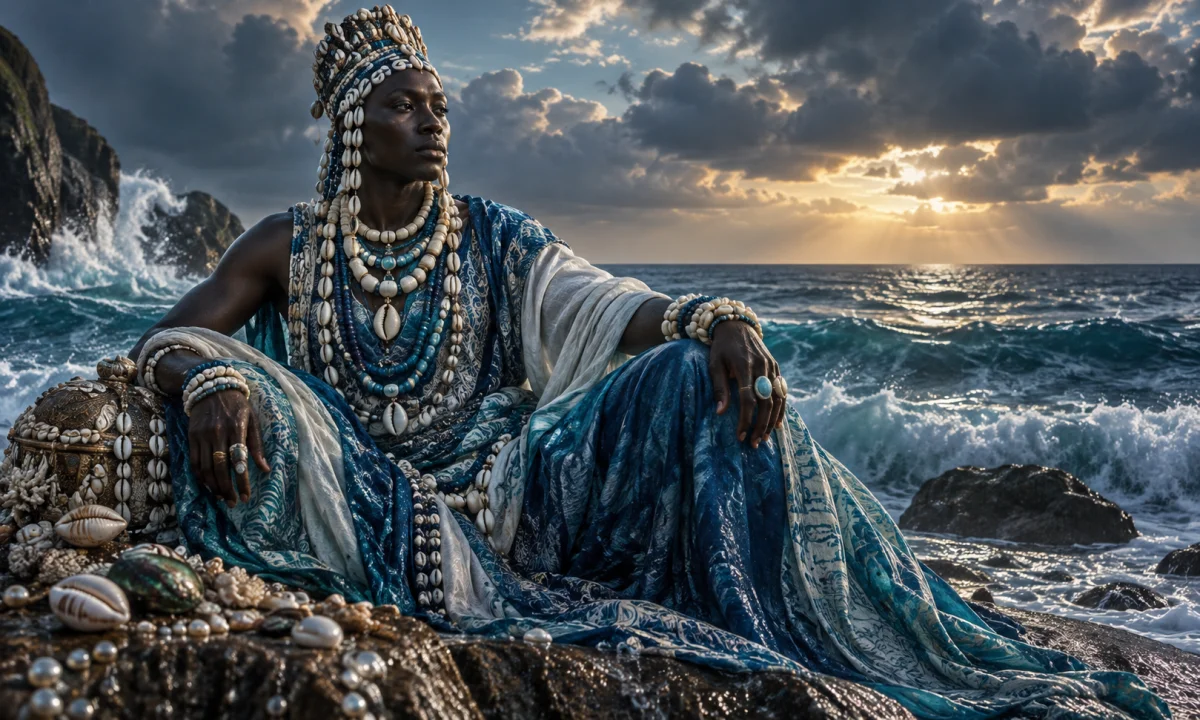
Olokun is a powerful divinity in Yoruba religious tradition, associated above all with the sea, its immense depths, its hidden riches and the forces that lie beyond ordinary human understanding. The name is commonly written Olókun in Yoruba, and is often interpreted as “owner of the sea” or “one who possesses the sea.” Olokun is connected with wealth, prosperity, health, fertility and profound spiritual mystery, but the exact nature and gender of the divinity vary between Yoruba regions and later religious traditions.
Olokun in Yoruba religious tradition
Yoruba religion does not depend on a single canonical book that defines every orisha in exactly the same way. Religious knowledge has been preserved through oral history, praise poetry, divination verses, ritual practice, songs, priestly training, family traditions and local interpretations. As a result, accounts of Olokun can differ without one version necessarily replacing all others.
In Yoruba cosmology, Olokun belongs to the broad class of òrìṣà, powerful sacred beings who govern or embody aspects of existence and who mediate between human beings and the supreme creator, commonly called Olódùmarè or Ọlọ́run. Olokun’s realm is the ocean, especially the deep sea rather than only the visible shoreline. The sea represents abundance and danger at the same time: it can provide fish, trade and wealth, yet it can also conceal storms, shipwrecks, drowning and unknown powers.
This combination helps explain Olokun’s distinctive character. The divinity is frequently regarded as generous and capable of granting prosperity, but also as remote, formidable and not easily approached. The ocean’s surface may appear calm while its depths remain invisible. In religious imagination, that hidden depth corresponds to spiritual knowledge, secret power, destiny and the limits of human control.
Name, gender and identity
The name Olókun is generally understood as a title or descriptive name connected with the sea. Yoruba compounds beginning with oló can express ownership, authority or association, while okun may refer to the sea or ocean. Interpretations of the name can vary slightly according to language, context and spelling, but its maritime meaning is well established.
Olokun does not have one universally fixed gender across all traditions. In many Yoruba contexts, Olokun is described as male. In other communities, the divinity is female, or is represented in a way that does not fit neatly into a male-female division. Some traditions emphasize Olokun’s royal or masculine authority, while others stress an oceanic, fertile and maternal dimension.
Gender differences become especially visible in the African diaspora. In Cuban Lucumí or Regla de Ocha, Olokun is often treated as a deep-ocean or underwater orisha whose nature can be described as dual, secretive or beyond ordinary gender categories. Other Caribbean interpretations may present Olokun differently from both Yoruba and Cuban practice. These are not simply errors in one tradition; they reflect the preservation, transformation and combination of religious knowledge under different historical conditions.
Olokun should therefore not be reduced to a single image or family relationship. A description of the divinity as male, female, androgynous or gender-fluid may be accurate within a particular community, but should not automatically be applied to every Yoruba or diaspora tradition.
The sea as Olokun’s domain
Olokun’s ocean is more than a geographical location. It is a sacred space associated with depth, secrecy, wealth and transformation. The surface world is familiar and visible; the deep sea is hidden, difficult to measure and populated by powers that humans cannot fully command. This makes Olokun an important figure for thinking about both material and spiritual abundance.
The sea’s wealth may include fish, shells, precious materials and the prosperity produced by coastal trade. In a wider symbolic sense, Olokun may grant financial success, fertility, dignity and the resources needed for a stable life. Devotees may also appeal to Olokun for protection from illness, misfortune and the destructive aspects of the ocean.
Yet wealth associated with Olokun is not necessarily simple or safe. The deep sea can give, but it can also take away. Its treasures are concealed, and access to them may require discipline, ritual knowledge and respect. This ambivalence distinguishes Olokun from a merely benevolent “god of the sea.” Olokun’s power includes the ocean’s unpredictability, authority and capacity to overwhelm human beings.
Because the sea connects distant lands, Olokun can also be associated with travel, exchange and contact between communities. These associations should not be treated as a fixed list of powers found in every locality, but they fit the broader Yoruba understanding of the ocean as both a source of livelihood and a boundary between known and unknown worlds.
Appearance and sacred imagery
Representations of Olokun vary widely. The divinity may appear as a richly dressed ruler, an imposing human figure, a mermaid-like being, or a form connected with fish and other marine imagery. In some settings, Olokun’s image is deliberately mysterious or partially concealed, reflecting the hidden nature of the ocean’s depths.
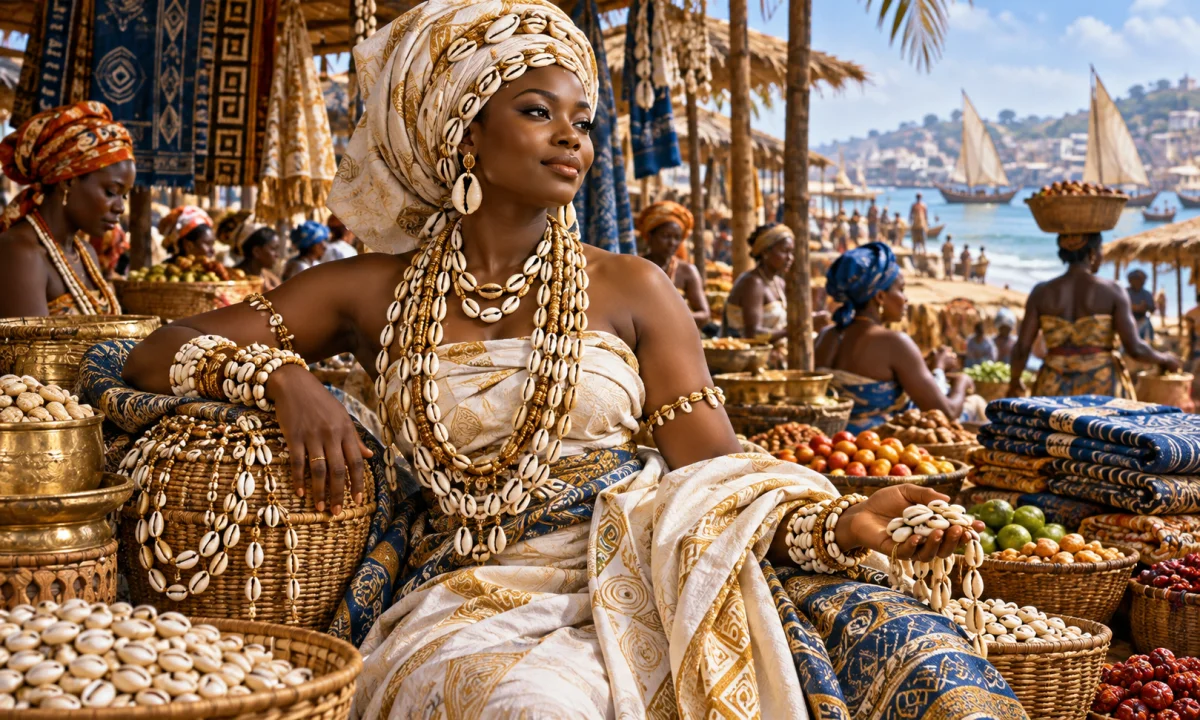
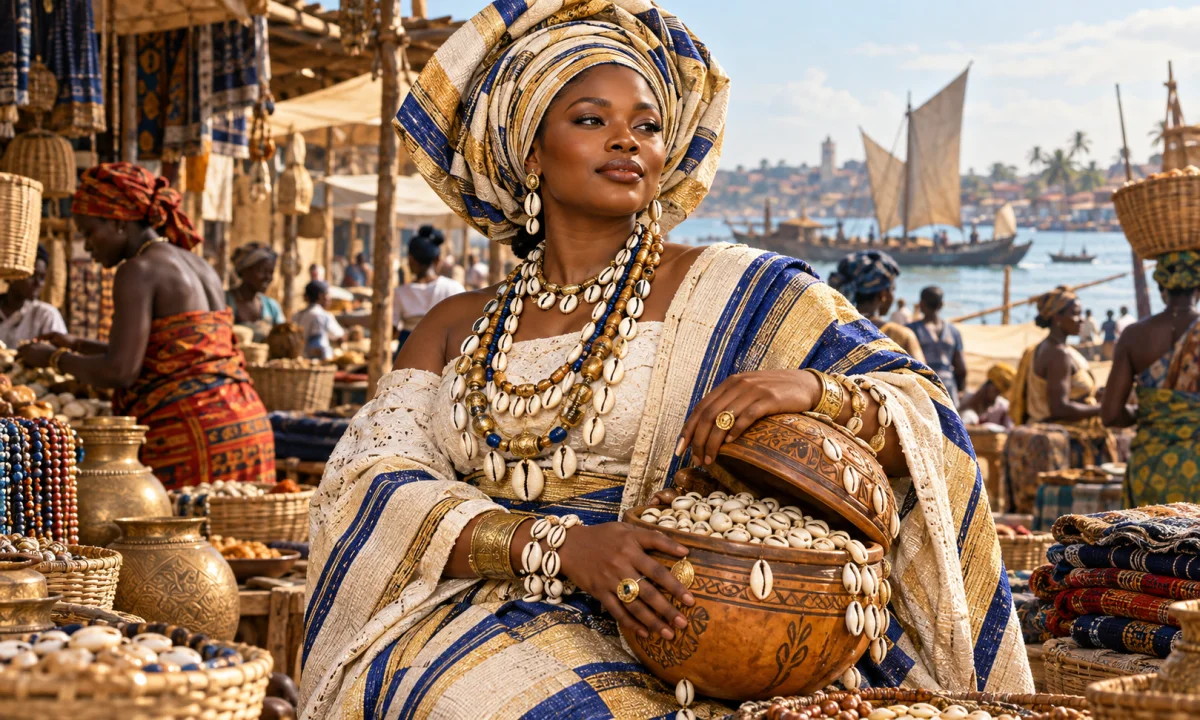
Blue and white are frequently associated with Olokun in Yoruba-derived traditions, although colours and ritual conventions are not identical everywhere. Blue may suggest the sea, while white can express purity, spiritual power or the luminous wealth found beneath the water. Beads, shells, coral and other objects connected with water or luxury may also appear in sacred contexts.
Mermaid imagery deserves particular care. A water spirit with a human upper body and fish-like lower body can be a meaningful representation of Olokun in some communities, especially in the African diaspora. It should not automatically be treated as the original or universal form of the Yoruba divinity. Mermaid and water-spirit imagery has developed through several cultural histories, including African, European and Atlantic traditions, and its significance changes from one religious setting to another.
Stories and relationships
There is no single authoritative Olokun story accepted throughout the Yoruba-speaking world. Oral traditions often exist in multiple versions, and some narratives are preserved through local performance rather than through a fixed written text. Several recurring themes nevertheless appear in accounts of Olokun.
One group of stories presents Olokun as an ancient and immensely powerful ruler of the watery realm. In versions connected with the creation of the earth, Olokun’s domain is already established while the ordered human world is being formed. The relationship between the sea and the land becomes a relationship between two great powers, neither of which can be understood in isolation.
Some narratives describe a conflict or rivalry between Olokun and Odùduwà, a foundational figure associated in many Yoruba traditions with the establishment of a political order at Ilé-Ifẹ̀. In these versions, Olokun resists the authority of the emerging land-based kingdom, or becomes involved in a contest over supremacy. A flood may follow, and the story can end with Olokun’s power being restrained, acknowledged or maintained in a separate realm.
These stories should not be presented as a single agreed account of creation. Yoruba traditions about Odùduwà, the origin of the earth and the relationship between land and water differ considerably. Some accounts focus on divine creation, while others emphasize political ancestry, sacred geography or the prestige of Ifẹ̀. The Olokun narratives connected with these themes are best understood as one important group of traditions rather than as a complete biography.
Other stories connect Olokun with fertility, childbirth and the preservation of life. Water is essential to living beings, and the ocean is imagined as a vast source of generative power. However, claims that Olokun is universally the parent, spouse or sibling of another orisha are often too broad. Relationships vary among local traditions and should be identified only when they belong clearly to a particular account.
Olokun and Yemoja
Olokun is frequently compared with Yemọja, also written Yemoja or, in many diaspora traditions, Yemayá. Both are associated with water, but they are not simply two names for the same divinity.
In many Yoruba traditions, Yemọja is associated with rivers, motherhood, fertility and the protection of children. Her name is commonly connected with the Ògùn River and the phrase “mother whose children are fish,” although interpretations and local practices vary. Olokun, by contrast, is more strongly connected with the sea’s deep, distant and concealed power.
The two may be related in particular communities, and their identities have sometimes overlapped as Yoruba religious traditions moved across regions and the Atlantic. In some diaspora systems, Yemayá is strongly identified with the open sea, while Olokun is understood as the deep ocean beneath it. This distinction is useful but not universal. It is better to speak of related and sometimes overlapping water traditions than to impose one rigid map on every community.
Olokun should also be distinguished from other water beings, including river spirits, local water mothers and mermaid figures. Shared symbols such as shells, fish, blue garments or flowing water do not prove that all these beings are the same.
Olokun, wealth and human destiny
Olokun’s relationship with wealth has both practical and spiritual dimensions. Coastal societies may depend on fishing, trade and maritime exchange, while shells, beads and other sea-related materials have carried economic and ceremonial value in different historical settings. The ocean therefore represents tangible prosperity as well as the mysterious source of fortunes that appear unexpectedly.
Within Yoruba religious thought, prosperity is not necessarily measured only by money. It can include health, children, social dignity, good character, protection and a favourable destiny. Olokun’s depth makes the divinity especially relevant to the idea that important blessings may be hidden before they become visible. At the same time, hidden wealth can create danger if pursued without restraint or moral responsibility.
Olokun’s connection with destiny should not be confused with the role of Òrúnmìlà, the orisha associated with Ifá divination and wisdom, or with the òrì, the individual spiritual head or destiny. Olokun may appear in divinatory verses and ritual interpretations, but this does not make Olokun the sole ruler of destiny or the equivalent of Òrúnmìlà.
Ritual and religious significance
Worship of Olokun is maintained through specific communities, lineages and religious specialists. Practices may include praise names, songs, prayers, offerings, consecrated objects, initiation or other rites determined by the tradition of a particular shrine or priestly house. There is no single worldwide ritual system that represents all Yoruba devotees.
In many traditions, Olokun is approached with respect for the divinity’s exceptional power. Ritual objects associated with the sea may be kept in sacred vessels or shrine settings, and water, shells, beads and white or blue materials may be significant. Such objects should not be treated as decorative symbols alone: within a living religious setting, they may be consecrated and connected with a lineage’s spiritual authority.
Olokun also appears in the corpus of Ifá knowledge. Divination verses can refer to orishas, historical figures, moral choices, illnesses, sacrifices and relationships among divine powers. The presence of Olokun in such material does not produce one standardized myth. Instead, it shows how the divinity participates in a larger system of interpretation in which personal circumstances, communal obligations and sacred narratives are considered together.
Historical and cultural setting
Yoruba-speaking peoples have never formed a completely uniform religious community. Their societies have included many kingdoms, towns and local cultural traditions, with important centres such as Ilé-Ifẹ̀, Ọ̀yọ́ and other regions contributing different religious emphases. Accounts of Olokun are shaped by this diversity and by the importance of coastal and inland connections.
Written descriptions produced by outsiders recorded only part of Yoruba religious life and sometimes forced local concepts into European categories such as “god,” “spirit” or “myth.” Modern scholarship and community-based religious knowledge therefore need to be read together carefully. A written account may preserve valuable information while still reflecting the observer’s language, assumptions and historical circumstances.
The transatlantic slave trade carried Yoruba religious ideas to the Caribbean and the Americas, where they survived under severe oppression and developed in new forms. In Cuba, Brazil and elsewhere, Olokun became part of religious systems shaped by Yoruba heritage, other African traditions, Catholic colonial conditions and local history. These traditions are historically related to Yoruba religion, but they should not be treated as unchanged replicas of practices in Yorubaland.
Olokun in the African diaspora
In Lucumí or Regla de Ocha, Olokun is widely revered as an orisha of the ocean depths, mystery, health, wealth and protection. Different houses and lineages may describe Olokun’s gender, symbols and ritual relationship with Yemayá in different ways. Some emphasize a hidden or enclosed presence, expressing the dangerous and inaccessible nature of the deep sea.
In Brazilian Candomblé and other African-derived religions, water divinities and Yoruba-derived orishas have developed within distinct ritual and historical environments. The names, ceremonies and relationships used in one tradition should not automatically be transferred to another. The continued presence of Olokun in these religions demonstrates cultural survival and creative adaptation, not a single uniform doctrine.
Distinguishing Olokun from similar figures
- Olokun and Yemọja: Both are connected with water, but Olokun is especially associated with the deep sea, hidden wealth and mystery, while Yemọja is often associated with rivers, motherhood and children. Their identities may overlap in particular traditions.
- Olokun and Ọ̀ṣun: Ọ̀ṣun is primarily associated with the Ọ̀ṣun River, beauty, love, fertility, diplomacy and sweet water. She is not simply another name for Olokun.
- Olokun and Olosa: Olosa is a distinct water-related divinity in Yoruba traditions. Similar aquatic associations do not make Olosa and Olokun interchangeable.
- Olokun and Mami Wata: Mami Wata is a broad and historically complex group of African and African-diaspora water-spirit traditions. Some images or practices may overlap with representations of Olokun, but Mami Wata is not merely a universal alternative name for the Yoruba orisha.
- Olokun and Edo Olokun: The name and sea associations also occur in Edo religious and cultural contexts. Yoruba and Edo traditions have interacted historically, but a figure from one tradition should not be automatically merged with the corresponding figure in the other.
Contemporary meaning
Olokun remains a living religious presence rather than only a character from ancient mythology. Devotees may understand the divinity through family inheritance, initiation, divination, shrine traditions and personal spiritual experience. For many people, Olokun represents the majesty of the ocean, the possibility of abundance, the protection of health and the recognition that much of reality lies beyond ordinary sight.
Modern paintings, jewellery, music, festivals and popular retellings often portray Olokun as a glamorous mermaid or as a generalized ocean goddess. Such images can make the figure more visible, but they may simplify the diversity of Yoruba and diaspora traditions. The traditional significance of Olokun lies not only in an attractive aquatic form, but in a complex sacred power joining wealth and danger, concealment and revelation, fertility and overwhelming depth.