WORLD
WORLD
Tengu
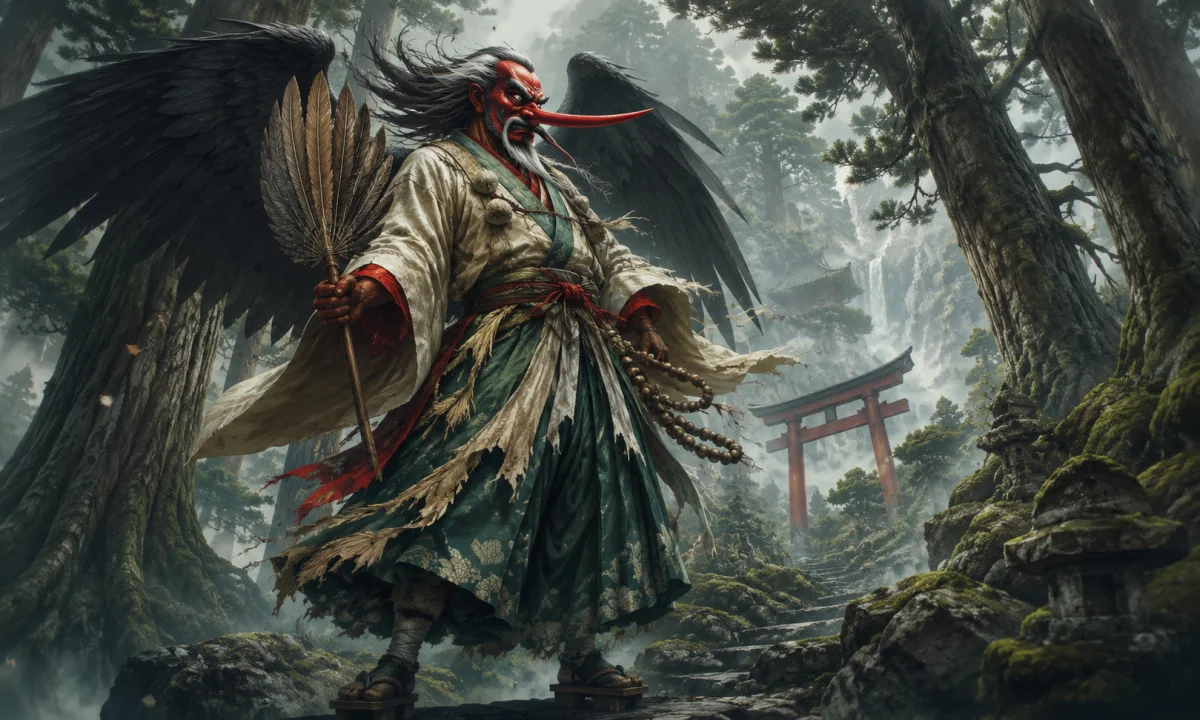
Tengu are supernatural beings of Japanese mythology associated especially with mountains, forests, religious discipline and martial skill. They are often depicted either as birdlike humanoids with wings and beaks or as red-faced figures with unusually long noses. Their character has changed considerably over time: early traditions portray them as dangerous spirits connected with Buddhism and the wilderness, while later folklore also presents them as guardians, teachers, tricksters and protectors of sacred mountains.
Origins and cultural setting
The history of the tengu reflects the interaction of several traditions rather than a single, fixed mythology. Their name and some of their earliest characteristics were influenced by Chinese ideas, while their later identity developed within Japanese Buddhist storytelling, mountain worship and local folklore.
The word tengu is written with characters that can be read literally as “celestial hound” or “heavenly dog.” This name was associated in Chinese tradition with the tiangou, a supernatural dog-like being and an ominous celestial sign. In China, the term could be connected with comets, meteors or other disturbances in the sky. When the word entered Japanese literary and religious culture, however, it did not retain one perfectly consistent meaning.
One early Japanese reference appears in the Nihon Shoki, a court chronicle compiled in the eighth century. It describes a strange sound in the sky that was interpreted as the voice of a tengu. The passage does not present the familiar long-nosed mountain spirit of later folklore. Instead, it shows that the word initially belonged to a wider vocabulary of celestial omens and supernatural disturbances.
Over succeeding centuries, tengu became increasingly connected with remote mountains. This setting was shaped by Shugendō, a Japanese religious tradition involving mountain asceticism, ritual practice and the cultivation of spiritual powers. Shugendō drew on Buddhist, local Japanese and other religious influences. Its practitioners, known as yamabushi, were often imagined as possessing unusual abilities because they lived and trained in difficult mountain environments.
Mountains were not regarded simply as empty wilderness. They could be places of divine presence, dangerous spirits, hidden religious communities and encounters with the otherworldly. Tengu became part of this landscape. Their appearance in stories could signal the risks of entering sacred or untamed territory, but it could also suggest access to secret knowledge and extraordinary discipline.
Name and classification
Tengu is both singular and plural in English usage, although Japanese does not require the same plural marking as English. The word may refer to a specific being, a local group of spirits or the broader category of supernatural mountain beings.
Traditional descriptions are not uniform. Some sources treat tengu as demons or hostile spirits; others associate them with mountain deities, powerful local beings or the restless souls of people who died with excessive pride. In Buddhist moral narratives, tengu could be linked to arrogance, spiritual error and attachment to worldly reputation. In popular religion, they could also become protectors of a mountain, shrine or village.
Later classifications commonly distinguish between karasu tengu, or crow tengu, and daitengu, often called “great tengu.” These categories are useful for discussing familiar imagery, but they should not be treated as an unchanging system found in every early source. The terms and visual distinctions developed over time, and local traditions may use different names or descriptions.
Appearance
The oldest Japanese depictions and literary descriptions tend to give tengu more birdlike features than the best-known images of today. They may have wings, claws, beaks or dark feathers. The crow tengu, sometimes called karasu-tengu or kotengu in later usage, preserves much of this avian character. It is often shown as a small or medium-sized humanoid with a crow-like head, wings and a sharp beak.
The long-nosed tengu became especially prominent in later medieval and early modern art. This form usually has a humanlike body, a red face, a very long nose, intense eyes and sometimes a beard. It may wear the clothing of a mountain ascetic, including robes, a small cap or a tokin-like head covering. It is frequently shown carrying a staff, sword or fan.
The long nose is not simply a literal representation of a dog. Its development is usually understood as the result of changing artistic conventions, visual resemblance to certain religious and folkloric figures, and the gradual transformation of the tengu from a birdlike spirit into a distinctive humanoid being. The connection between the nose and the tengu’s character is also symbolic: a conspicuous nose can suggest pride, self-importance or an imposing supernatural presence.
Images of tengu often include one or two wings, mountain clothing, wooden sandals and a feathered fan. The fan is especially associated with the long-nosed type. In legends and theatrical representations, it may raise or lower the wind, although the fan’s exact powers vary by story. Tengu masks exaggerate the red face, long nose and fierce expression, making the being immediately recognizable in festivals, religious performances and decorative art.
Powers and behaviour
Tengu are commonly credited with supernatural strength, speed and skill in combat. They may fly through the air, vanish into forests, create sudden winds, imitate human voices or mislead travellers. Some tales describe them carrying people away, causing illness or punishing those who enter the mountains disrespectfully. Others portray them as masters of swordsmanship who teach techniques unavailable to ordinary humans.
Their powers are often ambiguous rather than purely benevolent or evil. A tengu may be dangerous to a boastful person but helpful to someone who shows courage, humility or devotion. It may punish the breaking of a mountain taboo, yet defend a sacred place from worse threats. This variability is an important feature of tengu folklore. They are not equivalent to a single standardized category such as “devil” or “monster.”
In Buddhist-influenced stories, tengu are frequently associated with pride. A person who boasts of spiritual attainment, martial ability or social status may become a tengu after death, or may attract a tengu’s attention. Such stories use the supernatural being to warn against mistaking worldly reputation for genuine enlightenment. The danger is not only physical attack but spiritual delusion.
At the same time, the association with pride did not prevent tengu from being admired. Their independence, physical prowess and mastery of the mountains could make them appealing figures. In some traditions they function as guardians of religious sites or as powerful allies of heroes. Their moral position therefore remains unstable, shifting between demon, spirit, deity-like guardian and wild teacher.
Tengu in religious and literary traditions
Medieval Japanese Buddhist literature played a major role in shaping the familiar image of the tengu. Collections of miracle tales and sermons presented them as beings encountered by monks, ascetics and travellers. These accounts often interpreted strange mountain events through a Buddhist framework, linking tengu to delusion, karmic consequence and the dangers of religious vanity.
The Konjaku Monogatari-shū, compiled in the late Heian period, contains stories involving beings and events later associated with tengu traditions. Other medieval setsuwa collections also describe supernatural encounters in which monks are deceived, abducted or tested by mountain spirits. The term did not always carry exactly the same meaning in these texts, and the stories should not be read as evidence for one universally accepted tengu doctrine.
Some Buddhist institutions developed elaborate accounts of tengu communities in the mountains. These beings could be portrayed as organized groups with leaders, rivalries and military abilities. Such narratives sometimes reflected tensions between different religious centres or used supernatural warfare as a way to describe conflicts over authority and sacred territory.
The famous figure Sōjōbō, described in later tradition as the king of the tengu of Mount Kurama, belongs to this broad world of mountain mythology. Mount Kurama, north of Kyoto, became associated with esoteric practice, powerful spirits and martial legends. Sōjōbō is particularly known from stories about the young Minamoto no Yoshitsune, who was then called Ushiwakamaru.
According to later legend, Sōjōbō taught Ushiwakamaru military techniques and swordsmanship during the boy’s time at Mount Kurama. The story contributed to Yoshitsune’s reputation as a brilliant warrior. It is a legendary account, not a securely documented historical explanation of how the historical Yoshitsune learned martial skills. Versions differ, and Sōjōbō’s role is primarily that of a supernatural teacher in the developing heroic tradition.
Mountains, ascetics and martial arts
Tengu are especially connected with steep mountain paths, waterfalls, caves and forests. In folklore, these locations mark a boundary between ordinary society and a spiritually charged world. A traveller who hears strange laughter, sees an impossible figure or suddenly loses the path may be experiencing a tengu encounter.
The connection with yamabushi has several meanings. Tengu may imitate the appearance of mountain ascetics, wear similar clothing or be mistaken for them at a distance. The resemblance also reflects the ambiguous reputation of religious specialists who possessed secret knowledge and moved through remote places beyond the control of ordinary communities.
Stories of tengu teaching martial arts became increasingly important in medieval and early modern Japan. A human warrior might receive instruction from a tengu, defeat one in a contest or learn that apparent supernatural power was actually the result of extraordinary training. These tales support the image of the tengu as a master of technique, but they also preserve the warning that excessive confidence can lead to humiliation.
The sword is not an original or universal attribute of every tengu. It is most relevant to particular legends, especially those involving warrior heroes and the mountain traditions that grew around them. Similarly, not every tengu is a teacher or protector. Their roles depend on the story, region and period.
Important variants and related figures
Karasu tengu are the birdlike or crow-headed form most clearly connected with the older avian imagery. They may be depicted as attendants, minor spirits or agile mountain beings. In some modern descriptions, they are treated as a lower rank beneath the great tengu, but this hierarchy is not equally important in all traditions.
Daitengu are generally larger, more powerful and more humanlike. The familiar red face and long nose belong mainly to this form. A daitengu may rule other tengu, inhabit a particular mountain or act as a formidable teacher and guardian. Again, local traditions and artistic conventions vary, so the term should not be assumed to have one fixed meaning everywhere.
Sarutahiko Ōkami is sometimes compared with or identified with tengu because of his prominent nose, imposing appearance and association with crossroads and divine guidance. In Shinto mythology, however, Sarutahiko is a distinct kami. His role in the descent of the heavenly grandchild and his relationship with Ame-no-Uzume belong to a different mythological context. Similar physical imagery does not make Sarutahiko a tengu.
Tengu are also sometimes confused with oni. Oni are usually represented as horned, powerful ogre-like beings and have their own mythological and religious histories. A tengu may be frightening and may be described as a demon in a Buddhist text, but it does not thereby become an oni. Nor are tengu simply equivalent to Western demons, fairies or bird monsters. Comparisons can be useful, but they should not erase the particular Japanese traditions in which tengu developed.
Cultural significance
Tengu express the tension between civilization and wilderness, religious discipline and arrogance, fear and admiration. They inhabit places where human beings may encounter forces that are difficult to control or interpret. Their stories can reinforce respect for mountains and sacred sites while also providing comic, dramatic or cautionary entertainment.
Their association with pride is particularly significant. A tengu’s exaggerated nose, grand manner and supernatural confidence make the being an image of self-importance. Yet the same characteristics can represent independence and mastery. A story may mock the tengu’s vanity, admire its strength or use both responses at once.
Local festivals, shrine traditions, masks, paintings and theatrical performances have kept tengu imagery visible in Japanese cultural life. In some communities, a tengu procession or mask is connected with protection, purification or the identity of a particular mountain region. These local uses do not always preserve the same beliefs found in medieval Buddhist tales.
Modern reception
Tengu remain widely recognizable in modern Japan and abroad. They appear in novels, manga, anime, films, video games, fantasy literature and role-playing games. Modern works may emphasize their wings, swordsmanship, shapeshifting, long noses or connection with mountain clans. Some reinterpret them as heroic protectors, while others make them comic, sinister or romantic characters.
These adaptations draw on genuine traditional features but often combine forms that developed in different periods. A single modern tengu character might possess the crow wings of an older birdlike spirit, the red face and long nose of a later daitengu, and the warrior abilities of medieval legends. That combination can be artistically effective, but it should be distinguished from any one historical or religious description.
In traditional contexts, tengu are best understood as a changing family of Japanese supernatural beings whose meanings range from ominous mountain spirits to powerful guardians and teachers. Their enduring appeal comes from precisely this uncertainty: they stand at the boundary between animal and human, demon and deity, danger and wisdom, and wild nature and religious authority.