WORLD
WORLD
Metzli
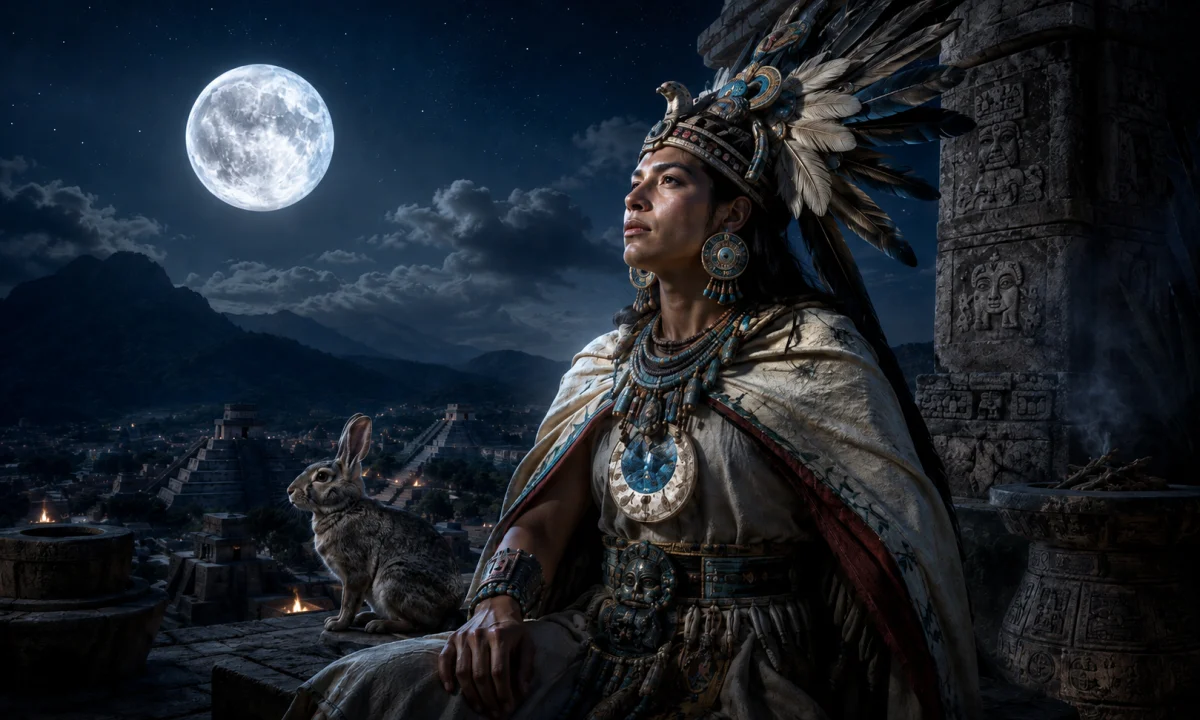
Metzli is a name associated with the Moon in Aztec, or Mexica, religious tradition. The name is more securely documented as the Classical Nahuatl word for “moon” than as the title of a single, clearly defined deity. For that reason, descriptions of Metzli as an independent Aztec moon god or goddess should be treated cautiously. Colonial-era texts and later interpretations connect the Moon with several figures, especially Tecciztecatl and Coyolxauhqui, but these figures are not simply interchangeable with Metzli.
Name and meaning
The form metztli is generally understood as a Nahuatl word meaning “moon.” Metzli and Meztli are modern spellings or simplified forms of the same name. Nahuatl spelling was not completely standardized in the period when Spanish missionaries and other colonial writers began recording the language, so variation in spelling is common.
In an ancient Nahuatl context, a word meaning “moon” did not necessarily function as the name of a personal deity in the same way that names such as Huitzilopochtli or Tlaloc did. Mesoamerican religious language could refer to a visible celestial body, a sacred power, a divine personification, or a deity connected with that body. Modern summaries sometimes turn metztli directly into “the Aztec moon god” or “moon goddess,” but the surviving evidence does not establish one uniform figure with that exact status.
The question of gender is equally uncertain. Some modern accounts call Metzli a goddess, while others call Metzli a god. The word itself does not settle the issue, and the surviving Aztec traditions do not present a consistent, widely attested deity known exclusively by the name Metzli. It is more accurate to describe Metzli as a name for the Moon or as a disputed personification of the Moon within Aztec tradition.
Aztec religious setting
The Mexica understood the sky as a realm of active sacred forces. The Sun, Moon, stars and planets were not merely physical objects; they participated in stories about creation, sacrifice, warfare, time and the survival of the present world. These beliefs formed part of a wider Mesoamerican concern with celestial cycles, although individual cultures explained those cycles in different ways.
The Aztec world was organized through several calendars and through careful observation of recurring natural events. The phases of the Moon marked periods of darkness and light and formed part of the rhythm of ritual and agricultural life. Even where a text does not identify the Moon as a separate god, the Moon remains religiously meaningful as a visible sign of cosmic order and change.
Aztec mythology was not preserved in a single sacred book with one official version of every story. Most surviving accounts were recorded after the Spanish invasion by Indigenous informants, bilingual scholars, Spanish missionaries or colonial writers. Important evidence comes from works such as the Florentine Codex, from other alphabetic Nahuatl texts, from central Mexican pictorial manuscripts and from archaeological remains. These sources were produced in different circumstances and do not always agree.
This evidence helps explain why Metzli is difficult to classify. A modern reader may expect one named moon deity with a fixed biography, appearance and family tree. The surviving material instead presents a network of lunar associations. The Moon can appear as a celestial body, as one of the participants in a creation narrative, or through deities whose myths explain lunar features and movements.
Metzli and the creation of the Moon
The most famous Aztec account of the Moon appears in the story of the creation of the Fifth Sun. The gods gathered at Teotihuacan and required a deity willing to sacrifice himself by leaping into a great fire. The proud and wealthy Tecuciztecatl volunteered first. The humble Nanahuatzin, who suffered from illness or physical affliction in many versions, was selected alongside him.
Tecuciztecatl initially hesitated before the flames, while Nanahuatzin gathered the courage to enter. Nanahuatzin became the Sun, and Tecuciztecatl followed and also became a radiant celestial body. Because two Suns would have made the world unbearably bright, one of the gods struck Tecuciztecatl in the face with a rabbit. The mark dimmed his light and transformed him into the Moon.
The story is especially important when discussing Metzli because it provides an origin for the Moon without necessarily naming its personified form Metzli. In the narrative, the lunar figure is associated with Tecuciztecatl, whose name is usually translated in relation to a sea shell or conch. Later explanations may identify the resulting celestial body with metztli, the Moon, but the story itself does not prove that “Metzli” was Tecuciztecatl’s regular personal name.
The rabbit’s mark became a familiar explanation for the shapes visible on the lunar surface. Similar “rabbit in the Moon” traditions are found in several Mesoamerican cultures, although the details and associated figures vary. In the Aztec story, the mark also expresses the contrast between the Sun and Moon: the Moon is luminous but weaker, and its light has been deliberately reduced.
Tecciztecatl and the lunar identity
Tecciztecatl is one of the figures most securely connected with the Aztec Moon through the Fifth Sun narrative. He is often described in modern works as a moon god, but his surviving role is more specific: he is the deity who becomes the Moon after Nanahuatzin becomes the Sun. The story emphasizes his wealth, pride, fear and eventual transformation.
Tecciztecatl should not automatically be renamed Metzli. Metztli means “moon,” whereas Tecciztecatl is a named mythological person. The two can be related in interpretation, just as one might distinguish between a planet and the god who is said to become that planet. Treating them as identical in every context erases an important difference in the sources.
The Fifth Sun story also gives the Moon a place in a larger theology of sacrifice. The present world exists because divine beings gave themselves to the fire, yet the gods still had to sacrifice themselves or be set in motion so that the Sun and Moon would move across the sky. The Moon is therefore part of a story about obligation, transformation and the cost of maintaining the cosmos.
Coyolxauhqui and other lunar associations
Another figure frequently described as an Aztec moon goddess is Coyolxauhqui, whose name is commonly translated as “She of the Bells on Her Cheeks.” She is the daughter of Coatlicue and the sister of Huitzilopochtli in the myth represented by the famous disk discovered at the Templo Mayor in Tenochtitlan.
According to the story, Coyolxauhqui led her brothers, the Centzon Huitznahua, against their mother after Coatlicue became pregnant under miraculous circumstances. Huitzilopochtli emerged fully armed and defeated them. He dismembered Coyolxauhqui and cast her body down the mountain. The myth is closely tied to the daily and political symbolism of the Templo Mayor, where the defeat of lunar and star powers by the solar or martial Huitzilopochtli was repeatedly enacted in ritual and architecture.
Coyolxauhqui is lunar in some modern interpretations, particularly because her defeat by Huitzilopochtli can be read as a cosmic conflict between the Sun and the Moon or stars. Yet the surviving evidence does not make her simply “the Moon” in every setting. Her name, iconography and mythological function are distinct from the word metztli and from the role of Tecciztecatl in the Fifth Sun story.
The Centzon Huitznahua, often called the Four Hundred Southerners, are generally interpreted as stars, especially in relation to the southern sky. This creates a broader celestial drama around Coyolxauhqui, but interpretation should not be confused with a universally stated Aztec doctrine that assigns every astronomical body a single fixed deity.
Appearance and symbolism
There is no securely established canonical appearance for a deity named Metzli. Images of the Moon in Aztec and central Mexican materials may be represented through different signs, deities or narrative contexts. A curved crescent, a lunar disk, a rabbit and a conch shell can all be relevant to discussions of lunar symbolism, but none should automatically be treated as the exclusive emblem of Metzli.
The Moon’s visible changes made it a powerful symbol of alteration. It appears, disappears, grows and diminishes, then returns. Such cycles could suggest renewal, vulnerability, death and rebirth. The Moon’s changing brightness also provided a natural contrast with the Sun, whose force was associated with daytime visibility and, in Mexica state ideology, with warfare and the continued feeding of cosmic powers.
Its night-time presence gave the Moon a different kind of significance. Darkness was not simply the absence of daylight; it was a period in which stars, dreams, dangers and supernatural forces became more prominent. Lunar symbolism could therefore overlap with ideas of secrecy, transition and the boundary between visible and invisible realms. These are reasonable cultural interpretations, but they should not be presented as a fixed list of powers belonging to a separately documented god called Metzli.
Moon, agriculture and bodily cycles
Modern descriptions often associate Metzli with agriculture, fertility, childbirth and menstruation. The Moon’s cycles naturally invite such associations, and many cultures around the world connect lunar phases with bodily or agricultural rhythms. Nevertheless, the evidence for assigning all these functions to a distinct Aztec deity named Metzli is limited.
Aztec religious life did include powerful female deities and traditions connected with childbirth, fertility, sexuality and the earth. These include figures such as Tlazolteotl, Toci and Coatlicue, although their identities and functions are also complex. A general statement that Metzli governed fertility can unintentionally combine lunar symbolism with the attributes of other deities.
The safest formulation is that the Moon participated in a religious world where time, fertility, agriculture and bodily processes were interconnected. The surviving sources do not justify a detailed independent mythology for Metzli in which every such area is assigned to a single lunar ruler.
Sources, uncertainty and interpretation
Knowledge of Aztec mythology comes from sources that were written or compiled after the Spanish conquest, often with the involvement of Christian missionaries. The Florentine Codex preserves extensive Nahuatl-language information, but it was produced through a colonial project and reflects both Indigenous testimony and European editorial conditions. Pictorial codices preserve additional material, although their signs and scenes can be difficult to interpret without assuming that they work like alphabetic writing.
These sources rarely provide a neat separation between “myth,” “ritual,” “astronomy” and “religion.” A story about the Sun and Moon may also explain sacrifice, political identity and the structure of time. A deity may have several names or titles, while a common noun may later be misunderstood as a personal name. Translation choices can further affect interpretation, especially when modern authors move between Nahuatl terms and familiar categories such as “god,” “goddess” or “moon deity.”
For these reasons, the following distinctions are useful:
- Metztli is securely associated with the Nahuatl word for the Moon.
- Tecciztecatl is the named figure who becomes the Moon in the Fifth Sun creation story.
- Coyolxauhqui is a distinct goddess connected with a major celestial and political myth, and is often interpreted as lunar.
- A modern label such as “Metzli, Aztec moon goddess” may simplify several different traditions into one figure.
Distinguishing Metzli from similar figures
Metzli is sometimes confused with lunar beings from other Mesoamerican traditions. The Maya moon goddess, often called Ix Chel in modern writing, belongs to a different cultural and linguistic tradition and should not be used as evidence for the identity of Metzli. Likewise, the Aztec god Tecciztecatl should not be treated as merely another spelling of Metzli.
Confusion can also arise because “Aztec mythology” is often used broadly for the religious traditions of central Mexican peoples. The Mexica were part of a larger Nahua cultural and linguistic world, and neighboring communities shared or adapted some religious concepts while maintaining local variations. A name or story recorded in one community cannot automatically be treated as a universal belief throughout Mesoamerica.
Later reception and modern usage
Metzli appears today in encyclopedias, fantasy writing, games, online mythology lists and modern spiritual discussions. Contemporary creators may give Metzli a definite gender, elaborate personality, lunar powers or a family relationship with other deities. Such portrayals can be creative adaptations, but they should not be mistaken for securely documented Aztec tradition.
The modern spelling Metzli is especially common in popular presentations because it is concise and visually distinctive. In an academic or historical discussion, it is important to explain that the word is primarily a Nahuatl term for the Moon and that the evidence for a separate, fully characterized deity under that name is uncertain. The most historically responsible approach is therefore to discuss Metzli through the broader Aztec meanings of the Moon while keeping its connection to Tecciztecatl and Coyolxauhqui clearly distinguished.