WORLD
WORLD
Tecciztecatl
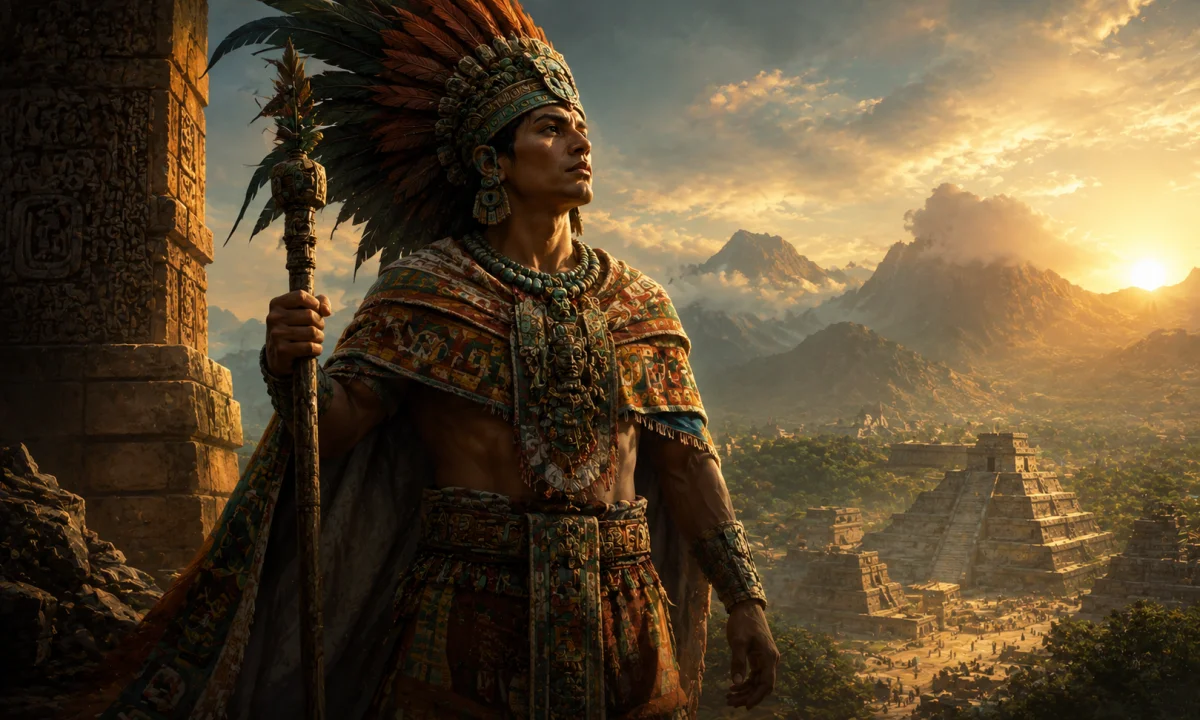
Tecciztecatl is a figure in Aztec and wider Nahua mythology who becomes the Moon in the creation story of the Fifth Sun. He is best known for his rivalry with Nanahuatzin, the humble, diseased god who becomes the Sun. Tecciztecatl is wealthy, splendidly adorned and confident in his own greatness, yet he hesitates when asked to leap into the sacred fire. His failure and Nanahuatzin’s courage explain the opposed positions of the Sun and Moon in one of the most important Nahua creation narratives.
Name and identity
The name appears in several spellings, including Tecciztecatl, Tecuciztecatl and Tecuciztécatl. These differences result largely from the ways colonial-era writers recorded Nahuatl words and from later editorial conventions. The name is commonly connected with the Nahuatl word for a conch or large shell, and is often translated as “He of the Conch Shell” or “Lord of the Conch.” The exact grammatical analysis and preferred translation vary.
Tecciztecatl is frequently described in modern reference works as an Aztec moon god. That description is useful, but it can give the impression of a simple, universally fixed identity. In the surviving creation accounts, he is specifically the divine candidate who becomes the Moon after the creation of the Fifth Sun. Nahua ideas about the Moon were not necessarily limited to one single figure in every context. The name Metztli, meaning “Moon,” is also used in Nahuatl traditions, and other lunar associations appear in different myths and sources.
Tecciztecatl should therefore be understood primarily through the creation narrative in which he appears. He is not simply interchangeable with every deity or personification connected with the Moon, and his mythic role is more distinctive than a general label such as “moon deity” suggests.
Cultural setting and surviving traditions
Tecciztecatl belongs to the religious world of the Nahua peoples of central Mexico, including the Mexica, often called the Aztecs. The best-known account of his transformation into the Moon was recorded after the Spanish conquest by Christian missionaries and Indigenous or mestizo informants working within colonial intellectual settings. Important versions occur in works associated with Bernardino de Sahagún, especially the Florentine Codex, and in other colonial compilations of Nahua traditions.
These records preserve valuable Indigenous narratives, but they are not untouched transcripts of a pre-conquest book. Their wording, arrangement and interpretation were influenced by the circumstances in which they were collected and written down. Different sources may vary in details, names and sequence. The broad structure of the story, however, is consistent: the gods gather at Teotihuacan, two candidates are chosen, Tecciztecatl hesitates, Nanahuatzin enters the fire, and both become heavenly lights.
Teotihuacan had been a major city centuries before the rise of the Mexica empire. By the Mexica period it was already an ancient, abandoned monumental centre, but it remained a place of great sacred importance. In Nahua thought, the city could be understood as the setting where the gods had created or renewed the cosmic order. Its pyramids and ruins were associated with divine beginnings rather than merely with a vanished human civilisation.
The creation of the Fifth Sun
In the most famous version of the story, the world exists in an uncertain state before the present Sun begins its course. The gods assemble at Teotihuacan and ask who will take on the dangerous task of becoming the new Sun. The chosen candidate must throw himself into a great fire. This is not an ordinary act of bravery: it is a sacrificial transformation that will establish light, time and movement for the world.
Tecciztecatl volunteers. He is rich, proud and accustomed to honour. The narrative contrasts his splendour with the condition of Nanahuatzin, who is poor and afflicted by illness or bodily sores. Tecciztecatl’s wealth allows him to present magnificent offerings. His gifts include valuable feathers, precious stones, fine incense and other luxurious materials. Nanahuatzin, by contrast, offers humble things such as reeds, grass or simple objects, along with his own blood and penitential effort.
The contrast is not merely between two individuals. It expresses a recurring theme in Nahua religious thought: the value of sacrifice depends on sincerity and personal commitment, not simply on outward wealth. Tecciztecatl can give splendid objects, but Nanahuatzin gives himself. The story does not necessarily reject wealth in every religious context, but it exposes the weakness of pride and the limits of ceremonial display without courage.
After a period of preparation and penance, the gods order Tecciztecatl to enter the fire. He approaches it, but fear overcomes him. In some versions he tries repeatedly and retreats each time. The number of attempts and the exact wording vary, but the central point remains that he cannot complete the act expected of him. Nanahuatzin is then called upon. Despite his poverty and physical suffering, he throws himself into the flames without hesitation.
Seeing Nanahuatzin’s sacrifice, Tecciztecatl finally follows him into the fire. The gods watch as the two are consumed and transformed. Nanahuatzin rises as the Sun, while Tecciztecatl becomes another brilliant celestial body. In the accounts that identify him with the Moon, his light is initially almost as strong as the Sun’s.
The gods object to the presence of two equally bright lights. One version says that one of them throws a rabbit at Tecciztecatl’s face, dimming his radiance. This produces the familiar rabbit-in-the-Moon image found in Mesoamerican traditions. The story thus explains both the Moon’s lesser brightness and the visible lunar marking that observers may interpret as a rabbit. The exact sequence differs among accounts, but the rabbit is one of the most memorable elements associated with Tecciztecatl’s lunar transformation.
Why the Sun and Moon do not move
Becoming heavenly bodies is not enough to establish an ordered cosmos. In some versions of the story, the newly created Sun and Moon remain still in the sky. Their failure to move threatens the existence of the world, because regular celestial motion is necessary for the passage of time and the continuation of life.
The gods decide that further sacrifice is required. In the account commonly associated with Sahagún’s material, the gods offer themselves so that the Sun can begin its journey. The wind god Ehecatl then plays an important role by setting the Sun and Moon in motion, or by driving them across the sky. As a result, cosmic order is founded through a chain of sacrifices rather than through the action of one creator alone.
This part of the narrative gives the story a religious significance beyond the explanation of the Moon’s appearance. The movement of the heavens depends on divine self-sacrifice, and the world continues only because sacred beings give up their lives. The story could be understood alongside Mexica ideas about maintaining the cosmos through offerings, bloodletting and ritual obligation.
Attributes and symbolism
Tecciztecatl’s principal attribute is his relationship with the Moon and the conch shell. Conch shells had important ritual and symbolic uses in ancient Mesoamerica. Their sound could announce ceremonies, and their association with water, fertility and the underworld gave them significance beyond their physical appearance. The conch connection in Tecciztecatl’s name may therefore carry several layers of meaning, although the surviving sources do not provide a single complete explanation.
His wealth is another defining feature. In the creation story, he is presented as splendidly equipped and capable of making impressive offerings. This visual and social contrast with Nanahuatzin makes his later hesitation especially meaningful. Tecciztecatl possesses status, beauty and resources, yet these advantages do not guarantee the courage needed for transformation.
The Moon’s rabbit marking is closely linked with him in the creation narrative. In later descriptions of Mesoamerican lunar imagery, the dark shape within the Moon may be explained as a rabbit. This motif should not be treated as a literal physical attribute in every representation of Tecciztecatl. Rather, it belongs to a traditional explanation of the Moon’s appearance and diminished light.
There is no single surviving portrait of Tecciztecatl that functions as a universally agreed visual type. Colonial descriptions and pre-conquest manuscripts use complex systems of signs, colours, ornaments and facial features, and the identification of a particular image can be uncertain. It is safer to associate him with the Moon, the conch, luxurious offerings and the rabbit marking than to claim a fixed costume or appearance across all Aztec art.
Tecciztecatl and Nanahuatzin
Tecciztecatl’s story cannot be separated from Nanahuatzin’s. The two figures are constructed as opposites, but they are not simple enemies. Both accept the role of sacrificial candidate, both approach the fire, and both become celestial bodies. Their relationship is a comparison between two kinds of religious value.
- Tecciztecatl represents status, beauty, wealth and confidence, but also pride and hesitation.
- Nanahuatzin represents poverty, illness, humility and unadorned devotion, yet proves capable of decisive sacrifice.
- The fire acts as the means of transformation, turning divine bodies into cosmic powers.
- The Sun and Moon establish a complementary but unequal order of light and time.
The story does not portray Tecciztecatl as wholly evil or useless. His eventual leap into the fire still contributes to the creation of the Moon, and the Moon remains essential to the ordered world. His failure is instead a moral and ritual weakness: he wants the honour of becoming the Sun but cannot initially endure the cost. His later transformation suggests that even an imperfect act can have a place in the cosmic order, although it does not receive the same status as Nanahuatzin’s first and fearless sacrifice.
Relationship to other lunar figures
Tecciztecatl is sometimes confused with other figures associated with the Moon, especially Coyolxauhqui. Coyolxauhqui is a major Mexica goddess whose myth concerns her conflict with Huitzilopochtli at Coatepec. She is often connected with the Moon in modern interpretations, partly because of the celestial symbolism of that story. She is not simply another name for Tecciztecatl, however. The two figures belong to different mythic narratives and have different relationships, attributes and symbolic settings.
The Moon may also appear as a named celestial power rather than as a fully individualised character. Nahuatl sources do not always organise divine identities according to the fixed categories used in modern encyclopedias. A deity can have several names, overlapping aspects or different ritual associations. For that reason, statements that Tecciztecatl was the one and only Aztec Moon god oversimplify the evidence.
Tecciztecatl should also not be confused with Quetzalcoatl, Ehecatl or other gods who participate in creation traditions. Ehecatl’s role in setting the celestial bodies in motion is important in some versions, but he is not the Moon. Likewise, the presence of the rabbit motif does not mean that Tecciztecatl is identical with every rabbit-associated lunar being in Mesoamerican folklore.
Religious and cultural significance
The myth of Tecciztecatl and Nanahuatzin presents creation as an act of sacrifice, risk and reciprocal obligation. Light does not simply appear because a god possesses the right name or status. It emerges when a divine being gives himself to fire, and the continuation of the cosmos requires further sacrifice and movement.
The narrative also gives cosmic importance to social and bodily conditions that might otherwise be treated as signs of weakness. Nanahuatzin’s illness and poverty do not prevent him from becoming the Sun. Instead, his willingness to act becomes the decisive quality. Tecciztecatl’s refinement and wealth are not worthless, but the story places them below courage and sincere offering.
The account can also be read as an explanation of why the Sun and Moon differ in brightness. Yet it is more than an etiological tale about the sky. It connects celestial order with ritual discipline, personal sacrifice and the obligations of gods toward the world. In a society where offerings, bloodletting and ceremonial labour were central religious practices, the story provided a powerful model for understanding why sacrifice was necessary.
Later reception
Tecciztecatl is less prominent in modern popular culture than figures such as Quetzalcoatl, Huitzilopochtli and Coyolxauhqui. When he does appear in fantasy fiction, games, comics or general mythology collections, he is usually presented as a personified Moon deity or as a proud rival of Nanahuatzin. Such portrayals may draw on genuine elements of the creation story while adding personalities, powers or visual designs not established by the surviving Nahua sources.
The traditional figure is best recognised through the specific narrative that defines him: the splendid volunteer who hesitates before the fire, follows Nanahuatzin into sacrifice, and becomes the Moon whose light is reduced by the rabbit’s mark. His importance lies not only in lunar symbolism but also in the story’s judgment of pride, courage and the cost of sustaining the world.