WORLD
WORLD
Tlazolteotl

Tlazolteotl was a powerful female deity in the religious traditions of central Mexico, especially those associated with the Mexica, often called the Aztecs. Her name is usually translated as “Filth Deity” or “Goddess of Filth,” but that translation can be misleading if it suggests only dirt or moral corruption. Tlazolteotl was connected with sexual acts, forbidden desire, childbirth, confession, disease, purification and the removal of impurity. In one of her most important religious roles, she was said to consume or absorb human wrongdoing, transforming pollution into a condition that could be cleansed.
Name and identity
The Nahuatl name Tlāzolteōtl combines tlāzolli, a term associated with refuse, corruption, waste or moral pollution, with teōtl, a word commonly translated as “god” or “divine being.” “Filth” therefore refers both to physical impurity and to actions or desires considered socially and ritually disordered. Her name may be understood not simply as “the dirty goddess,” but as a divine power dealing with what society casts away, what the body expels and what a person seeks to remove through purification.
Descriptions of Tlazolteotl do not always present her as a single, uniformly defined goddess. Colonial-era accounts record several related names, titles and manifestations, and scholars continue to debate how these figures were distinguished in pre-Hispanic worship. Tlazolteotl could be associated with Tlaelquani, “Eater of Filth,” a title emphasizing her ability to consume sin or impurity. She was also linked in particular contexts with Ixcuina, a name that may refer to a group of four female deities or to a related goddess complex. The precise relationship between Tlazolteotl, Ixcuina, Toci, Cihuacoatl and other female powers varies according to the source and ritual setting.
For this reason, it is safer to describe Tlazolteotl as a major divine complex or identity within Nahua religion rather than force her into a simple modern category. She could represent sexuality and its dangers, but also fertility, midwifery, maternal power, confession and renewal. These qualities were not necessarily contradictions. In Mesoamerican religious thought, forces associated with pollution and danger could also possess the power to cure, purify and restore balance.
Cultural setting and surviving evidence
Knowledge of Tlazolteotl comes largely from sources written after the Spanish conquest, including Nahuatl-language accounts produced by Indigenous informants and colonial-era friars. The most important evidence includes material associated with the Florentine Codex, a sixteenth-century encyclopedic work compiled under Bernardino de Sahagún, as well as ritual calendars, painted manuscripts and descriptions of festivals. Other codices and colonial chronicles provide additional images or interpretations.
These sources are invaluable but must be read carefully. They were produced in a colonial environment, often through collaboration between Nahua speakers and European missionaries. Christian concepts of sin, confession and impurity could influence the vocabulary used to describe Indigenous practices. At the same time, the Nahuatl accounts preserve detailed information that could not have come from European theology alone. The surviving record is therefore neither a transparent transcript of pre-conquest religion nor merely a European invention.
Images identified with Tlazolteotl appear in several central Mexican manuscripts and monuments, although not every proposed identification is certain. Some images show a female figure with a darkened or blackened area around the mouth, face or nose. This feature has often been interpreted as a sign of filth-eating, ritual impurity or the deity’s association with excrement and sin. Other elements, including cotton, lunar or fertility symbolism, and a distinctive headdress, have also been connected with her, but interpretations depend on the individual manuscript and cannot always be generalized.
Sexuality, desire and moral pollution
Tlazolteotl’s association with sexuality is one of her best-known characteristics, but it should not be reduced to a role as a “goddess of sex.” Nahua attitudes toward sexuality involved questions of marriage, social order, fertility, age, gender, restraint and ritual danger. Sexual acts could be part of ordinary life while still creating pollution when they violated social or ceremonial expectations.
In this context, Tlazolteotl embodied the dangerous and powerful dimensions of desire. She was connected with illicit sexual behavior, erotic temptation and the consequences of transgression. Yet she was also associated with childbirth and the female body. The same divine power could therefore be invoked in situations involving sexual danger, pregnancy, labor and the removal of impurity. Her sphere was not simply pleasure or shame; it was the unstable boundary between desire, reproduction, pollution and renewal.
Some colonial accounts portray Tlazolteotl as a deity who could inspire sexual wrongdoing and then receive the confession of the wrongdoer. This apparent paradox reflects a wider religious pattern in which a dangerous power also controls the remedy for the danger. She was not merely a judge standing outside human sin. She was imagined as a being capable of taking impurity into herself and making purification possible.
Confession and purification
Tlazolteotl is especially associated with confession. A person who had committed serious wrongdoing could make a formal confession before a ritual specialist, often identified in the sources as a priest connected with divination or confession. The confession was directed toward a deity understood as capable of hearing, judging and cleansing the offense.
The act was not equivalent in every respect to Christian confession. Nahua confession formed part of a wider system of ritual repair, moral responsibility and purification, and the surviving accounts describe it through concepts that European writers sometimes translated as sin. Some sources indicate that such a confession was made only once, or only at a particular stage of life, rather than as a regular weekly or communal sacrament. Details vary, and the evidence does not support treating all Mexica religious practice as a direct counterpart to Catholic penance.
Tlazolteotl’s title “Eater of Filth” expresses the logic of this rite. Wrongdoing, especially sexual wrongdoing, could be understood as a form of pollution that had to be acknowledged and removed. By consuming that pollution, the deity made forgiveness and restoration possible. The person who confessed was not simply declaring private guilt; the ritual addressed a disturbed relationship between the individual, the community and the sacred order.
Her power was therefore both threatening and compassionate. Tlazolteotl could punish or bring illness, but she could also cleanse the guilty and restore them to social and ritual life. This combination helps explain why she was feared, respected and appealed to in matters involving bodily and moral danger.
Childbirth, midwives and female power
Tlazolteotl was closely linked with childbirth and the work of midwives. In Nahua society, birth was a dangerous event involving blood, pain, bodily fluids and the uncertain passage of a new person into the community. Midwives held specialized knowledge and performed ritual actions as well as practical medical care. Their work placed them in a sphere that could be both honored and regarded as ritually perilous.
Sources connect Tlazolteotl and related female deities with pregnant women, labor and the protection of mothers. Her connection with childbirth fits her broader role as a power of bodily transformation. She governed processes that involved impurity, vulnerability and renewal, including menstruation, sexual activity, pregnancy and birth. These associations should not be interpreted as evidence that Nahua women were viewed only through reproduction; rather, they show the religious importance of embodied processes that could not be separated from social and cosmic order.
The goddess’s relationship with midwives also helped connect her to speech, counsel and moral instruction. Midwives could advise young people about sexual conduct and marriage, and the sources sometimes portray female ritual specialists as authoritative speakers. Tlazolteotl’s sphere thus included not only physical birth but the regulation of sexuality and the transition between stages of life.
Festivals and related goddesses
Tlazolteotl has been connected with the festival month Ochpaniztli, whose name is often translated as “sweeping.” This festival involved themes of cleansing, renewal, warfare and agricultural change. A woman who represented or embodied a goddess was ritually killed in one of the ceremonies, after which a male priest wore her skin. Colonial descriptions associate this figure with Toci, “Our Grandmother,” and with other earth or maternal powers.
The ritual is frequently linked with Tlazolteotl, but the identities should not be treated as interchangeable in every context. Toci was an important goddess in her own right, associated with the earth, older women, midwives and healing. Cihuacoatl, “Snake Woman,” was another major female power connected with childbirth, warfare, motherhood and the earth. Chicomecoatl was associated with maize and nourishment. These figures could overlap in symbolism or be grouped together in ritual and artistic contexts, yet they were not simply different names for one universally identical goddess.
Some sources describe Tlazolteotl through the name Ixcuina. Ixcuina has been interpreted as a collective identity involving four sisters, sometimes associated with different stages of female life or with different forms of sexual power. The evidence is not consistent enough to establish a single agreed explanation. Modern summaries sometimes present Ixcuina as a fixed fourfold group and Tlazolteotl as a completely separate goddess, while other interpretations see them as closely connected aspects of a broader divine complex.
The association with sweeping is significant even when individual identifications remain uncertain. Sweeping was both a practical and ritual act in Mesoamerican life. It removed dirt and prepared a space for ceremony, but it could also symbolize the clearing away of disorder. In relation to Tlazolteotl, cleansing did not mean denying the existence of pollution. It meant confronting and transforming it.
Appearance and symbolism
Images linked to Tlazolteotl often emphasize her connection with fertility, sexuality and impurity. A dark mark around the mouth is one of the most recognizable features in representations commonly identified as the goddess. It has been interpreted as a sign that she has eaten filth or sin. This reading is influential, although image identification in Mesoamerican manuscripts is complex, and the meaning of each mark cannot always be established with certainty.
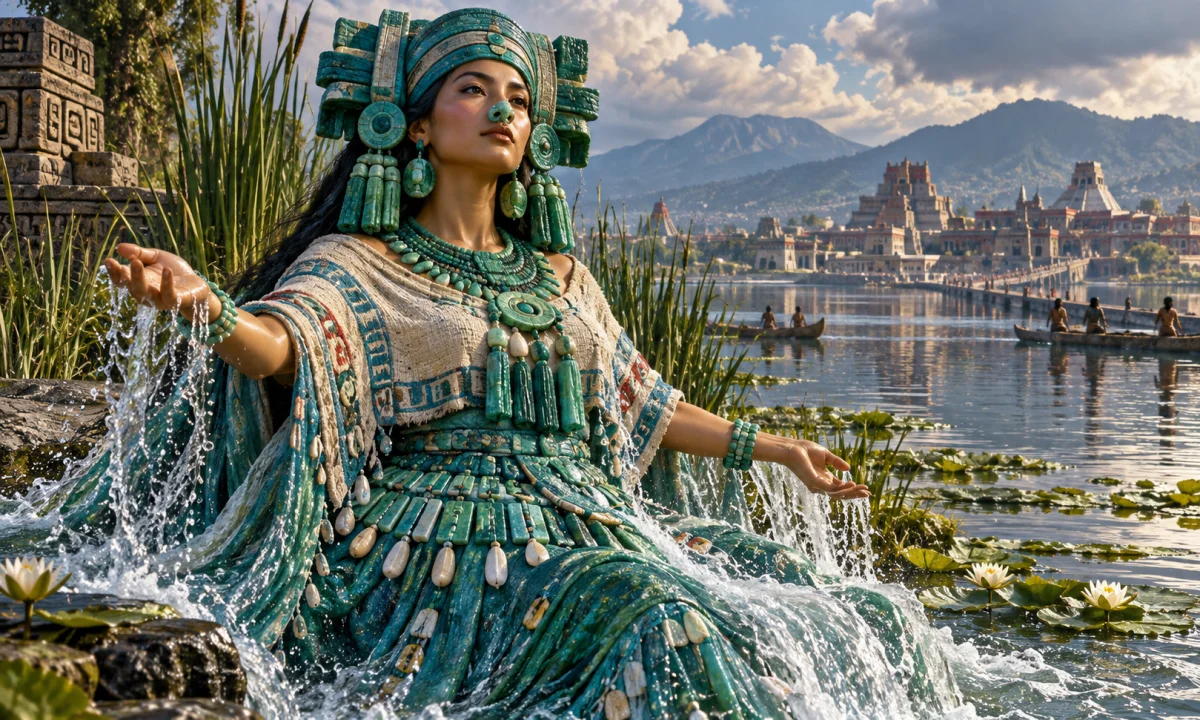
She may be shown with ornaments or garments associated with women, fertility and ritual authority. Some depictions include a distinctive headdress and elements that have been interpreted as cotton. Cotton is relevant to female production, weaving and bodily adornment, although the symbolic meaning of a particular cotton element depends on the image and its context. It is important not to treat every modern illustration of Tlazolteotl as an exact reconstruction of ancient appearance.
Her symbolism is best understood through a series of linked oppositions: filth and cleansing, desire and restraint, illness and healing, death and birth, danger and protection. These are not separate “powers” added to an otherwise simple fertility goddess. Together they express a religious understanding of transformation, in which what is dangerous or rejected may also contain the means of renewal.
Relationships with other divine figures
Tlazolteotl is sometimes described as a consort or companion of Tezcatlipoca, one of the most complex and powerful deities in central Mexican religion. Some colonial accounts connect her with Tezcatlipoca in stories or symbolic relationships involving temptation, sexual transgression and moral judgment. However, the evidence does not support a single universally accepted genealogy or marriage story for Tlazolteotl.
She is also associated with female earth and childbirth deities, particularly Toci and Cihuacoatl. These connections may reflect shared ritual concerns rather than a simple family tree. Aztec religious traditions frequently allowed a deity to appear through several names, titles, impersonated forms or locally important manifestations. A relationship recorded in one source may therefore describe a particular ceremony or theological interpretation rather than a permanent mythological identity recognized everywhere.
Meaning in Nahua religious thought
Tlazolteotl’s importance lies in the way she joined moral, bodily and cosmic ideas. Pollution was not merely a private feeling of guilt. It could affect health, relationships, ritual standing and the wider balance between humans and divine powers. Confession and purification addressed that condition through speech, ritual action and divine intervention.
Her presence also challenges modern assumptions about purity and sexuality. Tlazolteotl was not simply a demonized embodiment of lust, nor was she an uncomplicated symbol of sexual freedom. She represented sexuality as a potent force that could create life, cause disorder, generate shame and require purification. Her role as both source of danger and agent of forgiveness gave her a distinctive place within the religious imagination of central Mexico.
Interpretations must also account for the colonial framing of the evidence. Spanish writers often described Indigenous religious practices using the language of idolatry, sin and superstition. Nahuatl-speaking informants preserved concepts that do not map neatly onto Christian categories. As a result, terms such as “confession,” “sin” and “forgiveness” are useful only when their limits are acknowledged. Tlazolteotl’s traditional significance cannot be reduced to a Christian devil, a patron of lust or a generic fertility goddess.
Tlazolteotl in modern culture
Modern books, artwork, games and popular discussions often present Tlazolteotl as a powerful goddess of sexuality, death, magic or transformation. Some creative works use her name for characters whose abilities have little connection with Nahua tradition. Others emphasize the striking idea of a deity who consumes sin and turns impurity into cleansing. These adaptations may draw attention to her, but they should not be confused with the evidence for pre-Hispanic religion.
Contemporary interpretations can also romanticize or simplify her by presenting her as an ancient symbol of unrestricted sexuality or as a universal “shadow goddess.” Such readings are modern constructions. The traditional material instead places her within specific Nahua institutions, rituals, social expectations and ideas about the body. Her significance comes from that cultural setting: she was a divine power of pollution and purification, sexual danger and fertility, confession and renewal.