WORLD
WORLD
Fujin
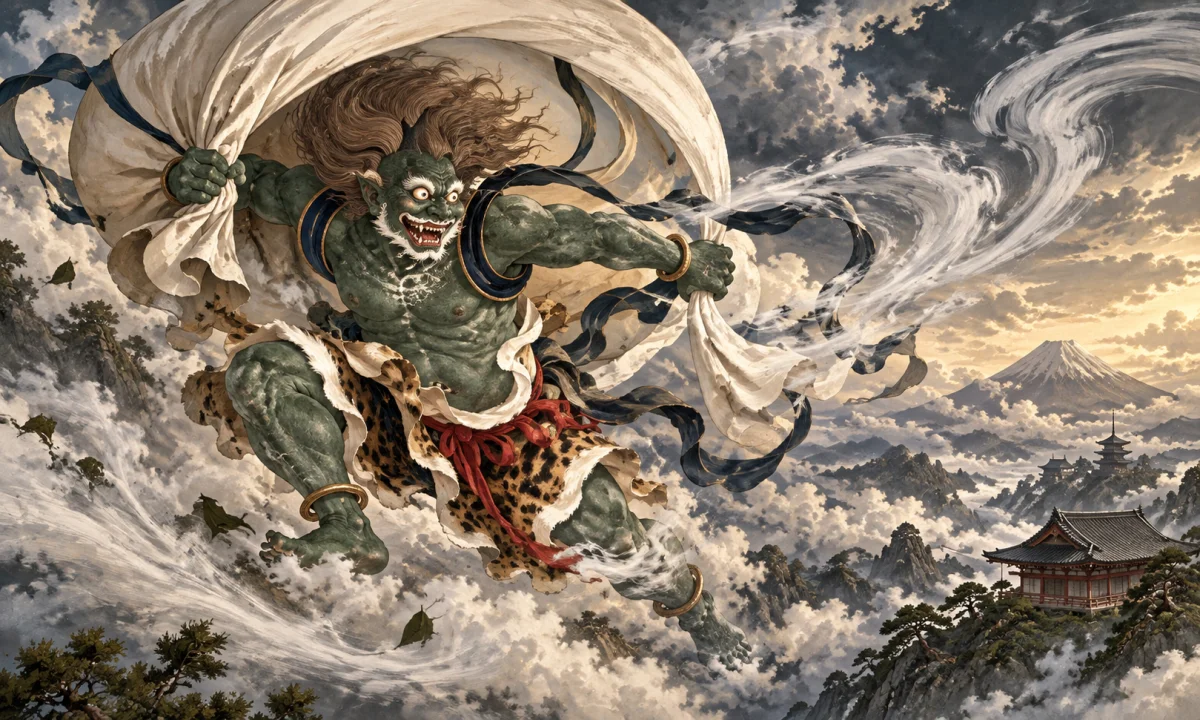
Fujin (風神, commonly romanised as Fūjin) is the Japanese deity or divine figure associated with wind. In traditional art he is usually shown as a wild, muscular, often demon-like being carrying a large bag from which the winds are released. Fujin is frequently paired with Raijin, the thunder and lightning deity, and the two are among the most recognisable figures in Japanese religious art. His identity, however, is not based on one single, fully developed myth. The figure known today as Fujin reflects several overlapping traditions: ancient Japanese worship of wind kami, Buddhist ideas about elemental deities, Chinese artistic models, and later Japanese painting and folklore.
Name and identity
The name Fūjin means “wind deity” or “wind god”: fū means wind, and jin means a deity or spirit. The same characters, 風神, may also be read Fūshin in certain contexts, although Fūjin is the usual Japanese name for the familiar figure. English-language writing often omits the macron and spells the name Fujin.
Fūjin can function as a general term for a wind deity rather than the name of one sharply defined individual. Buddhist contexts may use the name Fūten (風天), meaning “Wind Heaven” or “Wind Deva,” for a related divine being. These terms are sometimes treated as interchangeable, but their religious settings and histories are not identical. The popular image of Fujin developed through the interaction of Shinto and Buddhist traditions rather than emerging fully formed from a single ancient text.
It is also important to distinguish Fujin from the older kami Shinatsuhiko, and the related name Shinatobe, who are associated with wind in early Japanese tradition. Later writers and modern summaries sometimes identify these figures directly with Fujin. Such an identification can be useful when discussing the broad idea of a Japanese wind deity, but it should not imply that the ancient kami and the later Buddhist-influenced figure have exactly the same origin, personality, or mythology.
Ancient Japanese wind kami
Wind was a vital and unpredictable power in the life of early Japanese communities. It could bring rain and cool air, fill the sails of boats, carry seeds and pollen, or destroy crops and settlements through storms. As with other forces of nature, wind could be understood as the activity of a kami: a sacred presence or power deserving respect, ritual attention, and sometimes appeasement.
The Kojiki, compiled in 712, and the Nihon Shoki, completed in 720, preserve early accounts of the gods of Japan. These works do not present Fujin in the same vivid form found in later paintings. Instead, they mention older wind-related kami, particularly Shinatsuhiko. The details vary between texts and interpretations. In some accounts Shinatsuhiko is a male wind deity, while Shinatobe is treated as a corresponding or associated female deity. The relationship between these names is not entirely uniform across the early sources.
These ancient figures belong to the mythology of the formation and ordering of the world. They are connected with the natural environment rather than with the distinctive horned, bag-carrying figure familiar from Japanese screens and temple sculpture. The early texts therefore provide an important background for the worship of wind, but they do not offer a complete biography of the later Fujin.
One significant centre of wind worship is Tatsuta Taisha in Nara Prefecture, historically associated with the wind kami Shinatsuhiko and Shinatobe. Rituals there connected wind with agricultural prosperity and protection from destructive weather. The famous Tatsuta wind rites demonstrate that Japanese religious concern with wind was not limited to a frightening supernatural character. Wind could be a beneficent force whose proper movement supported the growth of crops and the health of the land.
Buddhist and continental influences
The visual and religious form of Fujin was strongly shaped by Buddhism and by artistic traditions transmitted through China and Korea. Indian Buddhism included divine beings associated with natural elements, including Vāyu, a deity of wind. Through the transmission of Buddhist teachings and images across Asia, wind deities entered a wider system of protective beings, celestial guardians, and elemental powers.
In Japan, such figures were incorporated into the complex religious environment often described as shinbutsu-shūgō, the combination or interaction of Shinto and Buddhist practices. Before the separation of Shinto and Buddhism in the modern period, it was common for kami and Buddhist deities to be interpreted alongside one another. A wind kami from Japanese tradition could therefore be associated with a Buddhist wind deva, even when their original backgrounds differed.
Chinese art also contributed important features to the image. East Asian representations of wind gods commonly portray them as supernatural beings carrying a bag, sack, or cloth container filled with wind. The bag allows the deity to control, release, or gather the moving air. Japanese artists adapted this motif into a particularly dynamic figure, often placing the bag in a broad arc behind the body so that it resembles a circular halo or a whirl of wind.
Fujin’s appearance is therefore not a straightforward survival from the earliest Japanese mythology. It is better understood as the result of a long process of religious exchange and artistic development. Ancient Japanese wind kami supplied the local sacred context, while Buddhist and continental traditions helped shape the figure’s name, attributes, and visual form.
Appearance and attributes
Fujin is usually shown as a powerful, airborne being with a compact, muscular body. He often has wild hair, sharp teeth, prominent brows, and a fierce expression. His skin may be green, blue-green, grey, or another unusual colour, depending on the work. These features give him an uncanny appearance, but he should not automatically be classified as an oni. Japanese artists frequently used monstrous or non-human traits for Buddhist guardians, nature deities, and other supernatural beings without making them oni in the strict folkloric sense.
The most important attribute is the great wind bag carried across his shoulders. It is sometimes shown as a long, rounded sack and sometimes as a cloth bundle opened at one end. The winds are imagined as emerging from it under Fujin’s control. In some interpretations the bag contains the many winds of the world; in others, it simply represents the deity’s power over moving air.
He is commonly dressed in a short tiger-skin garment or another rough, animal-like costume. Tiger skin has associations with fierce supernatural beings in Buddhist and East Asian imagery, although its precise meaning can vary by artwork. Fujin is rarely represented as a calm, courtly god. His posture is usually bent or twisting, with his limbs spread as if he is moving through the sky. The composition suggests speed, turbulence, and the sudden changeability of weather.
Fujin’s visual counterpart, Raijin, is generally shown with drums arranged around his body. Raijin beats the drums to produce thunder, while Fujin releases or drives the winds. Their pairing creates a dramatic representation of a storm, although neither deity should be reduced to a simple personification in every religious context. They are also protective and awe-inspiring figures whose supernatural force could be dangerous when uncontrolled.
Important artistic representations
Fujin and Raijin became especially prominent in Buddhist temple art and later painting. Sculptural representations from the medieval period show the two deities as energetic, almost weightless figures moving around an implied celestial space. One of the best-known groups is found at Sanjūsangendō in Kyoto, where the figures form part of a larger Buddhist temple environment. Their placement and movement are designed to be viewed together, with the wind and thunder gods acting as powerful attendants and protectors.
In the early modern period, the pair became celebrated subjects for painters. The famous Fūjin and Raijin screen associated with Tawaraya Sōtatsu presents the deities against a largely empty gold background. The absence of a detailed landscape makes the bodies, clouds, drums, and wind bag appear to float in a boundless space. Fujin’s circular bag and Raijin’s ring of drums create a visual balance, while their awkward, animated poses convey supernatural movement.
Later artists, including members of the Rinpa tradition, reinterpreted the same subjects with bold outlines, decorative colour, and simplified forms. These works helped establish Fujin and Raijin as cultural icons beyond the immediate setting of temple worship. Their images appeared in paintings, prints, decorative objects, and designs associated with weather, seasonal change, and supernatural power.
Roles and religious significance
Fujin’s primary sphere is the movement of air, including ordinary winds and violent storms. In an agricultural society, the distinction between helpful and destructive wind was crucial. Gentle or seasonally appropriate winds could support crops, while typhoons and prolonged storms could destroy harvests, damage buildings, and endanger ships.
Wind deities were therefore approached with a mixture of reverence and caution. Rituals might seek favourable weather, protection from storms, or the restoration of natural balance. The purpose was not necessarily to “worship a monster” in the modern fantasy sense. It was to acknowledge a force greater than human control and to maintain a proper relationship with the sacred powers believed to govern the environment.
Fujin can also be associated with travel and the sea. Wind determined the movement of boats and influenced communication between coastal communities and islands. In Buddhist settings, the wind deity’s role as a guardian or celestial being placed him within a larger protective universe. His frightening appearance could express the danger of the natural world while also signalling power directed against other threats.
The symbolism of Fujin is consequently double-sided. He represents freedom, motion, and the life-giving circulation of air, but also disorder, sudden violence, and the limits of human control. His restless posture is not merely decorative: it expresses the unstable character of wind itself.
Fujin, Raijin and the “divine wind”
The association between Fujin and Raijin is one of the most enduring features of their tradition. They are often placed together in temple sculpture and painting, and their names are sometimes used as a paired expression for wind and thunder. In legends and visual culture, their combined powers evoke storms sweeping across the landscape.
The term kamikaze, meaning “divine wind,” is connected historically with medieval Japanese accounts of the Mongol invasions of 1274 and 1281. Typhoons helped defeat or scatter the invading fleets, and later religious interpretations described the storms as protection granted by Japan’s deities, particularly through the authority of shrines and Buddhist institutions. It is too simplistic to say that historical sources uniformly identified Fujin alone as the cause. The idea of a divine wind belonged to a wider network of beliefs involving kami, Buddhist powers, imperial protection, and sacred institutions.
In modern history, “kamikaze” acquired a separate meaning through the use of the term for Japanese military pilots during the Second World War. That modern military usage should not be confused with the older religious concept of a protective storm.
Distinguishing Fujin from related figures
- Shinatsuhiko and Shinatobe: These are early Japanese wind kami preserved in ancient mythological and shrine traditions. They provide an important background for wind worship but are not simply identical to every later representation of Fujin.
- Raijin: Raijin is associated primarily with thunder and lightning. He is Fujin’s famous companion, not another name for the wind deity.
- Vāyu: Vāyu is an Indian deity of wind. Buddhist transmission helped influence the religious category of wind deities in East Asia, but Vāyu and Fujin belong to different cultural and textual traditions.
- Fūten: Fūten is a Buddhist designation for a wind deity or wind deva. It overlaps with Fūjin in Japanese religious art and interpretation, but the terms reflect different layers of tradition.
- Oni: Fujin may look like an oni because of his fangs, wild hair, and threatening expression. His appearance alone does not make him an oni, and traditional artworks do not all classify him that way.
Fujin in modern culture
Fujin remains widely recognisable in Japan and internationally because of the striking designs preserved in temple sculpture and classical painting. His wind bag, unusual body colour, and dynamic pose have become visual shorthand for storms, supernatural speed, and elemental power.
Modern manga, anime, films, and video games frequently use Fujin as a name or inspiration for characters who control wind. Some adaptations retain the traditional pairing with Raijin, while others turn Fujin into a warrior, a monster, or a human-like hero. Video game series such as Mortal Kombat have presented a character named Fujin as a wind god, but that character is a modern fictional adaptation rather than a direct account of Japanese religious tradition. Similar uses may borrow only the name or elemental ability without preserving the deity’s Buddhist and Shinto background.
The traditional Fujin is best understood not as a single character with a fixed set of adventures, but as a layered Japanese wind deity shaped by ancient kami worship, Buddhist cosmology, continental artistic influence, and centuries of visual reinterpretation. His enduring image captures both the nourishing movement of air and the destructive force of the storm.