WORLD
WORLD
Yo
Yo is a term that appears in Japanese religious and folkloric contexts, but it is not a single, securely defined mythological being with one fixed story. In Japanese tradition, the word can be written with different characters and can mean different things depending on context, including “night,” “yang,” “male,” or “positive” in paired cosmological ideas. Because of that, any discussion of Yo in Japanese mythology has to begin with caution: the name is ambiguous, and surviving sources do not present one universally recognised deity, spirit, or monster called simply “Yo.”
In studies of Japanese mythology, such ambiguous terms are common. Many words that look like proper names in English are in fact readings that can refer to broader ideas, paired concepts, or poetic usages in classical Japanese and Sino-Japanese vocabulary. When “Yo” appears in mythic or religious discussion, it is often connected to a contrast with in or yin, or to the idea of night and hiddenness, rather than to a singular personified being. That means the most accurate way to approach Yo is as a term with mythological and cosmological significance, not as a clearly personified god like Amaterasu or Susanoo.
Origins and cultural setting
Japanese mythology developed through a long interplay of indigenous beliefs, court ritual, poetic language, and later Buddhist and Chinese influence. Early Japanese texts such as the Kojiki and Nihon Shoki preserve creation myths, divine genealogies, and accounts of major kami, but they do not establish a well-known independent figure named Yo in the way they do for major deities. Instead, terms like yo may appear in broader cosmological language, in contrastive pairs, or in literary expressions that reflect a worldview shaped by both native and imported ideas.
The most important background for understanding Yo is the way East Asian traditions often organize reality through paired forces. In Chinese-derived thought, yin and yang describe complementary principles such as dark and light, passive and active, or hidden and manifest. Japanese religious and literary language absorbed many such concepts, although not always in exactly the same form or with the same philosophical system. In Japanese, a term written with the character for night, or used in contrast to ayo and similar paired expressions, can point to the realm of darkness, concealment, or the non-visible side of existence. In that sense, “yo” can be part of mythic imagination even when it is not a named divine being.
Because of this background, sources may treat yo as a symbolic realm or quality rather than an entity. It can evoke the night world, the hidden order of things, or the force that balances another principle. In ritual and folk belief, such categories can become meaningful on their own, especially when connected with auspiciousness, directionality, calendrical practice, or the separation of sacred and profane spaces.
Name, spelling, and interpretation
The term Yo is especially tricky because its meaning changes with the character used and the context in which it appears. In romanized English, “Yo” may hide several different Japanese words or readings. That makes it easy to confuse a cosmological term, a poetic word, and a personal or divine name. Without the original characters or a specific text, certainty is often impossible.
In some cases, yo may correspond to the idea of “night.” In others, it may be part of a yin-yang style contrast, where it is not a creature at all but one half of a larger conceptual pair. In still other contexts, it can appear in names, titles, or compounds that have no special mythological status by themselves. For that reason, scholars generally avoid treating “Yo” as a fixed mythic individual unless a specific source clearly identifies one.
This ambiguity matters because Japanese mythology contains many beings whose names are similar in Roman letters but distinct in origin and function. A single syllable can represent a deity, a poetic epithet, a grammatical element, or a cosmological label. When “Yo” is discussed outside Japanese-language context, it is easy for modern retellings to overstate its individuality. The more careful view is that Yo is best understood as a conceptual term with mythic resonance, rather than a stable supernatural persona.
Appearance and nature
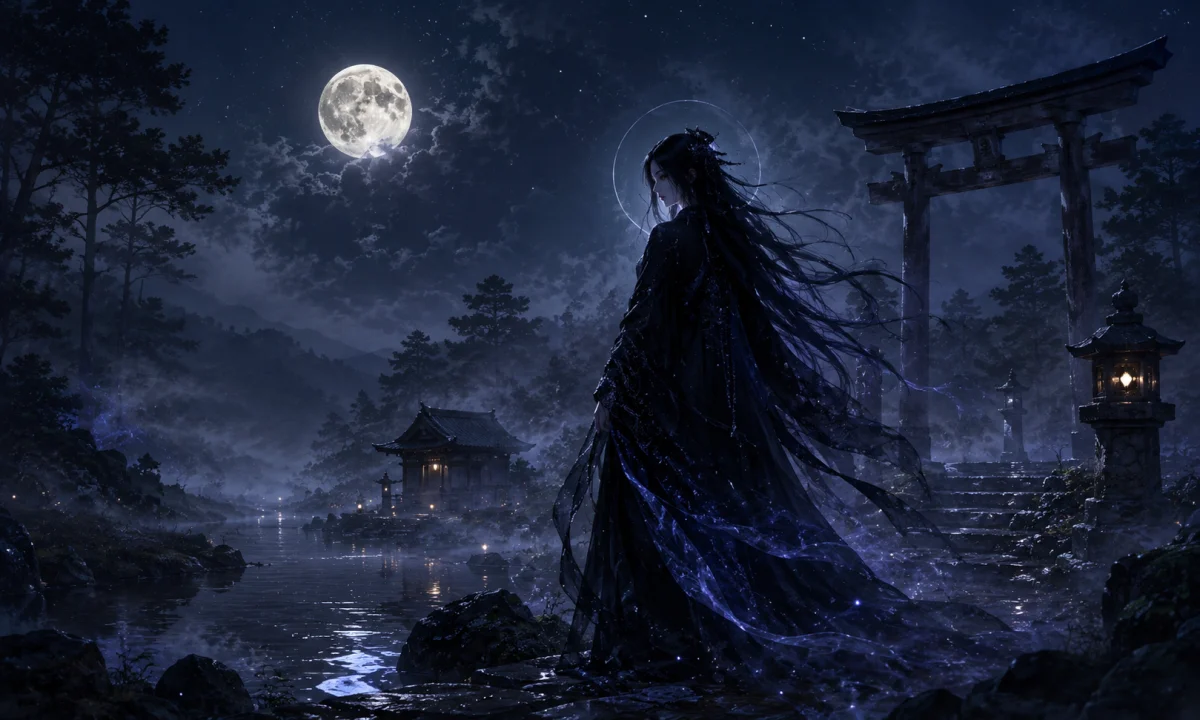
Since Yo is not consistently described as a single being, there is no standard traditional appearance to report. In texts or interpretive traditions where the word suggests night or darkness, Yo may be imagined indirectly through associated imagery: shadow, concealment, dusk, the hidden face of things, or the stillness of the world after daylight fades. Such imagery fits well with Japanese poetic and religious sensibilities, which often value suggestion over direct description.
If Yo is treated as part of a yin-yang style framework, then its nature is relational rather than personal. It represents one pole in a structure of balance. In that case, the “appearance” of Yo is not bodily but symbolic. It stands for what is receptive, obscured, inward, or linked to the moon and night. Yet these are interpretive associations, not fixed iconographic features preserved in an established cult image.
That lack of stable form distinguishes Yo from many kami and yokai who possess recognizable depictions in art and folklore. Yo is better understood as a word that may help describe a mythic atmosphere, a sacred opposition, or a symbolic side of reality.
Roles and symbolic meanings
Where Yo appears in a mythological context, its importance lies in symbolism. Night is not merely absence of day in Japanese thought; it can mark mystery, danger, fertility, concealment, or contact with invisible powers. Many traditions around the world treat darkness as a zone where boundaries weaken. In Japan, too, the unseen world can be associated with spirits, ancestors, divine revelation, or fear. A term like Yo can therefore evoke the conditions under which sacred or uncanny encounters become possible.
In cosmological interpretation, yo may stand for the visible world’s counterpart rather than its enemy. This is an important distinction. In many East Asian frameworks, complementary opposites are not morally absolute. The dark principle is not simply evil, but necessary. If Yo is read through that lens, it symbolizes balance, alternation, and the hidden half of reality. Such thinking can be applied to seasonal cycles, court ritual, divination, and literary imagery.
In folk practice, night-oriented symbolism can also shape taboos and protective acts. People may avoid certain actions after dark, recite prayers, or observe rules about travel, illness, or ritual purity. While these practices are not specifically the “story” of Yo, they show the cultural world in which a term connected with night or darkness could carry religious weight.
Sources and evidence
There is no single canonical myth of Yo that can be traced cleanly through the classical Japanese corpus. That is important to state plainly. The surviving evidence is indirect and interpretive rather than narrative in the usual sense. Classical literature, ritual language, and later scholarly reading may preserve uses of the word, but these do not amount to a unified mythology of a deity named Yo.
In Japanese religious history, many concepts survive less as stories than as recurring terms in poetry, court ritual, or doctrinal explanation. A word can be important without being personified. This is especially true where the vocabulary of classical Chinese, Japanese phonetics, and Buddhist terminology overlap. Because of that, modern attempts to define Yo as a specific spirit or god often rely on over-reading sparse evidence.
Where a source does clearly use yo as part of a mythic expression, its meaning still depends on context. The same word may be cosmological in one setting and purely literary in another. Any responsible account has to preserve that uncertainty rather than forcing a single identity onto the term.
Relationship to kami, spirits, and folklore
Japanese tradition includes many categories of supernatural beings, and it is easy to group too many of them under the label “mythology.” Yo does not fit neatly into the category of kami, because there is no broad, stable cult or narrative cycle centered on it as a divine personage. Nor is it a classic yokai in the folk-monster sense, since it is not normally described as a creature with a fixed shape, trickster role, or haunting behavior.
Instead, Yo belongs more comfortably to the symbolic language that underlies those categories. It can point toward the kind of darkness or hiddenness in which spirits are imagined to move. It may help frame ideas of contrast, secrecy, or the invisible side of life. In that way, it participates in folklore without itself being one of the best-known folklore beings.
This distinction is useful because Japanese supernatural traditions often blend categories that modern readers prefer to separate. A concept may function like a sacred principle in one context, a poetic image in another, and a folk belief in a third. Yo appears to belong to that fluid zone.
Distinctions from similar names and concepts
Confusion can arise because Romanized “Yo” resembles many unrelated Japanese words and names. It is important not to merge them. A personal name, a poetic syllable, a Buddhist or Chinese loanword, and a mythological concept may all look identical in English transcription while being distinct in Japanese.
It is also important not to confuse Yo with deities or beings whose names contain the sound “yo” but have different characters and histories. Japanese mythology includes many kami with similar-sounding names, and folklore collections sometimes transliterate them in ways that look misleadingly alike in English. If a specific source is not identified, caution is essential.
Another possible confusion involves broader cosmological ideas. Because “yo” can overlap with night, and because night can be associated with yin or hiddenness, some readers may assume a direct equivalent to a Chinese deity or a universal principle. That would be inaccurate. Japanese usage adapted these ideas in locally specific ways, and the term itself does not guarantee a direct philosophical correspondence.
Interpretation in scholarship
Scholars generally treat words like Yo as part of a larger pattern in Japanese religious language: the transformation of ordinary vocabulary into mythic or symbolic terms. The significance of such terms lies not in a single biography but in the way they organize perception. They help define what counts as hidden, sacred, dangerous, auspicious, or liminal.
From a historical perspective, this reflects the layered nature of Japanese religion. Indigenous beliefs about place, ancestors, and spirits interacted with court-based mythmaking, Buddhist doctrine, and imported cosmology. A term that might look simple in translation can therefore carry centuries of conceptual development. With Yo, the best-supported interpretation is not a fixed deity but a culturally meaningful expression tied to darkness, complementarity, and the unseen.
That interpretation also warns against overconfidence. When sources are sparse, it is better to say that a term “may signify” or “is used to suggest” than to claim a definite mythological identity. Yo is a good example of a word whose importance lies partly in its instability.
Modern popular culture and later usage
In modern Japanese and global popular culture, short mythic-sounding names are often reused for characters, games, manga, and fantasy worlds. A name like Yo can appear attractive because it is brief, memorable, and culturally suggestive. However, modern uses are usually disconnected from any stable traditional mythological being called Yo.
When Yo appears in contemporary fiction, it should not be assumed that the character or entity has direct roots in ancient mythology unless the work clearly states that connection. Modern creators often borrow the sound or feel of a word rather than its historical meaning. In some cases, they use it because it evokes Japanese aesthetics, night imagery, or spiritual mystery.
For that reason, modern uses are best treated separately from traditional material. They may be culturally interesting, but they do not establish a canonical mythology. The traditional significance of Yo remains primarily linguistic, symbolic, and interpretive rather than narrative or cultic.
Why Yo matters in Japanese mythology
Yo is important not because it is one of Japan’s most famous gods, but because it reveals how Japanese mythic language works. A single term can carry layers of meaning: night, hiddenness, complementarity, poetic atmosphere, and cosmological balance. Such words help form the texture of the tradition even when they do not become famous characters.
In that sense, Yo belongs to the quiet machinery of mythology: the vocabulary that shapes how sacred stories are imagined, how oppositions are understood, and how the unseen world is named. Its ambiguity is not a weakness in the tradition; it is part of the way Japanese religious and literary culture often operates.