WORLD
WORLD
Tilo

Tilo is a name associated in some comparative accounts with a sky-related supreme power in southern and central African religious traditions. The name is often placed within discussions of Bemba or wider Bantu-speaking mythology, although the evidence is not uniform. Short reference works may describe Tilo as a sky god, creator, or remote ruler of the universe, but they do not always identify the same community, language, or body of oral tradition. For that reason, Tilo is best treated as a carefully qualified traditional figure, rather than as a universally defined African deity.
Origins and cultural setting
Accounts of Tilo belong to the broader study of African traditional religions, particularly traditions from regions of south-central Africa. These religious systems were transmitted mainly through oral teaching, ritual practice, family memory, praise poetry, stories, proverbs, and the authority of specialists. They did not normally possess a single canonical scripture that fixed the identity and attributes of every divine being.
The name Tilo is most frequently encountered in modern summaries of Bemba-related or neighbouring Bantu traditions. The Bemba are a major ethnic community chiefly associated with north-eastern Zambia, with related communities and cultural connections extending across parts of the surrounding region. However, the classification of Tilo is not consistent in all sources. Some writers use the name for a high sky power, while others appear to treat it as a regional name or descriptive term connected with the heavens.
Older European descriptions of African religions often gathered information from limited interviews and then arranged diverse local traditions into categories such as “creator god,” “sky god,” “rain god,” or “supreme being.” These categories can be useful, but they may also conceal important differences between communities. A description of Tilo as a sky god should therefore not automatically be transferred to every Bemba-speaking group or to every Bantu tradition.
Name and identity
The spelling Tilo is not necessarily the only form in which the name appears. African languages were frequently written in different ways by missionaries, administrators, travellers, and early ethnographers. A single name could be altered by pronunciation, transcription conventions, or attempts to represent sounds that were unfamiliar to European writers.
There is also a linguistic difficulty. In a number of southern and central African languages, words connected with the sky, heavens, or the upper world can resemble one another because of shared historical relationships between Bantu languages. A term that one writer presents as the name of a deity may, in another context, function as an ordinary word for the sky or as a title for a divine power. The evidence does not justify treating every occurrence of the word Tilo as proof of one pan-African god.
For this reason, Tilo is not best understood as the equivalent of a single, standardized figure such as Zeus, Odin, or Ra. Those comparisons can create a misleading impression of a fixed mythology with a stable genealogy and a complete set of stories. The available material concerning Tilo is more limited and varies by source.
Tilo as a sky-associated power
Where Tilo is identified as a divine being, the most consistent feature is an association with the sky. In traditional African cosmologies, the sky was often understood not merely as a physical space but as the realm of rain, storms, celestial signs, fertility, and the distant power responsible for maintaining the world. A sky deity could therefore be connected with life-giving water, agricultural success, danger from storms, and the general order of nature.
Some summaries describe Tilo as a creator or as the highest power above other spiritual beings. Such descriptions should be used with caution. In many African religious traditions, the creator or supreme power is not represented through a long cycle of dramatic adventures. Instead, the being may be known through titles, blessings, ritual formulas, explanations of the world's origin, and beliefs about the continuing dependence of human life upon rain and fertility.
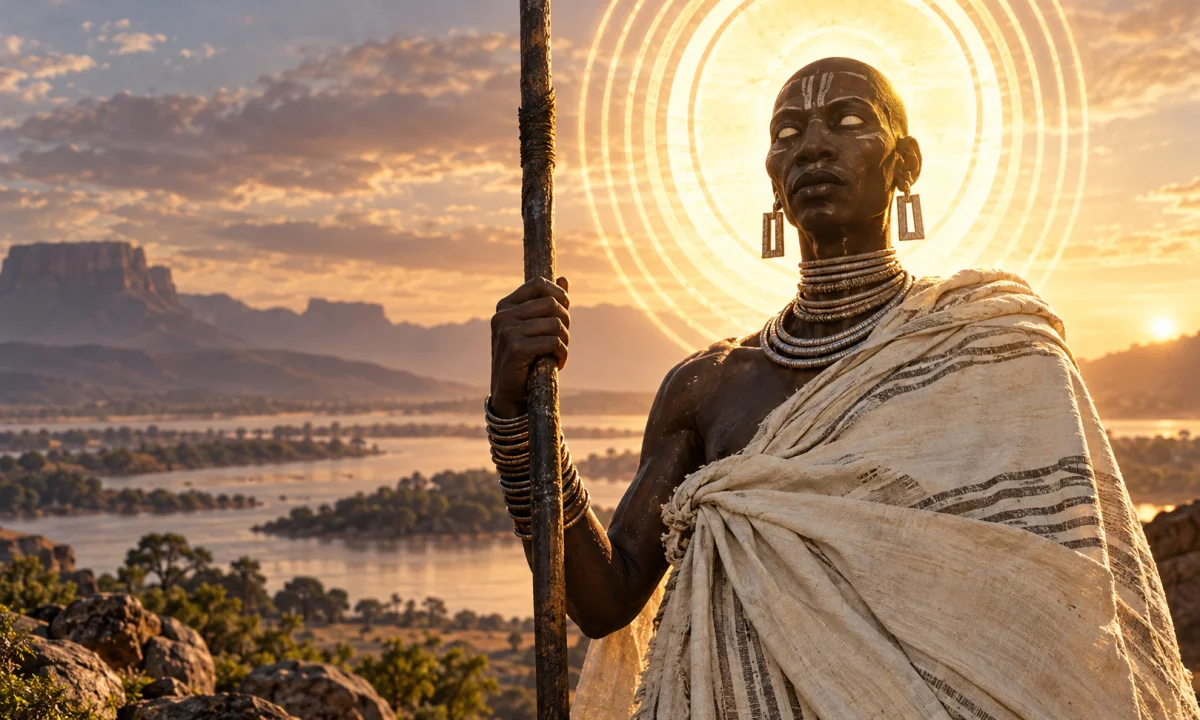
There is no reliable basis for assigning Tilo a single universally accepted physical appearance. Sky gods are sometimes depicted in modern illustrations as human-shaped figures seated among clouds, but such images generally reflect artistic convention rather than documented traditional iconography. Tilo should not automatically be imagined as an anthropomorphic ruler with a crown, weapon, throne, or distinctive costume.
Possible roles and attributes
The following features are associated with Tilo in some accounts, but they should not be treated as equally certain or equally widespread:
- Sky or upper-world association: Tilo is most often connected with the heavens and the distant realm above the human world.
- Supreme status: Some sources describe Tilo as a high god or ultimate divine power rather than as one spirit among many.
- Creation: Tilo is sometimes listed as a creator figure, although detailed creation narratives are not consistently preserved under this name.
- Rain and fertility: Because rain was essential to farming communities, a sky power could be linked with crops, prosperity, and the renewal of life.
- Distance from ordinary human affairs: High creator figures in many African traditions are described as remote, while ancestors, local spirits, or specialist ritual authorities deal more directly with everyday needs.
These attributes reflect a pattern found in many religious systems, but the pattern alone is not evidence that every tradition used Tilo in the same way. In particular, it is unsafe to claim that Tilo possessed a fixed consort, offspring, animal form, sacred weapon, or detailed divine court when the surviving record does not establish such features.
Stories and surviving traditions
Unlike better-documented mythological figures, Tilo is not associated in widely available sources with a large, stable cycle of named stories. There is no generally recognized epic narrative that establishes a complete biography, genealogy, or sequence of adventures. The limited descriptions that survive tend to be classificatory: they identify Tilo with the sky, creation, or supreme authority rather than preserving extensive narrative material.
This absence of long stories should not be interpreted as evidence that the tradition was unimportant. A supreme being can occupy a central place in religious thought without appearing frequently in folktales. In many oral traditions, narratives focus on culture heroes, tricksters, ancestors, animals, or human communities because these characters provide a way to explore social obligations and moral problems. The highest deity may remain beyond ordinary action, invoked in explanations of existence, natural events, or the source of life.
Oral traditions also change according to setting. A ritual specialist may emphasize rain and agricultural dependence; a family tradition may stress creation; a storyteller may use another divine name altogether. The same community can preserve multiple names or descriptions for the highest power, especially when local history has brought different linguistic and religious traditions into contact.
Relationship to ancestors and other spirits
A sky-associated high god should not be confused with the entire spiritual world. African traditional religions commonly recognize several levels or categories of spiritual presence, although the boundaries differ from one society to another. These may include creator powers, nature spirits, territorial beings, ancestors, and spirits associated with particular places or communities.
Ancestors in particular often have a more immediate role in family and social life than a remote sky deity. They may be remembered through ceremonies, offerings, kinship obligations, or appeals for protection and wellbeing. This does not necessarily mean that ancestors replace the supreme god. Rather, religious life can be structured through several interconnected relationships: the supreme power provides or governs the conditions of existence, while ancestors remain close to the living community.
It would therefore be misleading to describe Tilo simply as an “African god” in isolation from ritual and social context. The meaning of a high divine power depends on how a particular community understands rain, land, kinship, death, authority, and the relationship between the visible and invisible worlds.
Interpretation and cultural significance
Tilo is significant partly because the figure illustrates the difficulty of describing African religions through broad labels. The term “sky god” can suggest a familiar European-style deity who actively rules the world from above. In local religious contexts, however, a sky power may be understood less as a character in a dramatic mythology and more as the ultimate source of life, rain, order, or existence.
The association with the sky also has practical and symbolic importance. Agricultural societies depend on seasonal rainfall, and the heavens can appear both generous and threatening. Rain sustains crops, animals, and human communities, while drought, lightning, and destructive storms expose the vulnerability of human life. A deity connected with the upper world may therefore represent both provision and uncertainty.
Descriptions of Tilo as remote can also be interpreted in social terms. When a supreme being is considered distant, religious practice does not become empty. Instead, people may approach the sacred through ancestors, elders, ritual experts, communal ceremonies, sacred places, and established moral relationships. The distance of the high god may express transcendence, while the presence of other spiritual powers expresses the sacred character of the immediate environment.
Scholars have also warned against assuming that every African religion follows the same pattern of a remote creator who withdrew after making the world. That motif occurs in several traditions, but it is not a universal rule. It should not be added to accounts of Tilo unless a particular source clearly documents it.
Distinguishing Tilo from similar names
Confusion is especially likely because Tilo is a short name and because similar forms occur in several African languages. A name that resembles Tilo may refer to the sky itself, a divine title, a local spirit, or a different deity belonging to another ethnic tradition. Similar spelling does not prove shared identity.
Tilo should also not be automatically equated with other well-known African creator or supreme-god names, including Mulungu, Nyambe, Leza, Chukwu, Olodumare, or Unkulunkulu. These figures belong to different cultural and linguistic settings, and their attributes vary considerably. Comparative scholars may discuss them together when studying ideas of divine creation or high gods, but comparison is not the same as identification.
Nor should Tilo be merged with figures from southern African traditions who are linked with rain, thunder, or the sky under unrelated names. A rainmaker, storm spirit, ancestral power, and supreme creator may all be connected with weather without being versions of one being. Careful attention to community, language, and source is essential.
Sources and limits of the record
Knowledge of Tilo comes primarily through secondary descriptions and records of oral traditions rather than through an ancient written mythology devoted to the figure. Such material can preserve valuable information, but it must be read critically. Early observers sometimes translated local religious concepts into familiar terms such as “god,” “devil,” “idol,” or “creator,” even when those categories did not precisely match local ideas.
Names may also have been collected from people belonging to different communities, or recorded without enough information about language and ritual context. Later encyclopedias sometimes repeat a brief description without identifying its regional limits. As a result, statements about Tilo should distinguish between what is relatively consistent—the connection with the sky in certain accounts—and what remains uncertain, such as a detailed mythology, exact geographical distribution, or a universally accepted position within a divine hierarchy.
Tilo in modern reference works
Modern mythology websites, encyclopedias, and popular lists often present Tilo as a clearly defined African sky god or creator. These descriptions can make the figure easier to recognize, but they may also simplify a complex and uneven record. Illustrations and fictional treatments may give Tilo a human form, a personal family, or dramatic powers that are not securely documented in traditional sources.
No major, widely established modern popular-culture franchise has made Tilo a consistently recognizable character. When the name appears in contemporary fiction, games, artwork, or online mythology collections, those uses should be treated as modern reinterpretations unless they are explicitly grounded in a particular traditional account. The traditional Tilo remains best understood through the limited regional and comparative evidence that associates the name with a sky-related supreme power, rather than through later invented biographies or visual designs.