WORLD

Deng
Deng is a divine figure associated chiefly with Dinka religious tradition in South Sudan. He is commonly connected with rain, fertility, storms and the life-giving powers of the sky. In some accounts he appears as Dengdit, often translated as “Deng the Great,” while other descriptions simply use Deng. His identity is not fixed across all sources: some traditions treat him as a major spirit or divinity beneath the supreme creator, whereas others place him very close to the highest power of the heavens.
Deng belongs to the religious world of the Dinka, a Nilotic people whose traditional homeland lies around the Nile, its tributaries and the seasonal grasslands of present-day South Sudan. Dinka communities have historically lived through cattle keeping, agriculture, fishing and movement between wet- and dry-season camps. In such an environment, rain, rivers, pasture and the fertility of cattle and human families are not separate concerns. They are closely connected aspects of life, and Deng’s associations reflect that relationship.
Dinka religious setting
Dinka religion does not rest on a single canonical book or a standardized pantheon. Knowledge has been preserved through oral traditions, ritual practice, praise names, prayers, sacrifices, family histories and the teachings of ritual specialists. Accounts recorded by outsiders have also used different spellings and categories, sometimes translating Dinka beings as “gods,” “spirits,” “divinities” or “forces.” These terms do not always correspond exactly to Dinka religious ideas.
The supreme creator is widely known in Dinka contexts as Nhialic, a name associated with the sky and the power that brought the world into being. Dinka religious thought also recognizes many jok, a term often rendered in English as spirits or divinities. Some jok are connected with particular places, natural powers, communities or ritual concerns. Others may be associated with ancestors or with unusual events affecting people and cattle.
Deng is usually discussed within this wider network of divine and spiritual powers. He should not automatically be treated as an independent “rain god” in the same sense as a figure belonging to a neatly organized classical pantheon. His role and rank can look different depending on the Dinka community, the speaker, the ritual context and the interpretation of the ethnographer recording the tradition.
Name and identity
The form Deng is the most familiar spelling in English-language discussions, but the name also appears in forms such as Dengdit, Dengdit Nhialic and “Deng the Great.” Spelling varies because Dinka names have been written using different systems and because the Dinka language includes sounds that are not represented consistently in English.
The element dit is commonly understood in translations of Dengdit as meaning “great” or “large,” giving the sense of “Great Deng.” This does not necessarily indicate a separate being. In many discussions, Deng and Dengdit are treated as related names for the same important divine figure. Nevertheless, accounts should not be assumed to use the names identically. Some descriptions emphasize Deng as a particular spirit, while others present Dengdit as a more exalted or comprehensive form.
Deng is also a common personal name among people from South Sudan and neighbouring regions. A person named Deng is not therefore named after a god in every case, and the presence of the name in modern public life does not by itself demonstrate continued worship of the traditional deity. Personal names can preserve cultural memory, family history or linguistic identity without functioning as statements of religious belief.
Rain, fertility and the sky
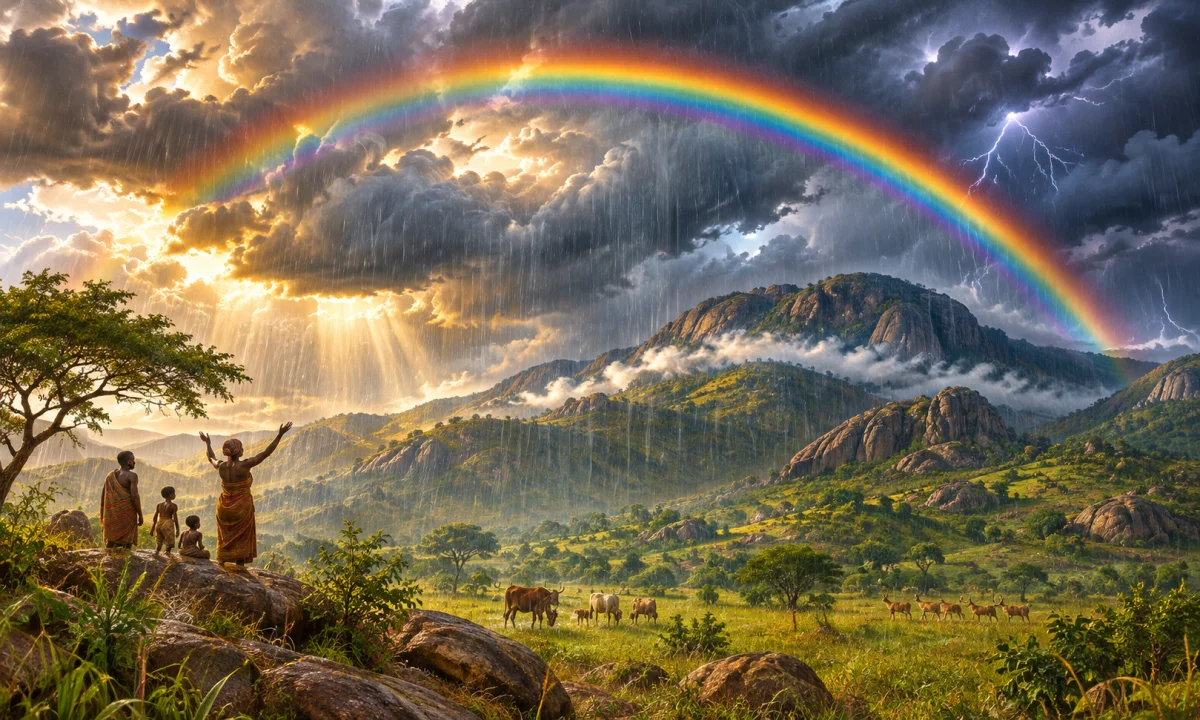
Deng’s strongest and most consistent associations are with rain and fertility. Rain determines the growth of grass and crops, the condition of grazing lands and the availability of water. For cattle-keeping communities, rainfall also affects the health and movement of herds. A divine power connected with rain is consequently connected with prosperity, survival and the renewal of the land.
Some accounts associate Deng with thunder, lightning and other manifestations of the upper world. These links are understandable within a religious system that sees natural events as signs of relationships between humans and spiritual powers. Yet descriptions of Deng as specifically a thunder god or lightning god should be treated with care. Such labels can simplify a broader complex of ideas, and not every account assigns exactly the same phenomena to him.
Deng’s fertility is not limited to agriculture. The word may refer to the fertility of cattle, the reproduction of herds, the birth of children and the general abundance necessary for communal life. In traditional Dinka society, cattle have economic, social, emotional and ritual importance. They provide milk and blood, serve in marriage exchanges and compensation, and occupy a central place in poetry and personal identity. A divinity connected with rain and fertility therefore touches nearly every major area of life.
Rain can also be dangerous when it arrives at the wrong time or in destructive abundance. Flooding, disease, failed crops and the loss of pasture create hardship even when rain is normally desired. Deng’s sphere should not be reduced to simple benevolence. Divine powers connected with weather may be approached with respect, requests and offerings because human beings depend on them but cannot command them.
Relationship with Nhialic
The relationship between Deng and Nhialic is described differently in different accounts. Nhialic is generally presented as the creator and highest divine power, while Deng may be described as a powerful manifestation, intermediary, son or associated spirit. Some sources use language suggesting that Deng is closely related to Nhialic in the structure of the cosmos; others distinguish them more clearly.
One frequently repeated interpretation presents Deng as a son of Nhialic. In some retellings, he is also placed within a family of primordial figures that includes Abuk, a female ancestral figure associated in Dinka tradition with human origins and cultivation. These genealogical descriptions should not be treated as universally accepted doctrine. Oral traditions can preserve several versions of a relationship, and a kinship term used in a myth may express rank, dependence or spiritual connection rather than a fixed biological genealogy.
It is therefore safest to say that Deng is often linked to Nhialic and may be understood as operating within Nhialic’s created or divine order. He is not consistently represented as a rival creator who replaces Nhialic. Nor should every story about rain, the sky or fertility be attributed to Deng alone. Dinka religious language permits overlapping powers and relationships that do not fit a rigid division of responsibilities.
Stories and forms of tradition
There is no single authoritative cycle of stories about Deng comparable to a written mythology with a fixed sequence of episodes. Much of what is known comes from oral performances and observations of religious life. Accounts may focus less on a dramatic biography and more on Deng’s presence in prayers, explanations of weather, ritual action and relationships between people, cattle and the land.
Stories connected with Dinka cosmology sometimes describe a time when the sky and earth were closer to one another than they are now. In a number of African traditions, a separation between the divine realm and human beings explains why direct access to the creator was lost. Dinka versions vary in their details and in the figures involved. It would be misleading to assign every “separation of heaven and earth” story specifically to Deng, but such narratives help explain the broader setting in which sky-associated divinities are understood.
Other traditions emphasize the transmission of ritual power and the role of prophets or diviners. Individuals recognized as having unusual contact with spiritual forces may interpret illness, misfortune, drought or conflict. In these settings, a divine figure such as Deng is not merely a character in a remote myth. The figure can be part of an active religious vocabulary used to understand present circumstances.
Because Dinka traditions are local and performative, a story may change according to the purpose of the telling. A ritual specialist may stress Deng’s authority over rain; a cattle owner may speak of fertility and herd well-being; a community elder may emphasize moral order or the consequences of neglecting spiritual obligations. These variations do not necessarily represent contradictions. They show how oral religion adapts its expression to social and environmental experience.
Ritual, prayer and sacrifice
Traditional Dinka religious practice includes prayer, invocation, sacrifice and the use of cattle in important ritual contexts. Cattle can be offered or dedicated in response to illness, crisis, vows or appeals for protection and prosperity. The exact meaning of an offering depends on the occasion and the community. It is not accurate to describe every cattle sacrifice as being made to Deng, because Dinka ritual may address Nhialic, particular jok, ancestors or other spiritual powers.
Rainmaking and fertility rites are especially difficult to generalize. European and later academic observers sometimes grouped diverse practices under broad labels such as “rain cult” or “rain god worship.” Those labels may obscure the identity of the ritual participants and the distinctions they themselves make between divine powers. Deng’s association with rain is important, but it does not prove that all Dinka weather rituals were directed exclusively to him.
Music, praise poetry and cattle names are also significant in Dinka religious culture. Dinka poetic expression often links human identity with cattle, landscape and divine order. A name or praise expression associated with Deng may communicate hopes for strength, fertility, rain or protection. Such language should be understood as part of a living cultural tradition rather than as a list of fixed attributes.
Interpretations of Deng
Scholars have interpreted Deng in several ways. Some regard him as a major Dinka deity associated with rain and fertility. Others describe him as a spirit or divine power within a larger system centered on Nhialic. A further interpretation treats the name as referring to a manifestation of the supreme power rather than to a wholly separate personality.
These differences partly arise from the nature of the evidence. Dinka religious knowledge was transmitted orally, and early written descriptions were produced by missionaries, colonial officials and anthropologists working through translation. Their categories were influenced by European assumptions about “gods,” “spirits” and “religion.” Even careful observers could record only particular communities and moments, not a complete account of every Dinka tradition.
Political and social change also matters. War, displacement, Christian mission activity, Islam, urbanization and the division of South Sudan from Sudan have all affected the circumstances in which Dinka religious ideas are expressed. Traditional concepts may be rejected, reinterpreted, combined with Christian language or retained as cultural knowledge. A modern Dinka person may speak about Deng in a way that differs substantially from an older ritual specialist without either use being treated as the sole authentic version.
Deng and similar names
Deng should be distinguished from unrelated figures and names that happen to look similar in English. In Chinese history and culture, Deng is a common surname and personal name, not a reference to the Dinka divine figure. The name also appears in other African languages and communities, where it may have a separate meaning or refer to another person, spirit or ancestor.
Deng should also not be merged automatically with Nhialic. The two are closely connected in many descriptions, but connection is not identity. Nor should Deng be treated as interchangeable with every African deity associated with rain, thunder or fertility. Rain-making figures occur in many cultures, but each belongs to a particular religious and linguistic setting.
Contemporary significance
Deng has limited presence in globally popular mythology compared with figures from Greek, Norse or ancient Egyptian traditions. He is more important as part of the cultural and religious heritage of the Dinka and of South Sudan than as a character in mainstream entertainment. Modern references may appear in writing about African religions, South Sudanese identity, oral tradition and the history of Nilotic peoples.
Contemporary uses of the name should be separated from traditional worship. Deng may be used in personal names, literature, political discussion or cultural education without implying belief in a rain divinity. At the same time, the persistence of the name preserves a connection to a worldview in which sky, rain, cattle, fertility and community life are interdependent.
The most responsible understanding of Deng therefore keeps several levels distinct: the traditional Dinka associations with rain, fertility and divine power; the varied oral and ethnographic accounts of his relationship with Nhialic; the uncertainties introduced by translation and regional variation; and the modern use of Deng as a cultural and personal name. He is best understood not as a universally standardized African god, but as a significant and variably described figure within Dinka religious tradition.