WORLD

Da
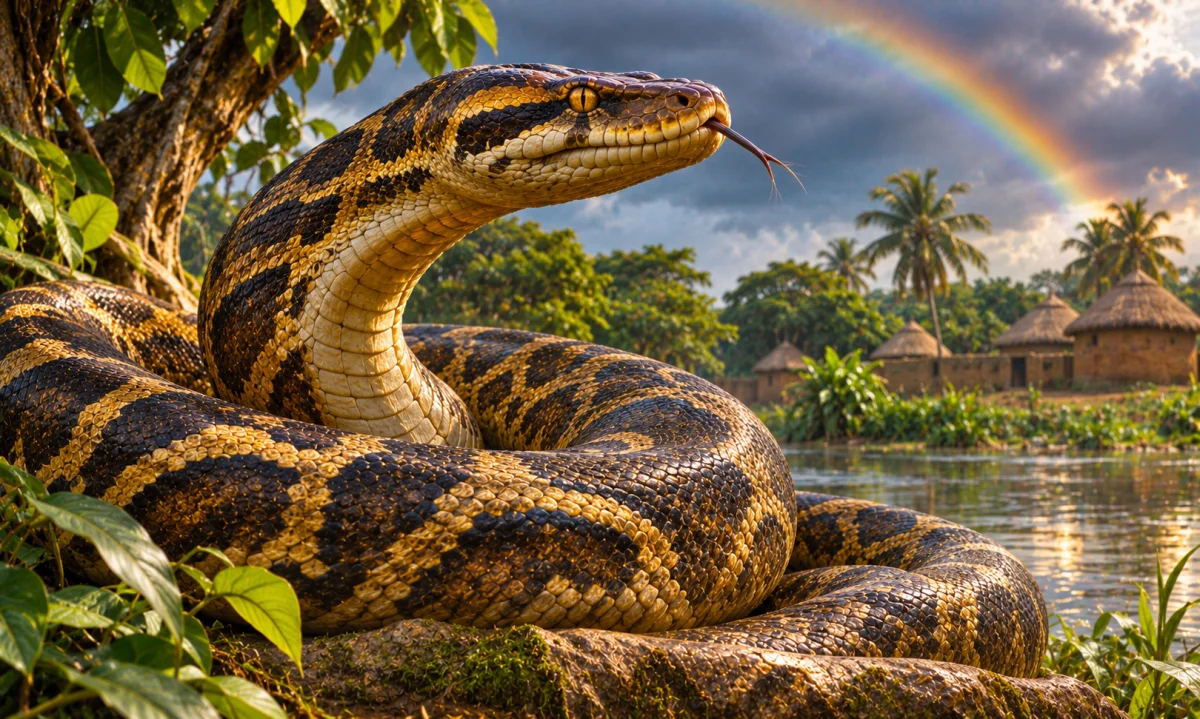
Da is a name associated with a serpent power in the religious traditions of the Fon and neighbouring peoples of present-day southern Benin and Togo. The name is not completely standardized: English-language sources may write it as Da, Dan, Dangbé or connect it with other serpent names. These forms can refer to related religious ideas, but they are not always interchangeable. In some accounts, Da is a cosmic serpent who helps sustain the ordered world; in others, the name refers more specifically to a sacred python, a deity of prosperity, fertility and life-giving power.
Cultural and religious setting
Da belongs to the wider religious world often called Vodun, especially the traditions of the Fon people of the former Kingdom of Dahomey. Dahomey occupied much of what is now southern Benin and became a major regional kingdom from the seventeenth century onward. Fon religious life was not based on a single canonical scripture. Its teachings were preserved through ritual practice, oral narratives, priestly knowledge, shrines, songs and community memory.
In this setting, the universe contains a supreme creative power and numerous vodun, or sacred beings and forces. The names, status and stories of these beings vary between communities. A deity may be understood as an independent divine personality in one locality and as an aspect, title or manifestation of a broader power in another. This local and oral character explains why descriptions of Da are sometimes brief or inconsistent.
The Fon religious universe is frequently described through the paired creator figures Mawu and Lisa, although their precise relationship and attributes also vary. Mawu is commonly associated with the moon, night and maternal or generative power, while Lisa is associated in many accounts with the sun, day and ordering force. Their creative work is supported by other divine beings, including earth, thunder, iron and serpent powers. Da should be understood within this network rather than as a figure isolated from the rest of Fon cosmology.
The name Da and related names
The short form Da presents a particular difficulty. Some modern summaries use it as the name of a serpent deity, while more detailed accounts use Dan or Dangbé. Linguistic spelling has also been affected by the movement of names between Fon, Ewe, French and English sources. Colonial writers often recorded African religious terms according to unfamiliar spelling systems, and later authors sometimes shortened or regularized those names.
Dan is widely associated with a serpent deity or sacred serpent power in Fon and related traditions. Dangbé is especially associated with the sacred python tradition of the coastal region around Ouidah, a historic centre of Vodun worship. The relationship between Dan, Da and Dangbé is described differently by different authorities. They may be treated as variants of one serpent power, as closely related beings, or as names belonging to distinct local cults.
Another name that often appears in discussions of African and Atlantic serpent traditions is Aido-Hwedo, also written in several other ways. Aido-Hwedo is commonly described as a cosmic serpent in Dahomean-derived accounts, especially in stories explaining the formation and stability of the world. Some popular references equate Aido-Hwedo with Dan or Da, while others distinguish them. Because the traditions are not uniform, it is safer to describe them as related serpent figures whose identities overlap in some retellings without assuming that every name denotes exactly the same being.
Da as a serpent power
When Da is presented as a cosmic serpent, the figure represents the principle that supports, encircles or stabilizes the created world. Serpents are particularly suited to this role because they move between visible and hidden places. They live on the ground, disappear into holes, shed their skin and emerge renewed. These characteristics allow a serpent deity to symbolize continuity, regeneration and the connection between the surface of the earth and deeper, unseen realms.
In traditions associated with Dan or Da, the serpent may be imagined as coiled beneath or around the earth. The image is not merely decorative. A coiled serpent suggests containment and balance, while the serpent’s movement can explain changes in the landscape. Some accounts connect its activity with earthquakes or other disturbances of the earth. Such stories should not be treated as a single fixed doctrine; they are part of a wider body of oral explanations in which the world remains stable because divine powers continually maintain it.
The serpent is also linked with water, rain, fertility and abundance. These connections are especially meaningful in the coastal and agricultural environments of southern Benin and Togo. Rain nourishes crops, rivers and lagoons sustain communities, and the sea provides both resources and danger. A serpent spirit associated with water can therefore embody both the physical conditions of prosperity and the sacred power behind them.
Appearance and sacred representation
Da is most commonly represented as a snake or python. The python is especially important in the Vodun traditions of the region because it is large, powerful and non-venomous. Its slow movement and ability to live near human settlements have contributed to its sacred status in some communities. A sacred python is not simply an artistic symbol: in a shrine tradition, living snakes may be treated as manifestations or companions of the deity.
Descriptions of colour vary. Some accounts connect serpent deities with the rainbow, whose arch resembles a great creature spanning the sky. Other accounts emphasize the patterned skin of the python, the shining appearance of wet scales or the contrast between the snake’s earthly body and its supernatural dimensions. These associations should not be combined into a single universal iconography. A rainbow serpent, a sacred python kept at a shrine and a cosmic serpent supporting the earth may belong to overlapping traditions while retaining distinct local meanings.
Serpent imagery can also express wealth. In parts of West Africa, snakes and other animals connected with the earth, water or hidden places became associated with valuables and the power to bring prosperity. Da’s wealth symbolism is therefore related to the serpent’s role as a guardian of concealed forces and fertile ground, rather than to a simple idea of treasure-hoarding.
Stories of creation and the support of the world
There is no single authoritative creation story for Da. In one family of accounts, the supreme creator forms the world and assigns a serpent to help carry or support it. The serpent’s body passes around the earth or beneath it, keeping the created order from collapsing. If the earth becomes too heavy or the serpent shifts its position, the movement may be used to explain earthquakes or changes in the landscape.
In another group of stories, a primordial serpent accompanies the creator during the formation of the world. As the creator establishes the earth, the serpent moves through the waters or around the unfinished land. Mountains, minerals and other features of the landscape may be explained through the serpent’s bodily presence or movements. These details are not consistent across all tellings and should not be presented as a single canonical narrative.
Some versions connect the serpent with the rainbow. The rainbow can be understood as the visible sign of a divine being that joins heaven and earth, or as a protective arc surrounding the world. In such interpretations, Da’s power is not limited to the ground. The serpent links the watery depths, the inhabited earth and the sky, making it a figure of cosmic continuity.
Stories of this kind are not simply attempts to provide primitive explanations for natural events. They express a religious understanding in which the world is alive, relational and dependent on the continuing action of sacred powers. The stability of the earth is a spiritual matter as well as a physical one. Human beings, divine forces, animals and the landscape participate in one interconnected order.
Fertility, healing and prosperity
Da’s serpent symbolism is associated with fertility in several related traditions. The snake’s ability to shed its skin makes it an image of renewal, while its closeness to the soil links it with planting, germination and the generative power of the earth. Water serpent traditions likewise connect the deity with rain, rivers and the reproductive vitality of nature.
These associations can extend to human health and family prosperity. Religious specialists may appeal to a serpent deity for protection, healing or the well-being of a household. The exact ceremonies, offerings and prohibitions depend on the local cult. It would be misleading to describe one universal ritual system for Da, since Vodun practice is organized through particular temples, priestly lineages and regional traditions.
Sacred serpents may be treated with respect and protected from harm. In a shrine context, an animal’s presence can be interpreted as a sign of the deity’s attention. This does not mean that every snake encountered in the region is automatically considered Da, nor that all communities maintain the same practices. The religious importance of the python is tied to specific traditions and ritual settings.
Relationship to other serpent figures
Da is often compared with Aido-Hwedo, Dan and Dangbé, but the comparisons require care.
- Dan: A serpent deity or serpent power in Fon and related traditions. Many accounts treat Dan as the principal form of the name that appears in English as Da.
- Dangbé: A sacred python power especially associated with the Ouidah region. Dangbé may be described as a local or developed form of the serpent tradition, but it should not automatically be reduced to every figure called Da.
- Aido-Hwedo: A cosmic serpent prominent in accounts of the creation and support of the world. Some writers identify Aido-Hwedo with Dan or Da, while others distinguish the figures.
- Damballa or Damballah: A major serpent lwa in Haitian Vodou. Damballa has historical connections with West African religious traditions, including Fon and Ewe heritage, but is a Haitian religious figure with its own ritual context and history.
Da should also be distinguished from serpent beings in unrelated traditions. The rainbow serpent figures of Aboriginal Australian religions, the Egyptian serpent Apophis and the feathered serpent of Mesoamerican religions arose in different cultural and historical settings. Similar imagery does not prove a common origin. Snakes are widespread religious symbols because their biological features invite associations with death, renewal, water, the earth and hidden power.
Da and the Atlantic religious world
From the seventeenth to the nineteenth centuries, warfare, trade and the forced migration of enslaved people connected Dahomey and other West African regions with the Atlantic world. Religious ideas travelled with these communities and changed in new settings. Haitian Vodou, Cuban religious traditions and other Afro-Atlantic religions contain serpent powers whose names or attributes may recall West African models.
The Haitian lwa Damballa is the clearest example of a later tradition often compared with Dan or Da. Damballa is commonly portrayed as an ancient, powerful serpent associated with creation, wisdom, purity and the waters. However, Damballa is not simply Da transported unchanged from Benin to Haiti. Haitian Vodou developed through the interaction of West and Central African traditions, Indigenous Caribbean history, European colonial religion and local Haitian experience. Its terminology, ceremonies and relationships belong to Haitian religious life.
Similar caution is needed when discussing modern labels such as “African serpent god.” Such labels can make distinct traditions appear more uniform than they are. Da is better understood as a name or cluster of names within a regional religious environment, whose meanings have been shaped by locality, language, oral transmission and later interpretation.
Interpretation and cultural significance
Da’s importance lies in the combination of qualities represented by the serpent: physical strength without dependence on weapons, movement between earth and water, renewal through shedding, and the capacity to remain hidden while influencing the visible world. The figure provides a way to imagine how order is maintained beneath ordinary experience.
The serpent also complicates the simple opposition between good and evil. In many modern fantasy settings, a snake is automatically treated as sinister. In Fon and related Vodun traditions, a serpent power can be protective, fertile, healing and necessary for the world’s survival. Its danger is not necessarily moral wickedness; it reflects the awe inspired by a force that humans cannot fully control.
Because the traditions are preserved through living communities rather than a single ancient text, Da does not have one definitive appearance, genealogy or list of powers. The most responsible descriptions retain the variations: Da may be a name for a serpent deity, a form of Dan, a power connected with sacred pythons, or a figure compared with the cosmic serpent Aido-Hwedo. Those possibilities belong to the history of the tradition and should not be flattened into a single invented mythology.