WORLD
WORLD
Nyambe
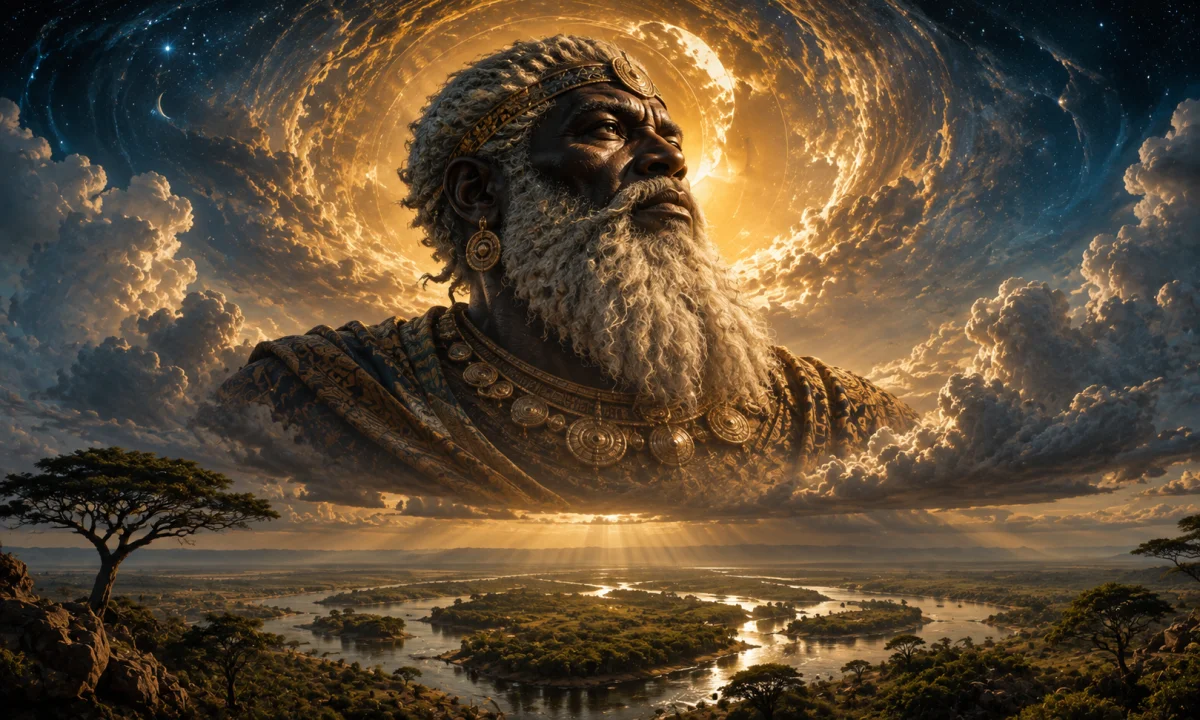
Nyambe is the supreme creator figure in the traditional religious thought of the Lozi people of western Zambia, especially in the cultural region historically known as Barotseland. He is generally described as the maker of the world, living beings and human beings. In many recorded Lozi traditions, Nyambe eventually withdraws from direct contact with humanity after the disobedience of the first human, usually called Kamunu. The stories explain both the origin of the world and the perceived distance between the creator and ordinary human life.
Nyambe belongs to a specific Central and Southern African tradition. The name should not be treated as the name of one universally shared “African god.” African religious traditions are diverse, and similar names may refer to different beings in different languages and communities. Spelling and interpretation also vary in written sources. Nyambe is sometimes written Nyambi, while other creator names from neighbouring traditions may resemble it without referring to the same figure.
Cultural setting
The Lozi are associated particularly with the upper Zambezi floodplain and surrounding areas of western Zambia. Their history includes the development of the Lozi kingdom, whose ruler is known as the Litunga. Lozi religious ideas developed within a wider environment of riverine agriculture, cattle keeping, fishing, seasonal flooding and close attention to the natural world. These surroundings are important for understanding why creation stories often connect humans, animals, plants, water and the sky within a single moral and social order.
Traditional Lozi knowledge was transmitted primarily through oral performance rather than through a single canonical scripture. Narratives could be preserved by elders, ritual specialists, political authorities and storytellers, with details changing according to the community, performer and purpose. The versions recorded by European missionaries, administrators and ethnographers therefore represent particular encounters with Lozi traditions rather than a complete or fixed religious system.
Written descriptions also reflect the assumptions of their collectors. Christian missionaries sometimes translated Nyambe using the word “God,” which made the figure understandable within Christian vocabulary but could obscure differences between Lozi ideas and Christian theology. The identification is useful in a broad sense because Nyambe is a supreme creator, but it should not imply that traditional Lozi religion was simply an African version of Christianity.
Name and identity
The meaning and linguistic history of the name Nyambe are not presented consistently in all sources. Some accounts treat it as a personal name, while others use it more like a title or a designation for the highest divine power. The form Nyambi occurs in some written discussions and may reflect pronunciation, orthography or the influence of related languages. It is safer to describe these forms as variants in the recorded tradition rather than to assume that every use refers to precisely the same figure.
Nyambe is generally classified as a creator deity and a supreme or high god. He is not usually portrayed as one member of a family of gods competing for control of the cosmos. In traditional accounts, other spiritual powers, ancestors and beings may have important roles, but Nyambe occupies a higher position as the originator of existence and the source of the order that makes life possible.
Descriptions of Nyambe’s personality are often shaped by the creation narratives. He can appear generous, inventive and patient, but also increasingly distant when humans repeatedly violate the limits set for them. This does not necessarily mean that the stories present him as an arbitrary or hostile god. His withdrawal can instead explain why the creator is no longer visible and why people must live within a world governed by consequences, custom and mortality.
Creation and the first human
In commonly recorded versions of the Lozi creation tradition, Nyambe brings the world and its forms of life into being. The accounts may differ in the order of creation and in the details of Nyambe’s activities, but they generally present him as the source of humans, animals and plants. Creation is not described only as the manufacture of physical objects. It also establishes relationships: humans depend on animals and plants, people are expected to respect limits, and the world has a moral structure as well as a material one.
The first human is often named Kamunu. Some versions describe Kamunu as being formed or created by Nyambe and placed in a world that already contains other living things. Nyambe gives Kamunu knowledge or instructions concerning proper conduct. The exact rules vary in retellings, but the central pattern is consistent: the first human fails to respect boundaries that Nyambe has established.
Kamunu’s disobedience is frequently connected with the killing of animals. In some tellings, Nyambe forbids Kamunu to kill particular creatures or warns him not to destroy life without necessity. Kamunu nonetheless kills an animal, often described as a relative or companion of another animal. The resulting conflict shows that human actions have effects beyond the immediate act. Humans are not entirely free to use the rest of creation as they please.
Some accounts include further episodes in which Kamunu repeats his errors, disobeys additional instructions or causes suffering. These episodes may explain why human life includes death, labour and separation from the divine. They also express a practical ethical principle: human beings survive through their use of the natural world, but that use must be controlled by restraint and responsibility.
Nyambe’s withdrawal from humanity
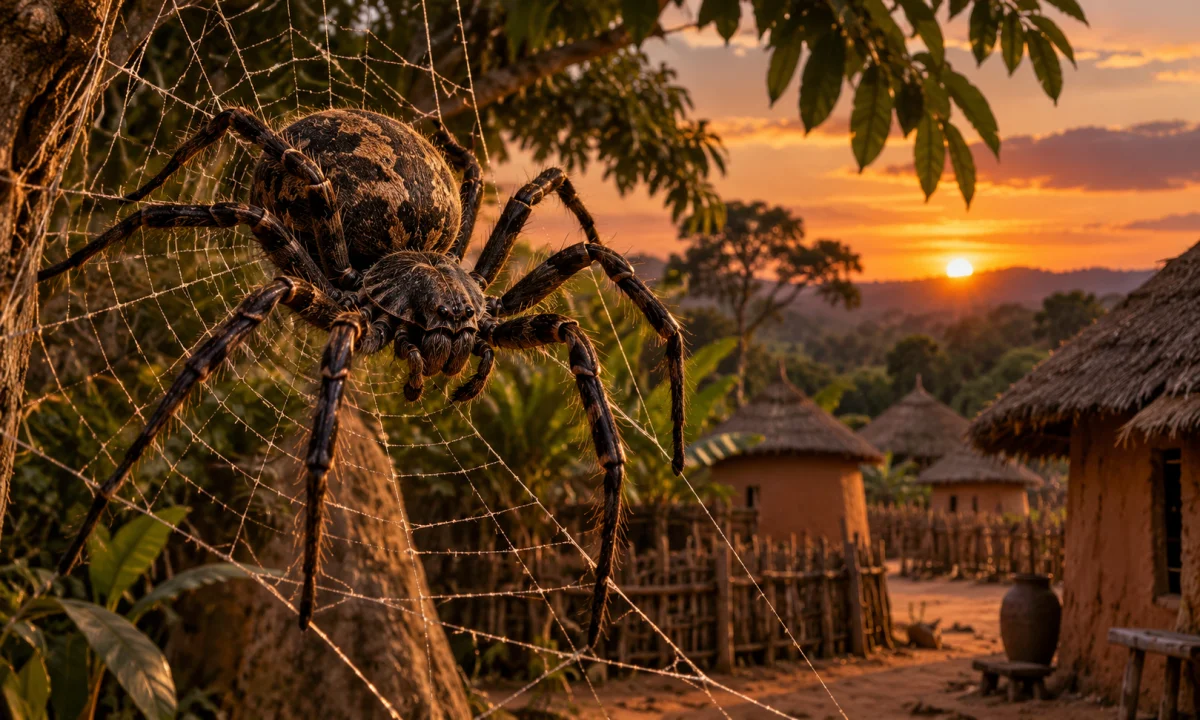
A central theme in stories about Nyambe is his movement away from the human world. After Kamunu’s repeated disobedience, Nyambe attempts to escape or distance himself from the first human. Kamunu follows him, so Nyambe continues to move farther away. In some versions, he rises into the sky with the assistance of a spider, whose web provides a path between earth and heaven.
The spider is an important figure in this episode, although not every retelling gives the same explanation of its role. The creature’s web provides a striking image of a connection between the earthly and celestial realms. At the same time, the web marks the final route by which Nyambe leaves ordinary human reach. Once he has gone to the sky, people can no longer approach him as they did at the beginning of creation.
The story is sometimes presented as an explanation for the apparent absence of the creator. Nyambe is not destroyed and does not cease to exist; rather, he becomes remote. The separation is linked to human conduct, especially the failure to obey divine instructions. It therefore explains both a cosmological fact—the creator is associated with the sky—and a moral fact—the world is marked by the consequences of human behaviour.
Some versions connect Nyambe’s departure with the introduction of death or with the end of direct immortality. The relationship between these elements is not identical in every source, and it is misleading to treat one written version as the definitive Lozi account. In oral traditions, the same basic narrative may be told with different names, incidents and emphases.
Attributes and powers
Nyambe’s most consistent attribute is creative power. He is responsible for the existence of the world and for the distinction between different forms of life. His power is therefore broader than that of a spirit associated with one river, animal, storm or locality. He is a cosmic figure whose authority extends over the whole created order.
Nyambe is also associated with the sky because of his withdrawal from the earth. This does not necessarily make him a sky god in the narrow sense. The sky is primarily the place to which he retreats and the realm that symbolises his separation from humanity. In some interpretations, his celestial location also helps explain why the creator is remote, difficult to approach and connected with forces beyond ordinary human control.
Traditional stories do not consistently provide a fixed physical appearance for Nyambe. He may be described in human terms when he interacts with Kamunu, but these narrative forms should not automatically be understood as a permanent bodily shape. High creator beings in oral traditions are often represented through their actions, names and relationships rather than through a standard iconographic image.
Nyambe’s authority includes moral knowledge. He establishes rules and expects humans to recognise that life is ordered rather than purely available for unrestricted use. The stories do not present morality as a separate subject from creation. The treatment of animals, the limits of human power and the consequences of disobedience all belong to the same religious understanding.
Nyambe and Nasilele
Some accounts name Nasilele as Nyambe’s wife or female companion. She appears in certain descriptions of Lozi creation traditions, but her role and the details of her relationship with Nyambe are not uniform across the available material. In some retellings she is associated with the formation or ordering of the human world; in others, she is mentioned only briefly.
The presence of Nasilele demonstrates why the traditions should not be reduced to a single standard family tree. Oral narratives may preserve a creator pair in one setting and focus almost entirely on Nyambe in another. The absence of a figure from a particular version does not necessarily prove that the figure was unknown to all Lozi communities.
Nor should Nasilele be confused automatically with female creator or earth figures from other African traditions. Similar functions—such as a creator’s companion, mother of humanity or personification of fertility—occur widely, but resemblance does not establish a shared identity or a common origin.
Meaning of the creation stories
The Nyambe narratives can be understood at several levels. They explain the relationship between the creator and humanity, account for the distance between heaven and earth, and provide an origin story for human mortality and limitation. They also reflect social ideas about obedience, responsibility and the proper use of living things.
The story of Kamunu is not simply a warning against curiosity or rebellion. It can also be read as an account of the difficult position of human beings. People must make use of animals, plants and land in order to live, yet they are not the owners of creation in an unlimited sense. The need for food and survival exists alongside duties of restraint. The narrative gives religious depth to a practical moral question: how can humans live from the natural world without treating it as valueless?
Nyambe’s retreat may also express the experience of divine hiddenness. The creator is foundational but not constantly visible. People inhabit a world that bears signs of an originating power while requiring them to act without direct, continuous divine instruction. In this interpretation, the story is not only about punishment. It is also about the conditions of human existence after the first age of closeness.
Some scholars have compared Nyambe with other African high-god traditions in which a creator becomes remote after a human offence or after a breach between heaven and earth. Such comparisons can be useful when they identify recurring themes, including the separation of the divine and human realms. They should not erase local differences, however. The details concerning Kamunu, animal life, the spider and the Lozi social setting belong to the Lozi tradition and should not be treated as interchangeable with stories from unrelated peoples.
Relationship to other spiritual beings
Nyambe’s position as supreme creator does not mean that Lozi religion consists only of belief in one distant deity. Religious life in the region has also involved respect for ancestors, local spirits, sacred places and powers connected with particular landscapes or communities. The surviving descriptions do not always arrange these beings into a single systematic hierarchy, and practices could vary across time and locality.
A remote creator may be approached differently from an ancestor or local spirit. Ancestors are connected with known families and communities, while Nyambe belongs to the origin of the whole world. This distinction helps explain why a high god can be central to cosmological narratives without being the focus of every everyday ritual activity.
Lozi political culture has sometimes been discussed alongside religious ideas about order and authority, especially because the Litunga occupies a powerful ceremonial position. Any direct equation between the king and Nyambe, however, requires caution. Political symbolism, royal ritual and theology are related subjects, but they are not identical, and the evidence does not justify treating the Litunga as a living form of Nyambe in every context.
Names that should not be confused with Nyambe
Nyambe should not automatically be equated with Nyame, the supreme deity in Akan religious traditions of Ghana and nearby regions. The names look and sound similar in some spellings, but the figures belong to different cultural and linguistic contexts. Nyame is associated with Akan traditions, whereas Nyambe is principally identified with Lozi traditions of western Zambia.
Likewise, the names Nyambi, Nzambi and other forms found in Central and Southern African religious vocabularies may have distinct histories and meanings. The broad category “creator god” is not enough to establish that two figures are the same. Names were often written by outsiders using inconsistent systems, and related Bantu languages can produce forms that resemble one another while referring to different traditions.
Sources and limits of knowledge
Knowledge of Nyambe comes from oral traditions, local cultural memory and written records produced at different periods. Oral accounts are not inferior because they vary; variation is a normal feature of traditions transmitted through performance and community teaching. It does mean that claims about a single original version, exact wording or universally accepted sequence of events should be treated with caution.
Older written accounts may preserve valuable information while also reflecting missionary aims, colonial categories or the recorder’s expectations. Terms such as “myth,” “heathen god” or “African supreme being” were not neutral in all historical contexts. Modern discussions therefore need to distinguish between what Lozi traditions say about Nyambe and how outsiders classified those traditions.
There is no widely established ancient written scripture devoted exclusively to Nyambe. The absence of such a text does not indicate that the tradition lacks religious importance. It means that interpretation must take account of oral transmission, local variants and the circumstances under which particular accounts were recorded.
Nyambe in contemporary cultural understanding
Nyambe remains relevant primarily through Lozi cultural heritage, discussions of Barotseland and the continuing study of Zambian religious traditions. The figure appears in educational, literary and cultural contexts as a symbol of Lozi cosmology and ancestral identity. Such uses may simplify the traditional narratives, especially when Nyambe is presented only as an equivalent of a generic “African creator god.”
Nyambe has not become a major globally standardised character in mainstream film, games or comic-book culture. Occasional modern retellings may adapt the creation story, particularly the themes of Kamunu’s disobedience, the spider’s web and the creator’s retreat. These adaptations are creative interpretations rather than evidence of new traditional beliefs. The older religious material is best understood within the Lozi cultural setting from which it comes.