WORLD
WORLD
Were
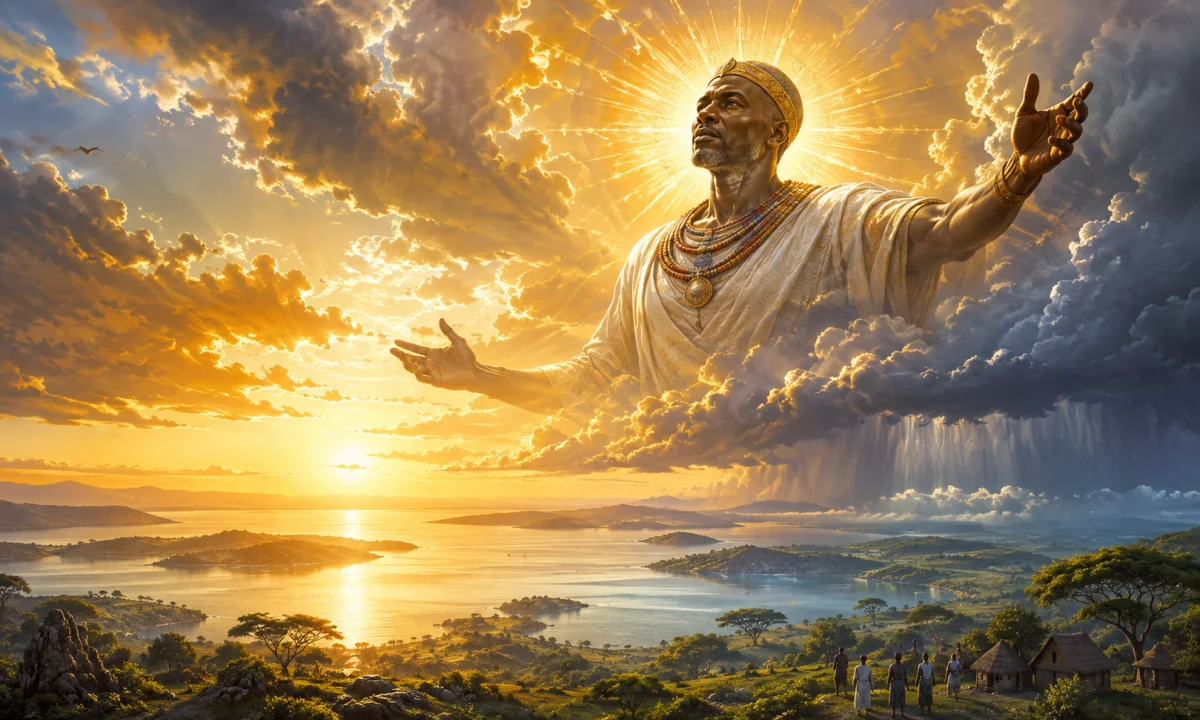
Were is a supreme creator deity in the traditional religious thought of some Luo-speaking communities of East Africa, especially in western Kenya and adjoining parts of Uganda and Tanzania. The name is also recorded alongside Nyasaye and other divine titles, although the relationship between these names varies according to community, language, family tradition and the source describing them. Were is commonly understood as the highest spiritual power, associated with creation, life, the sky and the ordering of the world.
Origins and cultural setting
The Luo are a group of related peoples living chiefly around Lake Victoria. Luo-speaking communities include the Luo of Kenya, the Acholi and Alur of Uganda, and other peoples whose languages and religious traditions share historical connections while retaining important local differences. Traditional Luo religion was not based on a single written scripture or a universally fixed creed. Knowledge about divine beings, ancestors, spirits, moral conduct and ritual practice was transmitted through oral teaching, prayers, stories, praise names and community customs.
Within this setting, Were appears as a name for the highest god rather than as a hero, monster or nature spirit. Accounts of Were were recorded by outsiders at different times, often during the colonial and missionary periods, when European writers attempted to translate African religious concepts into categories such as “God,” “creator” or “sun deity.” Such descriptions can be useful, but they do not always preserve the distinctions made by Luo speakers themselves.
Traditional Luo religious life included belief in a supreme creator, spiritual forces connected with particular places and activities, and the continuing importance of the dead. Ancestors could be remembered, honoured or approached in family and community contexts, while Were represented a greater and more encompassing divine power. The exact relationship between God, ancestors and other spiritual beings was not expressed identically in every Luo-speaking society.
Name and identity
The spelling Were is commonly used in English-language discussions of Luo religion, but the name may be written or pronounced differently according to language and orthographic convention. Some accounts give the extended form Were Nyakalaga, usually interpreted as a title connected with creation or the making of the world. Other accounts use Nyasaye as the principal name for God. These terms should not automatically be treated as separate gods, but neither should every local usage be assumed to be identical.
In some descriptions, Were is identified with the sun or with a solar aspect of the supreme deity. This has led to the simple statement that Were is “the sun god.” That wording may be too narrow when applied generally. The sun can be a visible sign of divine power, and a sky deity may be associated with light, warmth, regularity and the source of life without being reduced to a deity whose only function is control of the sun. The available descriptions suggest that Were is better understood primarily as a creator and supreme god, with solar associations in some interpretations.
The name is sometimes confused with words in other African languages that mean “person,” “man,” “animal” or “beast,” and with modern English compounds such as “werewolf.” These similarities are accidental unless a particular source demonstrates a linguistic relationship. Were, in the Luo religious context, is not a wolf-like shapeshifter.
Were as creator
Were is generally described as the power responsible for the existence and order of the world. Creation in this context does not necessarily refer to one standardized narrative with a fixed sequence of events. Oral religious traditions may express creation through titles, prayers, proverbs and broad statements about the origin of humanity, the earth, the sky and natural life rather than through a single canonical myth.
As creator, Were represents the source of life and the ultimate authority behind the visible world. The deity’s power may be invoked in relation to birth, health, rain, fertility, protection and the preservation of the community. The sky is an especially important sphere of association, since rain, sunlight and storms have direct consequences for agriculture, livestock and human survival.
Some accounts connect Were with the regular movement of the sun and the alternation of day and night. This association gives the deity a strongly cosmic character. Light may signify life, knowledge and order, while darkness can mark danger, uncertainty or the realm of forces that are less visible. These symbolic interpretations should be treated as broad patterns rather than as a universal theological system shared by every Luo community.
Character and powers
Were is not usually portrayed in the manner of a human-like hero with a detailed biography. Unlike many figures in heroic mythology, the deity has no widely agreed cycle of adventures, battles or romantic relationships. Were’s importance lies in divine status and cosmic function rather than in a narrative personality.
Attributes associated with Were include:
- Creation: Were is regarded in many accounts as the maker or origin of the world and living beings.
- Life-giving power: The deity is connected with the forces that sustain people, animals, crops and the wider natural environment.
- Sky and sunlight: Were may be associated with the heavens, daylight and the sun, though the strength of this association varies.
- Rain and fertility: As a supreme power controlling or permitting natural blessings, Were can be invoked in matters affecting agriculture and prosperity.
- Moral and spiritual authority: Were represents a power above human beings, clans and local spiritual forces.
These attributes do not necessarily mean that every event was understood as a direct act of Were. Traditional religious systems often explain everyday problems through a range of causes, including social conflict, ritual imbalance, ancestral displeasure, illness and the actions of other spirits. A supreme creator may be acknowledged as the highest power while remaining less prominent in ordinary ritual than ancestors or local spiritual beings.
Prayer, ritual and religious practice
There was no single temple system or priesthood devoted to Were that can be documented across all Luo communities. Religious practice was often embedded in family life, agricultural work, rites of passage, healing, rainmaking and remembrance of the dead. Prayers and offerings could be made in response to serious danger, drought, illness or communal need.
Places associated with unusual natural features, important ancestors or significant events could acquire spiritual importance. Sacred trees, hills, rivers and other locations appear in the religious landscapes of many East African societies, although the significance of any particular site belongs to the community that recognizes it. It would therefore be misleading to assign every sacred place in Luo country specifically to Were.
Ancestors occupied an important position in many traditional Luo accounts. They were not equivalent to Were, nor were they simply minor gods. They could serve as remembered members of the lineage and as spiritually significant figures whose conduct and status affected the living. The supreme deity and the ancestors belonged to different levels of religious understanding, even when prayers or rituals connected them.
Missionary writing sometimes presented African supreme gods as direct equivalents of the Christian God. In contemporary descriptions, Were may likewise be translated simply as “God.” This translation can be practical, especially when discussing Luo Christian usage, but it can obscure the differences between pre-Christian religious practice, later Christian theology and the continuing diversity of Luo interpretations.
Stories and the limits of the tradition
Were does not possess a single universally recognized mythology comparable to the extensive written cycles surrounding figures such as Zeus, Odin or Rama. Stories concerning the origin of human beings, the arrival of death, the relationship between the living and the dead, and the causes of natural events may be associated with wider Luo oral traditions rather than with a single, standardized biography of Were.
Descriptions of Were are therefore often theological rather than narrative. They explain who the highest god is, what powers belong to the deity and how the divine relates to people. Different storytellers and communities may emphasize creation, the sun, rain, judgement, protection or the remoteness of the divine without producing a contradiction within an oral tradition.
It is also important not to manufacture a detailed pantheon around Were. Some popular summaries place many named spirits beneath the deity or describe fixed divine family relationships, but such arrangements are not consistently documented across Luo communities. Spiritual beings connected with places, occupations, illness or ancestors should be identified according to their own traditions rather than automatically being classified as children, servants or companions of Were.
Interpretation and cultural significance
Were expresses the idea that the visible world depends on a greater power whose influence extends beyond any single family, clan or locality. The deity’s associations with creation, light, rain and life reflect concerns central to communities whose wellbeing has historically depended on agriculture, livestock, seasonal conditions and social cooperation.
The concept also illustrates an important feature of African religious traditions: belief in a supreme creator does not always lead to constant formal worship directed exclusively toward that being. A high god may be recognized as ultimate while daily religious attention is directed toward ancestors, local sacred places or immediate spiritual problems. This pattern has sometimes been described by outsiders as belief in a “distant god,” but the phrase should not be taken to mean that the deity is unimportant. It reflects the layered structure of religious life, in which different spiritual relationships serve different social and ritual purposes.
Were can also be understood as part of a continuing negotiation between inherited religious language and newer religious identities. Many Luo people are Christian or Muslim, and the older name for the supreme deity may appear in discussions of traditional belief, in translated religious language, or in cultural and historical writing. The use of Were today does not by itself prove adherence to a pre-Christian ritual system; names and concepts can survive while their interpretation changes.
Were and similar figures
Several distinctions help prevent confusion:
- Were and Nyasaye: These names are both associated with the supreme deity in accounts of Luo religion, but their usage is not identical in every community. They may function as alternative names, titles or culturally specific forms of reference.
- Were and Were Nyakalaga: Were Nyakalaga is an extended form reported in some sources, with a meaning connected to creation. It should not automatically be presented as a separate god.
- Were and Luo ancestors: Ancestors are spiritually important members of human lineages, whereas Were is identified as a supreme divine power and creator.
- Were and African shapeshifters: The name has no necessary connection with werehyenas, werewolves or other transformation legends found in Africa and elsewhere.
- Were and deities from neighbouring traditions: Similar ideas about a creator, sky or sun occur throughout East Africa, but shared themes do not establish that the figures are the same being.
Later representations
Were has received far less attention in global popular culture than highly fictionalized African figures such as Anansi or Mami Wata. When the name appears in modern books, websites or media, it is often treated as a generic “African god” or as a solar deity with a fully developed mythology. Such portrayals may be creative reinterpretations rather than faithful representations of Luo tradition.
Modern presentations are most reliable when they identify Were specifically within Luo religious culture, acknowledge the variation between sources and avoid treating African mythology as a single unified system. The deity’s significance lies not in a catalogue of spectacular powers, but in the religious conception of a supreme creator connected with life, the sky, sunlight and the continuing order of the world.