WORLD

Domfe
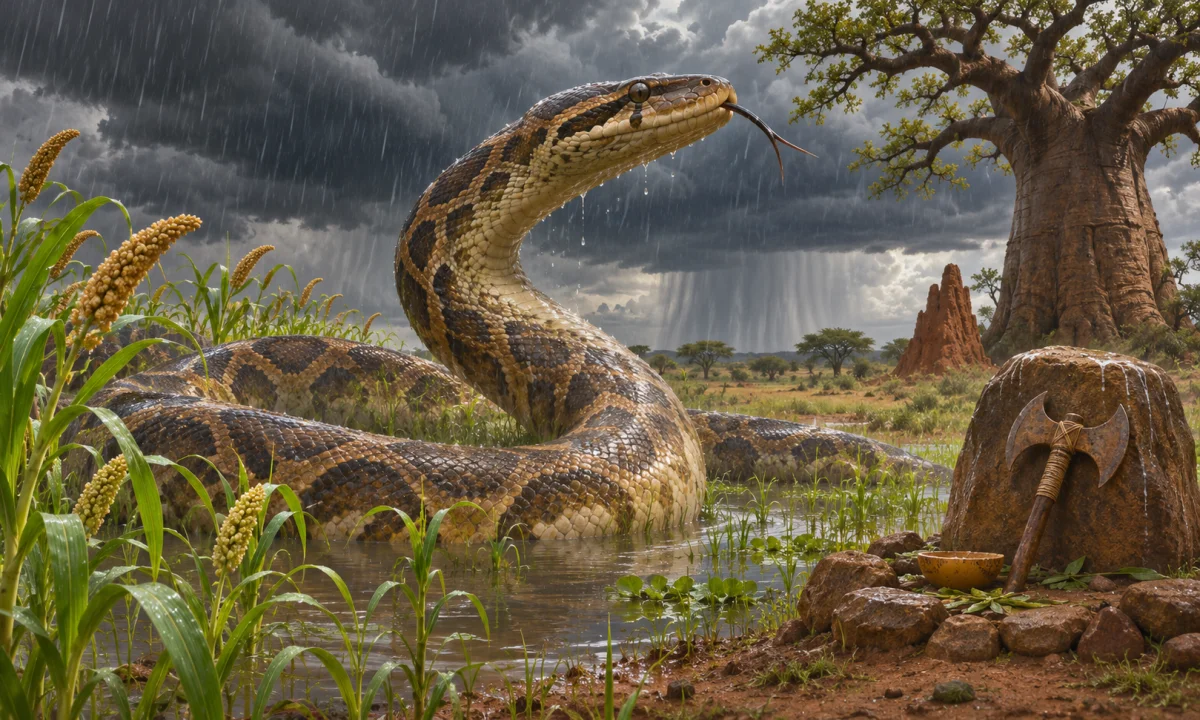
Domfe is an obscure name associated in some modern lists with African mythology, but its identity and cultural origin are uncertain. Unlike better-documented figures such as Anansi, Mami Wata, Nyame, or the Asanbosam, Domfe does not have a clearly established body of traditional stories, a securely identified ethnic tradition, or a consistent description in the surviving material commonly used to study African religions and folklore.
Origins and cultural setting
Africa contains hundreds of distinct religious and storytelling traditions. The word “African” does not identify a single mythology: Akan, Ewe, Yoruba, Fon, Igbo, Kongo, Somali, Maasai, San, Zulu, and many other peoples have their own languages, sacred beings, ritual systems, and narrative histories. A name cannot be assigned confidently to the whole continent merely because it appears in a general catalogue of African creatures.
The available information about Domfe is too limited to establish a definite place of origin. Some modern reference lists and online collections present the name as belonging to African mythology, but they do not consistently agree about whether Domfe is a spirit, monster, deity, ancestor, or folkloric creature. In many cases, the name is repeated without a story, a language of origin, or an explanation of the community in which it was traditionally known.
This lack of information is important. African oral traditions were preserved primarily through performance, ritual, family transmission, and local community memory rather than through a single continent-wide written canon. Many stories were recorded only after contact with European missionaries, colonial administrators, travellers, and later folklorists. Names were often written according to foreign spelling systems, and words from different languages could be confused with one another. A brief or corrupted record may therefore preserve a name while losing the narrative that explained it.
Name and identity
The spelling Domfe should not automatically be treated as definitive. It may represent a transcription from a language whose sounds are not fully conveyed by the Latin alphabet. Diacritics, tonal marks, consonant distinctions, and vowel length may have been omitted. It is also possible that the name has been copied from one secondary source into another, gradually becoming detached from its original context.
No broadly accepted interpretation of the name establishes what Domfe means. Nor is there a reliable consensus about the figure’s gender, appearance, powers, or social role. Descriptions that circulate without a traceable traditional context should therefore be regarded cautiously. A catalogue entry is not the same as an attested myth, and a modern summary cannot by itself demonstrate that a being was historically worshipped or widely known.
For that reason, Domfe is best described as an uncertain or poorly documented mythological name, rather than confidently classified as a god or a specific kind of monster. The term “mythological” is sometimes used broadly in popular writing to include gods, spirits, legendary animals, magical people, and frightening beings from folktales. That broad usage may explain why Domfe appears in lists of African mythology even though its classification remains unclear.
Attributes and appearance
There is no stable traditional description of Domfe that can be stated with confidence. Claims about a particular body shape, animal feature, habitat, magical power, or method of attacking people require a documented cultural context. Without that context, assigning such attributes risks turning speculation into supposed folklore.
Domfe should not be illustrated or described as a generic “African monster.” Such a portrayal would flatten the continent’s cultural diversity and could attach invented characteristics to a name whose original meaning is unknown. Traditional African beings are usually connected to particular places and social ideas: a forest, river, household, lineage, shrine, initiation system, moral taboo, illness, or relationship between the living and the dead. Removing a being from those relationships can make it appear more like a fantasy creature than a figure within a religious or storytelling tradition.
The absence of a secure description does not mean that the name is meaningless. It means that the evidence is insufficient to determine its meaning. A local spirit may be well known within a small community while leaving little written record. Conversely, an obscure name in a modern list may be a spelling error, a mistranslation, or a modern invention. These possibilities must be kept separate.
Stories and relationships
No universally recognised cycle of stories about Domfe has been established. There is no dependable basis for attributing to Domfe a particular origin story, family relationship, conflict with a god, connection with witches, or role in the creation of the world. Nor is there a clearly documented ritual tradition showing that people offered sacrifices, prayers, or protective objects specifically to Domfe.
This distinguishes the name from figures whose narrative settings are comparatively well recorded. Anansi, for example, belongs especially to Akan and related storytelling traditions and is known through numerous tales involving cleverness, greed, storytelling, and the acquisition or distribution of wisdom. Mami Wata is a broad and complex group of water-spirit traditions with regional variations, visual conventions, and continuing religious significance. The Asanbosam is associated in Akan contexts with a dangerous forest being, although accounts and spellings vary. These examples have identifiable cultural settings and bodies of tradition; Domfe cannot presently be placed with the same confidence.
It is possible that a similar-sounding name belongs to a local being in one African language. That possibility should not be used to merge Domfe with another figure. Similar spellings can result from unrelated words, transcription errors, or the independent use of similar sounds in different languages. Until a language, community, and narrative context are identified, relationships between Domfe and other beings remain unproven.
Religious and folkloric interpretation
Traditional African religions commonly distinguish between several kinds of supernatural presence, although the categories vary from one society to another. A community may recognise a supreme creator, lesser deities, territorial powers, ancestors, nature spirits, household beings, dangerous entities, and human practitioners of magic. These categories are not interchangeable, and a being described in a folktale is not necessarily an object of worship.
That distinction matters when interpreting Domfe. Calling an uncertain figure a “god” implies a religious status that has not been demonstrated. Calling it a “demon” may impose a Christian or Islamic theological category on a tradition that uses different concepts. Colonial-era observers often translated unfamiliar beings through the vocabulary of their own religions, describing spirits as devils, idols, or demons even when local beliefs made more nuanced distinctions.
Folklore also serves many purposes beyond explaining the supernatural. Stories may warn children away from dangerous places, express ideas about hospitality and social responsibility, explain illness or misfortune, dramatise conflicts within a family, or preserve memories of a landscape. A frightening name may therefore function as a warning or cultural symbol without referring to a single creature with a fixed appearance.
If future research identifies Domfe within a particular community, its significance should be interpreted through that community’s language and categories. Researchers would need to examine variant spellings, oral accounts, local histories, ritual practice, and the circumstances in which the name was recorded. A culturally informed interpretation would be more reliable than an attempt to fit Domfe into a universal list of monsters.
Possible sources of confusion
Several kinds of confusion may account for the uncertainty surrounding Domfe:
- Transcription: the name may have been written from an oral language without preserving tone, vowel distinctions, or consonant sounds.
- Secondary repetition: one brief catalogue entry may have been copied by later writers, giving an unsupported claim the appearance of independent confirmation.
- Loss of context: a personal name, place name, ritual term, or ordinary word may have been mistaken for the name of a supernatural being.
- Regional variation: a similar name may refer to different beings in different communities, while a general source treats them as one figure.
- Modern classification: a publisher or website may have grouped a little-known name under “African monsters” without providing evidence of a traditional story.
Domfe should also be kept distinct from unrelated figures whose names merely sound similar. In particular, it should not be identified with European household spirits, West African water beings, Akan forest creatures, or any other named entity without evidence linking the names. Resemblance in spelling is not proof of shared origin.
Modern reception
Domfe has little established presence in major modern popular-culture traditions. It is not comparable in public recognition to Anansi, whose stories have been adapted into novels, films, comics, television, and children’s literature. When Domfe appears in contemporary material, it is more often as an entry in a mythology database, a list of unusual creatures, or a work of fantasy inspired by general ideas about African folklore.
Such uses may create a new fictional interpretation, but they should not be presented as evidence for an ancient belief. A fantasy author can give Domfe a defined appearance, powers, and history; those creative details belong to the modern work rather than to a verified traditional account. The same distinction applies to illustrations, role-playing games, video games, and social-media summaries.
The most responsible description of Domfe therefore remains a cautious one: the name is associated with African mythology in some modern compilations, but its original tradition, meaning, classification, and stories are not securely established. Further identification would require reliable evidence from a named language and community, rather than repetition of an unattributed description.