WORLD

Nimba
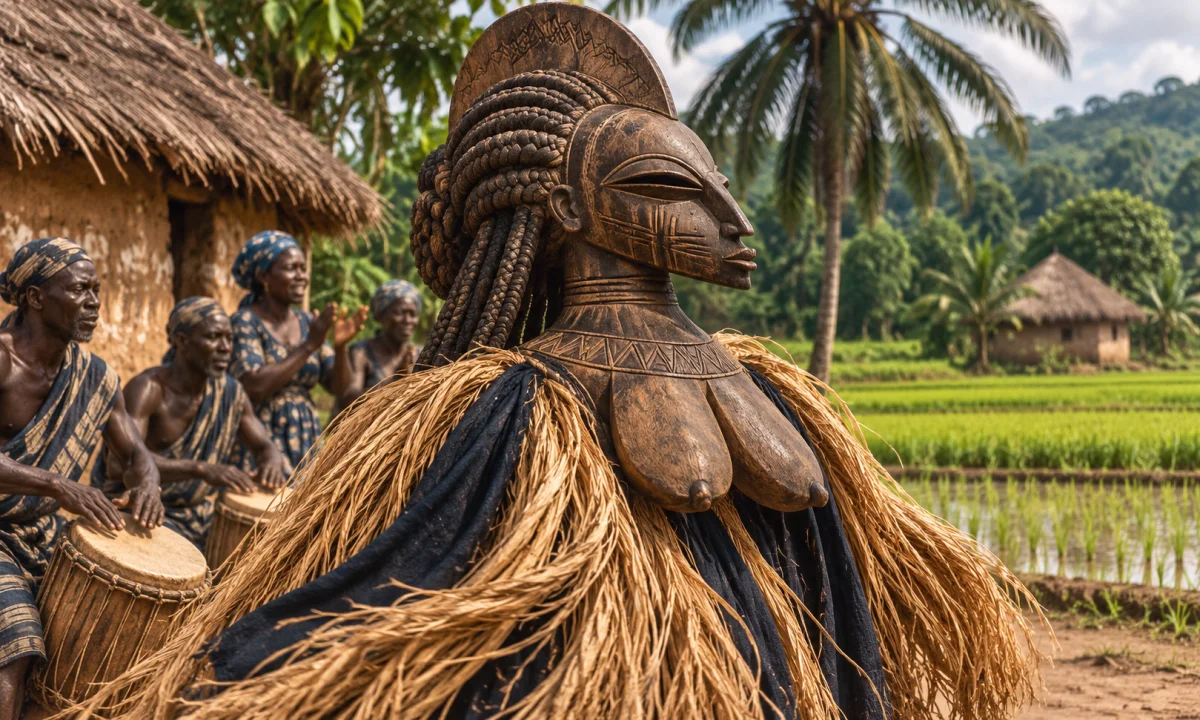
Nimba is a name commonly associated with a monumental female masquerade figure of the Baga-speaking peoples of coastal Guinea, in West Africa. The figure is especially known through a large wooden headdress, sometimes worn with a raffia costume so that the dancer becomes an almost complete moving image. Nimba is linked in many descriptions with fertility, motherhood, agricultural abundance, social responsibility and the ideal of a mature woman. The name, however, does not identify a single universally defined goddess in the manner of a figure from a fixed written mythology. It may refer to a masquerade, a sacred image, a spiritual presence or a traditional institution, depending on the community and the source.
Cultural setting
The Baga are a group of related communities living mainly along the coastal and riverine regions of present-day Guinea. Their history has been shaped by interaction with neighbouring peoples, including the Nalu, Susu and Temne, as well as by trade, Islam, Christianity and colonial rule. “Baga” is often used as a broad label for several communities with distinct local identities and speech varieties. Consequently, descriptions of Baga religious life should not be treated as though every Baga community has preserved identical beliefs or ceremonies.
Traditional Baga religious practice has included respect for powerful spiritual beings, ancestors, sacred places and masked figures. Religious knowledge was transmitted primarily through oral teaching, ritual performance, initiation and the work of specialist custodians rather than through a single canonical scripture. Masks were therefore not simply works of art or theatrical props. In their original settings, they could act as visible bodies for spiritual and social forces, appearing at particular times under the authority of a community or ritual association.
Nimba belongs to this world of performance and communal responsibility. The carved form seen in museums is only one part of the tradition. Its significance also lies in the dancer who carries it, the songs and movements that accompany it, the occasions on which it appears, and the people who have the right to commission, preserve or display it.
Name and identity
The terminology surrounding Nimba is variable. Nimba is widely used in English-language museum writing and popular discussions for the Baga female headdress. Some sources use D'mba, D’mba or related spellings for a comparable or overlapping figure. These names may reflect differences in language, transcription, regional usage or scholarly interpretation. They should not automatically be assumed to represent separate beings, but neither should all examples be treated as identical without considering their local origin.
There is also uncertainty about whether Nimba should be called a goddess. In general usage, the word “goddess” can suggest a clearly personified divine individual with a stable mythology and a defined place in a pantheon. The available evidence does not support such a simple classification in every Baga context. Nimba is more safely described as a sacred female masquerade figure or a spiritually significant embodiment associated with fertility and communal life. Some interpretations present her as a motherly or generative spirit; others place greater emphasis on the mask as an institution and ritual performer rather than on an independent supernatural personality.
Descriptions based on museum collections can create further confusion. A museum may catalogue a carved head as “Nimba” even when the original performance costume, ritual setting and local name are unknown. The object is then separated from the ceremonies that gave it meaning. For that reason, the form of a Nimba headdress can be discussed with confidence, while claims about a single universal myth or biography require caution.
Appearance of the headdress
The best-known Nimba form is a large wooden construction representing the upper body and head of a woman. It usually has an elongated neck, a broad head, a prominent forehead, a carefully arranged hairstyle and stylised facial features. The figure may have large breasts or a pronounced torso, emphasizing nourishment, maternity and physical maturity. Some examples include carved arms or other body elements, while others concentrate on the head and upper body.
The hairstyle is an important part of the image. It may be represented by geometric ridges, braided forms or an elaborate crest. The face is not normally carved as a naturalistic portrait. Its scale, symmetry and controlled stylisation give it a presence that is larger than that of an ordinary human being. The mask may be blackened, polished or decorated, and some costumes incorporate raffia, cloth or other materials that conceal the dancer.
The complete masquerade can be extremely heavy and demanding to carry. A performer places the structure on the shoulders or supports it with a framework, while a raffia covering hides the body below the carved head. From a distance, the human dancer disappears and the figure seems to move independently. This transformation is central to African masquerade traditions: the performer does not merely imitate a character for an audience but helps make a social or spiritual presence visible.
Fertility, motherhood and abundance
Nimba is most often interpreted through themes of fertility. This meaning can include several connected forms of generation: the ability to bear children, the nourishment of infants, the continuity of families, the fertility of cultivated land and the prosperity of the community. The breasts and mature female body are therefore not merely decorative details. They express the capacity to sustain life.
In agricultural societies, human fertility and the fertility of the earth are closely related. The successful birth of children, the growth of crops and the survival of a community all depend on forces that people cannot completely control. A powerful female figure may embody those hopes without being reducible to a single “fertility goddess” category. Nimba’s presence can affirm the value of care, productive labour, social cooperation and the continuation of the community.
The image also communicates an ideal of womanhood. This does not mean that the headdress should be read as a simple portrait of everyday women. Rather, its exaggerated scale and stylised body present qualities such as maturity, generosity, responsibility and the ability to nurture as public virtues. In some interpretations, the figure represents a respected mother whose authority extends beyond the household into the moral life of the wider community.
Performance and ritual roles
Nimba masquerades have been associated with agricultural ceremonies, especially occasions connected with planting, the growth of crops or the harvest. The figure may appear in processions or dances intended to encourage prosperity and mark important stages in the communal calendar. The exact timing and purpose vary, and not every surviving headdress can be assigned to one particular ceremony.
The masquerade may also be connected with weddings, communal celebrations, funerary events or other moments at which the well-being of a family and the continuity of society are publicly recognized. Such appearances should not all be assumed to have the same religious function. A performance can honour fertility in one setting, affirm social order in another and serve as a public celebration in a third.
Performers traditionally dance with energetic, controlled movements despite the size of the costume. The headdress may sway, bend or rise above the crowd, creating an impression of strength and animation. Music, singing and the responses of spectators help establish the identity of the masquerade. The audience is not simply looking at a sculpture; it is participating in a moment when a culturally meaningful presence enters public space.
Access to the masquerade has historically been governed by local authority and ritual knowledge. In many African masking traditions, the identity of the dancer is concealed because the power of the mask depends partly on the separation between ordinary human identity and the being represented. Women, men, elders, initiates and specialist groups may have different roles in preparing, performing or witnessing a mask. These arrangements differ among communities, so general statements about who may see or wear Nimba must be treated carefully.
Stories and oral tradition
Unlike characters known from a single written epic, Nimba is not documented through one definitive cycle of stories. Oral traditions may explain the origin of the figure, the reasons for its ceremonies or the relationship between the masquerade and the community. These accounts can vary between villages and may be known only to particular custodians. Many details were also affected by colonial disruption, missionary activity, conversion to Islam or Christianity, political change and the loss of ritual institutions.
Some modern descriptions present Nimba as a mother who taught people agriculture or as a supernatural ancestor who brought fertility to the land. Such narratives may reflect genuine local interpretations, but they should not automatically be presented as a universal Baga myth. In other accounts, the emphasis falls less on a named personality and more on the headdress’s power to embody ideals of motherhood, abundance and communal continuity.
The absence of a single standardized story does not make the figure less religiously important. In oral traditions, meaning may be carried through movement, costume, restricted knowledge, songs, ritual timing and social relationships rather than through a long narrative. A mask can be understood through what it does in a ceremony as much as through what a story says about it.
Symbolism and interpretation
Nimba’s scale is significant. The oversized head and body elevate the female figure above ordinary human proportions, expressing dignity and force. The long neck may suggest elegance, height and distance from everyday life, while the broad body and breasts emphasize nourishment. The elaborate hair reflects cultural ideals of grooming and presentation but also contributes to the figure’s authority.
Scholars and museum interpreters have sometimes described Nimba as an image of the “ideal woman.” This phrase can be useful if it is understood broadly, as referring to social virtues such as maternal care, physical maturity, fertility and responsibility. It becomes misleading when it implies that all Baga people held one unchanging idea of women or that the figure was created solely for male viewing. Nimba belongs to a complex ritual system in which gender, authority, agricultural work, family continuity and spiritual power intersect.
The performer’s body introduces another important meaning. The visible figure is female, but the person inside the mask may be male in traditions where men carry the headdress. This does not necessarily mean that the dancer is pretending to be an ordinary woman. Masking creates a transformation in which the performer’s personal identity is subordinated to the role and the collective power represented by the costume. The relationship between the gender of the image and the gender of the performer is therefore ritual and symbolic rather than a straightforward theatrical casting choice.
Distinguishing Nimba from similar figures
Nimba is sometimes grouped with African “fertility goddesses,” but that broad category can obscure important differences. She is not the same figure as Mami Wata, the water spirit or spirit complex known across many parts of West and Central Africa. Mami Wata is commonly represented through aquatic, mermaid-like or European-influenced imagery, while Nimba is a Baga-associated female masquerade linked especially with motherhood, agriculture and communal performance.
Nimba is also not a general name for every large African female mask. Many West African societies have powerful maternal, ancestral or fertility-related masquerades with their own names, histories and ritual rules. Similarities in breasts, hairstyles, raffia costumes or agricultural associations do not prove that the figures are versions of one goddess.
The name can cause confusion with unrelated uses of “Nimba,” including names given to games, organizations, places or other cultural objects. A board game or a modern commercial name should not be treated as evidence about the Baga masquerade. Likewise, an object labelled “Nimba” in a collection may be a related regional form, a later interpretation or an example whose original identity has not been securely recorded.
Historical change and modern reception
Baga masking traditions have undergone periods of suppression, decline and revival. Religious conversion, colonial policies, political upheaval, urban migration and changing systems of authority affected when masks could be made and performed. In some communities, older ceremonies became less frequent; in others, cultural organizations and local practitioners helped preserve or revive aspects of the tradition.
During the twentieth century, Nimba headdresses became highly influential in international collections and modern art history. Their monumental forms attracted artists, collectors and museums, where they were often admired as examples of formal abstraction. This recognition helped make Nimba one of the most recognizable African masquerade types, but it also separated many objects from their original communities. A gallery display may emphasize shape and craftsmanship while giving less attention to ritual ownership, performance, religious change and the people who continue to interpret the tradition.
Contemporary artists and cultural institutions may revisit Nimba as a symbol of African heritage, motherhood, resilience or national identity. Such uses can be meaningful, but they are modern reinterpretations rather than proof that the traditional figure had one fixed meaning everywhere. The most responsible understanding keeps both dimensions in view: Nimba is an important visual and cultural form in global art history, and it is also part of living, locally grounded traditions whose names, ceremonies and interpretations cannot be reduced to a single museum label.