WORLD
WORLD
Unkulunkulu
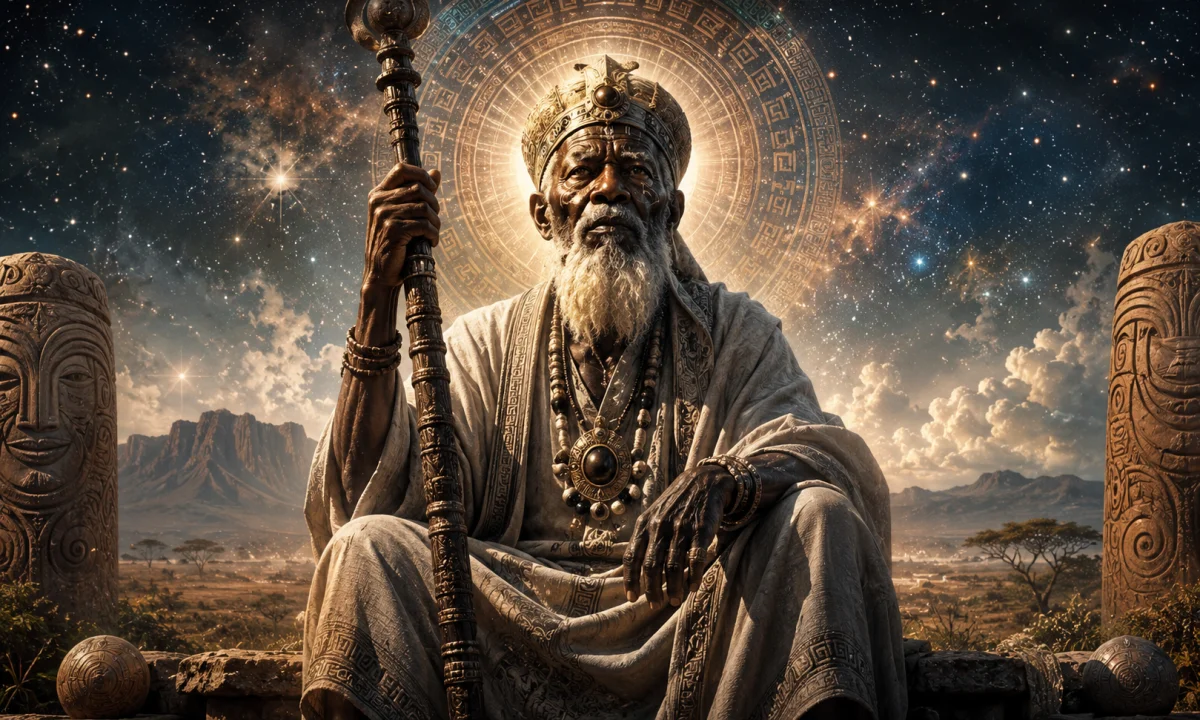
Unkulunkulu is a major ancestral and creator figure in Zulu religious tradition. The name is commonly associated with the “greatest one,” the “very great ancestor,” or the first human ancestor, although its exact meaning and religious force vary according to context and source. Unkulunkulu is sometimes described as the creator of human beings, animals, plants, and social life; in other accounts, the figure is presented less as an all-powerful god than as the primordial ancestor from whom humanity descended.
Unkulunkulu belongs specifically to the religious and cultural traditions of the Zulu people of southern Africa, rather than to a single, uniform “African mythology.” Zulu traditions developed within the wider historical and cultural world of the Nguni-speaking peoples, and certain themes found in accounts of Unkulunkulu also appear in neighbouring traditions. Similarities do not mean that all these figures are identical. Names, stories, and theological interpretations differ between communities and between individual tellers.
Cultural setting and surviving traditions
Traditional Zulu religious knowledge was transmitted primarily through oral performance, family memory, ritual practice, praise poetry, and storytelling. It was not preserved in one canonical scripture with a fixed account of creation. As a result, descriptions of Unkulunkulu can differ considerably. One narrator may emphasise the figure as the first ancestor, while another may speak of Unkulunkulu as a creator or as a being associated with the origin of the world.
Many accounts were written down during the nineteenth and early twentieth centuries by missionaries, colonial officials, and scholars who learned about Zulu beliefs through interpreters and conversations with Zulu informants. These records are valuable, but they must be read carefully. European writers often tried to fit Zulu religious ideas into categories such as “God,” “myth,” “primitive religion,” or “ancestor worship.” Such labels could obscure distinctions that were meaningful within Zulu society.
Oral traditions also change naturally over time. A story may be shortened, expanded, or adapted to explain a moral idea, a ritual practice, or a relationship between the living and the dead. There is therefore no single version of every Unkulunkulu story that can be treated as universally authoritative.
The name and identity of Unkulunkulu
The name Unkulunkulu is a Zulu form built around the idea of greatness or seniority. It is often translated into English as “the Great One,” “the Greatest,” or “the very great ancestor.” These translations are useful approximations rather than exact equivalents. The name can express both elevated status and ancestral precedence: Unkulunkulu is “great” because the figure is first, ancient, and foundational.
The identity of Unkulunkulu is therefore difficult to classify using only familiar Western categories. Calling Unkulunkulu a “god” may be appropriate in some discussions, especially where the figure is described as a creator or supreme being. Calling Unkulunkulu an “ancestor” is also appropriate in traditions that stress descent from the first human forebear. These descriptions are not always mutually exclusive in Zulu religious thought.
In many African religious systems, the boundary between creator, primordial ancestor, and source of social order does not correspond neatly to the modern distinction between “religion” and “mythology.” A first ancestor may be connected with the origin of people, customs, moral obligations, and relations between the living and the dead. Unkulunkulu can consequently be understood as a figure of beginnings as well as a focus for ideas about ancestry and order.
Origin from the reed or primordial vegetation
One of the best-known traditions states that Unkulunkulu emerged from a reed or a bed of reeds, usually called uHlanga in accounts written in Zulu. In some versions, the primordial reed is not merely an ordinary plant but a place or source of emergence. Human beings, animals, and other forms of life are connected with this origin.
Stories of emergence from reeds are found in several southern African traditions, and the details vary. Some accounts say that Unkulunkulu came forth first and then caused other beings to appear. Others describe people, cattle, and creatures as emerging from the same natural source. The reed can therefore symbolise fertility, the beginning of life, and the connection between human society and the living landscape.
The emergence story should not automatically be treated as a complete equivalent of a creation story in the biblical sense. In some tellings, the world already exists when Unkulunkulu appears. The emphasis may be on the origin of people and their way of life rather than on the creation of the universe from nothing. The story also reflects the importance of ancestry: humanity is imagined as having a tangible beginning from which generations descend.
Unkulunkulu as first ancestor and culture-bringer
Unkulunkulu is often associated with the first human beings and with the establishment of the conditions that make human life possible. Traditional narratives may connect the figure with the appearance of men and women, cattle, animals, plants, and knowledge of social customs. In this role, Unkulunkulu resembles a culture-bringer: a primordial figure through whom people receive or inherit the basic structures of existence.
Descriptions of Unkulunkulu’s personal appearance are limited and inconsistent. The figure is not usually represented through a stable, universally recognised physical form comparable to the standard images of many classical gods. In oral tradition, importance lies more in origin, age, power, and relationship than in a fixed visual portrait.
Unkulunkulu’s significance is also not necessarily expressed through a large mythology of personal adventures. The figure’s central position comes from being first and foundational. Stories about later ancestors, kings, spirits, and the history of the Zulu people often carry more narrative detail than stories about Unkulunkulu himself.
Death, the messenger story, and human mortality
A widely circulated southern African story explains how death came to human beings. In one common version, Unkulunkulu sent a chameleon to tell people that they would not die, or that they would continue living in some form. The chameleon travelled slowly and stopped along the way. A lizard, sometimes described as a different messenger, reached humanity first with the message that people would die.
Because the lizard arrived before the chameleon, death became the human condition. In many versions, the chameleon’s delay is the reason that the promise of continued life failed to reach people in time. The story can be interpreted as an explanation of mortality, but it also gives moral weight to speed, carelessness, delay, and the consequences of failing to deliver a message.
This narrative is often presented as a specifically Zulu story about Unkulunkulu, but versions occur across southern and southeastern Africa with different creator figures, messengers, animals, and outcomes. The details should not be treated as a single fixed doctrine. In some tellings, the animal associated with death is a lizard; in others, the terms used in English translations are less precise. The story’s wide distribution suggests a shared regional motif, while its local forms remain culturally distinct.
The tale also illustrates why oral traditions should not be reduced to simple explanations of natural facts. It can express ideas about the fragility of communication, the unpredictability of fate, and the separation between an original condition of life and the mortality experienced by human beings.
Relationship to ancestors and the spiritual world
Zulu religious life traditionally places strong importance on ancestors, often referred to in discussions of amadlozi or ancestral spirits. Ancestors may remain connected with their descendants, influence family welfare, and require respect through customary and ritual relationships. Unkulunkulu occupies a more primordial position than ordinary family ancestors because the figure represents the first or greatest ancestor.
It would nevertheless be misleading to assume that every act of ancestral ritual is directed to Unkulunkulu. Relationships with recently deceased relatives and lineage ancestors have their own importance. The religious world includes several levels of relationship and spiritual authority, and Unkulunkulu is not simply a name substituted for every ancestor or spirit.
Nor is Unkulunkulu necessarily the immediate recipient of every prayer or sacrifice in traditional practice. Accounts differ, and ritual life is shaped by family, locality, historical period, and the influence of Christianity and other religious traditions. A general description of Unkulunkulu as “the god worshipped by the Zulu” fails to capture these distinctions.
Unkulunkulu and uMvelinqangi
Confusion often arises between Unkulunkulu and uMvelinqangi, a name associated in some Zulu religious interpretations with a supreme or primordial being. The term uMvelinqangi is commonly explained in relation to what was first, foremost, or above. Some writers identify uMvelinqangi with Unkulunkulu, while others treat them as distinct aspects or names within different theological interpretations.
There is no universally accepted rule that makes the two names identical in every context. Missionary translations, later Christian writing, ethnographic descriptions, and modern discussions have sometimes rearranged or merged traditional categories. The relationship between the names should therefore be stated cautiously. A source that calls Unkulunkulu “the supreme God” may be reflecting a particular interpretation rather than recording a universally shared Zulu doctrine.
Unkulunkulu should also not be confused with Qamata, a major creator and supreme figure in Xhosa and related traditions. Qamata belongs to a different cultural and linguistic tradition, although historical contact and broad regional similarities can make comparisons tempting. Similar creation motifs do not erase the distinct identities of these figures.
Christian interpretation and changing usage
When Christian missionaries translated religious concepts into Zulu, Unkulunkulu was sometimes used as a term for the Christian God. This usage helped Christian teachers communicate with Zulu-speaking audiences, but it also affected how the older tradition was recorded and understood. In a Christian setting, Unkulunkulu could be presented as an equivalent of the biblical Creator, even where traditional accounts emphasised ancestry, emergence, or a more complex relationship between primordial beings and ancestors.
The use of the name in Christian contexts does not prove that traditional Zulu belief and Christian theology are identical. Words can acquire new meanings when they move between religious systems. A contemporary Zulu speaker may use Nkulunkulu or a related form in Christian worship, while historical accounts of Unkulunkulu describe an older or differently organised set of ideas. Context is essential.
Colonial-era writing also sometimes portrayed Unkulunkulu as evidence of a simple evolutionary stage in religion. Such judgments reflected European theories of the time rather than neutral descriptions of Zulu thought. Modern discussion is more likely to recognise that oral religious traditions can contain sophisticated ideas about origin, personhood, morality, death, and the relationship between human communities and the natural world.
Symbolism and cultural significance
Unkulunkulu’s symbolism centres on beginnings. The figure represents the deep past from which human life, kinship, and custom descend. The connection with the reed evokes emergence, fertility, and rootedness in the land. It can also suggest that human beings are part of a living environment rather than separate from it.
The figure’s ancestral character gives origin a social dimension. To speak of a first ancestor is to speak not only about how people came into existence but also about why people belong to families, lineages, and communities. The past remains relevant because descendants inherit obligations, names, memories, and customs.
The death-messenger story adds another dimension. Human mortality is not portrayed merely as an abstract biological fact; it is tied to communication, choice, and a break between an intended condition and the one people experience. Such stories provide a way to think about why death exists while also inviting reflection on human responsibility and the consequences of delay.
Modern representations
Unkulunkulu appears occasionally in modern writing about African religions, southern African history, and comparative mythology. The figure is sometimes simplified as a Zulu “creator god,” a description that is convenient but incomplete. Educational and popular accounts may also present one version of the reed-origin story or the chameleon-and-lizard narrative as though it were the only traditional version.
Modern representations are most reliable when they distinguish between traditional oral accounts, nineteenth-century written records, Christian reinterpretations, and contemporary scholarly analysis. The name may carry different meanings for people discussing ancestral tradition, Zulu cultural history, Christian theology, or comparative mythology.
Unkulunkulu is not a generic African deity and should not be used as a label for every supreme creator figure in Africa. Its significance lies in the particular religious and cultural history of the Zulu people, in the wider network of southern African traditions with which Zulu culture has interacted, and in the continuing effort to interpret oral traditions without flattening their differences.