WORLD
WORLD
Teoyaomiqui
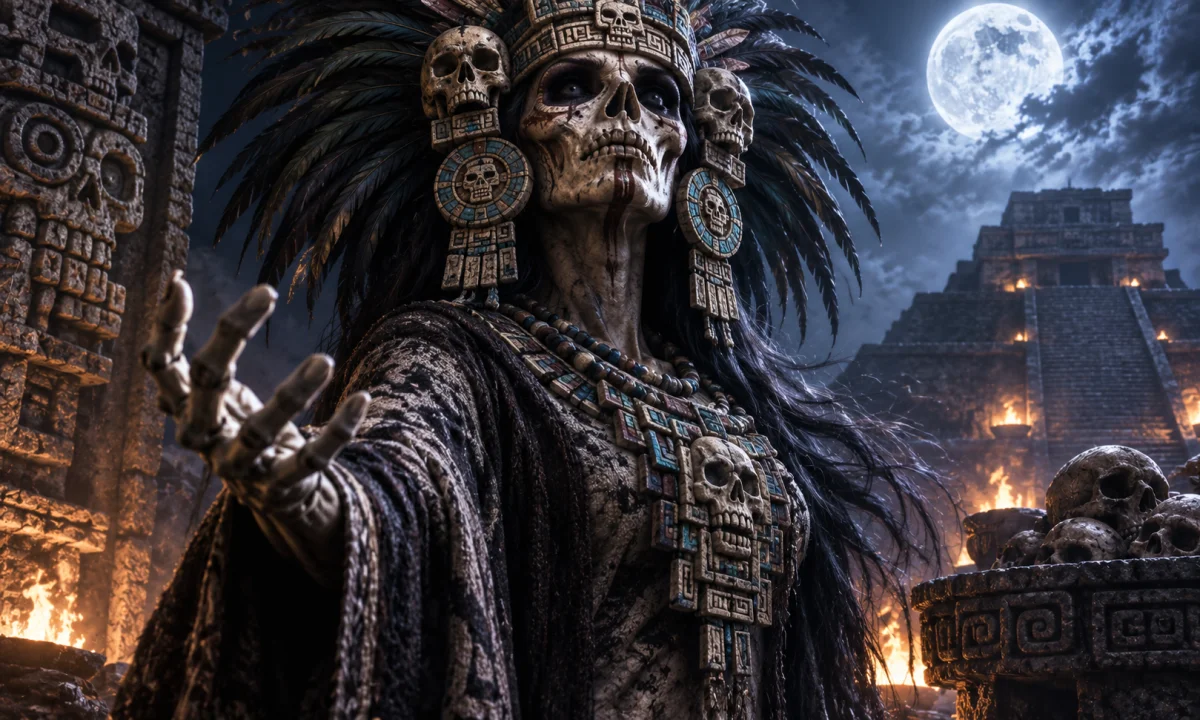
Teoyaomiqui is a name associated with Mexica, often called Aztec, ideas about sacred death, warfare and the fate of those who died in battle. It is also commonly attached to a monumental stone sculpture discovered in Mexico City in 1790. Both the name and the sculpture are difficult to interpret with certainty. Teoyaomiqui may have been the name of a deity, a sacred category of dead warriors, or a modern scholarly designation applied to a monument whose original identity is no longer securely known.
Name and identity
The name is usually written Teoyaomiqui, with longer forms such as Teōyaōmiqui appearing in discussions of Classical Nahuatl. Its meaning is uncertain because the compound can be divided and translated in more than one way. Interpretations include “sacred death,” “divine warrior death,” and “the death of the enemy.” The elements associated with teotl, “god,” “divine” or “sacred,” yaotl, “enemy” or “warrior,” and miqui, “to die,” do not produce a single uncontested English translation.
Modern descriptions often present Teoyaomiqui as an Aztec goddess of war and death. That description is widespread, but the surviving evidence does not establish her identity as clearly as it does the identities of major Mexica deities such as Huitzilopochtli, Coatlicue, Coyolxauhqui or Mictlantecuhtli. In particular, there is no universally accepted pre-conquest narrative centred on a deity named Teoyaomiqui.
The name may instead refer to the war dead as a sacred group. Mexica religious thought treated death in battle, death in sacrifice and death in childbirth as conditions with special ritual significance. People who died in these circumstances could receive a destiny different from that of those who died from illness or old age. A term connected with divine or warrior death may therefore have described a class of sanctified dead rather than a single anthropomorphic goddess.
Mexica religious and cultural setting
The Mexica understood warfare as part of a religious and political order that sustained the cosmos. Capturing enemies for sacrifice was a major concern of elite warriors, and military success enhanced the power of rulers, temples and noble families. The relationship between war and sacrifice was not simply symbolic: captives could be offered to deities, while the deaths of Mexica warriors also carried ritual meaning.
According to accounts recorded after the Spanish conquest, men who died in battle or on the sacrificial stone were associated with the sun’s journey. They were imagined as accompanying the sun at different times of day, while women who died in childbirth were granted a similarly exalted destiny and were called cihuateteo, “divine women.” These ideas do not prove that Teoyaomiqui was the name of a goddess, but they provide an important context for interpreting a title connected with sacred warrior death.
Mexica images of death were not limited to a single underworld deity. Skeletons, skulls, bones, blood, hearts and severed body parts could express several related ideas: the mortality of human beings, the fertility of the earth, the consequences of warfare, the offering of life to the gods and the renewal of cosmic power. A terrifying image could therefore be protective, nourishing or politically significant as well as funerary.
The monumental sculpture called Teoyaomiqui
The name Teoyaomiqui is most closely associated with a large Mexica stone monument unearthed in Mexico City in 1790. It was found during colonial efforts to level and reconstruct the central plaza, in the same broad period in which other major Mexica monuments, including the so-called Coatlicue sculpture and the Sun Stone, came to light. The discovery revealed that important Mexica monuments had survived beneath the colonial city.
The sculpture is a massive, highly complex work covered with supernatural and bodily imagery. Its surface includes skeletal features, skull-like forms, serpents, claws and other elements characteristic of Mexica representations of divine power. The monument is not an ordinary portrait and does not present a single figure in a simple human pose. Its imagery appears to combine multiple bodies and symbolic parts, making it difficult to identify through appearance alone.
Some interpretations describe the monument as a representation of a death or war deity. Others connect it with Coatlicue, an earth and mother goddess whose imagery includes a skirt of serpents, a necklace of human hands and hearts, and a face formed by two confronting snakes. Still other interpretations have looked for relationships with Huitzilopochtli, the Mexica patron deity, or with broader ideas about sacrificial and warrior death. None of these identifications has achieved complete agreement.
The problem is partly methodological. Mexica sculpture was not always intended to illustrate a single episode or to provide a recognisable portrait. A monument could combine several visual signs in order to express a deity’s powers, a ritual event, a cosmological relationship or the union of opposing forces. The original placement, accompanying ritual objects and dedicatory inscription would have helped ancient viewers interpret the sculpture, but that context has been disrupted or lost.
Appearance and symbolism
The death imagery associated with Teoyaomiqui can seem especially alarming to modern viewers because it presents the body as disassembled and transformed. Skulls and bones evoke the dead, while serpents suggest earthly and supernatural forces. Claws may indicate a predatory or warrior aspect, and hearts and hands, where present in related Mexica imagery, can refer to sacrifice, vital energy and the transformation of human bodies into offerings.
In Mexica thought, these elements did not necessarily indicate evil. Death was part of the exchange through which the gods, the earth and human communities were believed to sustain one another. Agricultural growth depended on the earth, yet the earth could be represented as a devouring power. War produced death and political domination, yet the dead could become sacred companions of the sun. A composite image of bones, serpents and living forms could therefore express the dependence of life upon death rather than a simple opposition between good and evil.
The monument’s imagery may also have communicated the danger and prestige of warfare. Mexica rulers used public sculpture to display the power of the state and its relationship with the gods. A work associated with warrior death could have reminded viewers of military obligations, sacrificial rituals and the fate awaiting those who served or opposed the Mexica order.
Teoyaomiqui and the dead of war
One reason the name became linked with a deity is its association with people who died in war or sacrifice. In popular summaries, Teoyaomiqui is sometimes described as a goddess who received fallen warriors or presided over their afterlife. This may reflect an attempt to turn a difficult name and a terrifying sculpture into the familiar category of a named goddess.
The surviving evidence supports a more cautious formulation. Mexica religion certainly included special beliefs about warrior dead, sacrificial victims and women who died in childbirth. It also included deities connected with warfare, the sun, the earth and death. However, the evidence does not clearly establish Teoyaomiqui as a separately defined female ruler of the dead, comparable to a figure such as the Greek Persephone or a later fictional underworld queen.
It is therefore useful to distinguish between Teoyaomiqui as an interpretive label and the broader religious ideas that may lie behind it. The label points toward sacred warrior death and a monument filled with death imagery, but it should not be treated as proof of a fully documented mythology with a fixed biography, family tree or set of individual adventures.
Distinction from related Mexica figures
Coatlicue
Coatlicue was a major earth and mother goddess whose name is commonly translated as “She of the Serpent Skirt.” She was associated with fertility, the earth, death and the birth of important deities. Her most famous surviving sculpture has a head formed by two snakes, a necklace made from human remains and a skirt of intertwined serpents. Because the monument called Teoyaomiqui also contains frightening skeletal and serpentine imagery, the two sculptures have sometimes been compared or confused.
Comparison does not demonstrate that they represent the same figure. Some scholars have proposed that the so-called Teoyaomiqui monument should be understood in relation to Coatlicue, while others treat the works as distinct monuments with different meanings. The identification remains interpretive rather than certain.
Coyolxauhqui
Coyolxauhqui was the moon-associated or lunar-linked figure defeated and dismembered by Huitzilopochtli in the famous myth of Coatepec. The story explains the triumph of Huitzilopochtli over his sister and other hostile relatives, and it was represented in the monumental disk discovered at the Templo Mayor. Coyolxauhqui’s dismemberment is sometimes confused with general Mexica images of death and bodily fragmentation.
Teoyaomiqui should not automatically be identified with Coyolxauhqui. The two are connected to different bodies of evidence and different mythic contexts. The Coyolxauhqui Stone has a relatively specific narrative setting, whereas the identity and purpose of the Teoyaomiqui monument are much more disputed.
Mictlantecuhtli and Mictlancihuatl
Mictlantecuhtli was the lord of Mictlan, the realm associated with the ordinary dead, and Mictlancihuatl was his female counterpart in later descriptions. These figures belong to Mexica traditions about the underworld and the journey of the dead. They are not simply interchangeable with a figure or term associated with warriors who died in battle.
Warrior death occupied a special place in Mexica afterlife beliefs, while Mictlan was generally associated with those whose deaths did not grant them another specialised destiny. This distinction is one reason why Teoyaomiqui, if the name refers to sacred warrior death, should not be reduced to another name for Mictlantecuhtli.
Tlaltecuhtli
Tlaltecuhtli was an earth deity whose name means something like “Earth Lord,” although the figure can appear with both masculine and feminine characteristics. Images of Tlaltecuhtli often show a crouching, open-mouthed being with claws and an appetite for blood or offerings. The deity’s imagery expresses the earth as a powerful force that receives the dead and gives birth to new life.
Because Tlaltecuhtli and Teoyaomiqui-related interpretations both involve death, earth and frightening bodily imagery, confusion is understandable. They are nevertheless separate names and should not be merged without evidence from a specific monument or text.
Sources and limits of reconstruction
Knowledge of Mexica religion comes from several kinds of evidence: archaeological remains, painted manuscripts, Nahuatl-language accounts, Spanish colonial descriptions and later linguistic analysis. Each source preserves valuable information but also presents problems. Indigenous informants often explained traditions through the circumstances of colonial recording, while Spanish authors interpreted unfamiliar practices through Christian and European categories. Archaeological monuments, meanwhile, rarely come with their original explanatory labels.
For Teoyaomiqui, the sculpture itself is the central piece of evidence, but its original name and function are not securely preserved. Colonial-era references and later museum classifications helped establish the name in modern discussion, yet a name used in a later inventory or interpretation is not necessarily the exact designation used by Mexica priests and artists. The spelling also varies because Classical Nahuatl was written with different orthographic conventions after the conquest.
Scholars therefore examine the monument’s iconography, proportions, carving technique, possible archaeological setting and relationship to other Mexica works. Interpretations may change as researchers reassess the sculpture and the meanings of terms recorded in colonial Nahuatl. A responsible description should present Teoyaomiqui as an uncertain but significant subject rather than as a deity with an undisputed profile.
Colonial discovery and modern reception
The discovery of major Mexica monuments in the heart of Mexico City changed the understanding of the pre-Hispanic past. At first, colonial and later Mexican observers often regarded such sculptures as alarming survivals of an abolished religion. Over time, they became central objects in the study and public presentation of Mexica art, history and religious thought.
Teoyaomiqui’s dramatic appearance has made it especially attractive to modern popular culture. Illustrations, fantasy fiction, games and internet summaries may present the figure as a clearly defined skeletal goddess of war, sometimes giving her weapons, powers, family relationships or stories that are not securely supported by Mexica evidence. Such portrayals can draw inspiration from genuine themes—warrior death, sacrifice, serpents and the earth—but they should be distinguished from historical reconstruction.
The most accurate understanding remains layered. Teoyaomiqui is a name connected with Mexica ideas of sacred or warrior death and with a monumental sculpture of uncertain identity. The sculpture’s complex imagery reflects the Mexica ability to unite death, fertility, warfare, sacrifice and divine power in a single sacred visual language, even though the exact figure or ritual for which it was created cannot now be established with confidence.