WORLD
WORLD
Mictlan
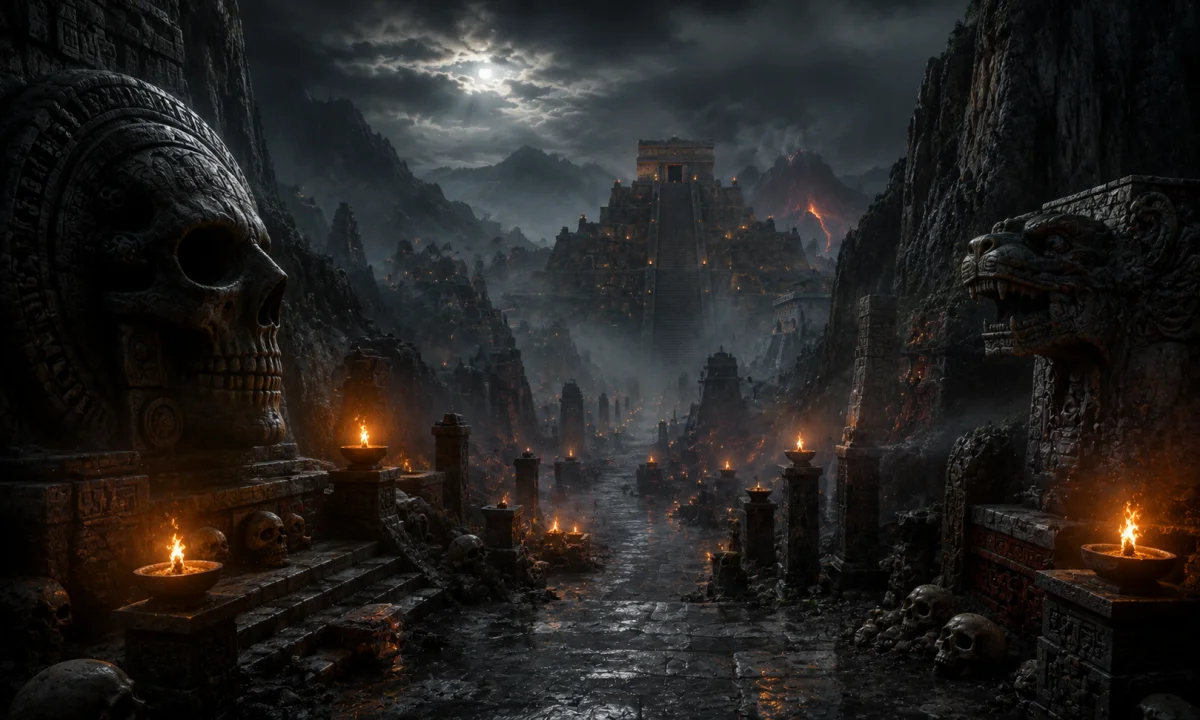
Mictlan is the realm of the dead in the religious traditions of the Mexica, often called the Aztecs, and in related Nahua traditions of central Mexico. It was generally understood as a distant underworld ruled by Mictlantecuhtli, “Lord of Mictlan,” and his female counterpart Mictecacihuatl, “Lady of Mictlan.” Unlike the Christian concept of hell, Mictlan was not primarily a place of punishment for moral wrongdoing. It was the ordinary destination of many people who died from causes that were not associated with a special sacred destiny.
Meaning and cultural setting
The name Mictlan comes from Nahuatl, the language spoken by the Mexica and many other peoples of central Mexico. It is commonly translated as “the place of the dead” or “land of the dead.” The word is related to micqui, meaning “dead person” or “the dead,” although translations and grammatical explanations can vary according to context.
Mictlan belonged to a larger sacred geography that included the earthly world, the heavens and various supernatural regions. Mexica religion did not imagine the universe as a single simple division between heaven and hell. Different forms of death could lead to different destinations. Those who died by drowning or through certain forms of water-related illness were associated with Tlalocan, the fertile paradise of the rain god Tlaloc. Warriors who died in battle and women who died in childbirth were linked with the sun’s course and with the divine powers of the sun. Mictlan, by contrast, was associated with the ordinary dead, including many people who died from illness, old age or other causes.
These categories should not be treated as a complete, fixed system shared identically by every Nahua community. The surviving evidence comes from different periods, regions and authors, and the descriptions do not always agree. The Mexica religious world was complex, and modern summaries sometimes make it appear more uniform than the historical evidence allows.
Sources and surviving traditions
Knowledge of Mictlan comes mainly from early colonial records written after the Spanish conquest. The most important materials include descriptions collected by the Franciscan friar Bernardino de Sahagún with Nahua collaborators, especially the work now known as the Florentine Codex. Other information appears in indigenous pictorial manuscripts, colonial accounts and recorded Nahuatl narratives such as the Leyenda de los Soles, or “Legend of the Suns.”
These sources preserve valuable indigenous testimony, but they are not untouched transcripts of a single pre-conquest book of mythology. They were produced in a colonial setting, often through translation and Christian-influenced recording practices. Some accounts describe ritual beliefs, while others preserve myths, speeches or explanatory narratives. As a result, details about Mictlan can differ in terminology, structure and emphasis.
A particularly influential source describes the dead as travelling toward Mictlan after burial. The journey is often said to last four years, after which the deceased reached the final underworld destination. The number four had important religious associations in Mesoamerican thought, but the surviving accounts do not provide one universally agreed map of the journey.
The structure of the underworld
Modern presentations frequently describe Mictlan as consisting of nine levels or regions. This idea has a basis in colonial-era descriptions and in the term Chicunamictlan, which is often translated as “the place of the nine dead” or “the ninth place of the dead.” However, the names, order and character of the supposed levels vary considerably between sources and later reconstructions.
Popular accounts commonly list dangers such as mountains that crash together, a field of sharp obsidian, freezing winds, wild animals and a dangerous river. Some of these images occur in descriptions or stories connected with the underworld, but the familiar complete sequence of nine clearly named trials is not securely documented as one standard Mexica account. It is therefore more accurate to speak of underworld trials and regions described in varying traditions than to present one modern list as an indisputable ancient system.
One recurring element is the need to cross a river or other boundary. A dog could assist the dead in making this passage. Dogs had an important relationship with death and burial in central Mexican tradition, and archaeological evidence shows that dogs could be sacrificed or buried with human remains. The belief that a dog might guide or help its deceased owner is often connected with the native hairless dog, the xoloitzcuintli, although the evidence does not support treating every later image of a xoloitzcuintli as a direct illustration of Mictlan belief.
The journey was not simply a test of personal virtue. The dead person’s ability to proceed depended on ritual conditions, supernatural assistance and the correct passage of time. Burial goods, offerings and mourning practices could help maintain a relationship between the living and the dead. Mictlan was remote and dangerous, but it was also part of the expected order of existence.
Mictlantecuhtli and Mictecacihuatl
Mictlantecuhtli was the principal male ruler of Mictlan. His name means “Lord of Mictlan,” and he is one of the most recognizable death deities in Mexica art and religious imagery. He was not merely a personification of evil. As ruler of the dead, he represented the inevitability of death and the power of the underworld within the cosmic cycle.
Mexica images often depict Mictlantecuhtli as a skeletal or partly skeletal figure. Artistic representations may show exposed bones, a skull-like head, protruding teeth, hair and bodily features associated with decomposition. Some images use fleshless ribs and other signs of death, while others present him in a more fully formed divine body. These representations should not be read as portraits in the modern sense. Mesoamerican artists used bones, blood, eyes, claws and other visual signs symbolically, and the exact meaning of an image depends on its context.
Mictecacihuatl was the female ruler or lady of Mictlan. Her name is generally translated as “Lady of Mictlan.” Later descriptions sometimes identify her as the wife or counterpart of Mictlantecuhtli. The evidence for her role is less extensive than the evidence for Mictlantecuhtli, and modern retellings sometimes give her a highly developed biography that is not securely present in pre-conquest sources.
Both deities belonged to a wider complex of death-related powers. Their skeletal appearance did not mean that they were demons in the Christian sense. They were gods within a religious system that understood death, decay and regeneration as necessary parts of the cosmos. The dead entered their domain because mortality was part of the human condition, not necessarily because the dead had committed a moral offence.
The journey of the dead
After death, the person was prepared through funerary rites and sent on the journey toward the underworld. Accounts associated with Nahua religion describe the dead as facing a series of obstacles before arriving at Mictlan. A river, mountains, cold or cutting winds and dangerous creatures appear in different versions or later summaries. The precise details are not consistent enough to establish one canonical itinerary.
The dog’s role is especially important in many retellings. A dog that had been treated well during life might recognize and help the deceased, while the animal could serve as a guide across the boundary between the human world and the realm of the dead. This belief helps explain why dogs appear in some burial contexts and why they became such a powerful symbol in discussions of Mesoamerican death traditions.
The four-year duration of the journey is also significant. It suggests that death was not always imagined as an instantaneous transfer to a final destination. The deceased remained involved in a process of transition. Offerings and remembrance could support the dead during this period, while the living continued to acknowledge their obligations to ancestors and recently deceased relatives.
Not every dead person was thought to follow the same route. The destination of the deceased depended in part on the manner of death. This principle is one of the clearest differences between Mexica ideas about the afterlife and systems in which the dead are judged primarily according to personal morality. In the Mexica religious framework, the manner of death could reveal or determine a person’s relationship with particular divine powers.
Quetzalcoatl’s descent to Mictlan
One of the best-known stories associated with Mictlan concerns Quetzalcoatl, the Feathered Serpent. In the narrative known as the Legend of the Suns, Quetzalcoatl descends to Mictlan to obtain the bones of earlier generations. These bones are needed to create the humans of the present age.
Mictlantecuhtli agrees to give up the bones, but only after Quetzalcoatl performs a task involving a conch shell. The story then becomes a contest of cunning. Quetzalcoatl’s allies, often described as worms and bees, help transform or prepare the shell so that it can produce sound. Afterward, the underworld lord tries to prevent Quetzalcoatl from taking the bones. The hero eventually escapes, although the bones are damaged or mixed, helping explain differences in the sizes of human beings.
This narrative is not simply a story about a hero defeating a villain. It expresses a conflict between death and the generation of human life. Mictlantecuhtli guards the remains of earlier beings, while Quetzalcoatl brings those remains back into the living world. The creation of humanity therefore depends on entering the realm of death, negotiating with its ruler and surviving the dangers of the underworld.
Versions of the story vary in their details, and the narrative should not be used as proof that every Mexica community understood Mictlan in precisely the same way. It does, however, show the importance of the underworld in accounts of cosmic history and human origins.
Symbols and religious significance
Mictlan represented more than a location beneath the earth. It was a place where the boundary between life and death was managed. Its rulers controlled the remains of the dead, while other gods governed birth, rain, fertility, fire, warfare and celestial movement. The underworld was therefore part of a network of divine powers rather than an isolated realm.
Images of bones and corpses could signify both death and the possibility of renewal. In agricultural societies, decomposition returned organic matter to the earth, and the hidden world beneath the surface was connected with seeds, fertility and the origin of life. This does not mean that Mictlan was a paradise of rebirth in the same way as Tlalocan. Rather, it occupied an important place in a cycle in which life emerged, flourished, declined and returned to the earth.
The association of Mictlan with ordinary death also made it relevant to the lives of nearly everyone. Warriors and victims of particular deaths might have special posthumous destinations, but Mictlan was the expected fate for many others. Its importance was therefore not limited to specialists, rulers or mythic heroes. Funerary customs, offerings and family remembrance all reflected the continuing presence of the dead in community life.
Mictlan and Día de Muertos
Mictlan is often connected with the modern Mexican observance known as Día de Muertos, or Day of the Dead. The connection is understandable because both traditions involve death, offerings, family remembrance and the continuing relationship between the living and the dead. Indigenous funerary customs contributed to the development of Mexican commemorative practices after the Spanish conquest.
Nevertheless, Día de Muertos is not simply an unchanged survival of ancient Mictlan worship. The contemporary observance developed through the interaction of Indigenous traditions, Catholic feast days, local customs and later national culture. Altars, candles, food, flowers and images of skeletons belong to a living and diverse tradition whose meanings differ among regions and families. Modern celebrations should not be reduced to a direct reenactment of a Mexica underworld journey.
The popular figure of La Catrina is also not the same as Mictecacihuatl. La Catrina was created by the Mexican illustrator and printmaker José Guadalupe Posada in the early twentieth century and later became strongly associated with Día de Muertos. She belongs to modern Mexican visual culture, whereas Mictecacihuatl is a deity from pre-conquest and early colonial accounts of Nahua religion. Treating them as identical erases the historical difference between ancient religious figures and later artistic symbols.
Distinguishing Mictlan from other underworlds
Mictlan is sometimes confused with Xibalba, the underworld in K’iche’ Maya tradition recorded in the Popol Vuh. Both realms contain dangerous powers and trials, and both are important in stories about death and heroic descent. They belong, however, to different cultural and linguistic traditions. Xibalba is not another name for Mictlan, and the Hero Twins of the Popol Vuh should not be inserted into Mexica mythology.
Mictlan should also be distinguished from Tlalocan. Both are destinations associated with the dead in Mexica belief, but Tlalocan is linked to Tlaloc, rain, water and abundant vegetation, while Mictlan is the general underworld ruled by Mictlantecuhtli and Mictecacihuatl. Confusing these destinations produces an inaccurate picture of the varied afterlife beliefs preserved in Nahua sources.
In modern fantasy, games and popular retellings, Mictlan is sometimes presented as a generic “Aztec hell,” a dungeon of monsters or a fixed series of video-game levels. Such versions may borrow names, skeletal imagery or the idea of nine trials, but they are creative adaptations rather than reliable descriptions of Mexica religion. Traditional Mictlan was a culturally specific realm of the dead, embedded in funerary practice, cosmology and stories about the origins of humanity.