WORLD
WORLD
Tamoanchan
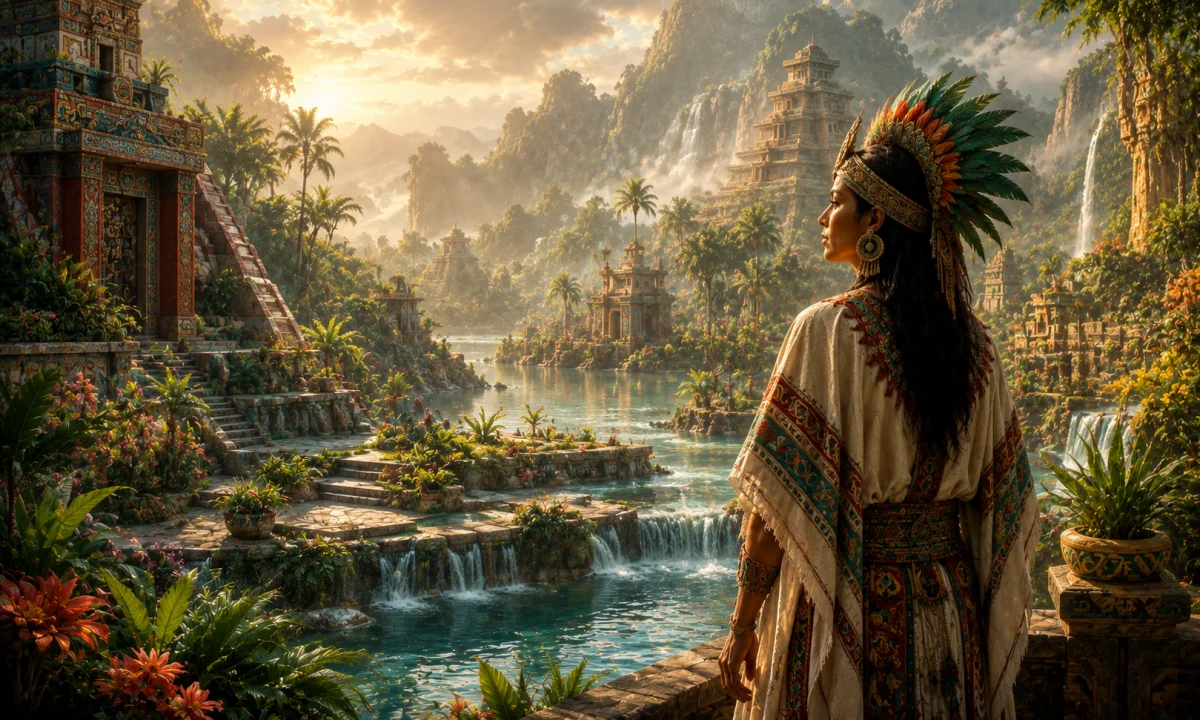
Tamoanchan is a mythical place associated with the religious traditions of central Mexico, especially those recorded in Nahuatl-speaking communities during the early colonial period. It is often described as a sacred paradise, a place where gods were born or gathered, and a setting connected with the creation of humanity. Although commonly labelled an element of Aztec mythology, Tamoanchan is better understood as part of a wider Mesoamerican religious imagination rather than as a simple equivalent of heaven, an underworld, or a historical homeland.
The surviving evidence does not present one single, complete story of Tamoanchan. Information about it appears in several colonial-era accounts, religious manuscripts, and discussions of Nahua traditions. These records were written after the Spanish conquest, often by European friars working with Indigenous informants and interpreters. They preserve valuable material, but they also reflect translation, Christian comparison, editorial choices, and the disruption of pre-conquest religious institutions. As a result, descriptions of Tamoanchan vary, and some details remain uncertain.
The name Tamoanchan
The meaning and origin of the name are disputed. Tamoanchan is the conventional spelling in English-language scholarship, but related forms and divisions of the name have also appeared in discussions of Nahuatl terminology. Proposed interpretations have included ideas such as “the place of mist,” “the place of descent,” or a location associated with returning or entering. None of these translations can be treated as certain.
The difficulty is partly linguistic. Colonial transcriptions do not always preserve the pronunciation or grammatical structure of Indigenous words accurately, and the name may have been understood differently by speakers from different communities. It is therefore safer to use Tamoanchan as a traditional place-name than to assign it a definitive literal translation.
Some interpretations connect the name with a place that lies beyond ordinary human geography. In this reading, Tamoanchan is not simply a village or kingdom but a sacred realm reached through mythic movement between different levels of existence. Other interpretations emphasize its association with birth, generation, or emergence. These possibilities are not mutually exclusive, since Mesoamerican sacred places could function simultaneously as locations, cosmic regions, and symbolic states.
Tamoanchan in Nahua religious thought
In Nahua traditions, the universe was not divided into completely separate categories corresponding neatly to modern ideas of “myth,” “nature,” and “religion.” Mountains, caves, springs, temples, trees, celestial bodies, and directions could all participate in a sacred cosmic order. Places of origin were especially important because they explained how gods, humans, plants, political communities, and ritual obligations came into being.
Tamoanchan belongs to this broad group of origin places. It is associated with the beginning of divine and human life, but its precise role changes from one account to another. In some traditions it appears as a dwelling or meeting place of the gods. In others, it is connected with the creation of human beings or with the emergence of plants and cultivated life. It may also be related to a primordial landscape filled with flowers, trees, and generative power.
This makes Tamoanchan different from a simple afterlife destination. It is not primarily the realm of the dead. Mictlan, ruled by Mictlantecuhtli and Mictecacihuatl in many Nahua accounts, is the better-known underworld associated with the dead. Tamoanchan is more closely connected with beginnings, divine activity, fertility, and the formation of the living world.
Surviving traditions and evidence
Knowledge of Tamoanchan comes mainly from sources produced in the sixteenth century. The most important materials include Nahuatl-language accounts collected by Franciscan scholars, painted manuscripts made or copied in the colonial period, and texts that preserve fragments of earlier Indigenous traditions. These records do not function as a single sacred canon. They contain overlapping traditions from different regions and communities.
Accounts associated with Bernardino de Sahagún and his Indigenous collaborators refer to Tamoanchan in connection with the gods and with primordial events. Other colonial manuscripts describe a sacred place associated with divine creation, luxuriant vegetation, or the actions of powerful beings. The documents do not always agree on whether Tamoanchan was the birthplace of the gods, the place where the gods created humans, or a wider cosmic region containing several important events.
Images in central Mexican religious manuscripts have also influenced interpretations of Tamoanchan. Researchers have connected certain depictions of flowering trees, broken trees, birds, flowers, and supernatural beings with the idea of a paradise or divine origin place. However, identifying an image as Tamoanchan is not always certain. Many Mesoamerican symbols have several meanings, and a flowering tree can represent fertility, cosmic connection, preciousness, or a particular deity without being a direct illustration of Tamoanchan.
Creation and the origin of humanity
Tamoanchan is frequently associated with creation narratives. In one important Nahua tradition, the gods are involved in the restoration or creation of humanity after an earlier cosmic age has ended. The bones of previous human beings are obtained from Mictlan, and divine action transforms them into the ancestors of the present human race. Quetzalcoatl plays a central role in this episode in several versions, while other deities contribute blood, grinding, or ritual assistance.
The surviving accounts do not all name Tamoanchan in exactly the same place within this sequence. For that reason, it is too strong to claim that every version places the entire creation of humanity there. Nevertheless, Tamoanchan’s association with divine generative activity helps explain why later summaries describe it as a place where the first people were made or where the gods established the conditions for human life.
Creation in these traditions is not usually an act performed once in a distant past and then forgotten. It establishes continuing relationships between humans and the gods. Human beings owe nourishment, ritual attention, and reciprocal obligations to the powers that made the world. The connection of Tamoanchan with creation therefore gives it religious significance beyond its role as a setting in a story.
The flowering tree and the sacred landscape
One of the most recognizable images associated with Tamoanchan is a flowering or fruit-bearing tree. In interpretations of central Mexican religious imagery, the tree can represent the axis linking different parts of the cosmos. Its roots reach into the earth, its trunk occupies the human world, and its branches extend toward the heavens. A tree of this kind is not necessarily a literal botanical object; it can be a visual expression of cosmic connection.
Flowers have particular importance in Nahua symbolism. They could signify beauty, preciousness, life, speech, song, ritual offering, and the fleeting nature of existence. A paradise filled with flowers would therefore represent more than pleasant scenery. It would suggest a realm of concentrated sacred vitality.
Some traditions describe a disturbance involving a sacred tree in the primordial realm. The details and interpretation are uncertain, but the motif has been understood as representing a breach in cosmic order, a separation from a former paradise, or the consequences of divine transgression. Such interpretations should be treated cautiously because the surviving sources do not provide one universally accepted explanation.
The image of a tree also helps distinguish Tamoanchan from a purely celestial paradise. Its symbolism joins heaven, earth, and the regions beneath the earth. This reflects a common Mesoamerican understanding of the universe as layered but interconnected rather than divided into isolated locations.
Gods and beings connected with Tamoanchan
Tamoanchan is not consistently ruled by one sovereign deity. It is instead linked with groups of creator gods and with beings associated with fertility, vegetation, birth, and sacred transformation. The identities of these figures vary according to the source and the particular tradition being recorded.
Quetzalcoatl is relevant to Tamoanchan through creation traditions, especially those involving the recovery of ancestral bones and the making of present humanity. This does not mean that Tamoanchan was simply Quetzalcoatl’s personal realm. Quetzalcoatl was a complex deity whose worship and stories extended across Mesoamerica, and his connection with a particular sacred place should not erase other gods or local traditions.
Other creator figures in Nahua accounts include Ometecuhtli and Omecihuatl, the dual powers associated in some sources with the highest generative principle, as well as Tonacatecuhtli and Tonacacihuatl, who are connected with sustenance and creation. The relationships among these beings are not presented consistently in all colonial texts. Some accounts treat them as distinct divine pairs, while others place them within overlapping systems of creation.
Fertility deities and gods connected with maize may also enter interpretations of Tamoanchan because the place represents the emergence of life and nourishment. Yet a general symbolic association should not be turned into a claim that every maize deity lived there or that Tamoanchan was exclusively a maize paradise.
Paradise, birthplace, or cosmic region?
Calling Tamoanchan an “Aztec paradise” is convenient but incomplete. The word paradise suggests a final destination for the righteous, whereas Tamoanchan is primarily a place of primordial creation and divine origin. It is closer to a sacred birthplace or mythic source of life than to a moral afterlife.
At the same time, some descriptions give it paradisal qualities. It is portrayed or imagined as fertile, beautiful, flower-filled, and free from the ordinary limitations of human existence. These features may have encouraged European writers and modern commentators to compare it with the Garden of Eden or other idealized gardens. Such comparisons can be useful as broad analogies, but they should not obscure the distinct religious concepts involved.
Tamoanchan is also not identical to Aztlan. Aztlan is a legendary homeland associated with the Mexica migration and with several other Nahua groups in later traditions. It occupies a different place in narratives of ancestry, migration, and political identity. Nor should Tamoanchan be automatically equated with Chicomoztoc, the “Seven Caves,” another important place of origin in central Mexican traditions. These places may overlap symbolically as sources of life or people, but they are not interchangeable names.
Relationship to broader Mesoamerican traditions
The concept of a sacred origin place is not unique to the Mexica or to Nahua-speaking peoples. Across Mesoamerica, myths and ritual systems often describe emergence from caves, mountains, water, trees, or other places that connect cosmic levels. Similar structural ideas can appear in cultures that did not share the same language or political history.
These parallels do not prove that Tamoanchan was the same place as a sacred origin location in Maya, Mixtec, Zapotec, or other traditions. Mesoamerica was culturally interconnected, but its religious traditions were not uniform. Similar images may reflect shared ancient patterns, regional exchange, or independent symbolic development. Tamoanchan should therefore remain grounded in central Mexican and Nahua evidence while being considered within the wider Mesoamerican context.
Interpretation and cultural significance
Tamoanchan can be understood as a model of cosmic fertility. It represents a realm in which divine powers generate the conditions for life, and where the boundaries between gods, humans, plants, and the landscape are unusually permeable. Its flowers and trees express abundance, but they may also carry a sense of fragility: life is precious because it is dependent on continued ritual and cosmic balance.
The place also reflects the importance of movement between realms. Gods travel, bones are retrieved from the underworld, life is formed through sacrifice, and sacred substances pass between divine and human spheres. Tamoanchan is therefore not an isolated garden but part of a network of cosmic regions, including the heavens, the earth, and the underworld.
Scholars have proposed different ways to interpret the name and imagery: as a memory of an ancient homeland, a metaphor for ritual transformation, a mythic paradise, or a component of a larger Mesoamerican creation system. These interpretations are not equally certain, and no single modern theory explains every reference. The most reliable description is that Tamoanchan was a powerful sacred place of origin whose meaning changed according to context.
Tamoanchan in modern culture
Modern fantasy, fiction, games, and esoteric writing sometimes use Tamoanchan as the name of a lost paradise, divine garden, or hidden world. These adaptations often treat it as a clearly defined location with a fixed ruler, inhabitants, and geography. That presentation is a modern reconstruction rather than a consistent feature of the surviving Nahua sources.
Contemporary uses can introduce wider audiences to a name from Mesoamerican tradition, but they may also blend Tamoanchan with Aztlan, Atlantis-like lost lands, generic heavens, or unrelated Indigenous concepts. Traditional evidence supports a more complex picture: Tamoanchan is a variable and partly elusive sacred realm connected with divine origins, creation, fertility, and the structure of the cosmos.