WORLD
WORLD
Mictecacihuatl
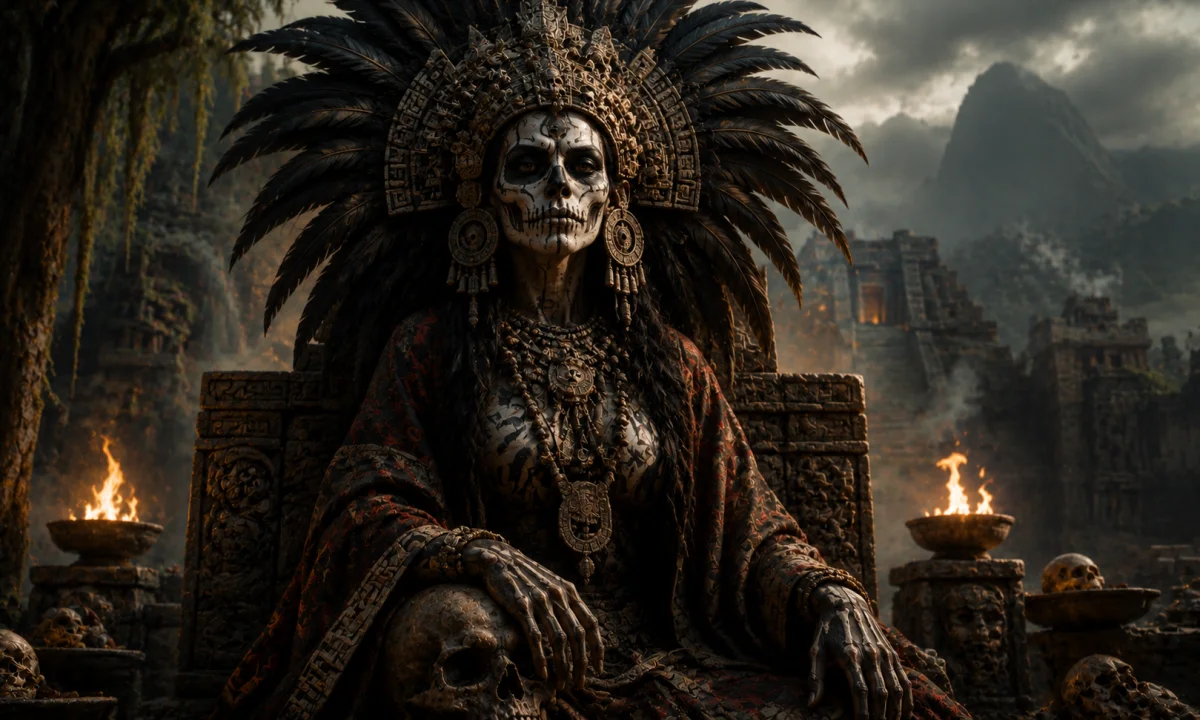
Mictecacihuatl is a female deity associated with the dead in Mexica, commonly called Aztec, religious tradition. Her name is usually translated as “Lady of the Dead” or “Lady of the Place of the Dead.” She is closely connected with Mictlan, the underworld ruled by Mictecacihuatl and her male counterpart, Mictlantecuhtli. Although she is widely described today as an Aztec goddess of death, surviving evidence presents a more limited and varied picture than many modern portrayals suggest.
Name and identity
The name appears in several spellings, including Mictecacihuatl, Mictecacíhuatl, and Mictēcacihuātl. These differences result from the ways that Classical Nahuatl was recorded using the Latin alphabet after the Spanish conquest. The name is generally understood as combining a term connected with the dead or the place of the dead with cihuātl, meaning “woman.” The precise grammatical analysis and preferred English translation can vary.
Mictecacihuatl belongs to the religious world of the Mexica and to the broader Nahua traditions of central Mexico. Calling her simply an “Aztec goddess” is convenient, but it can conceal the diversity of religious practices among different Nahua-speaking communities. The Mexica state shared important gods, myths and ritual concepts with neighbouring peoples, while local traditions could assign different names, emphases or functions to related beings.
She is most often identified as the female ruler or companion of Mictlantecuhtli, whose name is commonly translated as “Lord of the Place of the Dead.” Together, they govern Mictlan, the destination of many people who died ordinary deaths. Some accounts treat Mictecacihuatl and Mictlantecuhtli as a paired ruling couple; others give greater narrative attention to Mictlantecuhtli and mention the female deity less extensively.
Mictlan and the Mexica understanding of death
Mictlan was not equivalent to the Christian concept of Hell. It was a realm of the dead rather than a place reserved for sinners, and reaching it did not necessarily imply moral punishment. In accounts recorded during the colonial period, many people who died in ordinary circumstances were thought to travel through a difficult series of regions before arriving at the deepest part of the underworld.
Descriptions of the journey differ in detail, but commonly mention obstacles such as mountains that collided, dangerous winds, rivers and other hazards. A dead person could be accompanied by a dog, especially a dog believed capable of helping its owner cross the waters of the underworld. The journey was associated with endurance and transformation rather than a simple judgement of the deceased.
Not everyone was believed to go to Mictlan. The destination of the dead could depend on the manner of death. People who died by drowning or from certain water-related causes were associated with Tlalocan, the realm of the rain god Tlaloc. Warriors who died in battle and people sacrificed to the gods could receive different post-mortem destinies, while women who died in childbirth were sometimes compared ritually with fallen warriors and assigned a distinct place in the cosmic order.
These distinctions show why Mictecacihuatl should not be reduced to a universal personification of death. Her principal setting was Mictlan, one part of a larger and complex geography of the afterlife. Her association was with the dead and their underworld destination, not necessarily with every form of death or every fate after death.
Surviving sources and religious setting
No single sacred book provides a complete, authoritative biography of Mictecacihuatl. Knowledge of her comes from a combination of painted manuscripts, colonial-era descriptions, Indigenous testimony recorded in alphabetic Nahuatl or Spanish, and interpretations of ritual and iconographic evidence. Many records were created after the Spanish conquest, when Indigenous informants and artists were working within a Christian colonial environment.
The most important written information about Mexica religion was gathered by friars, Indigenous scholars and colonial administrators. Such records preserve valuable details, but they are not neutral transcripts of a pre-conquest religion. Translators sometimes used Christian categories, informants could describe different local traditions, and Spanish writers often selected material according to their own purposes. Consequently, details about Mictecacihuatl’s appearance, festivals and individual myths are not equally secure.
Mexica religious thought also did not separate gods into rigid categories in the same way that modern reference works often do. A deity could have multiple names, manifestations or relationships, and a single divine quality could be expressed through several related figures. This makes it important to distinguish what is directly recorded from what is inferred through comparison with other underworld beings.
Role as ruler of the dead
Mictecacihuatl’s central role is her connection with the administration of Mictlan. In modern descriptions, she is often called the “Queen of the Underworld,” a useful summary of her position beside Mictlantecuhtli. The surviving tradition, however, does not give her an extensive cycle of independent stories comparable to the myths of Quetzalcoatl, Huitzilopochtli or Tezcatlipoca.
Her presence represents the feminine aspect of the underworld’s ruling pair. This does not mean that she was merely a wife without religious significance. Mexica religion frequently expressed cosmic forces through complementary male and female forms. Yet the surviving accounts do not allow every later claim about her powers or personality to be treated as ancient fact.
She is sometimes described as guarding the bones of the dead or presiding over the remains kept in Mictlan. This idea is related to important Mexica creation narratives, especially the story in which Quetzalcoatl seeks the bones of former generations in the underworld. In the best-known versions of that story, Mictlantecuhtli is the principal figure who challenges Quetzalcoatl. Mictecacihuatl is not consistently given an active role, so claims that she personally guards or steals the bones should be presented as later expansions or uncertain interpretations rather than as universally established details.
Appearance and symbolism
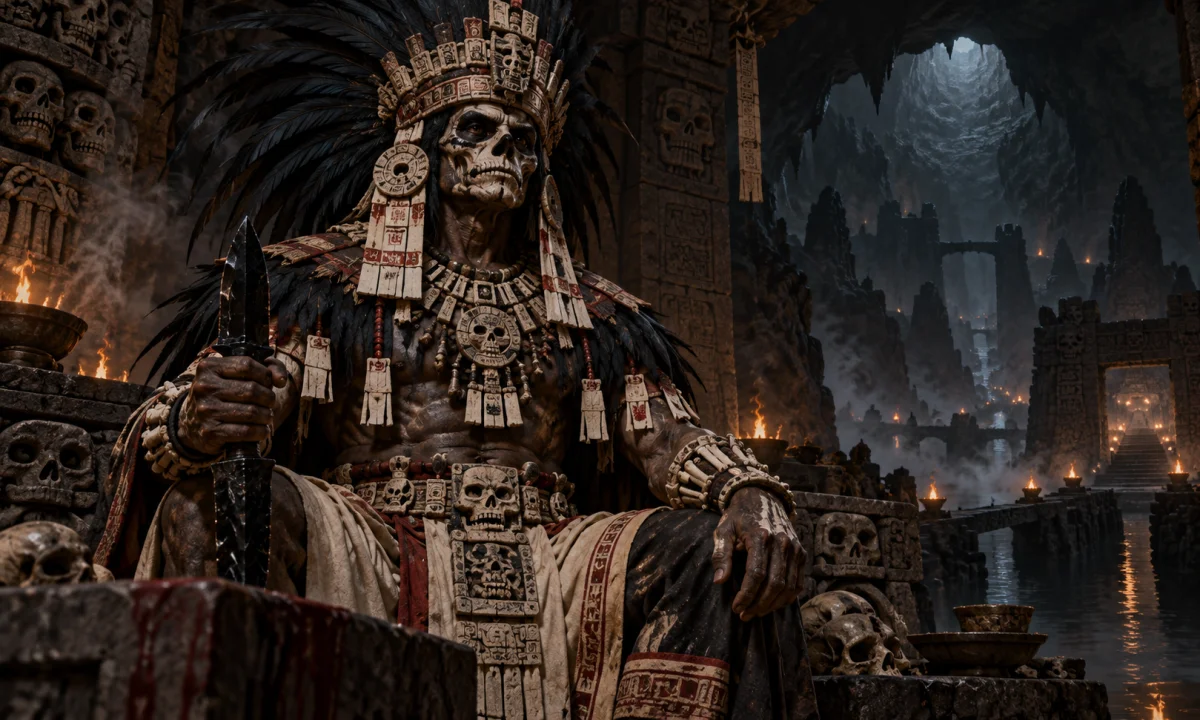
Modern illustrations often show Mictecacihuatl as a woman with a skeletal face, exposed bones, dark hair, and elaborate clothing or ornaments. A skeletal or corpse-like appearance is broadly appropriate to her association with the dead, but there is no single universally accepted portrait of her. The surviving visual evidence does not always identify figures as securely as modern labels imply.
Images of Mexica deities commonly combine human, animal and supernatural features. Death-related imagery could include bones, skulls, decaying flesh, darkness, blood, eyes, mouths and other powerful signs. These motifs did not necessarily express evil. In Mesoamerican religious thought, death was closely connected with fertility, regeneration, warfare, sacrifice, agriculture and the renewal of cosmic time.
A skull should therefore not automatically be treated as a portrait of Mictecacihuatl. Skull imagery was widespread and could refer to death generally, to the underworld, to sacrificial practice or to other deities and ritual contexts. Likewise, modern attributes such as a specific crown, weapon, flower arrangement or colour scheme may come from contemporary artistic convention rather than from securely documented Mexica tradition.
Her symbolism is best understood through the relationship between death and continuity. The dead were not simply erased from religious life. They remained connected to families, ritual memory, seasonal observances and the wider processes that sustained the community. The underworld was dangerous, but it was also part of the structure of the cosmos.
Festivals of the dead
Colonial descriptions of the Mexica ritual calendar record celebrations with names connected to the dead. Among these are Miccailhuitontli, often translated as the “Little Feast of the Dead,” and Huey Miccailhuitl, the “Great Feast of the Dead.” The exact timing, ceremonies and relationship between these observances are described differently in surviving sources.
These festivals are frequently presented as direct ancient origins of the modern Mexican Día de Muertos, or Day of the Dead. There is a genuine connection in the broad importance of remembering the dead and in the presence of Indigenous traditions within Mexican commemorative practices. However, the modern observance developed through a long process of cultural change. Catholic celebrations associated with All Saints and All Souls were combined with Indigenous customs, and different regions developed their own forms.
It is therefore too simple to say that Mictecacihuatl was the direct goddess of the modern Day of the Dead. Many present-day celebrations do not invoke her, and practices vary greatly among communities. The historical relationship is better described as a complex mixture of Indigenous ideas about death, colonial religious observances and later Mexican cultural traditions.
Stories and relationships
Mictecacihuatl’s most important relationship is with Mictlantecuhtli. Their pairing reflects the organisation of Mictlan as a realm governed by complementary powers. In some modern accounts, they are described as equal monarchs; in others, the male deity receives most of the narrative attention. The evidence does not support a single detailed family history for the pair.
The underworld journey of the dead is more central to her religious setting than a personal biography. A deceased person’s passage through Mictlan involved the separation of the living from the dead and the completion of a dangerous cosmic process. The rulers of the underworld represented the power that received and controlled the dead after this journey.
The story of Quetzalcoatl’s descent into Mictlan is sometimes treated as Mictecacihuatl’s principal myth. In that narrative, Quetzalcoatl wants to obtain the bones of earlier beings in order to create humanity. Mictlantecuhtli sets tasks and attempts to prevent the bones from leaving. Versions differ, and Mictecacihuatl may be absent or only indirectly implied. It is more accurate to describe the story as a myth involving the rulers or authorities of Mictlan than to claim that Mictecacihuatl has a consistent starring role in it.
Distinguishing Mictecacihuatl from related figures
Mictlantecuhtli is not another name for Mictecacihuatl. He is the male ruler associated with Mictlan, while Mictecacihuatl is the female figure paired with him. Their names and roles are closely linked, which can lead to confusion in simplified retellings.
Mictlancihuatl is another name or form found in discussions of the female ruler of the underworld. Spelling and naming conventions vary between sources, and scholars do not always treat every form as a completely separate goddess. It should not automatically be assumed that Mictlancihuatl and Mictecacihuatl represent unrelated beings.
Coatlicue, the earth mother associated with the Mexica gods, is also sometimes portrayed with death-related imagery, serpents, claws and a frightening appearance. She is not simply another name for Mictecacihuatl. Her myths and religious functions are distinct, even though earth, birth, death and regeneration could overlap symbolically.
Itzpapalotl, the “Obsidian Butterfly,” is another powerful female figure sometimes connected in modern writing with death, sacrifice or the underworld. She belongs to a different set of myths and should not be merged with Mictecacihuatl.
La Catrina is not an ancient Aztec goddess. She originated in the early twentieth century through the satirical imagery of the Mexican illustrator and printmaker José Guadalupe Posada and was later popularised in other artistic contexts. Her elegant skeleton has become strongly associated with Day of the Dead, but she is a modern cultural figure rather than a pre-conquest representation of Mictecacihuatl.
Santa Muerte is likewise distinct. Santa Muerte is a modern folk-saint figure venerated in parts of Mexico and elsewhere, especially from the late twentieth century onward. Her imagery may resemble depictions of death and can sometimes be discussed alongside Indigenous traditions, but she is not the same deity as Mictecacihuatl.
Modern reception
Mictecacihuatl has become increasingly visible in books, games, comics, animation, tattoos, fantasy art and online discussions of mythology. Contemporary portrayals often give her a dramatic skeletal body, a strong warrior personality, magical powers, or a central role in the Day of the Dead. These creative interpretations can make the figure accessible, but they frequently combine ancient material with modern Mexican imagery and invented narrative details.
Some popular depictions also treat Mictecacihuatl as the original or sole goddess of Día de Muertos. That claim simplifies both Mexica religion and modern Mexican practice. The traditional evidence supports her association with the dead and Mictlan, while the modern festival has multiple historical and regional influences.
Mictecacihuatl is most accurately understood as a female underworld deity of Mexica religious tradition, paired with Mictlantecuhtli and connected with the dead who travelled to Mictlan. Her surviving profile is significant but comparatively brief, and many detailed descriptions now attached to her come from later interpretation, modern art or popular culture rather than securely preserved pre-conquest accounts.