WORLD
WORLD
Tonacatecuhtli

Tonacatecuhtli is a creator deity in the religious traditions of central Mexico, especially those recorded in Nahuatl-speaking communities during and after the Spanish conquest. His name is commonly translated as “Lord of Our Sustenance” or “Lord of Our Nourishment.” Tonacatecuhtli is associated with the origin of the gods, the generation of human life, and the food that sustains the world. He is usually paired with Tonacacihuatl, “Lady of Our Sustenance,” although the surviving sources do not always present this divine couple in exactly the same way.
Name and meaning
The name Tonacatecuhtli comes from Nahuatl. Its most widespread interpretation connects it with tonacayotl, a term associated with nourishment, sustenance, or the things that keep living beings alive, together with tecuhtli, “lord” or “noble ruler.” The translation “Lord of Our Sustenance” is therefore useful, but it should not be treated as a completely certain word-for-word gloss. Nahuatl religious names often carried several overlapping meanings, and colonial transcriptions do not always preserve pronunciation and grammatical detail perfectly.
The name may also evoke the human body, flesh, or the material substance of life. This is significant in a religious system in which food was not merely a source of energy. Maize, blood, water, and other substances connected gods, humans, earth, and the cycles of the cosmos. Tonacatecuhtli’s name consequently suggests both nourishment and the material basis of existence.
Tonacacihuatl is the corresponding feminine name, usually translated as “Lady of Our Sustenance.” Together, the two names describe a complementary generative power. Their relationship resembles other Mesoamerican patterns in which a male and female pair represents the capacity to create, nourish, and reproduce. They should not automatically be equated with every other creator couple in Mesoamerican religion, however. Similar concepts appear in several cultures, but each tradition has its own history and terminology.
Religious and cultural setting
Tonacatecuhtli belongs to the complex religious world often called Aztec or Mexica religion. “Aztec” is a broad modern label for related Nahuatl-speaking peoples of central Mexico, while “Mexica” more specifically refers to the people who founded Tenochtitlan and built the dominant imperial state of the Late Postclassic period. The traditions associated with Tonacatecuhtli were not necessarily identical in every city or community.
Much of the surviving information comes from sources produced in the sixteenth century, after the Spanish invasion. These include Nahuatl-language manuscripts, alphabetic accounts written by Indigenous informants and Spanish friars, and illustrated religious manuscripts now known as codices. Such materials preserve valuable pre-conquest traditions, but they also reflect Christian influence, editorial choices, translation problems, and the loss of many earlier records.
For that reason, Tonacatecuhtli cannot be reconstructed from one single authoritative myth. Different sources arrange the creator gods differently, use alternative names, or emphasize different aspects of their activity. Some accounts place Tonacatecuhtli and Tonacacihuatl at the beginning of divine genealogy. Others use names such as Ometecuhtli and Omecihuatl, or describe a more abstract dual principle called Ometeotl. Scholars continue to debate how these names relate to one another and whether they represent distinct deities, titles for related manifestations, or different theological systems recorded in different contexts.
Identity as a creator deity
Tonacatecuhtli is generally presented as a primordial or high-ranking god rather than as a local hero, ancestor, or ordinary natural spirit. His most important role is generative. He belongs to the divine order that exists before the familiar world has been fully formed and is credited in some traditions with producing, or helping to produce, other gods.
In accounts that describe Tonacatecuhtli and Tonacacihuatl as a primordial couple, they occupy a remote celestial realm. This place is often called Omeyocan, a name associated with duality or the place of the Two. Some colonial sources also place the couple in the highest heaven, sometimes described as the thirteenth heaven. These descriptions should be understood as features of particular recorded traditions rather than as a universally fixed map accepted by every Nahua community.
The couple’s remoteness is meaningful. Tonacatecuhtli is not usually portrayed as a god who regularly walks among humans in a recognizable earthly form. Instead, he represents a prior and encompassing source of life. The world’s later struggles—creation and destruction, the succession of cosmic ages, the deeds of culture heroes, and the obligations of human ritual—take place beneath this more primordial level.
Some sources describe Tonacatecuhtli and Tonacacihuatl as the parents of four important gods. These children are commonly identified with the four Tezcatlipoca figures or with four major creative powers: the Red Tezcatlipoca, often associated with Xipe Totec; the Black Tezcatlipoca; Quetzalcoatl; and Huitzilopochtli. The exact names and sequence vary among accounts, and the grouping should not be treated as a simple family tree accepted in every tradition.
Association with nourishment and life
Tonacatecuhtli’s central symbolism is nourishment. The name connects him with the means by which people, animals, and the wider world continue to exist. In central Mexican religion, nourishment was inseparable from agriculture, seasonal change, fertility, and proper relations between humans and the divine powers.
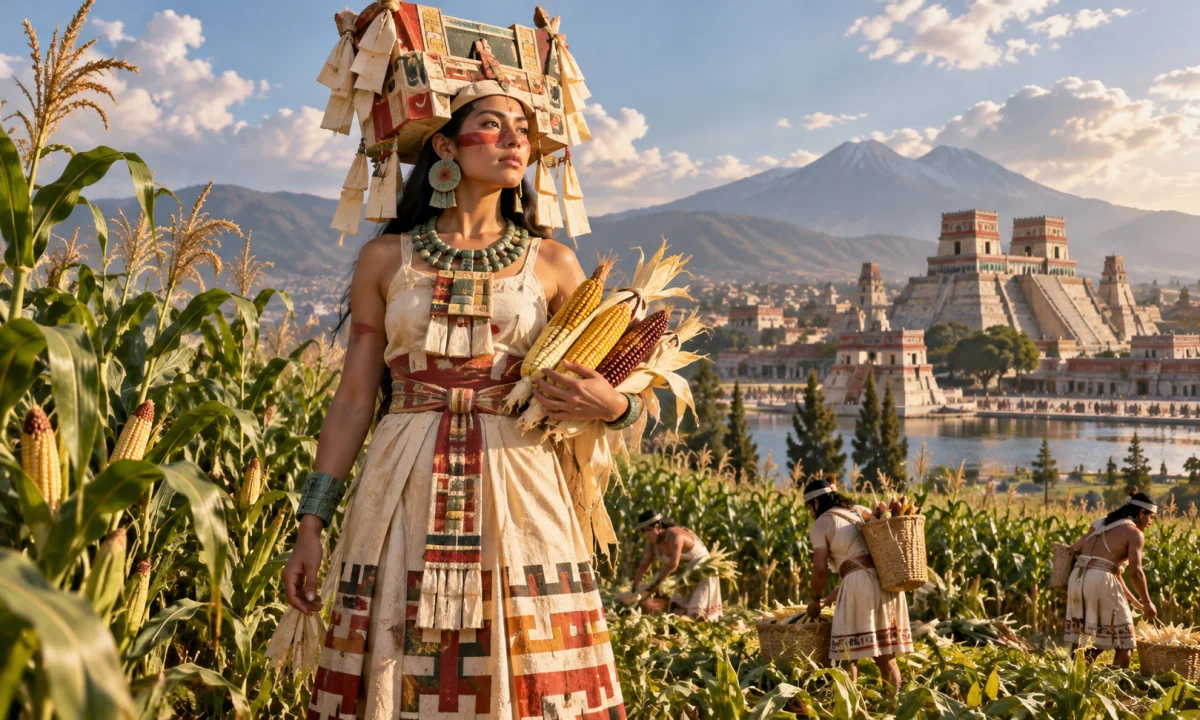
Maize had a particularly important place in this worldview. It was the foundation of daily food and a substance with deep religious significance. Nahua traditions describe humans as being made from maize or maize dough in the creation of the present human race. Tonacatecuhtli is not simply a “corn god” in the narrow sense, and he should not be confused with specialized maize deities such as Chicomecoatl. Nevertheless, his title places him close to the broader principle of food and sustenance on which maize agriculture depended.
His role also has a reproductive dimension. To nourish is to maintain life, but it is also to make growth possible. The divine couple therefore represents a generative relationship rather than only an abstract male ruler and female companion. Their imagery and names suggest the production of descendants, gods, humans, and the material abundance required for life to continue.
This symbolism helps explain why Tonacatecuhtli may appear in connection with birth and infancy. Some Nahuatl prayers and ritual contexts address high creator powers when speaking about pregnancy, childbirth, or the precarious arrival of a new person. The evidence is not uniform enough to define him as a separate “birth god” in the manner of a narrowly specialized deity, but his association with life’s origin made such connections appropriate.
Place in creation traditions
Accounts of creation in central Mexican sources are often layered rather than systematic. One story may explain the origin of the gods, another the making of the earth and sky, and another the creation of humans after earlier cosmic ages have ended. These stories do not always fit together as a single continuous narrative.
Within one important tradition, Tonacatecuhtli and Tonacacihuatl are the first divine parents. Their four sons then become agents in the ordering of the cosmos. The sons divide or arrange the heavens and the earth, establish the domains of other gods, and take part in the creation of humanity and the natural world. In this pattern, Tonacatecuhtli does not perform every creative act personally. Instead, he stands at the origin of a divine genealogy whose younger members carry out the active work of cosmic organization.
Other traditions emphasize Ometecuhtli and Omecihuatl as the primal pair, or use Ometeotl as a name for the dual source of creation. The relationship between these figures and Tonacatecuhtli is one of the most debated questions in the study of Nahua religion. Some interpretations treat them as equivalent or closely related forms of a high creator principle. Others argue that the sources preserve distinct theological ideas that were later grouped together by colonial writers or modern scholars.
It is therefore more accurate to say that Tonacatecuhtli participates in a family of overlapping creator concepts than to claim that all such names are unquestionably interchangeable. His own clearest distinctive feature is the language of sustenance and generative abundance.
Heavens, duality, and distance
Tonacatecuhtli’s association with the highest heavens reflects a broader Mesoamerican idea that the origins of life are located beyond the ordinary human world. The upper heavens were not simply a physical sky. They could be imagined as ordered levels inhabited by divine powers, celestial forces, and beings connected with creation.
The name Omeyocan is especially important because it expresses duality. Nahua religious thought frequently organized reality through paired forces: male and female, hot and cold, night and day, life and death, descent and ascent. Such pairs were not always opposites in a strict sense. They could be mutually dependent aspects of a single process.
Tonacatecuhtli and Tonacacihuatl embody this kind of complementary power. Their importance does not depend on one being active and the other passive. Together, they express the capacity to generate and maintain life. Their distance from the human realm may also indicate that nourishment is a cosmic principle before it becomes an agricultural or household reality.
Calendrical and manuscript associations
Tonacatecuhtli appears in some representations of the tonalpohualli, the 260-day divinatory calendar. In calendrical systems, gods could govern particular days or periods, influencing the character and prospects of people born under those signs. Tonacatecuhtli is especially associated in some manuscripts with the first day sign, Cipactli, the crocodile or earth-monster sign.
The exact arrangement differs between manuscripts and interpretive traditions. A day sign, its patron deity, and its divinatory meaning formed a structured system rather than a simple list of personal attributes. The association with Cipactli may therefore connect Tonacatecuhtli with beginnings, the earth, fertility, and the emergence of ordered life, but it should not be reduced to a single fixed meaning.
Illustrated codices show creator figures in forms that are difficult to identify with certainty. A figure labelled Tonacatecuhtli in one manuscript may look different from a figure given the same name in another. Artists used conventional signs, colors, headdresses, gestures, and costumes, yet the surviving manuscripts are not always fully labelled. Modern identifications can consequently be tentative, especially where the image resembles other elderly creator or fertility figures.
Descriptions of Tonacatecuhtli as an old man, sometimes paired with an old woman representing Tonacacihuatl, are based largely on colonial-era interpretations and manuscript imagery. This does not establish that every community imagined him as physically elderly. “Old” may express primordial age and authority rather than a fixed human appearance.
Relationships with other deities
Tonacatecuhtli’s most important relationship is with Tonacacihuatl. Their pairing emphasizes shared generative power and distinguishes them from deities whose roles are more specialized, such as rain, warfare, wind, pulque, or the underworld.
He is also connected genealogically with the major gods who emerge from the primordial creator pair in certain traditions. These include Quetzalcoatl and Huitzilopochtli, although the details of their parentage vary. The relationship should not be used to create a uniform family structure for all Aztec myths. The gods could have different origins in different narratives, and a deity’s relationship to another figure might be theological, genealogical, political, or symbolic.
Tonacatecuhtli should not be confused with Ometeotl simply because both are linked with primordial duality. Nor should he be confused with Tlaltecuhtli, the earth monster whose name also contains the element tecuhtli. Tlaltecuhtli is strongly associated with the earth’s consuming and fertile body, while Tonacatecuhtli is primarily associated with generative nourishment and the divine source of sustenance.
He is likewise distinct from Tonatiuh, the sun god. The similarity between the names can cause confusion, but they refer to different figures. Tonatiuh’s name is connected with the sun, whereas Tonacatecuhtli’s name concerns sustenance or nourishment. Tonacatecuhtli is also not the same as Centeotl or Chicomecoatl, deities associated more specifically with maize and agricultural abundance.
Interpretation and cultural significance
Tonacatecuhtli illustrates how creator gods in Mesoamerican traditions could be less prominent in public myth than younger deities associated with warfare, rain, agriculture, or rulership. A primordial deity did not need to dominate dramatic stories in order to hold a fundamental position. His importance lay in establishing the conditions under which all later divine and human activity was possible.
The title “Lord of Our Sustenance” also reveals an understanding of dependence. Human beings did not stand outside nature as independent observers. They relied on maize, water, earth, sunlight, seasonal cycles, animal life, and divine powers. Sustenance involved reciprocal obligations: people received what allowed them to live, while ritual, discipline, offerings, and communal practice helped maintain relationships with the sacred order.
At the same time, it would be misleading to describe Tonacatecuhtli as a simple benevolent creator in the modern sense. Nahua gods were not usually divided into absolute categories of good and evil. Creation could involve danger, sacrifice, conflict, and destruction. The food that sustains life also participates in cycles of death and renewal. Tonacatecuhtli’s generative role belongs to this larger and more demanding cosmology.
Sources and limits of the evidence
Knowledge of Tonacatecuhtli comes mainly from colonial-period records and painted manuscripts. These sources are indispensable, but they are not neutral windows onto an unchanged pre-conquest religion. Indigenous artists and speakers preserved traditions in circumstances shaped by conquest, conversion, political upheaval, and the destruction of temples and religious objects.
Different records may reflect local traditions from places such as central Mexican cities with distinct histories. Spanish writers sometimes translated Nahuatl names into Christian categories, while modern scholars have sometimes harmonized separate accounts into a single system. The result is that certain features—his role as a primordial creator and his association with nourishment—are broadly consistent, while details about his appearance, genealogy, heavenly location, and relationship to Ometeotl remain more uncertain.
Careful descriptions should therefore distinguish between what the name and major traditions strongly support and what comes from a particular manuscript or interpretive reconstruction. Tonacatecuhtli is best understood not as a character with one universally fixed biography, but as a high creator figure whose meaning changes somewhat according to the religious source in which he appears.
Modern representation
Tonacatecuhtli has a relatively limited presence in mainstream modern popular culture compared with Quetzalcoatl, Huitzilopochtli, or Tezcatlipoca. He may appear in illustrated books, educational projects, games, and modern retellings of Aztec mythology, where he is often presented as an elderly creator god or as the personification of nourishment.
These portrayals can be useful introductions, but they frequently simplify disputed relationships among Tonacatecuhtli, Tonacacihuatl, Ometeotl, and other creator figures. Modern fantasy may also give him powers, weapons, clothing, or personality traits not established by the surviving traditions. His traditional significance lies less in an adventurous narrative than in the profound religious idea expressed by his name: life depends on a sacred source of nourishment, and creation is inseparable from the continuing work of sustaining the world.