WORLD
WORLD
Sukuna-bikona
Sukuna-bikona—also written Sukunahikona, Sukunabikona, or Sukunahikona no Kami—is a small but important deity in Japanese mythology. He is best known as the companion of Ōkuninushi (also called Ōnamuchi), with whom he helped establish and order the land. Traditional accounts associate him especially with medicine, healing, agriculture, protection from disease, hot springs, and the practical knowledge needed for human life.
His diminutive form is central to his identity, but Sukuna-bikona is not merely a comic “tiny god.” In the surviving myths, his smallness exists alongside exceptional wisdom and sacred power. He is a culture-bringer: a deity who helps transform an unsettled world into a habitable country by teaching people how to live in it.
Origins in Japanese mythological texts
The main written accounts of Sukuna-bikona appear in the Kojiki and the Nihon Shoki, texts compiled in the early eighth century. These works present the mythology of the Japanese court and preserve traditions associated with different regions, ritual communities, and political interpretations. They are not identical in every detail, so the figure’s parentage, arrival, and departure can vary according to the passage being considered.
In the Kojiki, Ōkuninushi encounters a strange little deity who arrives across the sea in a tiny boat. The newcomer is so small and mysterious that Ōkuninushi does not know who he is. Kuebiko, a supernatural scarecrow who possesses knowledge of everything under heaven, identifies him as Sukuna-bikona no Kami, a child of Kamimusuhi no Kami. Kamimusuhi then confirms the identification and claims Sukuna-bikona as his son.
The story gives Sukuna-bikona an unusual birth or origin. Kamimusuhi explains that the deity came from his body, slipping through his fingers when he was squeezing them together. The image helps explain the god’s extraordinary smallness while also presenting him as a being of high divine status. He is tiny not because he is weak or mortal, but because his nature is intrinsically associated with miniature form.
The Nihon Shoki also describes Sukuna-hikona as a small deity who appears from across the sea and becomes associated with Ōnamuchi. Its accounts contain variations concerning the circumstances of his arrival and his divine parentage. Kamimusubi is commonly named as his father, although details differ among the text’s variant traditions. These differences are a reminder that Japanese mythology was transmitted through multiple local and ritual traditions rather than through one single, fixed canon.
The meaning and spelling of his name
The deity’s name is written with characters meaning approximately “small” and “male child” or “young male deity”: 少彦名神 or, in another form, 少彦名命. The element sukuna clearly conveys smallness. The second element appears in names such as Hikona or Bikona, a title or name-form used for a male divine figure.
Romanization varies because Japanese words are often represented differently in English-language works. Sukuna-bikona follows a common form based on the Kojiki, while Sukunahikona reflects another conventional spelling. The forms refer to the same deity, not to separate gods. The honorific no Kami means “deity” or “god” and is often included in formal references.
His classification is also more flexible than a modern category such as “god of medicine.” In Japanese religious language, a kami may have several overlapping areas of authority, and those areas can develop through myth, shrine worship, local legend, and later religious practice. Sukuna-bikona’s connection with healing is ancient and strongly supported by the written myths, while some of his more specialized associations became particularly prominent through later worship.
A tiny deity with a remarkable arrival
Sukuna-bikona’s entrance into the mythic world is one of the most memorable scenes connected with him. He comes over the sea in a miniature vessel, often described in translations as a boat made from a plant husk or another very small natural object. The exact object and wording vary among translations, but the essential image remains the same: an immensely small being arrives in a boat suited to his size.
Some versions also describe unusual clothing made from the skin or feathers of a small bird. The details are difficult to render consistently in English because the ancient Japanese wording is compact and has generated differing interpretations. What matters symbolically is that the deity appears as a complete, independent divine person despite his miniature body. His boat, clothing, and manner of arrival all emphasize a world in which natural materials can become sacred objects and ordinary scale does not determine spiritual importance.
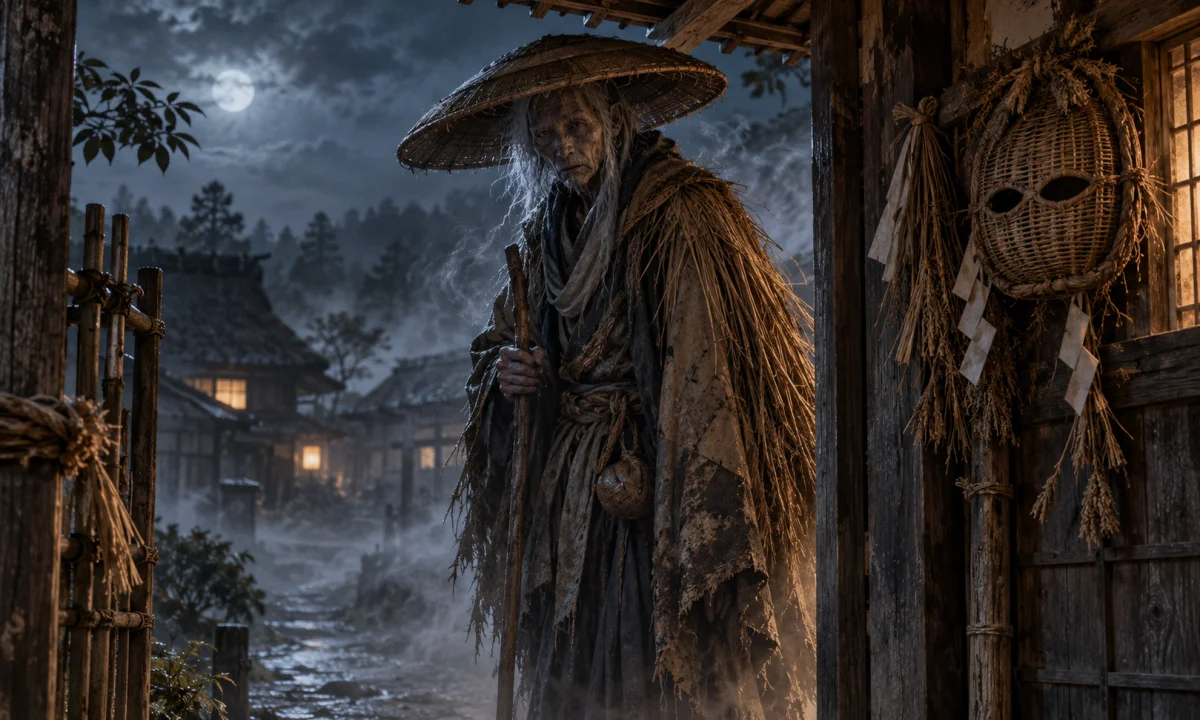
At first, Ōkuninushi cannot understand the visitor’s identity. Kuebiko’s recognition is significant. Kuebiko is traditionally represented as a scarecrow, a figure rooted in cultivated fields, yet he possesses universal knowledge because he stands in one place while observing everything that passes. His ability to identify Sukuna-bikona suggests that knowledge of the gods may come from unexpected and humble forms.
Partner of Ōkuninushi in establishing the land
After his identity is revealed, Sukuna-bikona joins Ōkuninushi in the work of organizing the land. This myth belongs to the broad cycle sometimes called the “land-making” or “land-development” tradition. Ōkuninushi is portrayed as a powerful deity involved in the formation, pacification, and governance of the earthly country, while Sukuna-bikona acts as his companion and specialist helper.
The two deities travel through the land and undertake work that makes it suitable for life. The surviving accounts speak generally of establishing the country and bringing order to it rather than providing a detailed map or a single sequence of engineering acts. Their partnership can be understood as a mythic explanation for the development of agriculture, settlement, social order, and knowledge of the natural environment.
In this partnership, Sukuna-bikona is not simply a subordinate assistant. His knowledge is indispensable. Ōkuninushi represents a major power of the land, while Sukuna-bikona contributes specialized understanding associated with healing, useful plants, ritual protection, and the management of dangers. The pair therefore embodies complementary forms of authority: broad lordship and precise practical knowledge.
Medicine, healing and protection from illness
The Nihon Shoki explicitly connects Ōnamuchi and Sukuna-hikona with the discovery or establishment of healing practices. They are said to have determined methods for treating disease and ways of protecting people from harmful influences associated with birds, animals, and insects. This does not describe medicine in the modern scientific sense. It presents health as part of a sacred system involving plants, ritual knowledge, environmental dangers, and the removal of pollution or misfortune.
Because of this role, Sukuna-bikona became closely associated with medicine and healing. His small size may also have contributed to an image of a deity who can enter hidden places, work with minute natural substances, or understand the unseen causes of illness. Those interpretations should be treated as symbolic or devotional developments rather than as explicit statements made by every ancient text.
His medical character overlaps with a wider East Asian tradition in which healing knowledge is attributed to divine or semi-divine teachers. In Japan, however, Sukuna-bikona remains a distinct Japanese kami with his own myths and relationship to Ōkuninushi. He is sometimes worshipped alongside foreign or continental medical figures, especially in later shrine contexts, but such pairings do not mean that the two figures originally had the same identity.
Hot springs, sake and agricultural knowledge
Later religious tradition also associates Sukuna-bikona with hot springs. One of the best-known legends connected with him concerns Dōgo Onsen in present-day Matsuyama, Ehime Prefecture. In the legend, Ōkuninushi and Sukuna-bikona visit the hot spring, and Sukuna-bikona becomes ill or weakened. Ōkuninushi places him in the healing waters, after which he recovers and dances joyfully on a stone or embankment. Details differ in retellings, but the story explains the spring’s curative power through the presence of the two gods.
This kind of legend does not function as a modern medical claim. It expresses the religious significance of hot springs as places where the boundary between natural power and divine healing is especially close. Springs, mountains, unusual rocks, and medicinal plants could all be understood as manifestations of sacred vitality.
Sukuna-bikona is also connected in various traditions with agriculture, useful plants, brewing, and the production of sake. These associations follow naturally from his role as a teacher of techniques that sustain human communities. They are not equally prominent in every early text, and local shrines may emphasize one aspect more than another. In one community he may be approached primarily as a healer; in another, as a protector of crops, a guardian of hot springs, or a deity of brewing and practical knowledge.
His departure to the other world
Sukuna-bikona does not remain permanently beside Ōkuninushi. After the work of establishing the land has been completed, he departs for Tokoyo no Kuni, often translated as the “everlasting land,” “eternal world,” or “land beyond the sea.” The location and nature of Tokoyo are uncertain. It may represent a distant otherworld, a realm across the ocean, or an idealized place outside ordinary human geography.
His departure introduces a note of loss into the land-making story. Ōkuninushi is left without his indispensable companion and laments that the country cannot be properly completed without him. This episode emphasizes how much the work depended on cooperation. It also reflects a recurring mythological pattern in which a culture-bringing figure arrives from beyond the human world, contributes essential knowledge, and then returns to a remote or sacred realm.
After Sukuna-bikona’s departure, the myths move toward another divine relationship involving Ōkuninushi and the deity Ōmononushi. The two figures should not be casually merged. Ōmononushi has his own identity, mythology, and major association with Mount Miwa. His appearance in the narrative follows the loss of Sukuna-bikona, but he is not simply Sukuna-bikona under another name.
Religious significance and shrine worship
Sukuna-bikona’s worship reflects the practical concerns of communities: health, survival, fertility of the land, safe travel through dangerous environments, and the preservation of specialized knowledge. His divine profile is particularly suited to a society in which illness could be attributed to natural causes, spiritual pollution, hostile forces, or a combination of these. A deity capable of treating disease and protecting the community would have broad religious appeal.
One notable modern shrine tradition is found at Sukunahikona Shrine in Osaka, located in an area historically associated with medicine and the pharmaceutical trade. The shrine venerates Sukuna-bikona together with Shennong, the ancient Chinese culture hero and deity connected with agriculture and medicine. Their joint worship illustrates the interaction between Japanese kami traditions and continental East Asian religious culture. It does not make Sukuna-bikona a Japanese version of Shennong; the two figures have different mythological histories.
Other shrines and local traditions may honor Sukuna-bikona with Ōkuninushi, particularly where stories of land development, healing waters, or regional foundation are important. His presence in worship is sometimes expressed through festivals, protective amulets, and prayers for recovery from illness. The exact practices depend on the shrine and should not be assumed to be universal.
Symbolism of smallness
Sukuna-bikona’s small body has several possible meanings. At the most direct level, it explains the form of his name and the memorable details of his arrival. At a symbolic level, it presents a reversal of ordinary expectations: a figure who appears insignificant possesses knowledge essential to the survival of the entire country.
His smallness can also suggest intimacy with the hidden and the easily overlooked. Medicines are often gathered from small plants or prepared in small quantities; disease may begin invisibly; agricultural knowledge depends on close observation of seeds, insects, soil, and seasonal change. These connections are interpretive rather than a complete ancient theory of the deity, but they help explain why a diminutive god could become associated with practical expertise.
The partnership with Ōkuninushi further strengthens this symbolism. Ōkuninushi is a large-scale figure of political, territorial, and earthly authority. Sukuna-bikona is physically tiny but intellectually and ritually indispensable. Their cooperation suggests that the ordering of society requires both visible power and specialized knowledge.
Distinction from Issun-bōshi and other small figures
Sukuna-bikona is sometimes compared with Issun-bōshi, the one-inch warrior of a later Japanese folktale. Both figures are unusually small, but they are not the same character. Issun-bōshi is a human-like tale hero who travels, seeks fortune, and eventually gains status through adventure. Sukuna-bikona is an ancient divine figure whose central role concerns land-making, healing, and sacred knowledge.
Small supernatural beings also appear in many other Japanese legends, including household spirits, yōkai, children of the gods, and miniature versions of familiar deities. Similar physical imagery does not establish a shared identity. Sukuna-bikona should likewise not be automatically equated with Ebisu, Ōmononushi, Shennong, or any other god whose worship may overlap with his in particular places.
Later reception
In modern Japan, Sukuna-bikona continues to appear in shrine worship, regional legends, discussions of Japanese mythology, and popular representations of deities with healing or pharmaceutical associations. His name is especially relevant in contexts connected with medicine and traditional religious culture.
Modern fiction may reinterpret him as a miniature supernatural character, a powerful being hidden behind a childlike appearance, or a figure connected with curses and healing. Such portrayals belong to contemporary popular culture and should not be treated as evidence for the ancient myths. The traditional Sukuna-bikona is best understood through his roles as Kamimusuhi’s small divine child, Ōkuninushi’s partner in establishing the land, and a teacher of healing and life-sustaining knowledge.