WORLD
WORLD
Somtup
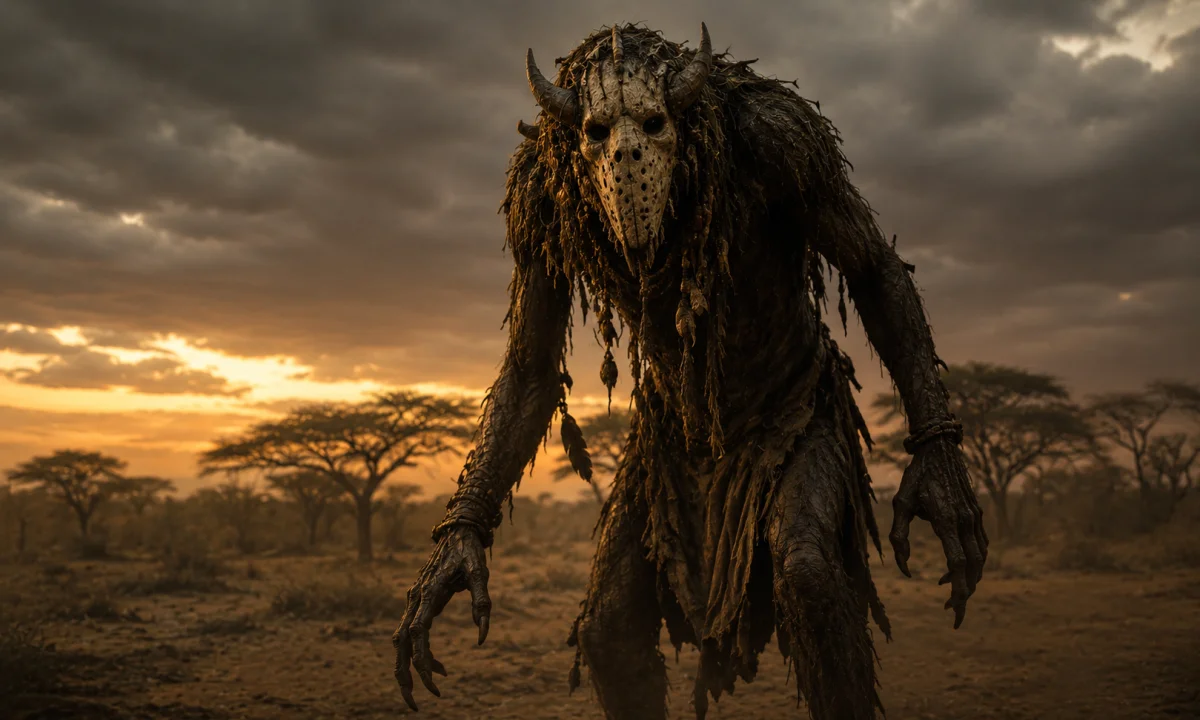
Somtup is not securely identifiable as a distinct figure in the documented mythologies of Africa. The name appears in some modern lists of “African mythical creatures” and mythology databases, but it is not supported by a clearly traceable traditional narrative, established religious cult, or consistently recorded African-language spelling. Its origin, meaning, cultural setting, appearance and supposed powers therefore remain uncertain.
The problem of identifying Somtup
Names from African oral traditions are often written in several different ways. Early European travellers, missionaries and colonial administrators commonly recorded unfamiliar words according to the spelling conventions of their own languages. A name could consequently acquire multiple forms when passed from one publication to another. Similar difficulties arise when an oral term is translated as “spirit,” “monster,” “god,” “devil” or “demon,” even though none of these English words may correspond exactly to the original idea.
In the case of Somtup, however, the difficulty is more fundamental. There is no widely recognised body of traditional material that establishes the name as belonging to a particular people, region or religious system. No generally accepted account identifies Somtup as a deity, ancestor, nature spirit, animal, monster or culture hero. Descriptions found in unsourced online collections are often brief, contradictory or repeated without a verifiable cultural context.
It is therefore unsafe to present Somtup as though it were a well-attested figure comparable to Anansi, Eshu, Nyame, Mami Wata, the orishas or the many creator and ancestral beings recorded in African religious traditions. Those traditions have identifiable communities, languages, stories, rituals and historical documentation. Somtup presently lacks that level of confirmation.
Africa is not a single mythological tradition
The label African mythology covers thousands of distinct societies and religious traditions. The cosmology of the Akan-speaking peoples of West Africa is not interchangeable with that of the Yoruba, Fon, Igbo, Kongo, Dogon, Maasai, Dinka, Shona, Zulu or Amazigh peoples. Even neighbouring communities may use different names and classifications for spirits associated with similar places or activities.
Traditional African religions frequently distinguish among creator beings, territorial spirits, divinities connected with natural forces, ancestors, the spirits of the dead, witches, dangerous beings and ordinary animals with unusual significance. These categories are not universal. A being described in English as a “monster” may be, in its original setting, a warning figure in a folktale, a personification of a dangerous place, an explanation for misfortune or an aspect of a much larger ritual system.
For that reason, a name cannot be interpreted responsibly without knowing its language, pronunciation, locality and narrative context. The absence of such information makes it impossible to determine what kind of being Somtup was supposed to be, if the name originated in a genuine traditional record at all.
Origins and surviving evidence
Most African mythological knowledge was transmitted orally. Oral tradition does not mean that a tradition is unreliable or ahistorical; it means that stories, prayers, genealogies and ritual knowledge were preserved through performance, memory and social practice rather than through a single canonical scripture. Specialists such as priests, diviners, elders, praise singers and storytellers could maintain extensive bodies of knowledge.
Written records were produced unevenly and often much later than the traditions they describe. A record may preserve a valuable account while still reflecting the recorder’s assumptions, translation choices or limited understanding of local categories. The strongest evidence for a mythological figure normally comes from several related forms of material: narratives recorded in a named community, indigenous-language terms, ritual references, accounts from multiple informants and evidence that the figure has a meaningful place in local religious or social life.
Such evidence has not been firmly established for Somtup. The name is not accompanied, in the material commonly circulated under that spelling, by a stable corpus of stories or by a documented community of worshippers. It is also unclear whether the word was copied from an older publication, altered during translation, confused with another name or created by a modern compiler.
Name, spelling and identity
The spelling Somtup should be treated as provisional. Without an identified source language, it is not possible to explain its etymology or to determine whether it represents a personal name, a title, a place-name or a descriptive term. The final consonant and the internal vowel sequence could have been shaped by the orthography of a European language, while the original pronunciation may have been different.
There is also no secure basis for assigning Somtup to a broad linguistic family such as Niger-Congo, Afroasiatic, Nilo-Saharan or any of the language groups of southern Africa. Doing so would be speculation. Nor is there adequate evidence to connect the name with a particular country. “African” is not an origin in itself; a meaningful identification would require at least a people, language area or historical record.
Some websites classify Somtup as a supernatural creature, while others may imply that it is a god or spirit. These classifications should not be treated as independent evidence. Online encyclopaedia entries frequently copy one another, and a repeated description can create the appearance of a tradition even when it ultimately derives from one unattributed modern listing.
Attributes and supposed powers
No consistent traditional description of Somtup can presently be stated with confidence. There is no securely established appearance, habitat, gender, family relationship, sacred animal, weapon, power or ritual function associated with the name. Claims that Somtup was a giant, a forest being, a water spirit, a demon or a guardian should therefore be regarded as unverified unless they are tied to a specific cultural record.
This distinction matters because African folklore contains many different kinds of supernatural beings associated with forests, rivers, mountains and the boundaries of settlements. A water spirit, for example, may be feared as a dangerous force, honoured as a source of wealth, approached through ritual specialists or understood as an ancestor-like presence. A forest being may represent the moral dangers of travelling beyond the community, while another may be connected with initiation, hunting or territorial authority. Assigning generic powers to Somtup would erase these differences rather than clarify them.
There is likewise no sound basis for saying that Somtup was benevolent or malevolent. African religious traditions often resist that simple division. A being may protect one community and harm trespassers, reward correct ritual behaviour and punish neglect, or possess both healing and destructive capacities. Moral interpretation depends on the story and the social relationship involved.
Stories and relationships
No widely attested story gives Somtup a definite role in the creation of the world, the origin of humanity, the ordering of the seasons or the founding of a royal lineage. There is no reliably documented relationship between Somtup and a major African deity, ancestral hero or trickster figure. In particular, the name should not automatically be associated with famous figures merely because both are described in general terms as spirits or supernatural beings.
Nor should Somtup be merged with African beings that have superficially similar descriptions. Numerous traditions tell of dangerous giants, shape-shifters, cannibal beings, serpents, river entities and spirits of the wilderness, but similarity of function does not prove identity. A motif may occur across many cultures because it expresses common human concerns—danger, death, hunger, isolation or the unknown—without implying that the figures share a historical origin.
How the name may have entered modern circulation
The most cautious interpretation is that Somtup may be a corrupted, isolated or modernly catalogued name whose original context has been lost. It could represent a transcription error, a mistranslation, a conflation of separate traditions or an entry that was copied from an earlier secondary source. At present, these possibilities cannot be ranked confidently.
Modern reference sites sometimes arrange names from many African cultures under a single category of “mythical creatures.” Such compilations can be useful starting points, but they often remove the information needed to evaluate a claim: the community concerned, the original spelling, the language, the date of collection and the distinction between folklore and religious belief. A short label can therefore outlive the evidence that once accompanied it—or appear to have evidence that was never supplied.
Popular fantasy also encourages the transformation of obscure names into discrete monsters with fixed appearances and abilities. An illustration, role-playing game entry or fictional encyclopaedia may give Somtup a body, habitat and powers for creative purposes. Those inventions belong to modern fiction, not to a demonstrable African tradition. Unless a particular adaptation is identified, no single modern depiction should be treated as authoritative.
Cultural significance of uncertainty
Uncertainty is not a judgement against African oral tradition. Many well-established African traditions were preserved for generations without written records, and the absence of a surviving text does not mean that a belief was unimportant. The problem with Somtup is the lack of enough information to identify which tradition, if any, the name represents.
Respectful treatment requires keeping the evidence separate from interpretation. It is reasonable to say that the name circulates in modern accounts presented as African mythology. It is not reasonable to claim, without further documentation, that Somtup was worshipped by a named people, lived in a particular landscape, possessed a specific physical form or played a defined role in ritual. Those claims would need support from identifiable traditional material.
Distinction from better-documented figures
Somtup should not be presented as another name for Anansi, the Akan trickster associated especially with spider imagery and storytelling; Eshu, a Yoruba òrìṣà whose roles include communication, crossroads and mediation; Mami Wata, a complex group of water-spirit traditions with varied regional histories; or any creator being such as Nyame, Olodumare or Unkulunkulu. These figures belong to particular cultural and religious contexts, even when their names and interpretations vary.
Until a reliable linguistic or ethnographic identification is found, Somtup is best described as an uncertain name in modern African-mythology catalogues, rather than as a confirmed god, demon or legendary animal. Any future identification would need to establish the original community, language, spelling and narrative or ritual setting before attributes could be assigned with confidence.