WORLD
WORLD
Nyame
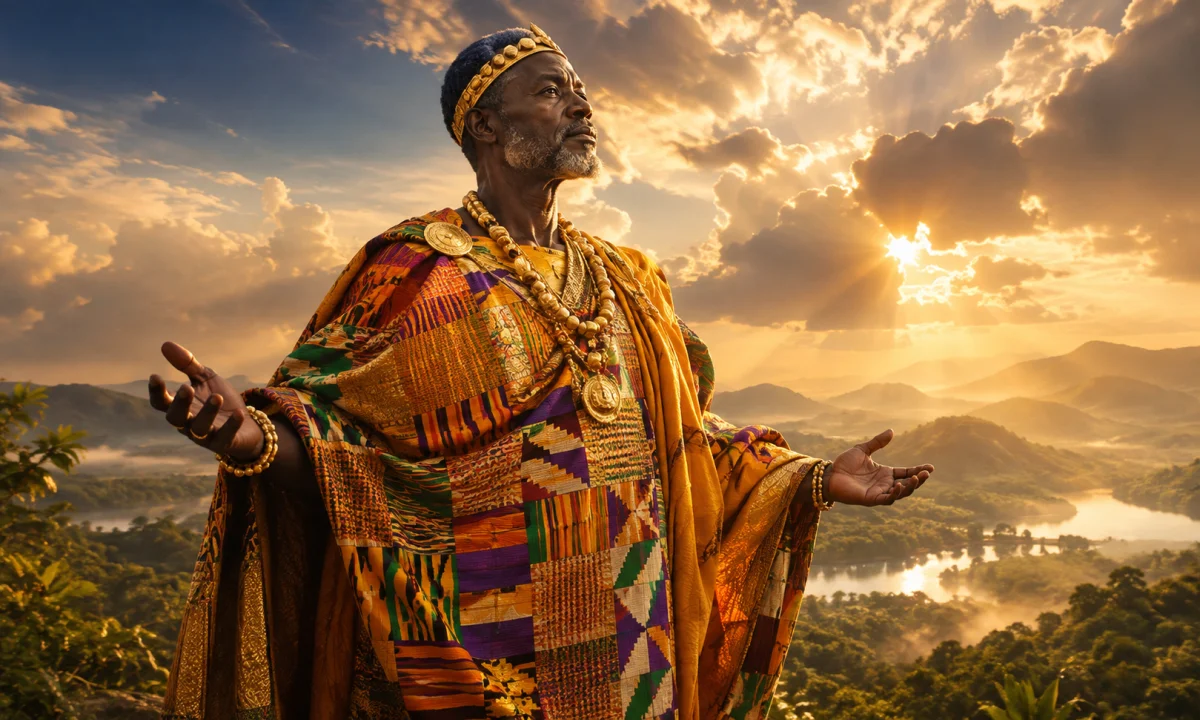
Nyame is the supreme creator and sky deity in many Akan religious traditions of West Africa, especially among Akan-speaking peoples in present-day Ghana and parts of Côte d’Ivoire. Akan religion is not based on one universally fixed scripture or a single standardized mythology. Its teachings have been transmitted through ritual, prayer, proverbs, oral narratives, family traditions and the authority of religious specialists. As a result, descriptions of Nyame can differ between Akan communities, languages and historical sources.
Nyame is commonly understood as the highest divine power: the source of creation, the ruler of the heavens and the ultimate authority over life and destiny. In many accounts, other spiritual beings have more immediate relationships with particular places, natural forces, ancestors or human communities, while Nyame occupies the highest position in the cosmic order. The deity is often approached through prayers and ritual specialists rather than represented by a human-like idol.
Akan cultural and religious setting
The Akan peoples include several related cultural and linguistic groups, among them the Asante, Fante, Akuapem, Akyem and Bono. Their traditional religious systems recognize a supreme deity together with numerous lesser divinities, spirits associated with natural features and ancestors who continue to influence the living. These elements are not necessarily separate religions in the modern sense. They form interconnected parts of a religious world in which the visible and invisible realms affect one another.
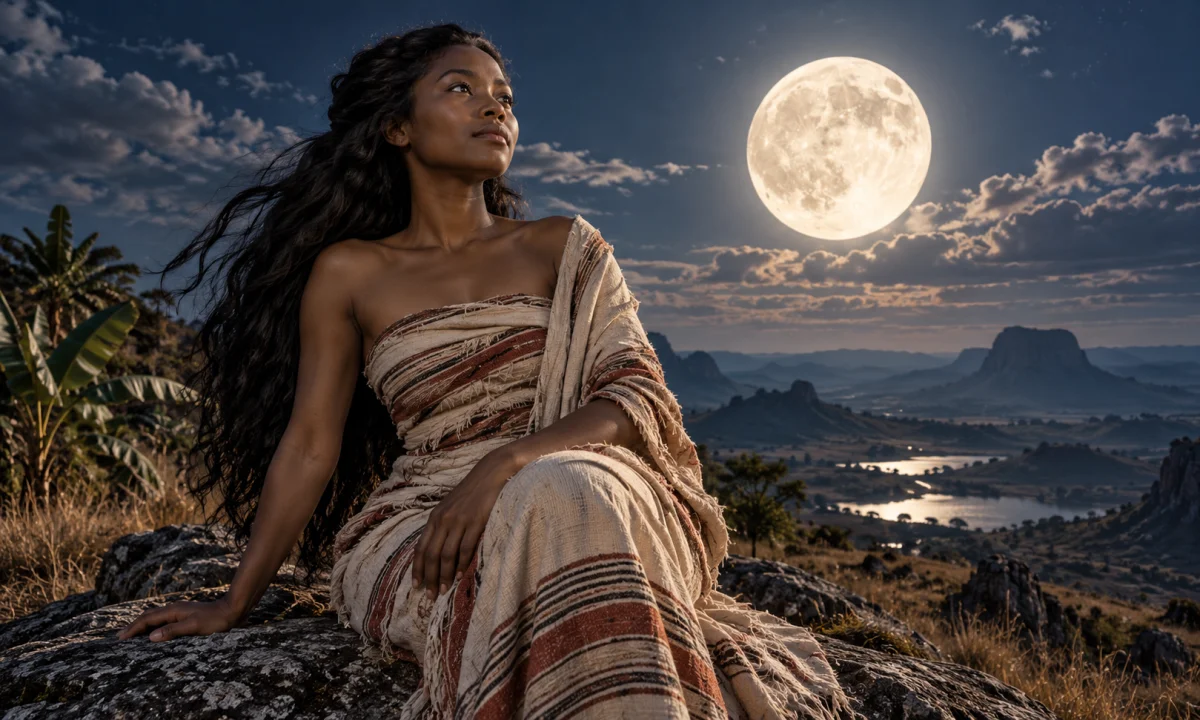
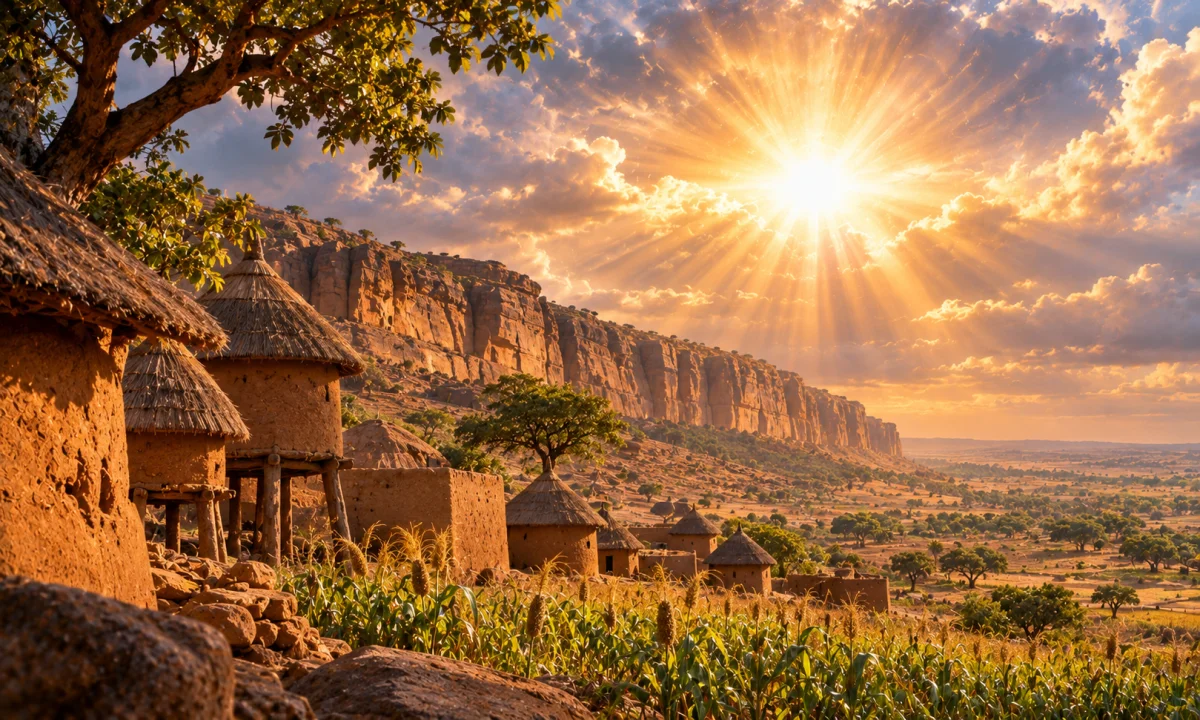
Nyame belongs to the highest level of this order. The deity is associated particularly with the sky, and the sky’s distance helps express Nyame’s transcendence. Rain, sunlight and the regular movement of the heavens can therefore be understood as signs of divine power, although Akan traditions do not reduce Nyame simply to a personification of weather. The deity is also connected with creation, life, moral authority and the general ordering of the world.
Traditional Akan religion has been preserved mainly through oral transmission. Prayers, praise names, stories, ritual practices, proverbial expressions and symbolic designs all provide evidence of how Nyame has been understood. Written descriptions produced by European missionaries, colonial officials and later anthropologists recorded some of these traditions, but they do not represent a single original text. Such records may also reflect the language, assumptions and religious categories of the writers who collected them.
Name, identity and classification
The form Nyame is widely used in Akan contexts for God or the supreme deity. The related form Onyame is also common, particularly in Twi-speaking usage. Other names and titles include Nyankopon and Onyankopon. Their exact use varies according to language, community, spelling conventions and the interpretation of individual scholars or religious teachers.
Some descriptions treat Nyame and Nyankopon as names or titles for the same supreme being. Other accounts distinguish them slightly, presenting one as a personal name and the other as an honorific or emphasizing different aspects of divine identity. These differences should not automatically be treated as evidence for separate gods. At the same time, it is unsafe to assume that every Akan community uses the names in precisely the same way.
The word Nyame is sometimes translated simply as “God,” but English translations can conceal important cultural distinctions. In a Christian context, “God” usually refers to the deity of Christian theology; in Akan traditional religion, Nyame belongs to a wider spiritual system that includes divinities, spirits and ancestors. Many Akan Christians also use Nyame or Onyame when speaking of the Christian God, so the word’s meaning depends on context.
Nyame as creator and supreme power
Nyame is generally described as the creator or ultimate source of the universe. Creation accounts do not always provide a systematic sequence of events. Instead, they often express the relationship between heaven, earth, humanity and the other powers of the world. Nyame’s authority is understood to extend beyond any individual locality or natural object, distinguishing the deity from divinities connected with rivers, forests, lakes, thunder or particular communities.
Nyame’s supremacy is also expressed through ideas of knowledge and judgment. The deity is often described as aware of human conduct and capable of rewarding, protecting or punishing. Akan religious thought places strong emphasis on social responsibility, truthfulness, respect for elders, obligations to family and proper relations with the spiritual world. Nyame’s authority is therefore not merely political or cosmic; it is also moral.
Descriptions of Nyame as all-powerful or all-knowing sometimes use theological language shaped by comparison with Christianity or Islam. Such comparisons can be useful when carefully qualified, but they should not erase the distinctive Akan setting. Traditional Akan understandings are conveyed through ritual and narrative rather than through a formal creed that defines every divine attribute in the same way.
Appearance and representation
Nyame does not have one fixed physical appearance shared by all Akan traditions. The deity is more commonly understood through titles, actions, natural signs and symbols than through a standard anthropomorphic image. The association with the sky gives Nyame a presence that is vast, elevated and not readily confined to a statue or human form.
One important symbol is the Nyame Dua, often translated as “God’s tree” or “God’s altar.” It is traditionally associated with a sacred forked post or tree placed near a house, shrine or settlement. The Nyame Dua can mark a place of blessing, prayer and spiritual protection. Interpretations vary, and the object should not be treated as a universal “image of Nyame.” It is better understood as a ritual sign of divine presence and a place where people may acknowledge God.
Another well-known Akan symbol is Nyame Ye Ohene, meaning “God is King.” It is represented in Adinkra design by a symbol expressing divine sovereignty. Adinkra symbols developed within Akan visual culture and are used on cloth, objects and other forms of artistic expression. The symbol’s popularity today has made it familiar far beyond the settings in which traditional religious meanings first developed, but its central message remains the supremacy of God.
Nyame and the earth
In many Akan traditions, Nyame is discussed alongside Asase Yaa, the earth deity. Asase Yaa is associated with the earth’s fertility, agriculture, moral order and the ground on which human life depends. Some accounts describe Nyame and Asase Yaa as a divine pair, while others emphasize their different functions without presenting a fixed marital relationship. The relationship between them varies across sources and should not be treated as a single universally accepted genealogy.
The contrast between sky and earth is religiously significant. Nyame’s heavenly position represents the remote and comprehensive authority of the creator, while Asase Yaa is connected with the immediate material basis of life. Farmers, families and communities have practical relationships with the earth, and respect for Asase Yaa can involve rules concerning farming, burial, oaths and the treatment of the land. Nyame and Asase Yaa therefore illustrate how Akan cosmology can connect a supreme heavenly power with sacred local and agricultural realities.
Stories of Nyame and the separation of heaven and earth
A group of Akan stories explains why the sky is now distant from the earth. In one widely circulated version, Nyame was once much closer to human beings. A woman pounding food, often described as pounding fufu, repeatedly struck or disturbed the sky with her pestle. Nyame moved higher and farther away to escape the blows. Other versions change the cause, the human character or the details of the separation.
This story is not necessarily intended as a literal account of cosmological history. Like many origin stories, it explains a present condition through memorable imagery: the distance between human beings and the supreme deity. It can also suggest that ordinary human actions have cosmic consequences, whether through carelessness, disrespect or the loss of an earlier closeness between heaven and earth.
Because the story has been recorded in different forms, no single wording should be treated as the definitive Akan version. The tale’s continued circulation demonstrates how oral traditions preserve a central idea while allowing performers, families and communities to adapt narrative details.
Nyame and Ananse stories
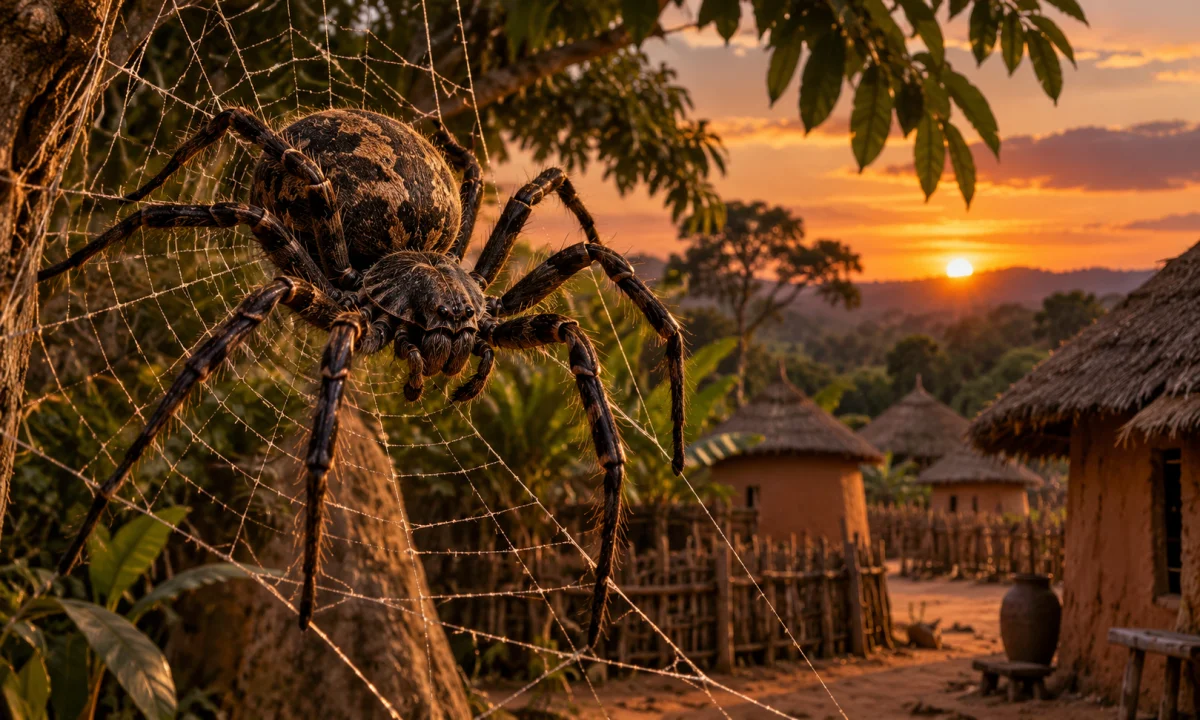
Nyame appears in a number of Akan folktales involving Ananse, the spider trickster. Ananse is one of the most important figures in Akan storytelling, and tales about him are often called Anansesem, or spider stories. These narratives are generally folklore rather than theological scripture. They may entertain, teach practical wisdom, expose greed or show how intelligence can challenge power.
In a well-known story pattern, Nyame possesses the stories of the world and sets a difficult price for them. Ananse agrees to obtain dangerous or elusive creatures, such as a leopard, hornets and a python, in order to gain access to the stories. Through planning, deception and an ability to exploit the habits of others, Ananse completes the tasks. Nyame then allows him to receive or control the stories, which become associated with Ananse’s name.
Details differ considerably between retellings. Some versions emphasize a contest between Nyame and Ananse; others present Nyame as the owner or guardian of stories who sets a test. The tales do not generally portray Ananse as equal to Nyame. Ananse is clever, ambitious and sometimes dishonest, but Nyame remains the superior cosmic authority. The contrast between divine power and trickster intelligence creates much of the story’s humor and moral tension.
The connection between Nyame and Ananse also helps explain why Akan storytelling has had such a strong cultural legacy. Through the Atlantic slave trade and the movement of Akan-speaking people, Ananse traditions influenced Caribbean and American traditions of Anansi or Anancy. The spider figure became especially prominent in Jamaica and other parts of the Caribbean. That later development concerns the transmission of folklore, not the replacement of Nyame by Ananse in Akan religion.
Nyame, lesser divinities and ancestors
Akan religious traditions commonly place Nyame above a range of other spiritual beings. These may include local or territorial divinities, river and lake powers, thunder-related beings, forest spirits and deities connected with particular communities. Their names, functions and status vary from one region to another. Some are served through shrines and priests, and some have close relationships with specific clans or settlements.
Ancestors form another important part of the religious landscape. They are not simply minor gods, and they should not be merged with Nyame. Ancestors are deceased members of a community who are remembered as continuing participants in family and social life. They may protect descendants, enforce moral expectations or receive ritual attention. Nyame, by contrast, is the supreme divine authority and creator. The two categories can be connected within ritual life without being identical.
In many accounts, people approach Nyame indirectly through prayer, praise and the mediation of other spiritual powers. This does not necessarily mean that Nyame is considered inaccessible or uninterested in human life. It reflects a religious structure in which different beings have different responsibilities and relationships with communities, landscapes and families.
Religious significance and interpretation
Nyame’s importance lies partly in the way the deity unites cosmic and ethical ideas. As creator, Nyame establishes the order in which the world exists. As ruler, Nyame represents ultimate authority. As a power associated with the sky, Nyame is beyond the immediate control of human beings, yet remains involved in the conditions that sustain life. These ideas help place human communities within a larger order that includes nature, society, ancestors and divine powers.
Scholars have sometimes compared Nyame with the supreme beings found in other African religious traditions. Such comparisons can reveal recurring themes, including a high creator deity, a network of more localized powers and a strong connection between religion and social ethics. However, similarities do not prove that the traditions are identical or that they all derive from one common figure. Nyame should be understood first within Akan languages, institutions, histories and ritual practices.
Missionary writers sometimes described Akan religion using terms such as “primitive monotheism,” suggesting that belief in a supreme deity represented an incomplete or corrupted form of biblical religion. That framework is now regarded as inadequate by many scholars because it imposes external categories and can undervalue the complexity of Akan religious life. The presence of other divinities and ancestors does not make Nyame’s supremacy meaningless; it reflects a different way of organizing relationships among spiritual beings.
Nyame in modern Ghanaian culture
Nyame remains a significant word and religious reference in modern Ghana. Akan speakers may use Nyame or Onyame in traditional prayers, Christian worship, personal names, proverbs and everyday expressions. The term consequently appears across both traditional and Christian contexts. Its presence in contemporary life does not mean that traditional Akan religion and Christianity are the same, but it shows how older religious vocabulary continues to function in changing cultural settings.
Adinkra designs, especially Nyame Ye Ohene, are now used internationally in clothing, jewelry, education and graphic design. Modern users may interpret the symbol broadly as faith in God, divine authority or spiritual protection. Those meanings can be connected to Akan tradition, but commercial and diasporic uses may simplify the historical context or detach the symbol from ritual settings.
Nyame is less prominent in global popular culture than Ananse, whose trickster stories have inspired books, plays, television, comics and other adaptations. When Nyame appears in modern retellings, the character may be reshaped according to the needs of fantasy, children’s literature or contemporary religious storytelling. Such portrayals should be distinguished from the varied oral traditions in which Nyame functions as the supreme Akan deity rather than as a conventional comic-book or fantasy character.