WORLD
WORLD
Shango
Shango, written more precisely in Yoruba as Ṣàngó, is one of the most important òrìṣà—sacred powers or deities—in Yoruba religious tradition. He is chiefly associated with thunder, lightning, fire, political authority, courage, justice and the force of the spoken word. Shango is especially connected with the historic Oyo kingdom in what is now southwestern Nigeria and parts of neighbouring Benin, although his worship and interpretation extend across many Yoruba-speaking communities.
Shango is understood in two closely related ways. In sacred tradition, he is an enduring divine power who governs thunder and receives worship. In many Oyo traditions, he is also remembered as a former ruler, usually identified with an Alaafin, or king, of Oyo who became an òrìṣà after death or through a dramatic transformation. These two aspects are not always separated: the historical king and the deity are joined in religious memory, while particular communities may tell the relationship between them differently.
Yoruba religious and cultural setting
Yoruba religion includes a supreme creator, often called Olódùmarè or Olórun, together with numerous òrìṣà who are associated with natural forces, social institutions, moral principles, ancestral histories and particular communities. The òrìṣà are not simply a fixed list of “gods” in the manner of a single standardized mythology. Their identities, stories and ritual importance vary by town, lineage, shrine and religious tradition.
Within this system, Shango represents concentrated power. Thunder is heard as a manifestation of his presence, and lightning is understood not only as a natural event but also as a sign of supernatural judgment or intervention. His worship has long been strongly associated with Oyo, whose rulers historically possessed major political and religious authority among Yoruba-speaking peoples. The Oyo connection helps explain why Shango is often portrayed both as a force of nature and as a powerful king.
Knowledge of Shango comes primarily through living oral and ritual traditions rather than through one ancient canonical book. Praise poetry, drum language, chants, divination traditions, royal histories, festivals, shrine practices and inherited narratives all preserve different aspects of his identity. Early European accounts and later ethnographic records provide additional evidence, but they were produced by outside observers and do not remove the variations found within Yoruba communities themselves.
Name and identity
The name is commonly written Shango in English, while Ṣàngó reflects Yoruba pronunciation and orthography. Other spellings include Sango, Xangô and Changó. The forms Xangô and Changó became especially familiar in Brazil and Cuba, where Yoruba-derived religious traditions developed in different historical circumstances.
Shango is classified as an òrìṣà, although English descriptions variously call him a deity, divine power, sacred being or god. “God” can be useful as a broad translation, but it may also suggest a religious system more uniform than Yoruba traditions actually are. Shango is not merely a personification of thunder. He has relationships, titles, praise names, ritual obligations and a distinctive moral and political character.
His identity is also expressed through praise names rather than through one universally fixed personal description. These names may emphasize his kingship, his strength, his ability to strike enemies, his association with fire or his command over thunder. The wording and interpretation of such praise poetry can differ between regions and religious lineages.
Appearance and sacred symbols
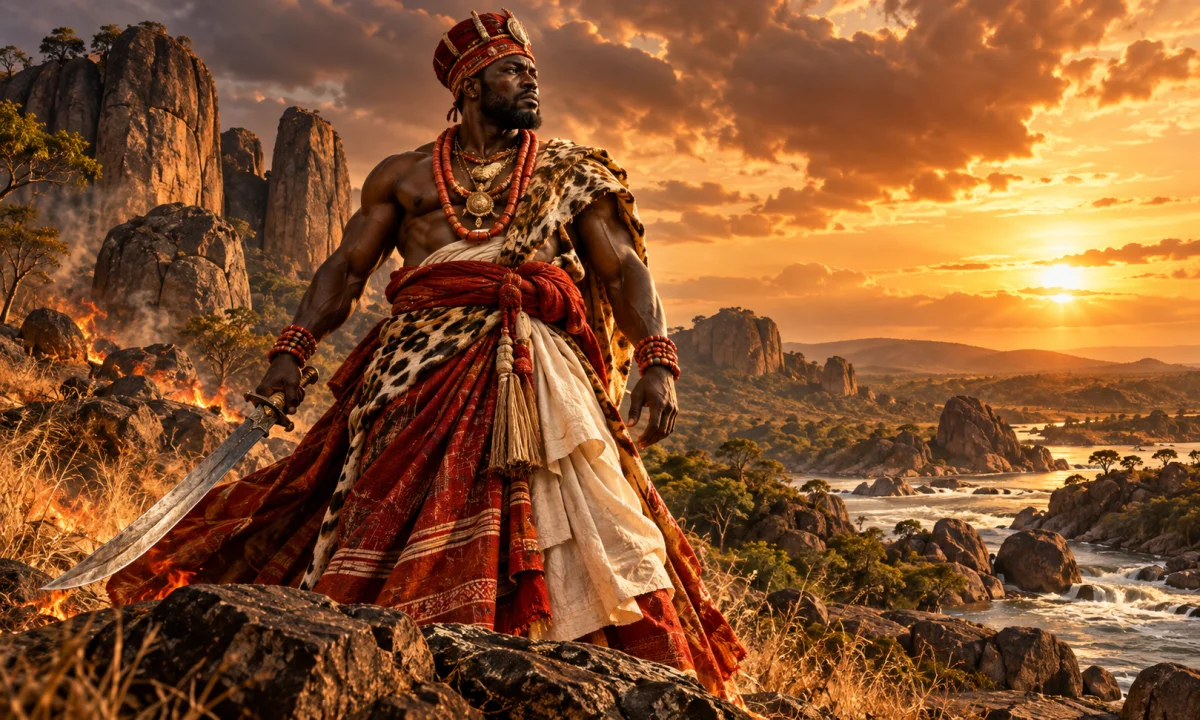
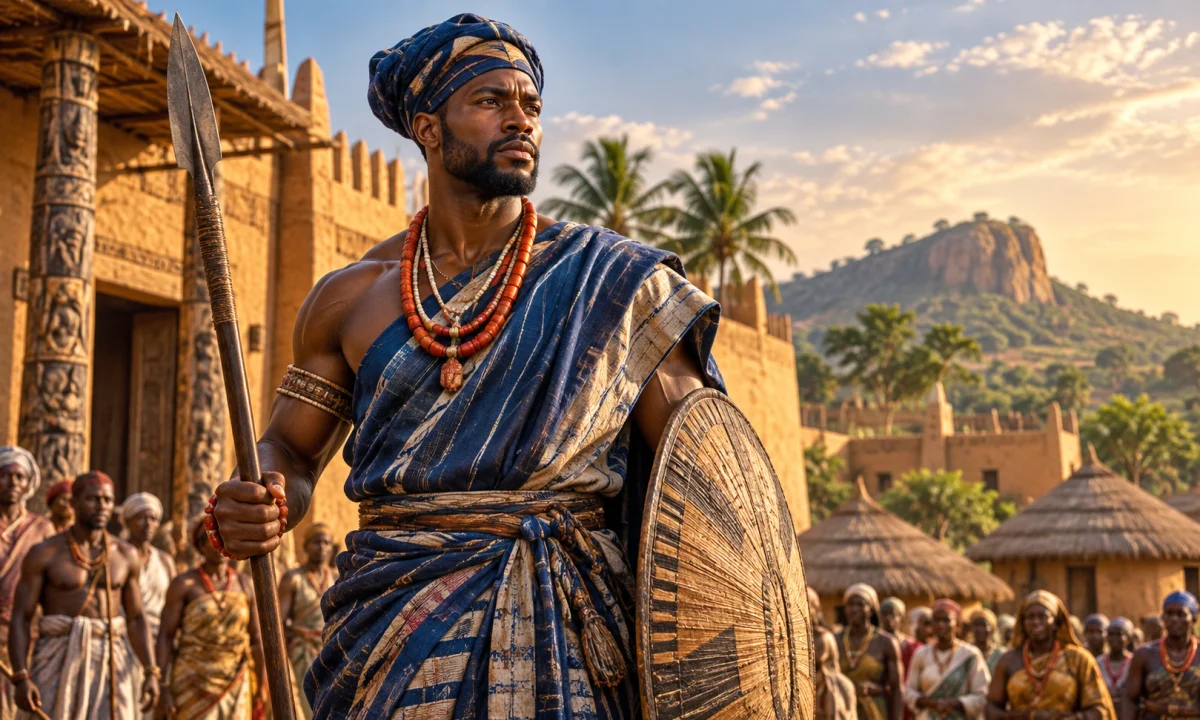
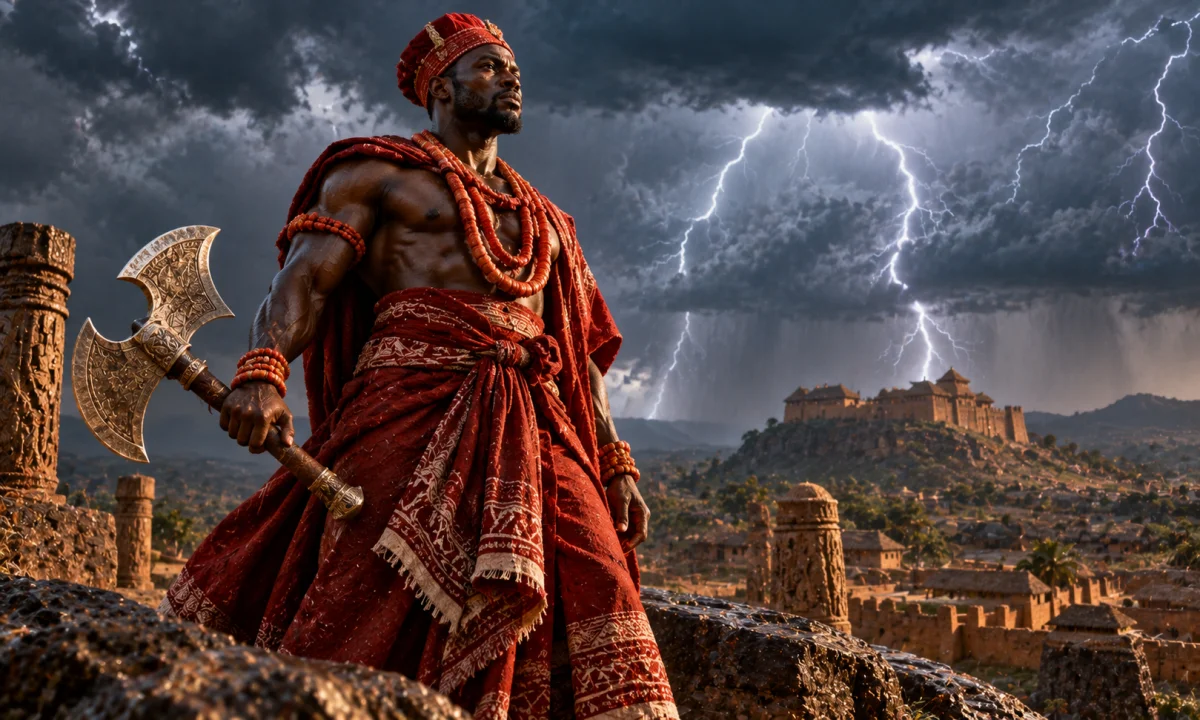
Shango is often represented with a powerful, regal or warrior-like appearance. Artistic images may show him holding an axe, wearing red and white clothing, or surrounded by signs of lightning and fire. Such images are interpretive rather than a single canonical portrait. Yoruba religious traditions have not depended on one standardized visual form, and shrine objects may carry meanings that are not obvious from an external image.
His most recognizable emblem is the double-headed axe, often called an oshe Shango. In carved form, the axe may have a central shaft with a symmetrical blade or human-like figure above it. It signifies his authority and destructive power, but it is not merely a weapon. The balance of its two heads has been interpreted in relation to judgment, power and the ability to strike in more than one direction. The exact meaning of an individual object depends on its ritual setting and the community that uses it.
Thunderstones, known in some Yoruba contexts as stones associated with lightning, are also connected with Shango. When lightning strikes the ground, stones or other objects found at the site may be treated as sacred manifestations and placed in a shrine. These objects are not simply “weapons thrown from the sky” in every interpretation; their significance belongs to local religious practice and to the sacred handling of lightning sites.
Red and white are strongly associated with Shango in many traditions. Red can suggest fire, vitality, authority and danger, while white may signify sacred power, clarity or the bright force of lightning. These meanings are not rigid colour codes applied identically everywhere. Ritual clothing, beads and shrine decorations may vary according to local custom.
Shango is also closely linked with bàtá drums, a family of double-headed drums used in Yoruba religious and musical contexts. Bàtá performance can communicate through tonal patterns that relate to Yoruba speech, and drumming may praise or address the òrìṣà. The association between Shango and the bàtá tradition reflects his importance as a ruler, dancer and master of forceful sound, not simply a modern decorative connection between drums and thunder.
Thunder, lightning and justice
Shango’s most prominent natural associations are thunder and lightning. In traditional religious interpretation, thunder can announce his presence, anger or authority. Lightning is sometimes understood as a divine strike against wrongdoing, especially offences that threaten the moral order or the community. This has contributed to Shango’s reputation as a figure of justice.
His justice is not necessarily equivalent to a modern legal system or to an abstract principle of impartiality. It is connected with authority, oath-taking, social responsibility and the punishment of serious violations. In some traditions, people accused of wrongdoing may be associated with Shango’s power through ritual processes. Such practices and interpretations differ, and historical accounts should not be treated as evidence that every Yoruba community shared one formal system of Shango justice.
Shango’s power is also morally ambivalent. Thunder can protect a community, but it can also destroy houses, trees and fields. His fire represents energy, kingship and creative vitality as well as danger. This combination is typical of many sacred figures associated with overwhelming natural forces: Shango is revered not because he is harmless, but because his power must be respected and properly approached.
Shango as king of Oyo
One of the best-known traditions identifies Shango with a former king of Oyo. The exact historical chronology is uncertain, and oral histories do not always agree about the sequence of rulers or the details of his reign. Shango is nevertheless strongly connected with Oyo kingship and with the political imagination of the Oyo Empire.
In these accounts, the king is a formidable ruler whose command over supernatural force reflects the authority of the throne. Some versions portray him as a powerful but dangerous leader whose experiments with magical or fiery power have disastrous consequences. In other versions, the emphasis falls on his military ability, charisma, sexuality, or capacity to defend and command his people. His transformation into an òrìṣà explains why the historical memory of a king can coexist with worship directed toward a divine being.
A frequently repeated narrative says that Shango’s power causes destruction in or near the royal capital. The details vary considerably. In some tellings, lightning or fire destroys the palace or harms members of the royal household. Shango then departs, disappears, or is believed to have hanged himself. The story may end with the discovery that he has not truly died but has entered another form of existence. In some Oyo traditions, the place called Koso becomes especially important in this connection, and Shango is associated with the expression that he has not vanished but has gone to Koso.
These stories should not be reduced to a single biography. They are sacred and political narratives, and their meanings can include the danger of unchecked authority, the transformation of a ruler into a divine ancestor, and the continued presence of royal power in the landscape. A version that emphasizes shame or destruction may coexist with another that emphasizes glorification and supernatural triumph.
Relationships with other òrìṣà
Shango is frequently described as the husband of Oya, an òrìṣà associated with winds, storms, transformation and the marketplace in many Yoruba traditions. Their relationship is especially prominent in Yoruba-derived religions in the Americas. Oya’s connection with powerful winds and storms complements Shango’s association with thunder and lightning, although the precise division of their powers varies by tradition.
Shango is also commonly associated with Oshun, known in Yoruba as Ọ̀ṣun, and with Oba, or Ọ̀bà. In stories from different communities, these figures may be described as his wives or as members of a royal household. Their relationships are not narrated identically everywhere. A well-known story involving Oba and Oshun, for example, is told in several forms and is often interpreted as a tale about rivalry, deception, beauty, power and the vulnerability created by competition for royal favour.
These relationships should not be treated as a single fixed family tree. Yoruba religious traditions contain regional variations, and stories may have different ritual purposes. The prominence of Oya, Oshun or Oba can also change when traditions are carried into new communities and reorganized under conditions of enslavement, colonial rule and religious secrecy.
Ritual and religious significance
Devotion to Shango may involve priests, initiates, shrine objects, drumming, dance, offerings, praise poetry and festivals. Ritual specialists serve as intermediaries between worshippers and the òrìṣà, although the precise forms of initiation and service differ among religious communities. Bàtá drumming and vigorous dance are particularly associated with Shango worship, expressing possession, royal energy and the audible force of thunder.
Shango’s devotees may wear red and white beads or clothing, but colour practices are not identical in all places. Offerings and ritual procedures are likewise determined by lineage and local authority. It is inappropriate to treat isolated objects—such as a double axe, a red garment or a drum—as complete explanations of the religion. Their meaning is established through relationships among people, shrines, ritual knowledge and the òrìṣà.
Shango’s significance also extends beyond weather. He embodies the potency of leadership, the danger of arrogance, the obligations of rulers and the possibility that political authority may become sacred. His stories invite reflection on the difference between legitimate power and destructive power, although the interpretation depends on the tradition and context in which a story is told.
Shango in the African diaspora
Yoruba religious traditions were carried across the Atlantic by enslaved Africans, especially during the period of the transatlantic slave trade. In the Caribbean and the Americas, Shango became part of distinct religious systems shaped by Yoruba heritage, local conditions, Catholic influence, other African traditions and the need to preserve worship under coercive regimes.
In Cuban Santería, also known as Regla de Ocha, he is generally called Changó. He is associated with thunder, lightning, drums, dance, masculine power and royal authority, and is commonly linked with the Catholic figure of Saint Barbara in devotional practice. This association is a historical form of religious correspondence, not evidence that Shango and Saint Barbara are the same figure in their original traditions.
In Brazilian Candomblé, he is widely known as Xangô. Xangô is one of the central òrìṣà in several religious houses, with ritual forms that reflect Yoruba-derived traditions as they developed in Brazil. He is commonly associated with thunder, justice, kingship, fire and the axe. Different terreiros preserve their own liturgical lineages, so descriptions of Xangô should not automatically be transferred to every Candomblé community.
The name Shango is also used for Yoruba-derived religious traditions in other parts of the Caribbean, including Trinidad and Tobago. These traditions are related through historical ancestry but are not interchangeable. Changó, Xangô and Shango belong to living religious worlds with their own authorities, ceremonies and interpretations.
Distinguishing Shango from similar figures
Shango should not be confused with Ṣàngó as a merely generic Yoruba word for thunder, with every historical king of Oyo, or with unrelated thunder deities from other African, European or American traditions. His similarities to figures such as Thor, Zeus or the Haitian lwa associated with thunder do not establish a common origin. Comparisons can be useful when discussing broad themes—lightning, kingship, storms or justice—but the traditions have different histories and religious structures.
Nor should Shango be reduced to a “god of war.” He can be portrayed as a warrior and powerful ruler, and force is central to his symbolism, but his primary associations are thunder, lightning, authority, justice, fire, music and the sacred memory of Oyo kingship. Modern fantasy and popular media sometimes turn him into a generic thunder warrior, which leaves out the ritual, political and historical dimensions of his Yoruba identity.