WORLD
WORLD
Oya
Oya is a major òrìṣà in Yoruba religious tradition, associated especially with wind, sudden change, storms, transformation and the boundary between the living and the dead. Her name is also written Ọ̀ya, while related traditions in the African diaspora use forms such as Yansan, Iansã and Oyá. She is widely understood as a powerful female divinity of movement and upheaval, but her identity is not defined by a single universal scripture or fixed mythology. Yoruba religious knowledge has been preserved through oral traditions, praise poetry, ritual practice, divination verses and regional accounts, so descriptions of Oya can differ between communities.
Oya in Yoruba religious tradition
Yoruba religion recognises a supreme creator, often called Olódùmarè or Olorun, together with numerous òrìṣà who connect divine power with the natural world, human society and particular forms of moral and ritual knowledge. The òrìṣà are not simply “gods” in the same sense as all figures in ancient pantheons. Their roles can include divine forces, ancestral powers, culture heroes and sacred patrons, depending on the tradition and context in which they are described.
Oya belongs to this sacred world as a force of motion and transition. Wind is an especially important image in accounts of her character: it cannot be held, may arrive suddenly, and can either refresh the land or become destructive. Storms likewise express her capacity to disturb established conditions. Oya therefore represents change that is not always gentle or predictable. She may be invoked in connection with courage, authority, protection, fertility, personal transformation and the ability to survive a crisis.
Her importance is not limited to weather. In many Yoruba and diasporic traditions, Oya is associated with the threshold of the cemetery and with the spirits of the dead. This does not make her identical with death itself. Rather, she is often portrayed as a guardian or controller of passages: the movement between life and death, one state and another, one settlement and another, or one phase of existence and the next.
Name and classification
The spelling Ọ̀ya reflects Yoruba orthography, including tone and underdot marks that are often omitted in English writing. The name may appear as Oya, Oyá or other forms in languages and religious systems outside Yorubaland. In Cuban Lucumí, she is commonly called Oyá or Yansá; in Brazilian Candomblé, the related form Iansã is widely used. These names reflect the transmission and adaptation of Yoruba religion in the Atlantic world.
The origin and meaning of the name are not explained in one agreed account. Some interpretations connect it with wind or with the Niger River, while others treat the name through praise names, oral etymologies or stories about her powers. A popular epithet, Ìyá Mésàn-án, means “Mother of Nine” in Yoruba and is often associated with Oya. Its explanation also varies. Some traditions connect it with nine children, nine aspects or the nine tributaries of the Niger River, but these interpretations should not be treated as a single settled doctrine.
Oya is sometimes described in English as a goddess, but òrìṣà is the more culturally specific term. “Goddess” can be useful as a broad comparison, yet it may obscure the ritual relationships, initiatory knowledge and regional differences that shape Yoruba religious life. Oya is a divine being with specific worship traditions, praise names, offerings and ritual associations, rather than merely a character in a fixed collection of myths.
Wind, storms and transformation
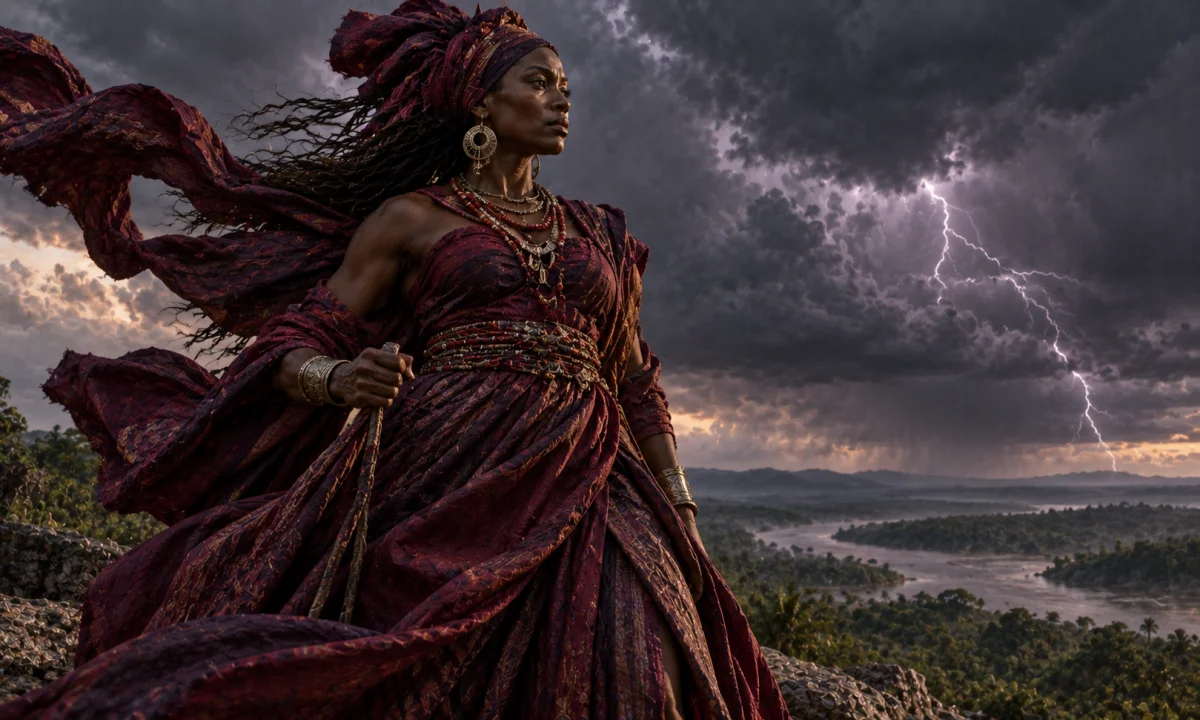
Oya’s most consistent natural association is the wind. In oral descriptions, she may arrive as a sudden gust, a powerful storm or a force that clears the air. Wind gives her an elusive quality: she is mobile, difficult to restrain and capable of crossing boundaries. Her power can be creative, because moving air brings change, but it can also be dangerous when joined with violent weather.
Oya is sometimes linked with lightning and thunder because storms may involve several natural forces at once. In Yoruba religious thought, however, the strongest and most specific association with thunder and lightning generally belongs to Ṣàngó. Oya may accompany or command storm winds in particular traditions, but she should not simply be reduced to a female equivalent of Ṣàngó or treated as the sole deity of lightning.
Change is one of the central ideas expressed through Oya. She is associated with moments when an old order has broken down and a new one has not yet fully formed. This can include political upheaval, emotional transformation, migration, bereavement and personal growth. Her symbolism may therefore be reassuring or alarming. Oya does not promise that change will be comfortable; her power suggests that resistance to necessary transformation can be more dangerous than transformation itself.
Death, ancestors and the cemetery
Many Yoruba-derived traditions connect Oya with cemeteries, burial grounds or the threshold of the dead. In Cuban Lucumí, she is especially known as a guardian of the cemetery gates and as a powerful presence in relation to the Egúngún, the ancestral dead. These associations developed through the wider history of Yoruba religious transmission and should not automatically be projected back as an identical practice in every Yoruba community.
The cemetery connection reflects Oya’s broader role as a keeper of boundaries. She stands at a place where the visible and invisible worlds meet. This does not mean that she is a demonic figure or an embodiment of evil. In Yoruba religious frameworks, death is part of a continuing relationship among the living, the dead and the unborn. Oya’s connection with the dead can therefore express guardianship, authority and controlled passage rather than fear alone.
In some diaspora traditions, Oya is represented with nine symbols, garments or ritual associations. The number nine is often connected with her title “Mother of Nine” and with her relationship to the dead. The exact interpretation, ritual use and symbolism vary by lineage. There is no single universal set of objects that defines Oya for every Yoruba or diasporic practitioner.
Relationship with Ṣàngó
Oya is frequently described as the wife or consort of Ṣàngó, the powerful òrìṣà associated with thunder, lightning, kingship, justice and political authority. Stories about their relationship are prominent in both Yoruba-derived traditions and the African diaspora. Oya may be portrayed as one of Ṣàngó’s wives, a trusted companion, or a formidable partner whose own power is essential to his success.
These stories should not be read only as domestic romance. The relationship can symbolise the interaction of storm forces, royal authority and complementary forms of power. Ṣàngó’s thunder and Oya’s winds may work together, while her independence prevents her from becoming merely an extension of his identity. In many accounts, Oya is decisive, martial and capable of acting on her own behalf.
Some traditions describe conflicts, separations or competition among Ṣàngó’s wives. Such narratives vary considerably in detail and should not be treated as a single canonical biography. They often serve to explore jealousy, loyalty, pride, political power and the danger of underestimating a strong woman.
Oya, Ogun and regional variants
Another group of stories links Oya with Ògún, the òrìṣà of iron, tools, hunting, warfare, roads and difficult labour. In some narratives, Oya has a relationship with both Ogun and Ṣàngó, or is connected to Ogun before becoming associated with Ṣàngó. The details differ between oral sources and religious lineages.
A well-known story says that Oya could transform herself into a buffalo. In versions of the tale, a hunter discovers her animal skin hidden near a body of water, takes it away or conceals it, and thereby prevents her from returning to buffalo form. Oya becomes his wife but later recovers the skin and leaves after instructing their children to call on her in a particular way. The story is sometimes connected to the origin of a powerful family line or to the recognition of Oya as an extraordinary being.
Different versions assign the discovery of the buffalo skin to different figures, including Ogun or another hunter. The story is best understood as a widespread motif with regional and religious variations rather than as evidence for one fixed sequence of events. Its themes include hidden identity, female autonomy, marriage negotiations and the danger of treating a powerful being as property.
The Niger River and water associations
Oya is often associated with the Niger River, which is called the Odo-Ọya in Yoruba. Some traditions explain the river’s name through a story about Oya, and she may be treated as a river divinity in particular communities. Her strongest general symbolism, however, concerns wind and transition, not water alone.
The relationship between Oya and the Niger should be described with care. Religious traditions may connect a river, a deity and a place through sacred history without offering a modern geographical explanation. Some accounts present Oya as the river itself, while others distinguish the òrìṣà from the physical river and connect them through naming, worship or myth. These interpretations are not identical, and local practice remains important.
Appearance, symbols and ritual imagery
Descriptions of Oya often emphasise motion, force and regal authority. She may be portrayed carrying a sword, cutlass or other weapon, reflecting her protective and martial character. A horsetail whisk, a symbol of authority in many Yoruba contexts, may also appear in representations of her. In some accounts she uses weapons to defend her community or to clear a path through danger.
Her colours vary according to religious tradition and lineage. Red, burgundy, purple, brown and related dark or fiery tones are commonly associated with her in diasporic representations, though there is no single colour scheme shared by all worshippers. Masks, swirling cloth, windblown garments and imagery of storms can express her movement and power.
The buffalo is one of her most important animal associations because of the transformation story. Some traditions also connect her with the antelope or other creatures of the forest, but these associations should not be combined indiscriminately. Ritual objects and offerings likewise vary. Religious practice is determined by community knowledge, initiation and divination, not by a general list of symbols taken from popular summaries.
Oya and women’s power
Oya is frequently understood as a figure of female authority. She is not passive, domestic or dependent on the men with whom myths associate her. Her stories portray her as a warrior, ruler, strategist, lover, mother and supernatural force. These roles may coexist without reducing her to any one of them.
Her connection with markets is also significant in some Yoruba traditions. Markets are places of exchange, communication, mobility and social negotiation, and Oya’s association with them fits her wider character as a power of movement and public life. The exact form of this association varies, and she should not be described as the universal or exclusive patron of all markets. In some contexts, market activity is connected more strongly with other òrìṣà or with particular local cults.
Oya’s femininity is therefore linked with strength, authority and unpredictability rather than with a narrow ideal of gentleness. Her presence can challenge social arrangements that appear permanent. At the same time, interpreting her only through modern ideas of “empowerment” can flatten the religious meaning of her worship. For devotees, she is not merely a symbol of independence but a sacred power approached through ritual obligations, lineage and respect.
Worship and religious transmission
Traditional Yoruba religious knowledge has been transmitted through priests, priestesses, elders, family traditions, divination and festivals. Praise poetry is especially important because it preserves names, actions and qualities through which an òrìṣà is recognised. Such poetry can contain compressed references that require specialised cultural knowledge; it should not always be read as literal biography.
The Atlantic slave trade carried Yoruba religious concepts to the Caribbean, South America and North America. There, Oya’s worship developed within religious systems including Lucumí or Regla de Ocha in Cuba, Candomblé in Brazil and related traditions elsewhere. The resulting forms are neither simple replicas of one another nor detached inventions. They preserve Yoruba elements while also reflecting new languages, local histories, other African traditions, Christianity and changing social conditions.
In Cuba, Oya is commonly known as Oyá or Yansá and is associated with wind, storms, the cemetery and the dead. In Brazil, Iansã is prominent in Candomblé and Umbanda, although the meaning and ritual position of the figure differs between houses and religious systems. These traditions may use Catholic correspondences, but such correspondences are historical adaptations rather than proof that Oya and a Catholic saint are the same figure.
Distinctions from similar figures
Oya should not be confused with Yemọja or Yemayá, who is strongly associated with motherhood and water, especially the sea in many diasporic traditions. Oya can have river associations, but her central imagery is wind, storm, transformation and the threshold of death.
She is also distinct from Ọ̀ṣun, associated with sweet waters, beauty, love, fertility and diplomacy, and from Obà, another female òrìṣà whose stories are often connected with marriage, sacrifice and the river. The relationships among these figures vary in different traditions, but they should not be merged simply because all are powerful female òrìṣà.
Oya is not the same as the Orisha of the Dead as a generic category, nor is she equivalent to every cemetery guardian in African or diasporic religion. Her connection with death is specific to her own religious identity and to the traditions that recognise her in that role. Comparisons with figures such as the Greek Hecate or other boundary deities may be suggestive, but they are modern comparisons, not evidence that the traditions share an origin.
Oya in modern culture
Oya appears in contemporary novels, poetry, visual art, music, theatre, spiritual writing and popular media. Modern creators often use her as an image of storms, revolution, Black womanhood, migration, grief, sexuality or personal transformation. These interpretations can be meaningful artistic engagements, but they are not automatically traditional teachings.
Modern representations sometimes combine Yoruba, Cuban, Brazilian, Caribbean and Afro-American elements into one composite version of Oya. Such blending reflects the global circulation of Yoruba-derived religions, yet it can obscure important differences in language, ritual and history. A careful description distinguishes the sacred traditions practised by communities from later symbolic or fictional uses of her name.