WORLD
WORLD
Oshe
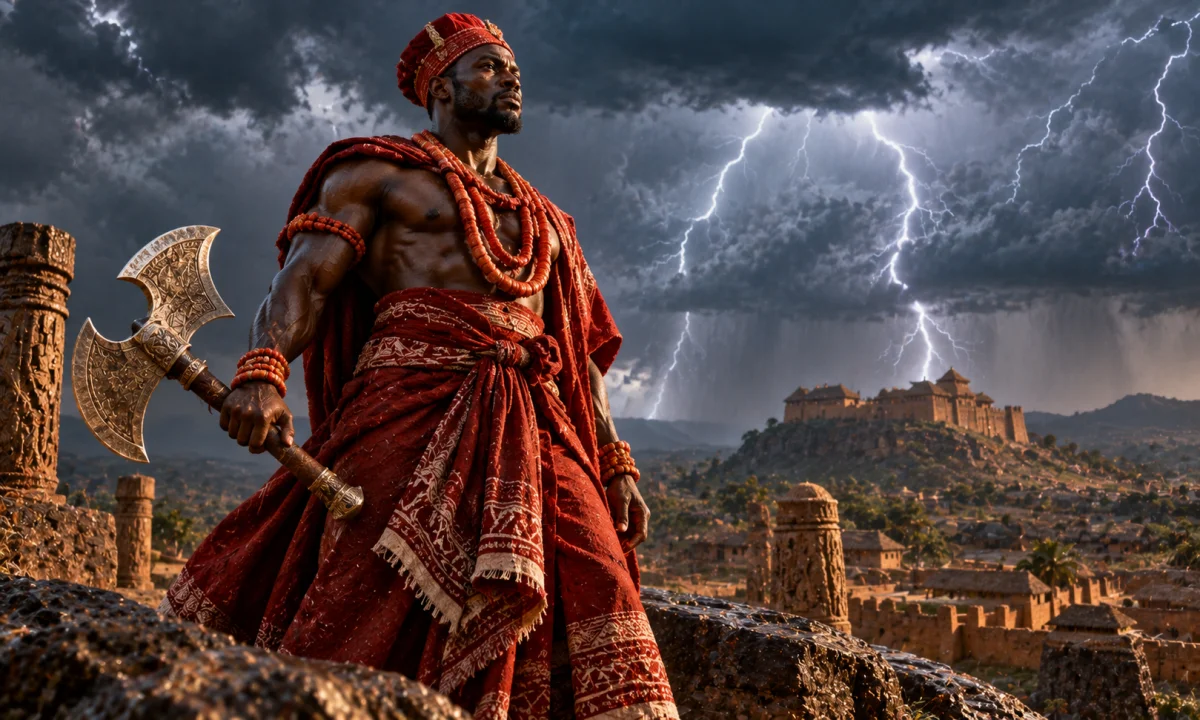
Oshe is usually the name given to the distinctive ritual axe or staff associated with Ṣàngó, the Yoruba òrìṣà of thunder, lightning, authority and warrior power. It is not generally understood in Yoruba religious tradition as an independent god or spirit. Rather, the oshe is an emblem, sacred object and visual expression of Ṣàngó’s presence. In museums, art history and popular writing, the object is often described as a “double-headed axe,” although its form and interpretation can vary.
Meaning and place in Yoruba tradition
Yoruba religion developed among the Yoruba-speaking peoples of West Africa, especially in present-day southwestern Nigeria and neighbouring areas of Benin and Togo. Its religious world includes a supreme creator, commonly called Olódùmarè or Ọlọ́run, together with numerous òrìṣà. These divine powers are connected with natural forces, human occupations, moral responsibilities, communities and particular historical traditions.
Ṣàngó, also written Shango or Sango, is one of the best-known òrìṣà. He is associated with thunder and lightning, but also with kingship, political authority, courage, sexuality, music, dance and the enforcement of justice. Yoruba traditions also remember Ṣàngó as a former ruler of Ọ̀yọ́ who became divine after death or after a dramatic transformation in the sacred history of the kingdom. Accounts differ in detail, and the relationship between the historical ruler and the divine Ṣàngó is interpreted in more than one way.
The oshe belongs to this complex of Ṣàngó symbolism. It can be carried in ritual processions, placed before a shrine, held by a priest or devotee, or represented in sculpture. Its presence identifies the power of Ṣàngó without making the object identical with the deity. As with many sacred objects, its importance comes from ritual relationships, consecration and religious knowledge rather than from its shape alone.
The name and its spellings
The name is commonly written oshe, oshé or ose in English-language writing. Yoruba orthography uses tone marks and underdots that are often omitted outside specialist or Yoruba-language contexts. Forms such as ọ̀ṣé may therefore appear alongside simplified spellings. The exact spelling is not consistent across museum catalogues, books, websites and communities in the African diaspora.
“Oshe” should not automatically be treated as the name of a separate mythological character. Some modern lists of gods and legendary beings present it as if it were a deity, but the better-established Yoruba usage refers to a ritual implement connected with Ṣàngó. The object may also be called Ṣàngó’s axe or staff in English. These translations are useful but incomplete, because an oshe is not merely a weapon in the ordinary sense.
Names and terminology can also vary between Yoruba communities and related religious traditions in the Americas. A similar-looking object may have a different ritual name or function in a particular lineage. Identification therefore depends on context, language, the design of the object and the tradition in which it is used.
Appearance and design
The most recognisable form of an oshe is a wooden staff or handle ending in a double-headed axe. The two blades usually curve outward in opposite directions, creating a symmetrical silhouette. Some examples are relatively simple, while others are elaborately carved and painted. The axe head may be fixed directly to a staff or integrated into a taller sculptural composition.
Many well-known oshe sculptures include a human figure beneath or supporting the axe. The figure is often female, sometimes shown standing with arms raised to hold the axe head. In other examples, the figure may be seated, kneeling or combined with additional symbolic forms. The presence of a woman is frequently connected by interpreters with Ṣàngó’s relationships to powerful female figures, with the role of women in sustaining religious authority, or with broader ideas of fertility and protection. These interpretations are not universal, however, and the meaning of a particular sculpture cannot always be established from its appearance alone.
Carving styles differ according to region, period, artist and intended use. A museum object made for a shrine is not necessarily identical to an object made for public display or collected during the colonial period. Some works have been removed from their original ritual setting, which can make their function and original interpretation difficult to recover.
The axe form is especially significant because Ṣàngó’s power is expressed through the imagery of thunder and lightning. Lightning strikes can split trees, destroy buildings and transform the landscape. The double blade may suggest force directed in more than one direction, while the balanced shape can evoke authority and controlled power. These are broad interpretive possibilities rather than a single universally fixed Yoruba explanation.
Relationship with Ṣàngó
Ṣàngó is commonly described as a thunder deity, but this description alone does not capture his role. He is also linked with the Ọ̀yọ́ royal past, judicial power, masculine vitality, dance, drumming and the dangerous consequences of uncontrolled anger. His followers honour him through particular songs, rhythms, colours, foods, ritual objects and forms of possession.
The oshe functions as one of his principal signs. When displayed or carried, it can indicate that Ṣàngó is being invoked or represented. In ritual contexts, it may participate in a network of objects rather than operate by itself. The shrine, the priest or priestess, offerings, drums, spoken formulas, garments and the presence of the worshipping community all contribute to the object’s significance.
In Yoruba religious thought, sacred objects are not simply illustrations of invisible beings. An object may be prepared, empowered and maintained through ritual practice. Its meaning is consequently relational: it connects a community with an òrìṣà, a lineage with its history and a ceremony with a particular form of divine presence. Treating an oshe only as an “idol” or decorative sculpture obscures this religious context.
Stories and sacred history
There is no single canonical Yoruba scripture that gives one definitive story of the oshe. Yoruba religious knowledge has historically been transmitted through oral tradition, ritual performance, praise poetry, divination literature, songs, historical memory and the teachings of religious specialists. Narratives about Ṣàngó consequently vary between communities and genres.
Many traditions connect Ṣàngó with the city and kingdom of Ọ̀yọ́. He is remembered as a powerful ruler whose temperament could be magnificent and destructive. In some narratives, a disastrous use of supernatural power leads to his departure, death or disappearance; in later sacred understanding, he becomes an òrìṣà associated with thunder and lightning. Other versions place greater emphasis on his divine nature from the beginning. The details are not identical across Yoruba sources or across retellings.
Stories also describe Ṣàngó’s relationships with other figures, especially Ọ̀ṣun, Ọya and Oba. These relationships are represented differently in different traditions and should not be reduced to one fixed family tree. Ọya is often associated with winds, storms, the Niger River and transformation; Ọ̀ṣun with rivers, beauty, fertility, diplomacy and healing; Oba with the historical and legendary traditions of Ọ̀yọ́. Their connections with Ṣàngó are important in many religious settings, but the stories have regional and lineage-based variations.
The oshe itself is not usually the protagonist of these narratives. Its importance comes from its association with the power, authority and identity of Ṣàngó. A story may mention the deity’s axe, thunder weapon or emblem without turning the object into a speaking or independent character.
Religious symbolism
Thunder, lightning and danger
The oshe’s axe head recalls the violent and sudden force attributed to Ṣàngó. Thunder and lightning are signs of divine power, but they are also dangerous natural phenomena. The symbol therefore carries both protection and threat. Ṣàngó can defend a community, punish wrongdoing and expose hidden misconduct, yet his power must be approached with discipline and respect.
Justice and authority
Ṣàngó is frequently associated with judgment and the punishment of falsehood. The axe can be read as an instrument that cuts through disorder or imposes authority. This does not mean that every oshe carries a simple moral slogan. Its significance is shaped by ritual use and by the broader understanding of Ṣàngó as a ruler and force of social order.
Gender and the supporting figure
The female figure found on many oshe sculptures has attracted considerable attention from historians of African art. She may be interpreted as a devotee, an attendant, a representation of a royal or spiritual relationship, or a symbolic bearer of divine power. There is no adequate basis for assuming that every female figure has the same identity.
The motif can also challenge assumptions that religious authority is represented only through a male deity. A sculpture of Ṣàngó’s emblem supported by a woman may express the indispensable role of women in religious institutions and ritual transmission. That interpretation is valuable, but it should be presented as an interpretive possibility rather than as a universally stated doctrine.
Ritual use and religious specialists
Oshe objects may be connected with Ṣàngó shrines and with specialists responsible for maintaining his worship. Depending on the setting, a priest or priestess may carry an emblem during a procession, dance with it, place it near a shrine or use it in a performance involving drums, praise poetry and possession. The precise procedure is not uniform, and public descriptions often leave out knowledge reserved for initiated practitioners.
Ṣàngó worship is especially associated with drumming and movement. The deity’s presence may be invoked through rhythms, chants and bodily gestures as well as through physical objects. An oshe displayed in such a setting is part of a living ritual system, not an isolated work of sculpture.
Some oshe carvings are made for religious use, while others are produced for artistic, commemorative or commercial purposes. A carved axe in a museum or private collection cannot automatically be assumed to have been consecrated. Conversely, an apparently plain object may have great significance within a particular shrine. Material appearance alone does not establish sacred status.
Historical evidence and interpretation
Knowledge of oshe comes from a combination of oral traditions, surviving religious practice, photographs, collected objects, museum records and the study of Yoruba art. Written documentation was often produced by outsiders, including missionaries, colonial officials, travellers and collectors. Such records can be useful, but they may misunderstand Yoruba categories or separate objects from the communities that gave them meaning.
Art historians have studied the formal qualities of oshe sculptures, including their symmetry, human figures, axe blades and relationship to other Yoruba shrine objects. Religious practitioners provide another kind of knowledge, grounded in worship, initiation and lineage. Neither an aesthetic description nor a general museum label is sufficient by itself to explain every object.
Interpretations should also allow for historical change. Yoruba religious traditions have adapted to political upheaval, Christianity, Islam, urbanisation, migration and the Atlantic slave trade. The meaning of Ṣàngó and his emblems has continued to develop in different communities without becoming identical everywhere.
Oshe in the African diaspora
Ṣàngó’s worship travelled across the Atlantic through the forced migration of enslaved Yoruba and other West African peoples. In the Caribbean and the Americas, he became known by related names such as Shango, Xangô or Changó. His traditions were preserved and reshaped within religious systems including Trinidadian Shango, Cuban Santería or Regla de Ocha, Brazilian Candomblé and other communities.
The forms, names and ritual meanings of Ṣàngó’s axe or related emblems differ among these traditions. A diaspora object resembling a Yoruba oshe should not automatically be classified as a direct replica. It may reflect local theology, artistic practice and historical experience. In some communities the axe remains a strong sign of thunder, kingship and justice; in others it forms part of a broader symbolic system with its own terminology and ritual rules.
These traditions are living religions rather than merely artistic survivals. Their practitioners may distinguish carefully between public representations and objects intended for ceremonial use. Discussions of oshe should therefore avoid treating African and diaspora forms as interchangeable.
Distinguishing Oshe from similar names and figures
- Oshe and Ṣàngó: Oshe is normally the axe or staff associated with Ṣàngó, whereas Ṣàngó is the òrìṣà and legendary ruler connected with thunder, lightning and authority.
- Oshe and Ọ̀ṣun: Ọ̀ṣun, often written Oshun, is a distinct òrìṣà associated especially with rivers, fertility, beauty, healing and diplomacy. The similar English spellings can cause confusion, but Ọ̀ṣun is not the oshe axe.
- Oshe and Ọ̀ya: Ọ̀ya is another distinct òrìṣà, frequently linked with winds, storms, transformation and the Niger River. She should not be identified with the female figure carved on every oshe.
- Oshe and a generic weapon: Although its form resembles an axe, an oshe is not simply a battlefield tool. Its religious meaning depends on its association with Ṣàngó and on the context in which it was made or used.
- Oshe and an independent spirit: The object is sometimes listed online as a separate Yoruba deity, but this classification does not reflect its more established role as Ṣàngó’s emblem.
Modern representation
Images of the double-headed axe now appear in exhibitions, textbooks, tourism materials, jewellery, tattoos and popular illustrations of African mythology. These representations can make Yoruba symbolism more widely known, but they often detach the oshe from shrine practice, oral tradition and the authority of religious communities.
Contemporary artists and designers may use the form to explore African identity, kingship, justice, resistance or diasporic heritage. Such creative uses are modern interpretations and should not be confused with the ritual functions of a consecrated object. The enduring significance of the oshe lies in its connection to Ṣàngó, whose worship remains part of living Yoruba and Afro-diasporic religious traditions.