WORLD
WORLD
Sanbai-sama

Sanbai-sama is a regional Japanese agricultural kami associated especially with rice cultivation, the beginning of the planting season, and the fertility of the rice fields. The name is also written or romanised in more than one way, including Sanbai-sama and Sambai-sama. Unlike famous figures from the Kojiki or Nihon Shoki, Sanbai-sama does not have one fixed mythology or a universally recognised place in the Japanese pantheon. The figure belongs primarily to local folk religion, where beliefs and ceremonies differed from village to village.
Origins in Japanese agricultural religion
Traditional Japanese village religion often treated the rice field as a sacred space. Rice was not only a staple food but also a central offering in shrine ceremonies, household observances, and seasonal festivals. The success of the crop depended on rain, sunlight, water management, soil, labour, and protection from pests and disease. These practical concerns were expressed religiously through local kami connected with mountains, waterways, fields, boundaries, and harvests.
Sanbai-sama is understood in this setting as a rice-cultivation deity, particularly one associated with rice planting. In many regional traditions, an agricultural kami was believed to move through the landscape according to the farming year. The kami might spend the winter in the mountains or in another sacred place, descend when the fields were prepared, remain near the rice paddies during cultivation, and return after the harvest.
This seasonal movement is closely related to the broader Japanese idea of the ta no kami, or “deity of the rice field.” The rice-field deity was not always imagined as a single named being. In some communities, the local agricultural kami was identified with a mountain kami in spring and autumn, or with a protective spirit belonging to the village. Sanbai-sama may therefore represent a local name or form of a wider agricultural religious pattern rather than an entirely separate deity with a single origin story.
The name Sanbai-sama
The exact meaning and origin of the name are not completely settled. The element -sama is an honorific, indicating respect for the being addressed. The first part may have regional explanations connected with rice planting, ritual cries, or local vocabulary, but no single etymology can safely be applied to every tradition using the name.
Spellings and pronunciations vary because many local beliefs were transmitted orally before being recorded. A name written with different Japanese characters may also acquire a different apparent meaning, while the same pronunciation can refer to related but not identical customs in separate areas. For that reason, Sanbai-sama should not be treated as a figure with a standardised name comparable to Amaterasu or Susanoo.
Some interpretations connect the name with the ceremonial act of calling down the agricultural deity before planting. Regional expressions for bringing a kami from the mountain or shrine into the fields are associated with rice-planting rites. However, the precise relationship between these expressions and the name Sanbai-sama depends on the locality. Claims that the name universally means a particular number, object, or divine genealogy are not supported by a single nationwide tradition.
Role in the agricultural year
Sanbai-sama’s most important role is linked with the transition from preparing the land to planting the rice seedlings. Before planting, a community might perform a ritual intended to welcome or invite the field deity. The rite could involve offerings, prayers, music, dance, sacred objects, or the first ceremonial planting of seedlings.
In this context, the deity’s presence made the paddy more than a cultivated plot. The field became a temporary sacred dwelling and the planting process became a religious act as well as agricultural labour. The first seedlings could carry particular importance because they symbolised the beginning of the entire crop. By honouring the deity at this moment, villagers sought good growth, adequate water, protection from misfortune, and a successful harvest.
After the rice had ripened and been gathered, some communities observed a closing ceremony. The field deity was thanked, sent away, or understood to return to the mountains or another place of residence. Such movements should not be assumed to occur in exactly the same manner everywhere. In Japanese folk religion, one village might speak of a mountain kami descending into the fields, while another might understand the agricultural deity as permanently connected with the paddy or village boundary.
Attributes and representation
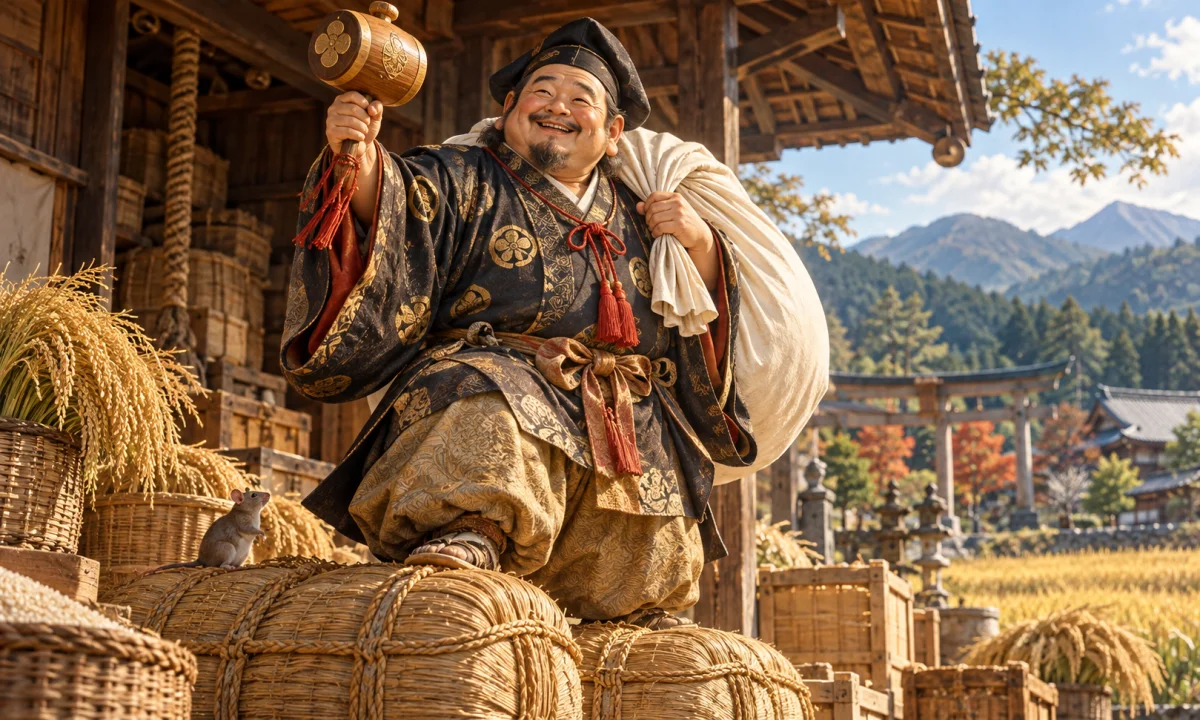
Sanbai-sama has no universally established appearance. Unlike many well-known mythological beings, the figure is not normally defined by a standard costume, animal form, weapon, or physical body. The deity’s identity is expressed more through ritual position than through a fixed visual image.
Where an agricultural kami was represented materially, the representation could be a simple sacred object, a temporary marker, a branch, a staff, or another item placed in or near the field. Such objects were not necessarily portraits of the deity. They could serve as a place for the kami to arrive, a sign of sacred presence, or a focus for communal attention. The exact forms differed according to local custom.
The deity’s powers are likewise practical and seasonal. Sanbai-sama may be associated with:
- the vitality and growth of rice seedlings;
- the fertility of the paddy and surrounding land;
- the arrival of a favourable planting season;
- protection of the crop from disease, pests, storms, and other dangers;
- the proper supply and movement of water; and
- the success of the harvest and the prosperity of the village.
These functions do not necessarily make Sanbai-sama a god of all agriculture. The strongest associations are with rice and the social world built around rice farming. Other crops, livestock, forests, rivers, and household activities had their own spirits, kami, or ritual protections.
Stories and local variants
There is no single canonical myth about Sanbai-sama. The traditions connected with the name are better understood as a collection of local practices and explanations than as one continuous narrative. A village may preserve a story about a deity coming down from a mountain, while another may emphasise an ancestral presence, a field guardian, or the sacred power of the first rice seedlings.
In some Japanese folk traditions, the agricultural deity is imagined as changing with the seasons. During the winter, it belongs to the mountain or another elevated sacred place. In spring, it descends to the cultivated land. After the harvest, it departs again. This pattern links the life of the kami with the agricultural calendar and with the movement between uncultivated mountain space and human-managed field space.
The mountain in these beliefs is not simply a distant wilderness. It can be the source of water, trees, game, and spiritual power. Rain and streams descending from the mountain make rice cultivation possible, so a mountain deity and a rice-field deity may be treated as two seasonal aspects of the same sacred presence. This helps explain why local communities could use different names or forms for agricultural protection without considering them contradictory.
Ritual specialists, village leaders, or farmers might take leading roles in ceremonies for the crop. In other places, women working as rice planters played an important part in the ritual dimension of planting. Rice cultivation required coordinated communal labour, and ceremonies connected the agricultural season with obligations among households. Sanbai-sama was therefore not only a supernatural protector but also part of the social organisation of the village.
Relationship to the ta no kami
The closest comparative category is the ta no kami, the rice-field or paddy deity. The two should not automatically be treated as separate gods. In one locality, Sanbai-sama may be a local name for the rice-field kami; in another, it may refer specifically to the deity’s appearance during the planting period or to the rite of inviting that deity into the fields.
Japanese folk religion often allows several names and identities to overlap. A kami may be understood through its dwelling place, seasonal activity, function, or relationship with a particular community. A mountain kami can become a field kami without being replaced by a completely different being. Consequently, comparisons with the ta no kami are useful, but they do not prove that every tradition of Sanbai-sama has exactly the same beliefs.
Distinction from similar names and figures
Sanbai-sama should not be confused with Sanbō Kōjin, also called Kōjin, a powerful kami associated in different traditions with the hearth, household, fire, land, and protection. The names may sound similar in English romanisation, but they refer to different religious contexts. Sanbō Kōjin has a more recognisable iconographic and institutional history, especially in Buddhist and Shingon-related traditions, whereas Sanbai-sama is primarily associated with local agricultural observances.
Nor should Sanbai-sama be automatically identified with Inari. Inari is a major Japanese deity or complex of traditions associated with rice, agriculture, fertility, prosperity, commerce, and fox messengers. Because both Inari and Sanbai-sama may be connected with rice, they can appear conceptually related. Nevertheless, a local belief in Sanbai-sama does not by itself indicate an Inari cult, and the two names should remain distinct unless a particular community explicitly equated them.
The figure should also be distinguished from generic terms such as tanokami, yama no kami, and ujigami. These terms describe broader categories or roles: the rice-field deity, the mountain deity, and a clan or community tutelary kami, respectively. Sanbai-sama may overlap with one or more of these roles in local practice, but the overlap is not a universal definition.
Religious and cultural significance
Sanbai-sama reflects a central feature of Japanese folk religion: the boundary between nature, agriculture, society, and the sacred is porous. A rice field is simultaneously a workplace, a source of food, a landscape shaped by water and weather, and a place where divine presence may be welcomed. The deity’s seasonal arrival gives religious meaning to tasks that might otherwise appear purely practical.
The tradition also expresses dependence on forces beyond human control. Farmers could prepare the land and maintain irrigation, yet they could not command the rain, prevent every disease, or guarantee a harvest. Rituals for Sanbai-sama acknowledged this vulnerability while strengthening cooperation within the community. The ceremonies helped establish when the farming season began, who took part, and how the village related to its surrounding landscape.
As rural life changed during the modern period, many agricultural rites declined, moved into shrine festivals, or survived as cultural performances rather than everyday religious practice. Mechanised farming, depopulation, altered land use, and the reduction of rice-growing communities all affected local observances. Even so, the ideas represented by Sanbai-sama remain important for understanding how Japanese communities traditionally connected seasonal work with sacred power.
Sanbai-sama in modern culture
Sanbai-sama is not a major recurring figure in internationally known Japanese popular culture. The name may occasionally be used in discussions of yokai, local deities, folklore, or rural supernatural beings, but such presentations can simplify a complex tradition. Treating Sanbai-sama as a monster, a standardised character, or a universal Japanese rice god would impose modern categories on a figure whose identity is regional and ritual.
When the name appears in contemporary writing, games, illustrations, or other adaptations, the portrayal should be separated from the older agricultural beliefs. A modern creator may give Sanbai-sama a defined face, personality, powers, or storyline for artistic purposes. Those features belong to the adaptation unless they can be connected to a particular documented local tradition. The traditional figure is better understood through the seasonal relationship among the kami, the rice field, the mountain, and the farming community.