WORLD
WORLD
Rímac
Rímac is best understood as a sacred river and an associated spiritual presence of the central Peruvian coast rather than as a clearly defined, universally recognized Inca god. The name belongs to the Quechua word rimaq, usually translated as “the speaker” or “the one who speaks.” It refers principally to the Rímac River, which descends from the Andes through the valley of Lima and reaches the Pacific. In religious traditions connected with the valley, the river could be treated as a living, powerful being and as a source of signs or messages. Later summaries sometimes present Rímac as a separate water deity, but the surviving evidence does not establish a single canonical biography, appearance or mythology for such a figure.
The Rímac River and its sacred setting
The Rímac River runs through one of the most important valleys on the central coast of Peru. Its waters supported agriculture in a region that is naturally arid, making the river essential to settlement, food production and political power. Long before the Inca conquest, communities in the Lima region constructed canals, fields, ceremonial buildings and settlements connected with the river and its tributaries.
The valley was not originally an exclusively Inca religious landscape. Several societies flourished on the central coast, including communities associated by modern scholars with the Lima cultural tradition and later with the Ychsma religious sphere. The famous sanctuary of Pachacamac, south of the Rímac Valley, became one of the most influential pilgrimage centres on the coast. When the Inca Empire expanded into the region, it incorporated existing sacred places and local cults into a wider imperial system rather than replacing every local tradition with a new one.
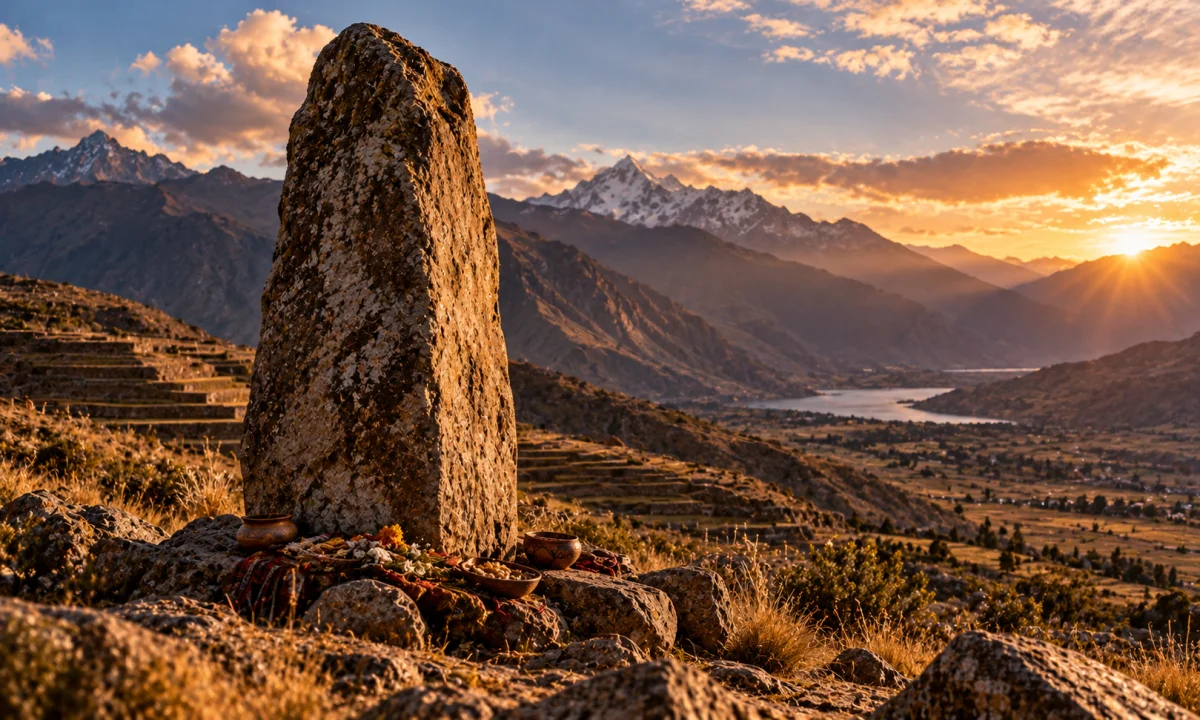
In this setting, the Rímac could possess religious importance because it was both a life-giving natural force and a feature of a populated sacred landscape. Andean religion commonly treated mountains, springs, rocks, fields, rivers and other places as huacas: beings or sites with sacred power. A huaca was not necessarily a god in the later European sense. It could be a natural feature, a constructed shrine, an ancestor, a mummy, an object or a place where supernatural power was concentrated.
The meaning of the name
Rímac is the Spanish spelling commonly used for the river and the modern district of Lima. The underlying Quechua form is generally given as Rimaq, derived from a verb meaning “to speak” or “to say.” The name is therefore often explained as “the speaker” or “the speaking one.” Spanish writing introduced considerable variation in the spelling and pronunciation of Quechua names, and the accent mark in modern Spanish does not by itself indicate how the word functioned in pre-Hispanic religious language.
The name has encouraged interpretations of Rímac as an oracle or prophetic power. In Andean traditions, a sacred place could “speak” through the words of a specialist, through ritual responses, through unusual natural events or through signs interpreted by religious authorities. The expression need not mean that the river was imagined as a human-shaped deity who literally spoke in ordinary conversation. It may instead describe its role as a source of divine communication, or refer to an oracle located near the river.
Because the name is also the name of the river itself, it is important not to assume that every reference to Rímac describes a distinct supernatural person. Some accounts may be speaking geographically, others ritually and others through a later mythological interpretation. The evidence is too limited to draw a firm boundary between the river, its huaca and an anthropomorphic “god of the Rímac.”
Rímac as a huaca or oracle
Colonial descriptions of Indigenous religion in Peru often use words such as “idol,” “god” or “demon” for beings and places that did not fit neatly into Christian categories. These accounts are valuable, but they were written after the Spanish conquest, usually by observers attempting to describe unfamiliar traditions through their own religious vocabulary. They also reflect campaigns against Indigenous ritual practices, during which sacred objects and ceremonies were questioned, condemned or deliberately destroyed.
Within this documentary context, Rímac is associated in some traditions with a speaking or oracular power. The association is consistent with the Quechua name and with the importance of sacred consultation in Andean societies. Political leaders, communities and pilgrims could seek guidance from huacas, ancestors and other powerful beings. Ritual specialists interpreted responses, omens and offerings, while the authority of a shrine could extend beyond the immediate settlement.
There is no securely preserved pre-Hispanic text presenting Rímac as a character with a fixed family, genealogy or sequence of adventures. Claims that identify Rímac as the son, brother or spouse of another major Andean deity should therefore be treated cautiously unless they can be tied to a specific local tradition. Popular mythology lists frequently assign relationships to Rímac that are not consistently supported by the colonial record or by archaeological evidence.
Attributes and religious associations
Rímac’s most reliable associations arise from the river and from the meaning of its name:
- Speech and communication: The name “the speaker” connects Rímac with utterance, revelation, oracular answers and the capacity of a sacred power to communicate with human communities.
- Water and fertility: The river supplied water in a dry coastal environment. Its religious importance would naturally have been linked with irrigation, crops, livestock, human settlement and the continuation of life.
- The valley: Rímac was not an isolated supernatural figure detached from geography. Its significance belonged to the river basin, its canals, cultivated land, settlements and shrines.
- Sacred power: As a possible huaca or sacred presence, Rímac could be approached through offerings and ritual attention rather than through a standardized image or temple system known across the entire Inca Empire.
- Natural force: The river’s changing flow, especially during periods of heavy rainfall in the Andes, could be beneficial or destructive. Such variability helped make rivers religiously significant in societies dependent on their waters.
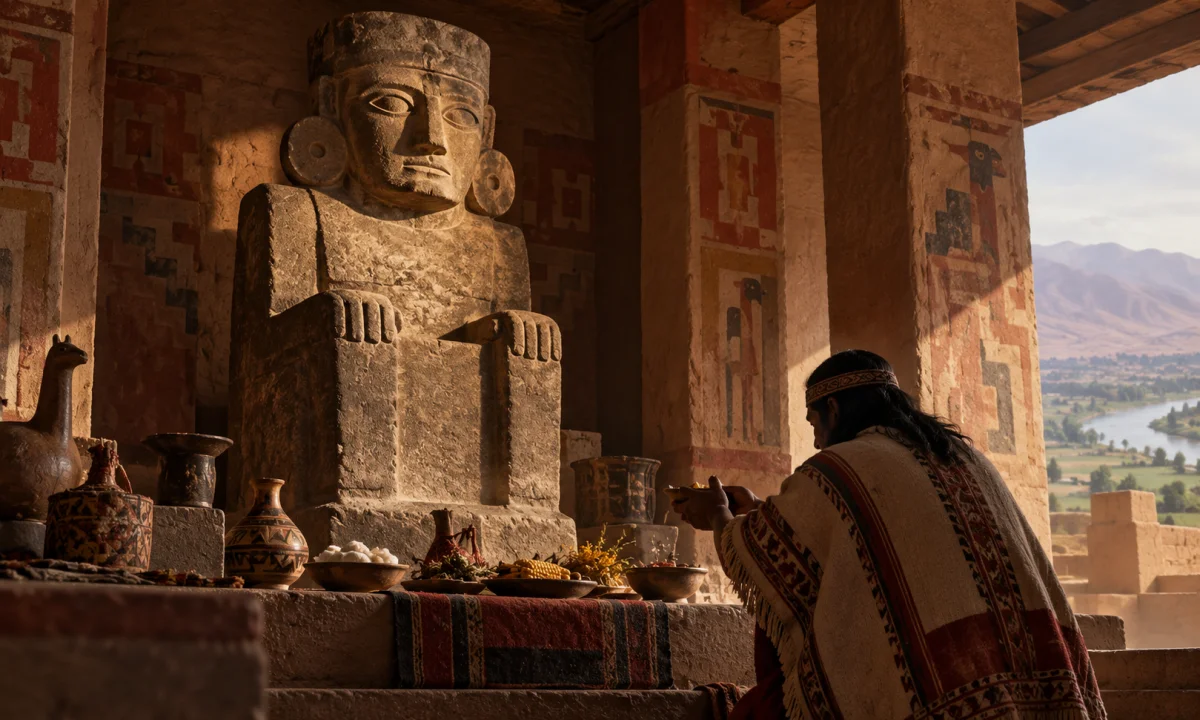
No reliable description establishes a standard physical appearance for Rímac. Images of a human figure carrying water, a bearded river god or a crowned Inca deity belong to modern artistic invention or generalized representations unless a particular historical tradition is identified. The surviving evidence supports a sacred river and an oracular association more securely than it supports a fixed iconography.
Rímac and Inca religious practice
The Inca state organized a large and diverse religious world. It honoured imperial deities such as the sun god Inti, maintained reverence for royal ancestors and incorporated many regional huacas into systems of pilgrimage, tribute and ritual administration. A local sacred power did not need to be transformed into a major imperial god in order to remain important. It could retain local authority while being placed within an imperial network of shrines and offerings.
The Rímac Valley was valuable to the Inca state for economic and strategic reasons, as well as for its religious geography. Irrigated coastal agriculture produced crops in a region where rainfall was scarce. Control of the valley meant control of water, farmland, labour and access routes. Sacred places associated with those resources could acquire political significance, especially when rulers sponsored offerings or claimed the right to supervise local ceremonies.
It would nevertheless be misleading to describe Rímac as one of the principal gods of all Inca religion. The Inca Empire included many local cults, and the same name or sacred place could carry different meanings in different communities. “Inca mythology” is often used broadly for the religious traditions of the Andes under Inca rule, even when a figure’s origin lies in a regional culture that predates or exists outside the imperial centre.
Stories and the limits of the evidence
Unlike better-known figures such as Viracocha, Inti, Manco Capac or Mama Ocllo, Rímac does not have a widely attested narrative cycle preserved in the major colonial accounts of Andean religion. There is no universally accepted story describing his or her birth, deeds, death or transformation. Nor is there a single ancient text that clearly defines Rímac as a male or female being.
Some modern retellings turn the river into a speaking person or a guardian of Lima. Others connect the name with stories about the creation of the valley, the origins of irrigation or the actions of neighbouring sacred beings. These stories may express genuine local memory, literary creativity or later attempts to give a personified form to the river. They should not automatically be presented as surviving Inca mythology.
Traditional Andean religion often allowed sacred places to be understood through multiple overlapping identities. A river could be a physical source of water, the dwelling or manifestation of a huaca, a landmark associated with ancestors and an object of political ritual at the same time. From a modern perspective, these categories may look separate; within an Andean religious landscape, they could coexist without requiring a single definitive mythological explanation.
Relationship to Pachacamac and other beings
Because the Rímac River lies near the sanctuary of Pachacamac, modern descriptions sometimes place Rímac within a family of coastal gods. The proximity is historically meaningful, but it does not prove that Rímac was a relative or subordinate of Pachacamac. Pachacamac was a major coastal deity and oracle whose influence extended over a broad area, while Rímac’s religious identity appears more closely tied to the river and the valley named after it.
Rímac should also not be automatically identified with Illapa, the Inca-associated power of thunder, lightning and rain. Water, storms and agricultural fertility are related themes, but the river’s name and local setting do not make Rímac another name for Illapa. Nor should Rímac be confused with Viracocha, the creator figure known from several Andean traditions, or with Mama Quilla, the moon deity of Inca state religion.
The term huaca is often a more precise classification than “god,” provided that it is used carefully. Rímac may refer to the sacred river itself, to a shrine or oracle associated with it, or to a personified local power connected with the river. These possibilities are related but not identical. Treating them as interchangeable can create a character who appears more clearly defined than the historical evidence allows.
Cultural significance in Lima
The Rímac remains one of the defining geographical features of Lima. The modern district of Rímac takes its name from the river, and the river continues to shape the city’s history, settlement patterns and public identity. Its waters have been used and altered by urban growth, while flooding, pollution and the reduction of natural river environments have affected its condition.
Contemporary references to Rímac often emphasize the river as a symbol of Lima’s Indigenous and pre-colonial past. Artists, writers and cultural organizations may personify it as a voice of the landscape or as a reminder that the modern capital grew within an older network of valleys, canals and sacred places. Such uses are culturally significant, but they are modern interpretations rather than proof of a complete ancient mythology.
Rímac therefore occupies an important position between geography and religion. The name preserves the idea of a “speaking” river, while the historical record points to a complex sacred landscape shaped by local coastal traditions, Inca incorporation and colonial reinterpretation. Its significance lies less in a fully developed pantheon entry than in the Andean understanding that rivers, valleys and other forces of the living landscape could possess agency, receive reverence and communicate powerfully with the communities that depended on them.