WORLD
WORLD
Mama Quilla
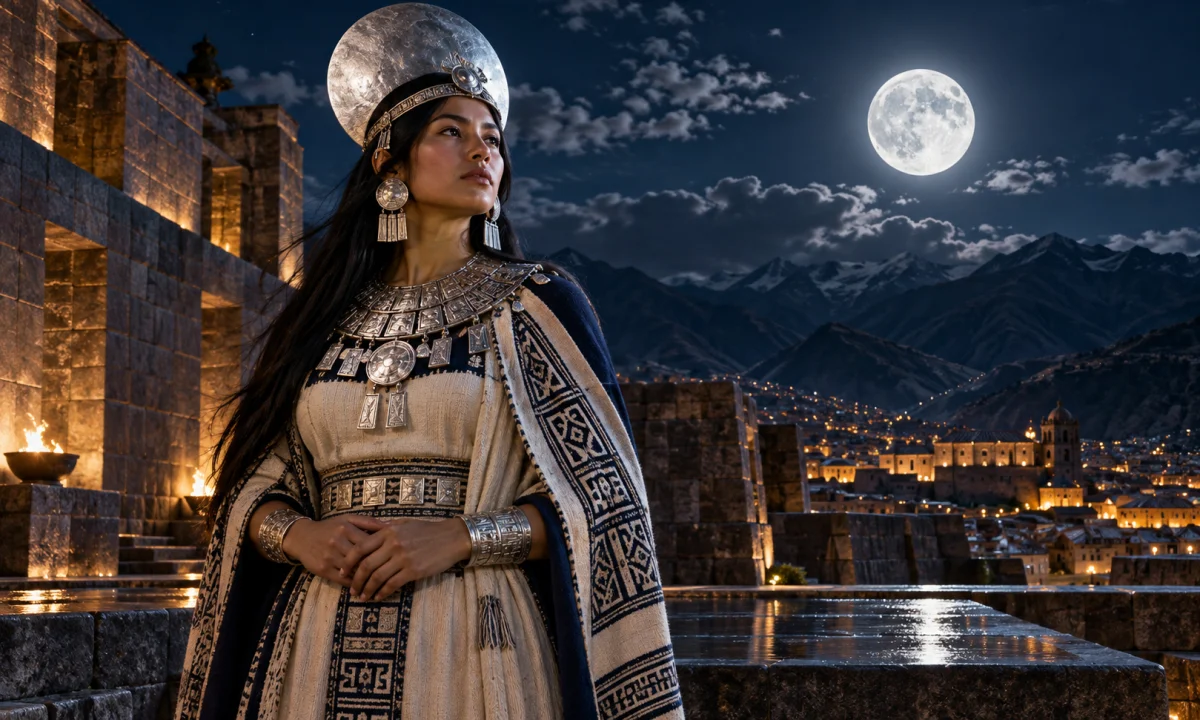
Mama Quilla, also written Mama Killa or Mama Quila, is the Inca moon goddess and the personification of the Moon. Her name is commonly translated as “Mother Moon” in Quechua, although spellings vary because the earliest written descriptions of Inca religion were recorded by Spanish-speaking observers using changing systems for representing Indigenous languages. Mama Quilla belonged to the religious world of the Inca state, whose centre was in the Andes and whose political heart was Cusco.
She was associated with the measurement of time, the organisation of the ritual calendar, women’s life cycles and the regulation of festivals. Colonial accounts often describe her as the wife or female counterpart of Inti, the Sun, and sometimes as the mother of important Inca ancestors. These descriptions are valuable but must be read cautiously: they were written after the Spanish conquest, by authors with different levels of access to Quechua traditions, and they do not always agree.
Mama Quilla in the Inca religious world
The Inca Empire, or Tawantinsuyu, united a large part of the Andes during the fifteenth and early sixteenth centuries. Its territories included areas of modern Peru, Bolivia, Ecuador, Chile, Argentina and Colombia. Religious life was not based on a single simple system. The imperial cult centred on powerful celestial and sacred beings, while local communities continued to honour mountains, springs, stones, ancestors and other beings known in Quechua as huacas or wak'as.
Within this wider religious landscape, the Sun received exceptional attention from the ruling dynasty. Inti was closely connected with the authority of the Sapa Inca, the emperor, and with the prosperity of the state. The Moon occupied a complementary but distinct position. Mama Quilla was not merely an inferior version of the Sun. Her changing appearance, recurring phases and relationship to the night gave her a particular importance in reckoning time and observing the heavens.
Inca worship involved temples, images, ritual specialists, offerings, processions and carefully timed ceremonies. The most famous sanctuary associated with the celestial cult was the Qorikancha, or Coricancha, in Cusco. Spanish descriptions of the sanctuary mention images or representations connected with major deities, including the Sun and Moon. The exact form and placement of these images are uncertain, because the temple was dismantled and transformed after the conquest, and surviving accounts do not provide a complete or consistent record.
Name and identity
Mama Killa is the form most closely reflecting modern standardised Quechua spelling, while Mama Quilla is a widespread Spanish-influenced spelling. The first element, mama, means “mother” in Quechua and in several neighbouring Andean languages. Killa commonly refers to the Moon and can also be connected with the lunar month or month as a unit of time. The name therefore conveys both maternal status and the celestial body that measures recurring periods.
In English-language writing, Mama Quilla is usually called a goddess. That description is convenient, but it should not suggest that Inca religion divided the world into categories identical to those of ancient Greek or Roman mythology. The Moon could be treated as a living sacred power, a cosmic person and an object of ritual attention at the same time. The boundaries between deity, ancestor, natural force and sacred manifestation were not necessarily fixed in the way modern categories imply.
Colonial authors sometimes present the Inca pantheon as though it were an orderly family tree. Such accounts can make relationships appear more uniform than they were in practice. The Inca state incorporated traditions from many regions, and different communities could have understood the Moon through their own local histories and ritual customs. Mama Quilla was important to the imperial religious system, but the evidence does not justify assuming that every Andean population worshipped her in exactly the same way.
Relationship with Inti
The most familiar description identifies Mama Quilla as the wife of Inti, the Sun. In this pairing, the Sun and Moon form a powerful celestial couple whose movements structure the visible sky. Some colonial traditions also call them the parents of the Inca people or of the first Inca rulers. Other accounts place the origin of the Inca dynasty in a different mythic sequence, involving Manco Capac and Mama Ocllo, or the Ayar brothers and their companions.
These stories should not be forced into one single canonical mythology. Inca origin traditions varied according to the chronicler, the informants consulted and the political setting in which a story was recorded. The relationship between the Sun and Moon is well established in descriptions of Inca religion, but the details of their marriage, children and role in human origins are less consistent.
The pairing also reflects a contrast between celestial functions. Inti’s regular course across the sky was associated with light, warmth, agriculture and imperial authority. Mama Quilla’s phases offered a different kind of rhythm. The Moon’s changing form made the passage of time visible at night and provided a way to organise months, ceremonies and observations of seasonal change. The two bodies were related, but they were not interchangeable.
Time, calendars and ritual observance
Mama Quilla’s most important practical association was with the measurement of time. Andean societies observed the movements of the Sun, Moon and stars in order to regulate agricultural activity and ritual life. The Inca state maintained a complex ceremonial calendar, although its exact structure is debated because Spanish accounts describe it in different ways and because some systems may have been regional rather than uniform.
Lunar phases helped mark the passage of months. The word killa itself is connected in Quechua with both the Moon and the month, showing how closely the two ideas were linked. The lunar cycle did not operate in isolation from solar observations. Agricultural seasons, solstices, planting and harvest required attention to the Sun and to local environmental conditions, while lunar observation contributed to the timing of ceremonies and the broader organisation of ritual time.
Colonial descriptions connect Mama Quilla with festivals held in her honour. The best-known was Coya Raymi, a ceremony associated with the queen, or coya, and with the Moon. Accounts of the festival differ in their details, but it was connected with purification, the removal of illness or disorder and the participation of women. Some descriptions place it during a period when the Moon’s role was especially prominent in the ritual calendar.
It is important not to treat every detail in colonial descriptions as a direct, unchanged record of pre-conquest practice. Spanish writers sometimes translated unfamiliar religious ideas into Christian or classical categories, and some accounts were written decades after the events they described. Nevertheless, the repeated association between the Moon, calendrical observance and women indicates that Mama Quilla had a significant ritual position.
Women, fertility and bodily cycles
Mama Quilla is often linked with women, marriage, fertility and menstruation. The lunar cycle and the menstrual cycle were commonly associated by European observers and by later interpreters of Andean religion. Some colonial accounts state that women appealed to the Moon or that the Moon had authority over female bodily processes. These associations are plausible within the wider symbolism of a female lunar power, but the surviving evidence is uneven and should not be presented as a fully documented universal doctrine.
Her title as “Mother Moon” expresses more than biological motherhood. It can signify protection, continuity, the generation of life and the dependable return of a cosmic rhythm. In an agricultural society, fertility had social, ecological and religious dimensions. The prosperity of households and communities depended on crops, animals, water, labour and favourable seasonal conditions. A lunar goddess could therefore be connected with human reproduction without being limited to that subject.
The connection with the coya also gave Mama Quilla a political dimension. The queen was a major participant in court ritual, and her symbolic relationship with the Moon complemented the Sapa Inca’s relationship with the Sun. This did not make the Inca state a simple system of equal male and female authority, nor does it prove that women held the same political power as men. It does show that imperial ritual represented the dynasty through a paired celestial order.
Silver, light and the night sky
Colonial accounts commonly associate the Moon with silver, just as the Sun was associated with gold. This contrast has often been repeated in modern descriptions of Inca religion. It reflects the visual distinction between the pale Moon and the bright Sun, as well as the importance of precious metals in imperial ritual and elite display.
Gold and silver were not simply “money” in the modern economic sense. They were prestigious materials with ritual and political significance. Gold was linked to the Sun and to the imperial centre, while silver could represent the Moon and her sacred presence. Some descriptions of Cusco’s temples speak of precious-metal ornaments and images, but the details of Mama Quilla’s image are uncertain. Claims that a specific surviving statue represents her should be treated carefully unless its identification is supported by reliable evidence.
The Moon’s phases may also have contributed to ideas of renewal and disappearance. Unlike the Sun, which appears broadly constant in its daily course, the Moon visibly grows, diminishes and vanishes from the night sky for a time. These changes made it a powerful symbol of recurring transformation. The evidence does not allow every symbolic interpretation to be stated as an official Inca teaching, but lunar change clearly formed part of the religious significance of observing the sky.
Eclipses and celestial danger
A lunar eclipse would have been an extraordinary and potentially threatening event. When the Moon darkened or reddened, Andean observers could interpret the event as an attack or affliction affecting a sacred being. Colonial sources describe rituals intended to protect the Moon, including noise-making and other acts directed at the apparent danger in the sky. The exact meaning and form of these responses vary in the records.
Some accounts explain an eclipse through the idea that a jaguar or another dangerous creature was attacking the Moon. This motif is sometimes presented as a fixed Inca belief, but the surviving descriptions are not completely consistent, and similar interpretations may have existed in different Andean traditions. It is safest to say that eclipses were treated as serious disturbances requiring ritual response, while the precise mythic explanation could vary.
Because the Inca ruler was closely connected with the Sun and the imperial order, unusual celestial events could have political as well as religious implications. A disturbance in the heavens might be read as a warning about the condition of the state, the dynasty or the wider relationship between human society and sacred powers. Such interpretations belong to the logic of an integrated ritual cosmos, not to a sharp division between “religion” and “astronomy” as separate fields.
Sources and historical limits
No extensive body of Inca religious literature survives in the form of pre-conquest books or scriptures. The Inca used systems of record-keeping including khipu, cords with knots and other encoded features, but the surviving khipu have not provided a complete written account of Mama Quilla’s myths. Most detailed information comes from Spanish colonial chronicles, Indigenous or mestizo authors writing under colonial rule, missionary works and later ethnographic comparisons.
These sources preserve important testimony, but they have limitations. Chroniclers differed in their descriptions of the Inca gods, used Spanish religious vocabulary to explain unfamiliar concepts and sometimes shaped their narratives to support arguments about imperial legitimacy, Christian conversion or colonial administration. Some authors had direct access to Indigenous informants; others relied on earlier reports or interpreted Andean religion through European models.
For that reason, statements about Mama Quilla should be distinguished by their level of certainty. Her identification with the Moon and her importance within the Inca celestial cult are well supported. Her association with Inti, women and the ritual calendar is also strongly represented in colonial descriptions. Detailed stories about her family, personality, temple image or specific actions are more variable and should not be treated as parts of one uncontested mythology.
Distinguishing Mama Quilla from related figures
- Inti: Inti is the Inca Sun deity. Mama Quilla is associated with the Moon. They are often described as a married or paired celestial couple, but they are distinct beings with different ritual identities.
- Pachamama: Pachamama is a major Andean earth and fertility power, especially prominent in later and continuing Indigenous traditions. She should not be treated as another name for Mama Quilla merely because both may be connected with fertility and agricultural life.
- Mama Ocllo: Mama Ocllo is an ancestral woman in important Inca origin traditions, often presented alongside Manco Capac. She is not the Moon goddess, although colonial writers and later popular accounts can blur ancestral figures and deities.
- Chasca: Chasca or Ch'aska is associated in colonial sources with a bright celestial body, commonly identified as the planet Venus, and sometimes with dawn or dusk. This figure is not simply another name for Mama Quilla.
- Quilla in other contexts: The word killa means Moon or month in Quechua, but every use of the word does not necessarily refer to a separate goddess or to the imperial deity Mama Quilla.
Continuing significance and modern representation
Mama Quilla remains recognisable in discussions of Andean heritage, Quechua language and Indigenous cosmology. Her name appears in educational materials, cultural projects, public art, festivals and contemporary writing about pre-Columbian religion. Modern Andean communities are diverse, and contemporary religious life may combine Indigenous practices, Catholic traditions and other forms of belief. A reference to Mama Quilla today does not automatically reproduce the religious system of the Inca state.
Modern popular culture sometimes presents Mama Quilla as a generic “goddess of the Moon,” giving her powers, costumes or dramatic family relationships borrowed from unrelated mythologies. Such portrayals may be creative adaptations rather than evidence about Inca tradition. A historically grounded depiction should preserve the specifically Andean setting of Mama Quilla: her connection with the Inca celestial cult, lunar timekeeping, women’s ritual roles, imperial ceremony and the changing night sky.