WORLD

Apocatequil
Apocatequil is a thunder and lightning deity associated especially with the Huamachuco region of northern Peru. Although commonly listed among the gods of Inca mythology, his worship appears to have been rooted in an older regional tradition that the expanding Inca state encountered and incorporated into its religious world. The evidence for Apocatequil comes mainly from early colonial descriptions, and those accounts preserve valuable traditions while also reflecting Christian criticism, Spanish interpretation and uncertainty about Indigenous names and beliefs.
Name and identity
The name appears in several forms, including Apocatequil, Apu Catequil and Catequil. The first element may represent apu, a Quechua title meaning something like “lord” or “powerful one,” while Catequil is generally treated as the deity’s personal or regional name. Because Spanish writers recorded Indigenous words according to their own spelling conventions, the exact original form and meaning remain uncertain.
Some sources treat Apocatequil and Catequil as the same figure, with “Apocatequil” meaning “Lord Catequil.” Other discussions use the names less consistently, sometimes presenting Apocatequil as a distinct Inca thunder god and Catequil as the older Huamachuco deity. There is no secure evidence that two separate gods were universally recognized. The safest interpretation is that the names are closely connected and often refer to one major northern Andean deity, while acknowledging that colonial descriptions do not provide a completely consistent classification.
Catequil was not simply a personification of ordinary weather. In the religious setting of the northern Andes, thunder, lightning, rain and mountain power were closely related. A deity who controlled storms could influence crops, herds, springs and the general prosperity of a community. Such a god could also be feared as a destroyer, since lightning, hail and violent storms threatened settlements and fields.
Regional origins and Inca context
The strongest traditional association of Apocatequil is with Huamachuco, a highland region in what is now northern Peru. The deity’s principal sanctuary was connected with a mountain or hill known as Catequil, near the ancient Huamachuco area. The site functioned as a place of worship and consultation, and the god appears to have possessed an important oracle.
Huamachuco had its own religious traditions before the area was brought under Inca rule. This matters because “Inca mythology” can give the impression that every deity in the imperial religious system originated in Cuzco. In practice, the Inca state incorporated many local gods, sacred places and ancestral traditions. Some were identified with Inca deities, placed within an imperial hierarchy or connected with the official cult of the sun. Others retained strong local identities.
Apocatequil is best understood in this wider setting: a powerful regional god whose cult became known within the Inca sphere. His prominence does not prove that he was originally a god created by the Inca state. Nor does the survival of his worship in a colonial account show that every community across the Andes understood him in the same way.
Surviving evidence
Knowledge of Apocatequil comes from Spanish colonial writings produced after the conquest of Peru. The most important material is associated with descriptions of Huamachuco and its religious traditions, including an account produced by an Augustinian missionary or missionaries in the sixteenth century. Other colonial writers discuss Andean thunder gods more generally, but they do not always distinguish local deities clearly.
These records must be read carefully. Missionaries often described Indigenous gods as “idols,” demons or false divinities, and Spanish observers sometimes forced unfamiliar religious ideas into categories borrowed from Christianity or classical mythology. Translators may also have supplied names or explanations that were not exact equivalents of the original traditions. At the same time, colonial records sometimes preserve myths, ritual details and local names that would otherwise have been lost.
Archaeological remains at places associated with Catequil demonstrate the importance of highland ceremonial centres in the region, but archaeology cannot by itself identify every belief connected with the deity. Nor can a surviving temple layout provide a complete biography or appearance. Descriptions of Apocatequil therefore combine limited historical testimony with cautious interpretation rather than offering a single, fully preserved mythology.
Role as a thunder and lightning god
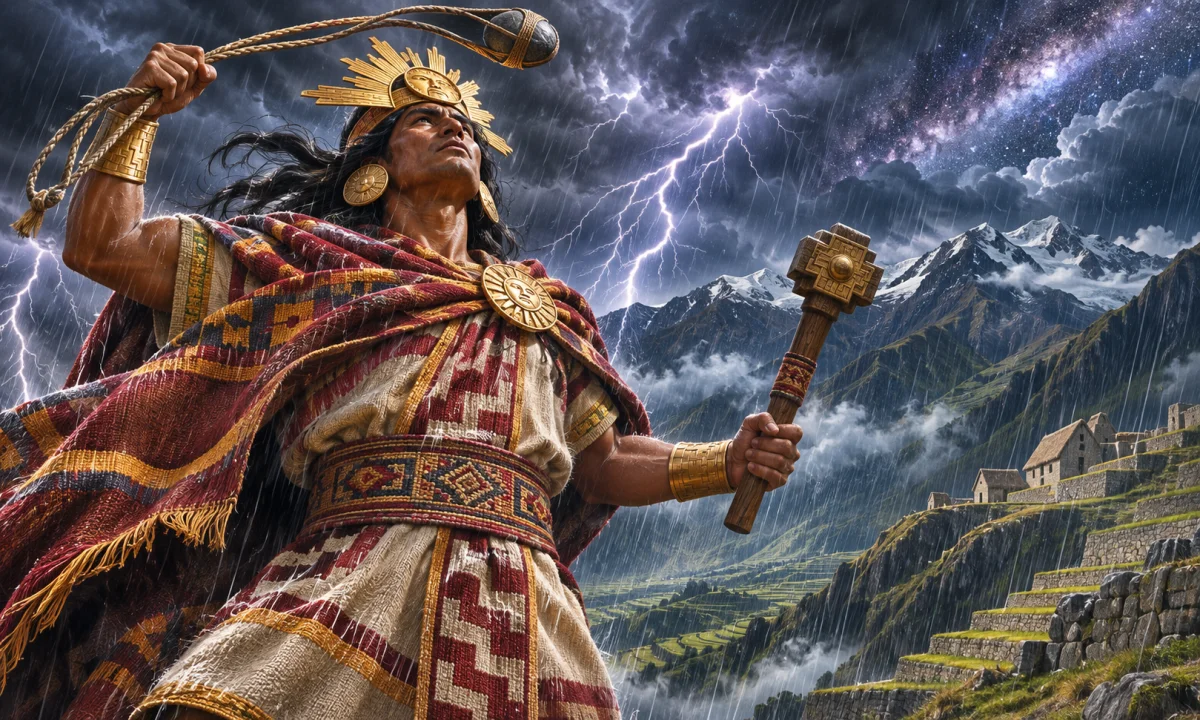
Apocatequil’s principal sphere was the power of the storm. He was associated with thunder, lightning and rain, and his authority likely extended to the agricultural consequences of weather. In an Andean farming society, rainfall was essential, but too much rain could cause erosion, flooding or crop failure. The god’s power was therefore both life-giving and dangerous.
Thunder deities in the Andes were often connected with weapons or striking forces. Colonial descriptions of Catequil associate him with the ability to produce or command lightning, and some traditions connect him with a sling. A sling was a practical weapon in the Andes, but in myth it could also represent the sound and impact of a storm. The crack of thunder could be imagined as the report of a divine projectile or the blow of a supernatural weapon.
His connection with mountains is equally significant. Peaks and high places were sacred throughout the Andes, and storms gathered around them. A mountain sanctuary could therefore unite several forms of sacred power: the permanence of the earth, the height of the sky, the arrival of rain and the presence of a local community’s protecting deity. Apocatequil’s worship at a highland centre reflects this close relationship between landscape and religion.
As an oracle deity, Apocatequil may also have been consulted about matters affecting the community. Oracles were not merely places where individuals asked private questions. They could help authorize political decisions, explain misfortune, identify ritual obligations or determine whether a campaign, journey or offering should proceed. The reputation of a thunder god made his pronouncements especially consequential: weather and divine approval were both necessary for communal survival.
Myths connected with Catequil
A major myth preserved in the Huamachuco tradition places Catequil within a genealogy of regional gods and culture heroes. The details vary in modern presentations because the surviving account is difficult to interpret and was recorded through a missionary framework. In broad outline, the story involves Ataguju, a high creator or supreme divine power, and a family connected with the origin of the Huamachuco people. Catequil appears as a powerful descendant or agent who confronts hostile beings and establishes order.
Some versions of the story associate Catequil with a brother named Piguerao. The narrative includes unusual births, the death or mistreatment of a mother figure and the later revenge or restoration carried out by the divine brothers. Catequil’s actions are linked with the defeat of dangerous ancestral beings and the formation or protection of the human community. Because the account is transmitted through a colonial text rather than a continuous Indigenous manuscript, individual relationships and episodes should not be treated as universally fixed.
The myth is important even where its details remain uncertain. It presents Catequil as more than a weather spirit. He is a being who acts in sacred history, overcomes disorder and helps define the origins of a people. His storm powers are part of a wider authority involving violence, justice, fertility and the ordering of the world.
Some retellings describe Catequil as using lightning or a sling against enemies. Such descriptions fit his character as a thunder deity, but they should not automatically be assumed to belong to every version of the myth. Colonial accounts frequently combine a deity’s ritual attributes with narrative episodes, and later summaries may merge details from different passages or traditions.
Worship and sacred landscape
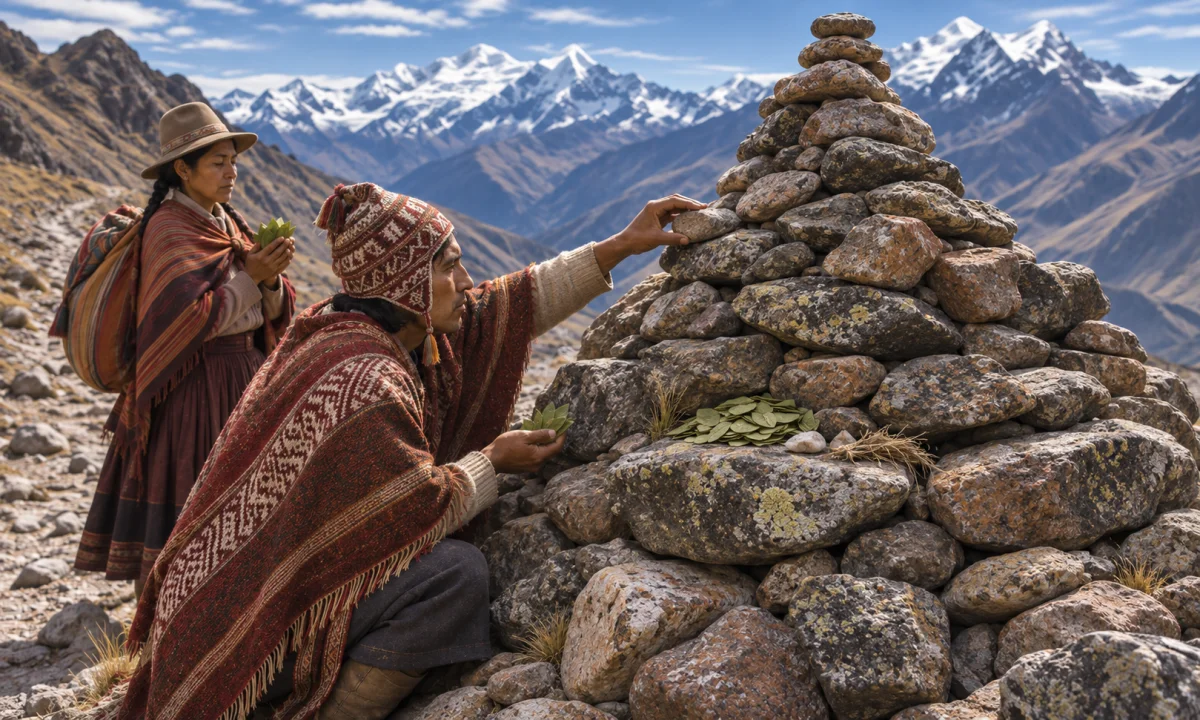
The sanctuary of Catequil was important because it linked the god to a specific place rather than presenting him as an abstract force. Andean religious life commonly treated mountains, springs, stones and other features of the landscape as living or spiritually powerful. A sanctuary associated with a mountain deity could serve as a centre for offerings, pilgrimage, political authority and communication with the supernatural world.
The exact rituals performed for Apocatequil are not securely documented in enough detail to reconstruct a complete cult. Colonial accounts of Andean religion mention offerings such as food, drink, textiles and animals in various contexts, but it is unsafe to assign every commonly recorded offering specifically to Catequil. The general purpose of such gifts was to maintain reciprocity between human communities and sacred powers: people gave honour and nourishment, while the deity was expected to provide protection, rain, fertility or good fortune.
The importance of a thunder god also helps explain why his cult could become politically significant. Control of a sanctuary and its oracle could strengthen the authority of local leaders. When the Inca expanded into northern Peru, recognition of a powerful local deity would have been a practical and religious matter. Incorporating the sanctuary into a broader imperial system could acknowledge local identity while placing it within Inca political order.
Apocatequil and other Andean thunder gods
Apocatequil is often compared with Illapa, the thunder deity associated with the Inca imperial tradition. Illapa is commonly described in colonial sources as a god of thunder, lightning, rain and sometimes hail. Because both figures have storm-related powers, modern summaries sometimes treat them as identical. That identification is not certain.
Illapa appears more strongly connected with the religious vocabulary of the Inca state, while Catequil is especially associated with Huamachuco and northern Peru. The two may have been equated, related or interpreted as local and imperial expressions of a similar divine power, but the surviving evidence does not justify assuming that they were always the same god. Regional traditions could preserve different names, myths and ritual relationships even when their functions overlapped.
Apocatequil should also not be confused with every Andean being linked to mountains, rain or lightning. The Andes contained many local sacred powers, including huacas, ancestral beings and mountain spirits. Similar functions do not necessarily indicate shared identity. In particular, the word apu could be used as an honorific for powerful sacred beings or mountains; it does not by itself prove that every figure called an apu belonged to one standardized pantheon.
Meaning and cultural significance
Apocatequil represents the intimate connection between the natural environment and religious life in the Andes. Storms were not distant phenomena with purely symbolic meaning. They directly affected planting, harvests, pasture, water supplies and the safety of communities. A deity who governed thunder and rain therefore stood at the meeting point of cosmology, agriculture and political authority.
His story also illustrates the diversity hidden by the phrase “Inca religion.” The Inca Empire ruled a vast territory containing many languages and local traditions. Some regional gods were diminished, reinterpreted or absorbed into imperial categories; others remained powerful in their home territories. Apocatequil’s association with Huamachuco shows how a deity could be both part of the wider world known to the Inca and deeply rooted in a local religious landscape.
The colonial history of his representation is part of his modern significance. Missionaries who recorded Catequil’s traditions often intended to condemn the cult, yet their writings became the principal evidence through which later readers learned about it. This creates a double task: the accounts must be used because they preserve important information, but they must also be read critically because they were shaped by conquest, translation and religious polemic.
Later reception
Apocatequil has received less attention in modern popular culture than better-known figures such as Viracocha, Inti or Pachamama. He does appear in encyclopedic treatments of Inca and pre-Inca religion, fantasy writing and occasional games or online lists of mythological beings. These modern uses often simplify him into a generic “Inca god of thunder,” sometimes giving him a fixed appearance, weapon or family tree not securely supported by the historical evidence.
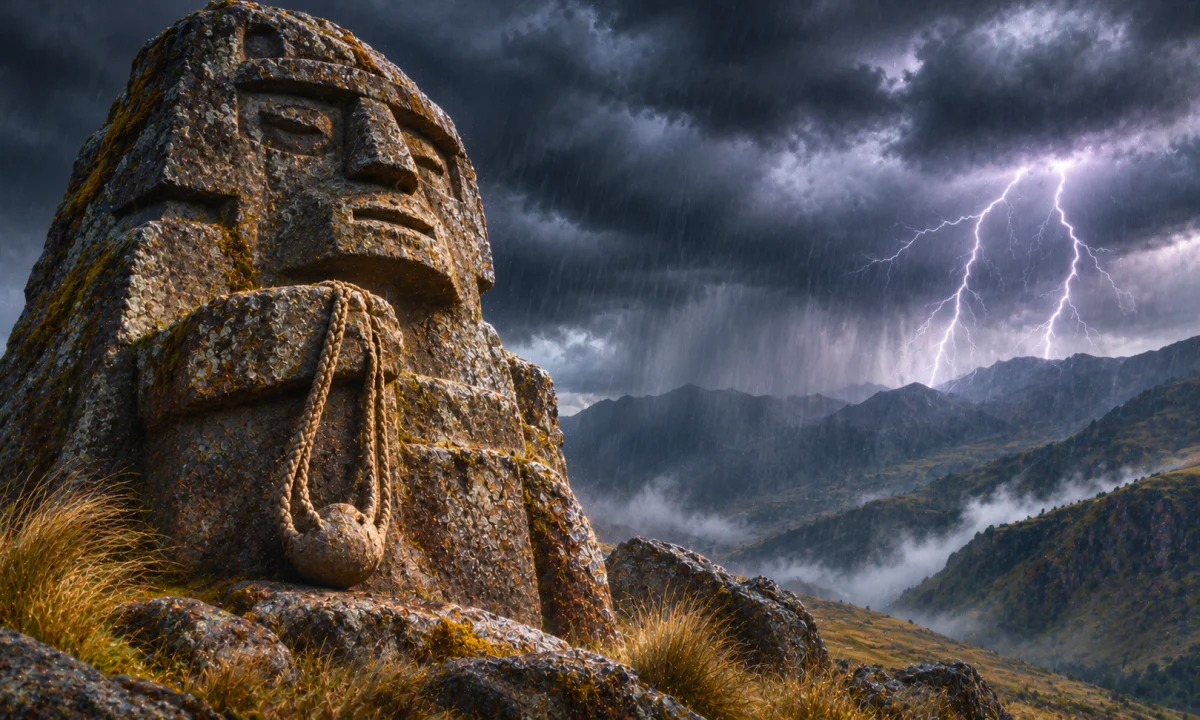
No single canonical image of Apocatequil survives from ancient Andean art. Claims that he had a standardized human form, a particular costume or a universally recognized emblem should therefore be treated cautiously. His most reliable traditional profile is that of a powerful northern Andean deity associated with Catequil, thunder, lightning, storm power, an important sanctuary and the sacred history of Huamachuco.