WORLD

Inti
Inti is the principal sun deity of the Inca religious tradition, which developed in the central Andes before and during the expansion of the Inca Empire. The Quechua word inti means “sun,” and the name could refer both to the visible sun and to the divine power believed to dwell within or act through it. Inti was associated with light, warmth, fertility, agriculture, royal authority and the prosperity of the imperial state.
Origins and religious setting
Inca religion formed within a much older Andean cultural world. Communities in the Andes had observed and ritually honoured celestial bodies, mountains, springs, rivers, ancestors and other powerful features of the landscape for centuries before the Inca Empire arose. The Incas did not create all these traditions from nothing. Instead, they incorporated local sacred beings and practices into an imperial religious system centred on Cusco.
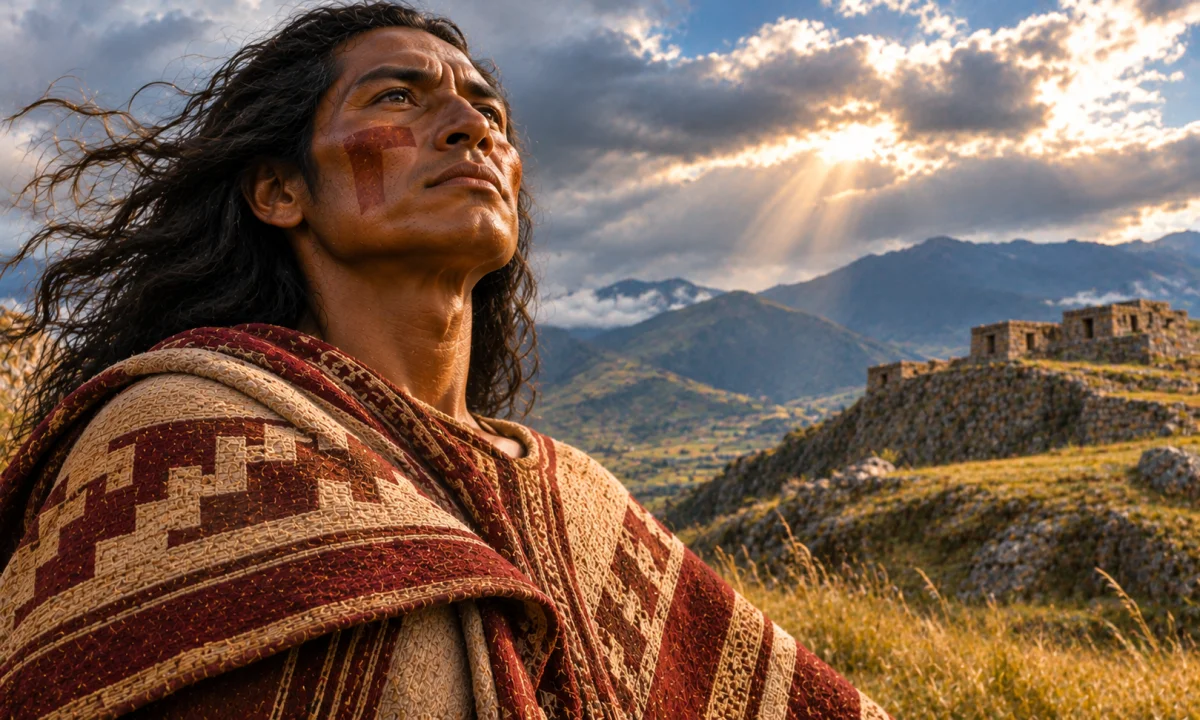
The sun was especially important to the ruling dynasty. Its regular movement across the sky provided heat and light, governed agricultural seasons and supported the growth of crops in difficult mountain environments. For the Inca state, solar worship also expressed political legitimacy. The emperor, known as the Sapa Inca, was traditionally described as a descendant or earthly representative of Inti. This relationship helped present imperial rule as part of the proper order of the cosmos.
Inca beliefs were not recorded by their original religious authorities in a surviving written scripture. Knowledge of Inti comes mainly from Spanish colonial accounts, Indigenous testimony recorded after the conquest, archaeological evidence, later Quechua traditions and the study of ritual and architecture. These sources do not always agree. Some descriptions were written by outsiders attempting to interpret unfamiliar beliefs through European religious categories, while others reflect changes that occurred after the Spanish invasion. As a result, the details of Inti’s identity and mythology should not be treated as a single, completely uniform system.
Name and identity
Inti is generally translated as “sun” in Quechua. In traditional contexts, the word could describe the heavenly body, a divine being associated with it or a broader solar power. Some colonial writers used different names or spellings, and the relationship between Inti and other solar terms is not always clear. The name Punchao, meaning something like “daylight” or “day,” appears in accounts of a particular sacred solar image and may represent an aspect or manifestation of the sun rather than a completely separate god. Interpretations vary.
It is also important not to assume that Inca religion divided the universe into categories identical to those of classical European mythology. Inti was a personal and divine power, but he was not merely a human-shaped character who happened to control the sun. The sun itself was visible, active and materially present in the world. The distinction between a celestial object and the sacred force expressed through it could be more fluid than the distinction between “god” and “natural phenomenon” in many modern descriptions.
Inti and the Inca ruler
One of Inti’s most important roles was his relationship with the imperial dynasty. Inca rulers were commonly understood to possess a special connection to the sun, and some traditions describe the first ancestors of the Inca royal line as children of Inti. This divine ancestry gave the Sapa Inca authority over the empire and helped connect political obedience with the maintenance of cosmic balance.
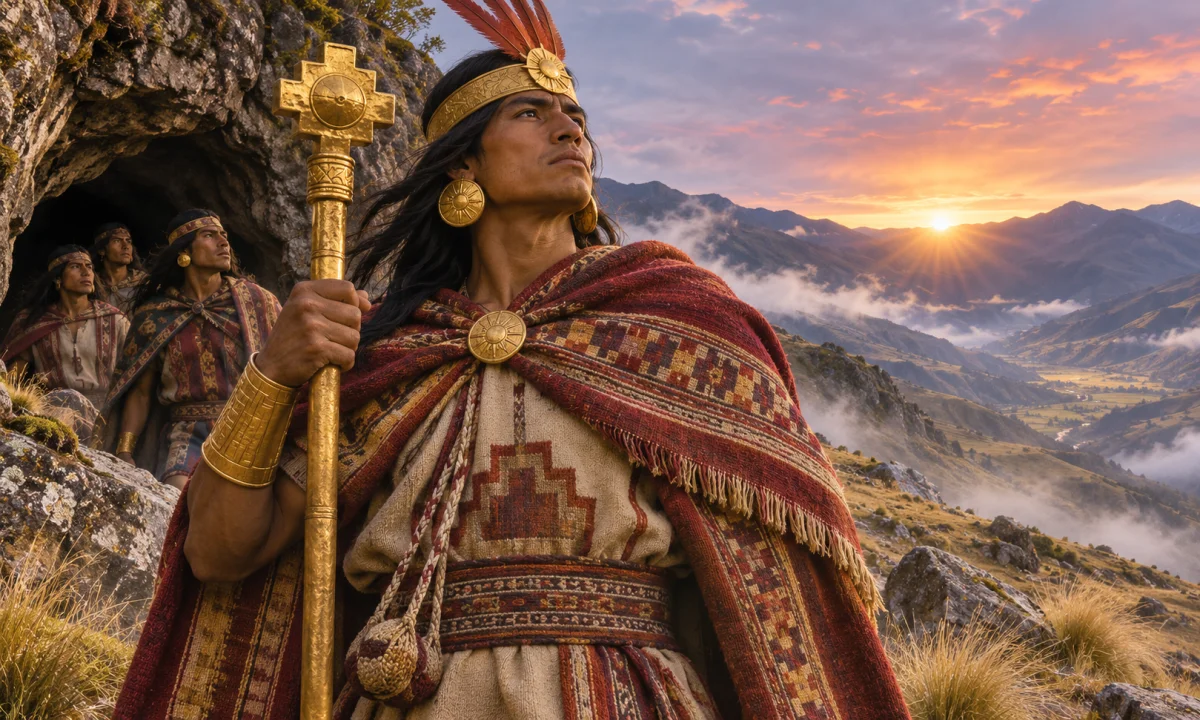
Several origin traditions are associated with the beginnings of the Inca people. In one widely known account, the culture heroes Manco Cápac and Mama Ocllo emerged from the waters of Lake Titicaca after being sent by the sun to establish a civilised society. They travelled with a golden staff or rod and were instructed to settle where it sank into the earth. That place was identified with the region of Cusco. Other traditions place the ancestors of the Incas in a cave or place of emergence known as Pacaritambo. These accounts are not interchangeable, and they do not necessarily come from one original, consistent myth. The Lake Titicaca story is often connected with Inti in later written sources, while the cave-origin traditions have their own complex symbolism.
In such narratives, Inti is not only a source of biological ancestry. He is also a giver of order, agriculture, social organisation and sacred law. The first rulers associated with the sun teach people how to live in settled communities, cultivate crops and observe proper customs. These stories therefore explain both the origin of the dynasty and the foundations of civilisation.
Attributes and symbolism
Inti was associated with the qualities necessary for life in the Andes:
- Light: The sun revealed the world and marked the passage of day and night.
- Warmth: Solar heat was essential in high-altitude regions where cold and frost threatened crops and people.
- Agricultural fertility: Sunlight helped maize and other crops grow, although fertility depended on rain, soil, irrigation and the cooperation of many sacred powers.
- Royal power: The ruling dynasty’s relationship with Inti supported the authority of the Sapa Inca.
- Order and time: The movement of the sun helped structure calendars, ceremonies and agricultural work.
- Prosperity: A favourable relationship with the sun was linked to the well-being of the empire.
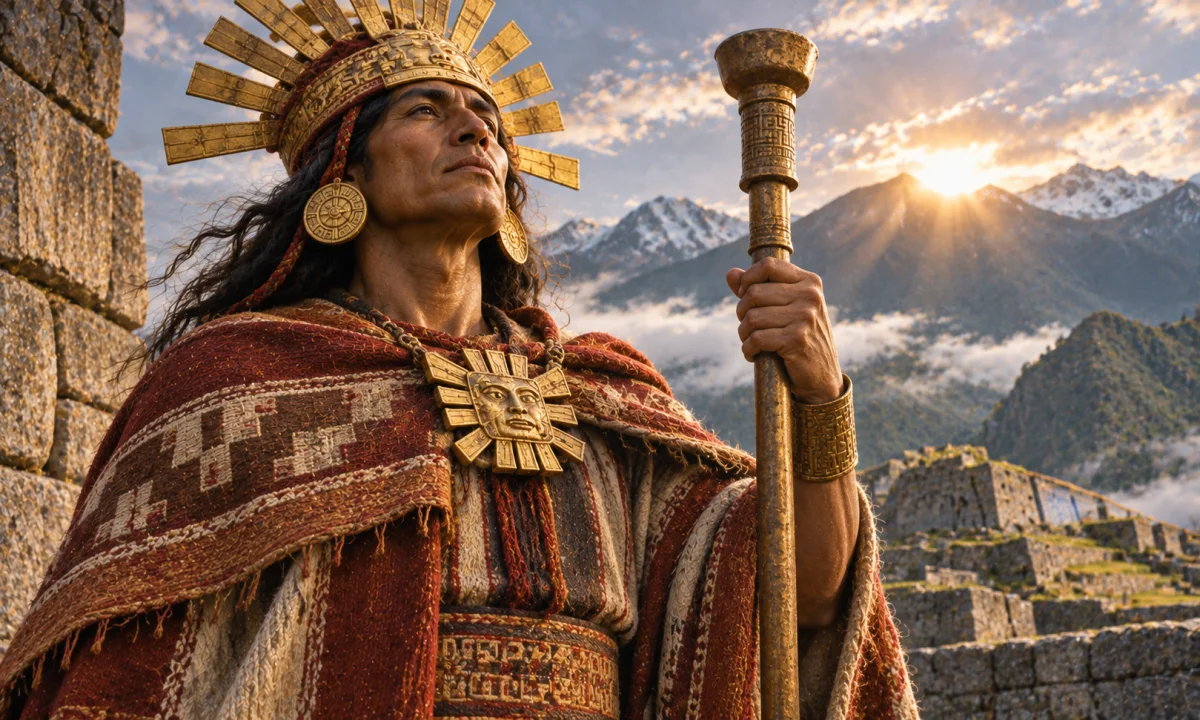
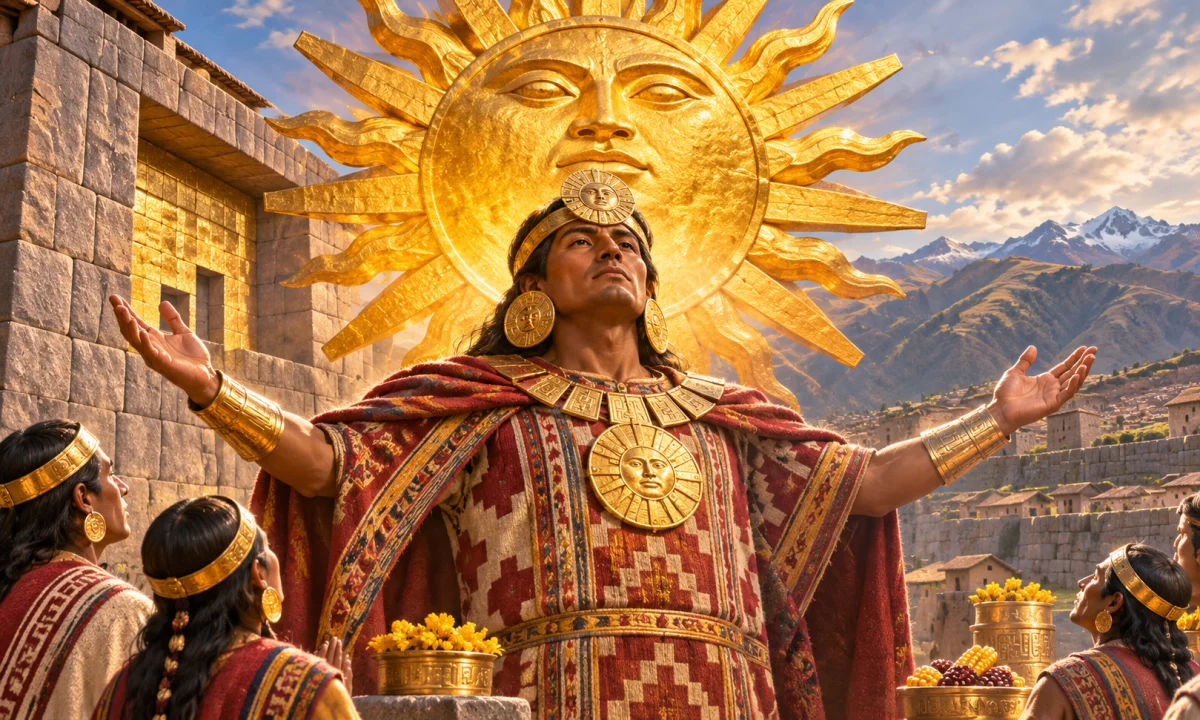
Colonial descriptions commonly portray Inti as a radiant figure or as a golden disk with a human-like face. Some accounts say that the sun’s image had rays extending from it, sometimes represented by serpents or other projecting forms. These descriptions should be approached carefully. Much of the famous visual image of Inti comes from accounts written after the conquest, and the surviving evidence does not establish that one standard portrait was used throughout the Inca world.
Gold was strongly associated with Inti because of its colour and brilliance. Inca religious objects and temple furnishings made from gold were not simply valuable decorations. Gold was sometimes understood as the sun’s material likeness or “sweat,” just as silver could be associated with the moon. Spanish conquerors removed, melted or redistributed many sacred objects, so the original appearance and ritual use of most solar images cannot now be reconstructed with certainty.
The Coricancha and sacred solar images
The most important solar sanctuary in the Inca capital was the Coricancha, usually translated as the “Golden Enclosure” or “Golden Temple.” It stood in Cusco and was dedicated especially to the sun, although the sanctuary was part of a wider sacred complex rather than an isolated building in the modern sense. Colonial accounts describe walls and furnishings covered with gold and include reports of a large solar image displayed within the temple.
The Coricancha was a centre of ritual, administration and elite religious activity. Priests, attendants and selected women connected with state worship helped maintain ceremonies and offerings. The sanctuary also contained or was associated with representations of other sacred beings and places. This reflects the interconnected nature of Inca religion: devotion to Inti did not necessarily exclude reverence for Viracocha, the moon, stars, mountains, ancestors or local huacas.
One important solar object mentioned in colonial records is the Punchao. It was described as a precious image or representation of the sun kept in Cusco. Accounts differ about its exact form, meaning and history. It may have been regarded as a particularly powerful embodiment of the sun, perhaps connected with the imperial dynasty. After the conquest, Spanish authorities seized and transported sacred objects, and the original history of the Punchao became entangled with colonial reports. It should not automatically be treated as simply another name for every image of Inti.
Rituals and offerings
Solar ceremonies were tied to the agricultural calendar and the political life of the empire. Offerings could include food, drink, textiles, precious objects, animals and other valuable goods. Chicha, a fermented maize drink, played an important role in many Andean ceremonies. Ritual actions expressed reciprocity: humans honoured powerful beings and sought protection, fertility, health and success in return.
The Inca state also sponsored large public festivals. The best-known solar celebration was Inti Raymi, held around the June solstice, when the sun appears to reach its most northerly position in the sky for observers in the southern hemisphere. In the Inca calendar, this period was associated with the renewal of the sun and the beginning of a new agricultural and ceremonial cycle. Colonial suppression and the destruction of Indigenous religious institutions interrupted the traditional festival, and descriptions of its original form are incomplete.
Some accounts of Inca state religion mention human sacrifice, including the ceremony known as capacocha. Children and young people could be selected for exceptionally important offerings associated with mountains, major political events, crisis, illness or the well-being of the empire. Such offerings were part of a broader Andean ritual system and should not be described as ordinary or constant worship of Inti. The surviving evidence indicates that different sacred powers and political circumstances could be involved. Archaeological discoveries, including preserved high-altitude burials, have provided evidence of these ceremonies, but their precise meanings remain subjects of scholarly interpretation.
Relationships with other sacred beings
Inti occupied a high position in the imperial religious order, but Inca cosmology included many other beings and forces. The creator figure known as Viracocha is particularly important. Some colonial accounts describe Viracocha as the supreme creator or as a power existing before the sun, moon and stars. Other interpretations emphasise that Inca religion did not necessarily arrange its gods in a simple, fixed hierarchy. Inti and Viracocha should therefore not be merged into one figure, even though both could be presented as exceptionally powerful.
Mama Quilla, the moon deity, was often described in colonial sources as Inti’s wife and sister. The moon was associated with the passage of months, women’s reproductive cycles and the regulation of the calendar. This pairing reflects the close relationship between solar and lunar observation in Andean ritual life. The details of the relationship, however, come primarily from later written descriptions, and the terminology used for the two deities could vary.
The stars, planets and constellations also held religious significance. Certain celestial bodies were linked to animals, ancestors or protective powers. Mountains, called apus in many Quechua contexts, were powerful sacred beings in their own right. Local communities could honour their own huacas while also participating in imperial solar ceremonies. Inca religious practice was therefore both centralised and diverse: the state promoted Inti as a dynastic and imperial deity, but local sacred landscapes remained important.
Inti in historical interpretation
It is common to call Inti the “chief god” or “supreme god” of the Incas, but that wording can oversimplify the evidence. Inti was unquestionably central to imperial ideology and royal ritual. Yet the Inca world did not have a single universally defined theology preserved in a canonical book. Different regions, periods and communities may have understood the sun’s importance in different ways.
Some European chroniclers interpreted Inca religion as if it had a neat pantheon comparable to those of Greece or Rome. Their records remain valuable, but they were shaped by translation, colonial expectations and Christian ideas about idolatry, creation and false worship. Indigenous informants also lived through the upheaval of conquest and conversion. Modern reconstructions must therefore compare written accounts with architecture, material remains, linguistic evidence and continuing Andean traditions.
The sun’s role in Inca ideology was also political. By claiming descent from Inti, the imperial household presented the conquest and administration of a vast territory as divinely sanctioned. At the same time, the Incas often incorporated local deities rather than simply abolishing them. The empire could impose ceremonies, labour obligations and state offerings while allowing older sacred traditions to continue in altered or subordinate forms.
Inti and similar solar figures
Inti should not be confused with every sun deity from South American or Mesoamerican traditions. The Aztec sun god Huitzilopochtli, the Maya solar deities and the Mapuche figure Antü belong to different cultural and historical systems. Even within the Andes, Inti is not identical to every local being associated with sunlight, daylight, heat or seasonal change.
Nor should Inti be reduced to a simple equivalent of Apollo or Helios. Comparisons can help explain the broad idea of a solar deity, but they can hide important differences. Inti’s identity was closely connected with Andean agriculture, reciprocity, mountain environments, imperial ancestry and the political structure of the Inca state. His worship formed part of a living relationship between humans, celestial powers, ancestors and the landscape.
Later reception and Inti Raymi today
After the Spanish conquest, public ceremonies dedicated to Inti were restricted or suppressed, and many temples, images and ritual objects were destroyed or repurposed. Yet solar symbolism and Andean religious ideas did not disappear. Indigenous communities preserved elements of older ceremonial practice, often adapting them within a Christian environment. The sun also remained an important symbol of ancestry, identity and cultural continuity.
Modern celebrations of Inti Raymi, especially the large public festival held annually in Cusco, are cultural and historical commemorations rather than unchanged survivals of the pre-conquest ceremony. The contemporary event was established in the twentieth century and draws on colonial descriptions, archaeological interpretation, Indigenous performance traditions and modern cultural politics. It presents Inca history through processions, costumes, speeches, music and staged ritual. While it invokes Inti and the June solstice, it should not be assumed to reproduce the original festival exactly.
In contemporary Andean and wider Latin American contexts, Inti may appear as a symbol of Indigenous heritage, the Inca past, the sun, national identity or resistance to colonial erasure. Modern artistic depictions often show a golden human face surrounded by rays. This image reflects a combination of colonial descriptions, later artistic conventions and present-day cultural interpretation rather than a securely documented single portrait from the Inca period.